
Integrating Scientific Credibility, Market Intelligence, and Ethical Engagement for Sustainable Healthcare Growth
Introduction: The Strategic Importance of Pharmaceutical Sales and Marketing
The pharmaceutical industry occupies a unique position at the intersection of science, healthcare, economics, and public policy. Unlike conventional consumer markets, pharmaceutical sales and marketing are governed not only by commercial objectives but also by strict regulatory frameworks, ethical considerations, and scientific credibility. The success of a pharmaceutical company is therefore not merely determined by the number of prescriptions generated but by its ability to build trust with healthcare professionals, demonstrate therapeutic value, and contribute to improved patient outcomes.
Effective pharmaceutical sales and marketing require a sophisticated integration of scientific knowledge, relationship management, data-driven market analysis, regulatory compliance, and strategic communication. The pharmaceutical sales professional is not simply a salesperson but increasingly functions as a scientific communicator, therapeutic consultant, and healthcare partner.
In an era characterized by rapid medical innovation, digital transformation, increasing regulatory oversight, and evolving physician expectations, pharmaceutical companies must adopt strategic, evidence-based, and ethically grounded marketing approaches. This article explores the principles, strategies, and best practices required to execute effective sales and marketing in the pharmaceutical industry according to international standards.
The Unique Nature of Pharmaceutical Marketing
A Highly Regulated Environment
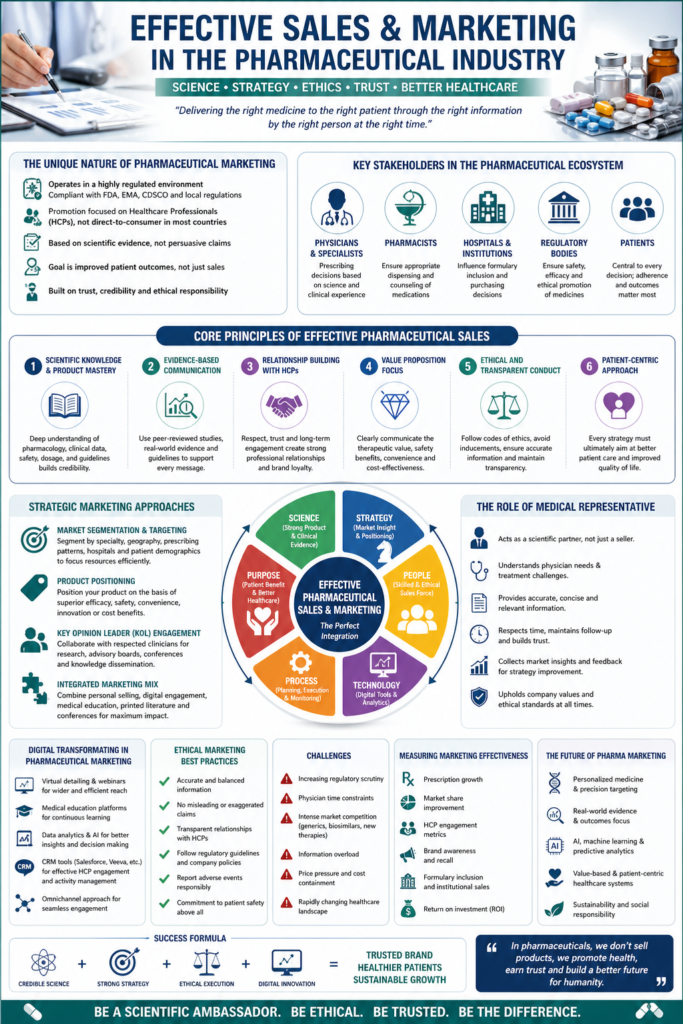
Pharmaceutical marketing operates within one of the most heavily regulated industries in the world. Regulatory authorities such as the U.S. Food and Drug Administration, the European Medicines Agency, and the Central Drugs Standard Control Organization establish strict guidelines governing how medicines may be promoted.
These regulations ensure that pharmaceutical marketing:
- Provides accurate scientific information
- Avoids misleading therapeutic claims
- Protects patient safety
- Maintains transparency in physician engagement
Unlike conventional consumer products, prescription medicines cannot be promoted directly to patients in many countries. Instead, the primary audience includes physicians, pharmacists, hospitals, and healthcare institutions.
Consequently, pharmaceutical marketing must be built on scientific evidence, regulatory compliance, and ethical responsibility.
Understanding the Pharmaceutical Market Ecosystem
Effective pharmaceutical marketing requires a deep understanding of the healthcare ecosystem, which includes multiple stakeholders.
Key Stakeholders
Physicians and Specialists
Doctors remain the primary decision-makers in prescribing medicines. Building professional relationships with physicians requires clinical credibility, therapeutic knowledge, and respect for their time and expertise.
Pharmacists
Pharmacists influence medication dispensing and patient counseling. They often guide patients regarding drug alternatives, generic substitutions, and dosage instructions.
Hospitals and Healthcare Institutions
Institutional purchasing decisions depend on formulary inclusion, cost-effectiveness, and clinical evidence.
Regulatory Bodies
Regulators determine drug approvals, labeling claims, and marketing permissions.
Patients
Although patients may not directly choose prescription drugs, their awareness, preferences, and treatment adherence significantly influence therapeutic outcomes.
Understanding the interactions between these stakeholders allows pharmaceutical companies to design comprehensive market engagement strategies.
Core Principles of Effective Pharmaceutical Sales
1. Scientific Knowledge and Product Mastery
Pharmaceutical sales representatives must possess deep therapeutic knowledge of their products.
Essential competencies include:
- Pharmacology of the drug
- Mechanism of action
- Clinical trial evidence
- Safety profile
- Comparative advantages over competing drugs
- Treatment guidelines
Healthcare professionals expect pharmaceutical representatives to act as credible scientific resources rather than promotional agents.
The ability to explain complex pharmacological concepts in a concise and clinically relevant manner significantly enhances credibility.
2. Evidence-Based Communication
Modern physicians prioritize evidence-based medicine.
Therefore, pharmaceutical marketing must emphasize:
- Peer-reviewed clinical trial data
- Real-world evidence
- Treatment guideline alignment
- Pharmacoeconomic benefits
Marketing messages should always be supported by scientifically validated data rather than exaggerated promotional claims.
This approach not only enhances credibility but also aligns marketing with international ethical standards.
3. Relationship Building with Healthcare Professionals
The foundation of pharmaceutical sales success lies in long-term professional relationships with physicians.
Effective relationship-building strategies include:
- Respectful and concise physician engagement
- Providing educational resources
- Offering clinical updates
- Supporting continuing medical education programs
- Maintaining consistent professional communication
Physicians value representatives who provide reliable scientific information that contributes to better patient care.
Trust and credibility cannot be achieved through aggressive selling but through consistent scientific engagement.
Strategic Marketing Approaches in the Pharmaceutical Industry
Market Segmentation and Targeting
Successful pharmaceutical marketing begins with precise market segmentation.
Segmentation may be based on:
- Medical specialty
- Geographic region
- Prescribing patterns
- Hospital affiliations
- Patient demographics
For example:
Cardiologists may represent the primary target segment for antihypertensive drugs, while oncologists are the primary prescribers of anticancer therapies.
Data-driven segmentation allows companies to allocate marketing resources efficiently.
Product Positioning
Product positioning refers to how a drug is perceived relative to competitors.
Effective positioning strategies emphasize:
- Superior efficacy
- Improved safety profile
- Novel mechanism of action
- Better patient compliance
- Cost-effectiveness
For instance, a drug with once-daily dosing may be positioned as enhancing patient adherence compared to multiple-dose alternatives.
Clear and scientifically supported positioning strengthens brand differentiation.
Key Opinion Leader (KOL) Engagement
Key opinion leaders are highly respected physicians who influence clinical practice.
Engaging KOLs is a critical component of pharmaceutical marketing.
Activities include:
- Scientific advisory boards
- Clinical research collaborations
- Medical conferences
- Publication partnerships
KOLs help disseminate clinical insights and validate therapeutic value within the medical community.
However, such collaborations must adhere strictly to ethical guidelines and transparency standards.
The Role of Medical Representatives
Medical representatives remain the frontline ambassadors of pharmaceutical companies.
Their responsibilities include:
- Physician visits
- Product presentations
- Clinical literature distribution
- Prescription tracking
- Market feedback collection
An effective medical representative must combine:
- Scientific knowledge
- Communication skills
- emotional intelligence
- professional ethics
- strategic planning
Modern representatives are increasingly expected to function as therapeutic consultants rather than sales agents.
Digital Transformation in Pharmaceutical Marketing
The pharmaceutical industry is undergoing rapid digital transformation.
Digital marketing channels now complement traditional field-based promotion.
Digital Tools and Strategies
Virtual Physician Engagement
Webinars and virtual detailing allow companies to reach physicians remotely.
Medical Education Platforms
Online educational portals provide physicians with updated clinical knowledge.
Data Analytics
Advanced analytics help identify prescribing patterns and market opportunities.
Customer Relationship Management Systems
Platforms such as Salesforce and Veeva CRM help pharmaceutical companies manage physician interactions and sales activities.
Digital tools enable personalized physician engagement and more efficient marketing strategies.
Ethical Considerations in Pharmaceutical Marketing
Ethical conduct is essential to maintain public trust in the pharmaceutical industry.
International guidelines such as those established by the World Health Organization emphasize responsible promotion of medicines.
Key ethical principles include:
- Transparency in physician interactions
- Avoiding financial inducements
- Accurate representation of clinical data
- Patient-centered communication
- Responsible use of marketing materials
Ethical marketing ensures that commercial success does not compromise patient welfare.
Challenges in Pharmaceutical Sales and Marketing
Despite technological advancements, pharmaceutical marketing faces several challenges.
Increasing Regulatory Scrutiny
Regulators increasingly monitor marketing practices to prevent misleading claims.
Physician Time Constraints
Doctors have limited time for pharmaceutical representatives, requiring highly efficient communication strategies.
Market Competition
The rise of generics and biosimilars intensifies competition.
Information Overload
Physicians are exposed to large volumes of medical information, making it difficult for marketing messages to stand out.
Addressing these challenges requires strategic innovation and professional credibility.
Measuring Marketing Effectiveness
Pharmaceutical companies rely on multiple metrics to evaluate marketing success.
Key indicators include:
- Prescription growth
- Market share
- physician engagement rates
- formulary inclusion
- brand recall
Advanced analytics allow companies to continuously optimize marketing strategies.
The Future of Pharmaceutical Sales and Marketing
The future of pharmaceutical marketing will be shaped by several emerging trends.
Personalized Medicine
Advances in genomics and precision medicine will require highly targeted marketing approaches.
Artificial Intelligence and Data Analytics
AI-driven analytics will help predict physician prescribing behavior and optimize marketing strategies.
Value-Based Healthcare
Healthcare systems increasingly demand evidence of clinical outcomes and cost-effectiveness.
Pharmaceutical companies must therefore focus on demonstrating real-world therapeutic value.
Conclusion: Toward a Scientific and Ethical Model of Pharmaceutical Marketing
Effective pharmaceutical sales and marketing represent a delicate balance between commercial success and ethical responsibility. In an industry fundamentally dedicated to improving human health, marketing strategies must transcend traditional sales techniques and embrace scientific communication, evidence-based engagement, and patient-centered values.
The pharmaceutical sales professional of the future will function not merely as a product promoter but as a knowledge partner to healthcare professionals, facilitating informed clinical decisions and contributing to improved patient outcomes.
By integrating scientific rigor, strategic market intelligence, digital innovation, and ethical integrity, pharmaceutical companies can build sustainable success while fulfilling their broader responsibility to global healthcare systems.
In this evolving landscape, the most successful pharmaceutical organizations will be those that recognize that trust, credibility, and scientific value remain the most powerful marketing assets in medicine.