

10 Habits to Deal with Enemies Effectively: A Practical Guide to Staying Strong
By Devanssh Mehta
Abstract
Opposition, criticism, and interpersonal conflict are unavoidable aspects of both personal and professional life. The ability to manage these challenges constructively is a defining characteristic of emotionally intelligent and resilient individuals. This article explores ten practical habits that enable individuals to deal with adversaries effectively while preserving their integrity, emotional well-being, and long-term goals. The habits include maintaining emotional composure, relying on facts rather than rumors, pursuing continuous self-improvement, choosing conflicts wisely, building a trustworthy reputation, establishing healthy personal boundaries, strengthening supportive relationships, developing strategic thinking, prioritizing physical and mental well-being, and allowing sustained success to become the ultimate response to criticism. Rather than encouraging confrontation or retaliation, the article emphasizes self-discipline, ethical conduct, resilience, and personal growth as sustainable approaches to handling difficult people and challenging situations. By integrating principles from psychology, leadership, emotional intelligence, and personal development, these habits provide a practical framework for transforming conflict into an opportunity for learning, character development, and long-term success.
Keywords: Emotional intelligence, resilience, conflict management, personal development, strategic thinking, self-improvement, leadership, reputation management, mental well-being, interpersonal relationships.
In every stage of life, whether in business, the workplace, academia, or personal relationships, disagreements and opposition are inevitable. While some people become supportive allies, others may criticize, undermine, spread rumors, or attempt to obstruct your progress. Although it is tempting to respond emotionally, history consistently shows that successful people rarely defeat their opponents through anger. Instead, they rely on discipline, patience, and strategic thinking.
The goal should never be to create more enemies but to develop habits that reduce unnecessary conflict while protecting your reputation, peace of mind, and long-term success. The following ten habits can help you deal with difficult people effectively without compromising your values.
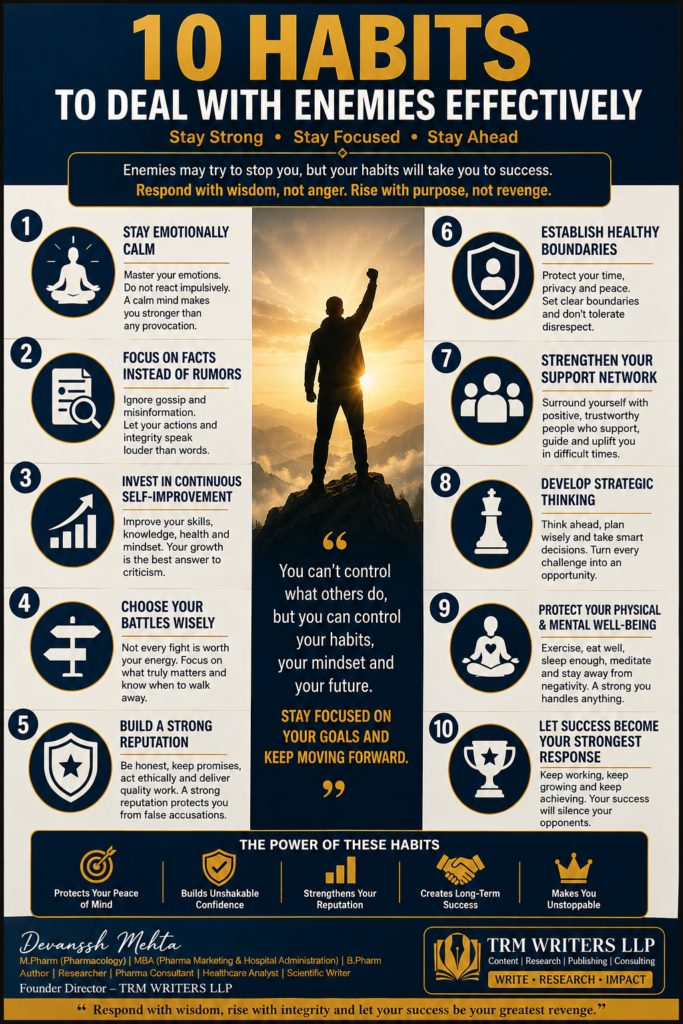
1. Stay Emotionally Calm
The first victory over any adversary is mastering your own emotions. People who provoke others often seek an emotional reaction because it clouds judgment and creates opportunities for further conflict.
When confronted with criticism or hostility, pause before responding. Take time to assess the situation objectively instead of reacting impulsively. Emotional stability allows you to make rational decisions while preventing others from controlling your behavior.
Remember that self-control is a strength, not a weakness.
2. Focus on Facts Instead of Rumors
Rumors, gossip, and misinformation spread rapidly, particularly in social and professional environments. Reacting to every rumor often gives it more attention than it deserves.
Instead, build a reputation based on honesty, transparency, and consistent actions. Over time, facts speak louder than speculation. People tend to trust individuals whose actions consistently match their words.
Avoid wasting valuable time trying to correct every false statement. Let your credibility become your strongest defense.
3. Invest in Continuous Self-Improvement
The most effective response to criticism is continuous personal growth.
Develop new professional skills, improve your communication, strengthen your health, expand your knowledge, and build your expertise. Every achievement increases your confidence while reducing the influence of negative opinions.
Success often changes conversations more effectively than arguments.
4. Choose Your Battles Wisely
Not every disagreement deserves your attention.
Ask yourself three questions before responding:
- Does this issue matter in the long term?
- Will responding improve the situation?
- Is my energy better invested elsewhere?
Learning when to walk away demonstrates maturity rather than defeat. Strategic silence is sometimes more powerful than endless confrontation.
5. Build a Strong Reputation
Your reputation is one of your most valuable assets.
Develop habits such as:
- Keeping your promises.
- Being respectful to everyone.
- Acting ethically.
- Delivering quality work consistently.
- Maintaining professionalism under pressure.
A strong reputation naturally weakens the impact of malicious criticism because people judge you by your character rather than by rumors.
6. Establish Healthy Boundaries
Some individuals repeatedly create unnecessary conflict because boundaries are unclear.
Protect your time, privacy, and emotional energy by clearly defining what behavior you will and will not accept.
Healthy boundaries may include:
- Limiting unnecessary interactions.
- Avoiding personal arguments.
- Refusing to engage in gossip.
- Communicating respectfully but firmly.
Boundaries prevent small disagreements from becoming major conflicts.
7. Strengthen Your Support Network
Isolation makes challenges more difficult.
Cultivate meaningful relationships with trustworthy family members, friends, mentors, colleagues, and professional contacts who appreciate your integrity and provide constructive advice.
A strong network offers emotional support, practical guidance, and opportunities for growth. It also helps maintain perspective during stressful situations.
8. Develop Strategic Thinking
Successful individuals think several steps ahead.
Rather than reacting impulsively, consider the long-term consequences of every decision.
Ask yourself:
- What outcome do I truly want?
- Which response will improve my position?
- Which action protects my reputation?
Strategic thinking transforms conflict into an opportunity for learning, resilience, and better decision-making.
9. Protect Your Physical and Mental Well-Being
Stress caused by conflict can affect sleep, concentration, productivity, and overall health.
Maintain habits that improve resilience, including:
- Regular physical exercise.
- Nutritious eating.
- Adequate sleep.
- Mindfulness or meditation.
- Reading and continuous learning.
- Limiting exposure to unnecessary negativity.
A healthy body and a calm mind make it easier to respond wisely under pressure.
10. Let Success Become Your Strongest Response
One of the most powerful ways to deal with opposition is to continue making meaningful progress.
Invest your energy in achieving personal goals, advancing your career, building valuable relationships, and contributing positively to society.
When people consistently observe competence, professionalism, and integrity, negative voices gradually lose their influence.
Your achievements eventually become more persuasive than any argument.
Final Thoughts
Enemies, critics, and difficult people are an unavoidable part of life. However, they do not determine your future. Your habits, decisions, and character shape the direction of your life far more than the opinions of others.
Instead of allowing conflict to consume your energy, channel that energy into personal growth, professional excellence, emotional maturity, and meaningful achievements. Respond with wisdom rather than anger, with consistency rather than impulse, and with progress rather than distraction.
Ultimately, the strongest position is not one where every opponent is defeated, but one where your values, confidence, and purpose remain intact despite opposition. That is the hallmark of lasting success.
Conclusion
Dealing effectively with enemies or difficult individuals is not about overpowering others through aggression or revenge; it is about mastering one’s own thoughts, emotions, and actions. Individuals who consistently demonstrate emotional maturity, ethical behavior, and strategic decision-making are better equipped to overcome adversity while maintaining their credibility and peace of mind. The ten habits discussed in this article illustrate that lasting success is achieved through patience, continuous learning, disciplined behavior, and unwavering commitment to personal values rather than impulsive reactions.
In an increasingly interconnected and competitive world, criticism and opposition are inevitable, but they need not become barriers to growth. By focusing on self-improvement, protecting mental and physical well-being, nurturing positive relationships, and maintaining a strong reputation, individuals can transform challenges into opportunities for development. Ultimately, the most effective response to negativity is not retaliation but sustained excellence, resilience, and purposeful progress. These habits empower individuals to navigate conflicts with confidence while building a meaningful, respected, and successful life.
REFERENCES
Bandura, A. (1997). Self-efficacy: The exercise of control. W. H. Freeman.
Brown, B. (2018). Dare to lead: Brave work. Tough conversations. Whole hearts. Random House.
Carnegie, D. (1936). How to win friends and influence people. Simon & Schuster.
Covey, S. R. (1989). The 7 habits of highly effective people: Powerful lessons in personal change. Free Press.
Dweck, C. S. (2006). Mindset: The new psychology of success. Random House.
Ekman, P. (2003). Emotions revealed: Recognizing faces and feelings to improve communication and emotional life. Times Books.
Frankl, V. E. (2006). Man’s search for meaning (Beacon Press ed.). Beacon Press. (Original work published 1946)
Goleman, D. (1995). Emotional intelligence: Why it can matter more than IQ. Bantam Books.
Goleman, D. (1998). Working with emotional intelligence. Bantam Books.
Grant, A. (2021). Think again: The power of knowing what you don’t know. Viking.
Kabat-Zinn, J. (1994). Wherever you go, there you are: Mindfulness meditation in everyday life. Hyperion.
Lencioni, P. (2002). The five dysfunctions of a team: A leadership fable. Jossey-Bass.
McGonigal, K. (2011). The willpower instinct: How self-control works, why it matters, and what you can do to get more of it. Avery.
Seligman, M. E. P. (2011). Flourish: A visionary new understanding of happiness and well-being. Free Press.
Sinek, S. (2009). Start with why: How great leaders inspire everyone to take action. Portfolio.
Stone, D., Patton, B., & Heen, S. (2010). Difficult conversations: How to discuss what matters most (2nd ed.). Penguin Books.
Tzu, S. (2005). The art of war (T. Cleary, Trans.). Shambhala Publications. (Original work written approximately 5th century BCE)
World Health Organization. (2022). World mental health report: Transforming mental health for all. World Health Organization.
American Psychological Association. (2020). Publication manual of the American Psychological Association (7th ed.). American Psychological Association.