

Top Twenty Qualities of Outstanding Management Professionals in India
Introduction
India has emerged as one of the world’s fastest-growing economies, driven by innovation, entrepreneurship, digital transformation, manufacturing, healthcare, finance, and technology. Behind every successful organization stands an effective management professional who transforms vision into reality through strategic planning, leadership, execution, and continuous improvement.
Modern management professionals are no longer confined to supervising employees or maintaining operations. They are expected to inspire teams, solve complex business problems, adapt to rapidly changing market conditions, embrace digital technologies, and create sustainable organizational growth. Whether working in multinational corporations, startups, government organizations, hospitals, pharmaceutical companies, manufacturing units, educational institutions, or consulting firms, exceptional managers possess a unique blend of technical competence, emotional intelligence, ethical leadership, and business acumen.
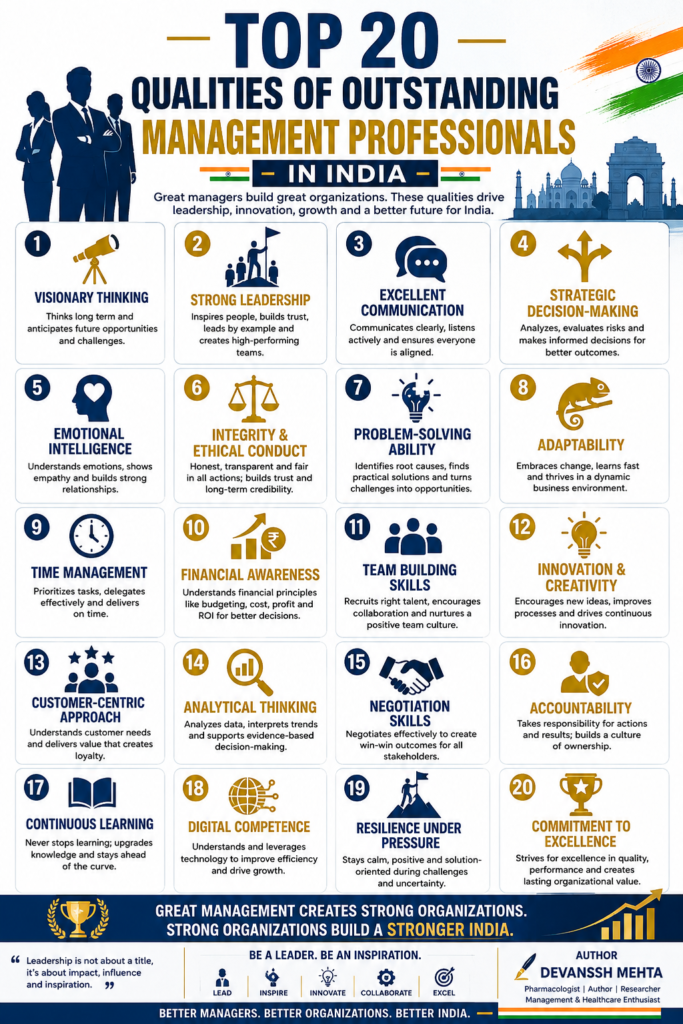
This article discusses twenty essential qualities that distinguish outstanding management professionals in India.
1. Visionary Thinking
Successful managers think beyond daily operations. They develop long-term strategies that align organizational goals with emerging market opportunities while anticipating future challenges.
Visionary leaders inspire confidence by providing clear direction and purpose.
2. Strong Leadership Skills
Leadership involves influencing people rather than simply exercising authority.
Great managers:
- Motivate employees
- Build trust
- Encourage innovation
- Lead by example
- Create high-performing teams
Leadership is earned through integrity, competence, and consistency.
3. Excellent Communication Skills
Communication forms the backbone of effective management.
Successful professionals communicate clearly through:
- Meetings
- Presentations
- Emails
- Negotiations
- Public speaking
- Active listening
Clear communication minimizes misunderstandings and improves productivity.
4. Strategic Decision-Making
Every business faces uncertainty.
Outstanding managers:
- Analyze available data
- Evaluate risks
- Compare alternatives
- Make informed decisions
- Accept responsibility for outcomes
Strong decision-making separates leaders from followers.
5. Emotional Intelligence
Technical expertise alone cannot ensure managerial success.
Emotionally intelligent managers:
- Understand their emotions
- Control stress
- Demonstrate empathy
- Build relationships
- Resolve conflicts peacefully
High emotional intelligence improves employee satisfaction and organizational culture.
6. Integrity and Ethical Conduct
Trust is one of the most valuable assets in management.
Ethical managers:
- Maintain transparency
- Follow organizational policies
- Avoid conflicts of interest
- Treat everyone fairly
- Build long-term credibility
Integrity strengthens organizational reputation.
7. Problem-Solving Ability
Organizations face operational, financial, technical, and human resource challenges daily.
Top managers:
- Identify root causes
- Develop practical solutions
- Evaluate outcomes
- Prevent recurrence
Problem-solving converts obstacles into opportunities.
8. Adaptability
Business environments constantly evolve due to technological innovation, economic fluctuations, globalization, and changing customer expectations.
Adaptable managers embrace change rather than resist it.
9. Time Management
Effective managers prioritize important tasks while minimizing distractions.
Good time management includes:
- Planning
- Scheduling
- Delegation
- Meeting deadlines
- Monitoring progress
Efficient time utilization enhances productivity.
10. Financial Awareness
Even non-financial managers should understand basic financial principles.
Knowledge of budgeting, cost control, profitability, cash flow, and return on investment enables better decision-making.
Financial literacy contributes directly to organizational sustainability.
11. Team Building Skills
Organizations succeed through collaborative effort.
Successful managers:
- Recruit talented individuals
- Encourage teamwork
- Recognize achievements
- Resolve interpersonal conflicts
- Promote mutual respect
Strong teams consistently outperform individual efforts.
12. Innovation and Creativity
Innovation drives competitive advantage.
Outstanding management professionals encourage:
- New ideas
- Process improvement
- Digital transformation
- Product innovation
- Continuous learning
Innovation ensures long-term organizational growth.
13. Customer-Centric Approach
Customer satisfaction remains central to business success.
Excellent managers understand:
- Customer expectations
- Market trends
- Service quality
- Feedback mechanisms
- Relationship management
Satisfied customers become loyal brand ambassadors.
14. Analytical Thinking
Modern organizations generate enormous amounts of data.
Analytical managers:
- Interpret business reports
- Identify trends
- Evaluate performance
- Predict future outcomes
- Support evidence-based decisions
Data-driven management improves organizational efficiency.
15. Negotiation Skills
Managers frequently negotiate with:
- Clients
- Suppliers
- Employees
- Government agencies
- Investors
- Business partners
Successful negotiation creates mutually beneficial outcomes.
16. Accountability
Outstanding managers accept responsibility for both successes and failures.
Accountability builds trust, enhances credibility, and promotes a culture of ownership throughout the organization.
17. Continuous Learning
Management practices evolve continuously.
Top professionals regularly upgrade their knowledge through:
- Professional certifications
- Industry conferences
- Online courses
- Reading
- Networking
- Executive education
Lifelong learning maintains professional relevance.
18. Digital Competence
Digital transformation has become essential across industries.
Modern managers should understand:
- Artificial Intelligence
- Data Analytics
- Cloud Computing
- ERP Systems
- Digital Marketing
- Cybersecurity
- Business Automation
Digital literacy enables organizations to remain competitive.
19. Resilience Under Pressure
Managers regularly encounter:
- Tight deadlines
- Financial constraints
- Market competition
- Organizational restructuring
- Business uncertainty
Resilient leaders remain calm, optimistic, and solution-oriented during crises.
20. Commitment to Organizational Excellence
Exceptional managers consistently strive for excellence by improving quality, productivity, innovation, customer satisfaction, employee engagement, and sustainable business performance.
Their focus extends beyond personal success toward creating lasting organizational value.
Conclusion
The role of management professionals in India has expanded significantly in today’s dynamic and globally connected business environment. Organizations require leaders who possess strategic vision, ethical values, emotional intelligence, digital competence, financial understanding, and the ability to inspire diverse teams. While technical knowledge provides a strong foundation, enduring success depends on adaptability, continuous learning, resilience, and a commitment to excellence.
By cultivating these twenty qualities, aspiring and experienced managers can enhance their leadership effectiveness, contribute meaningfully to organizational growth, and help shape India’s future as a global economic powerhouse. In an era marked by rapid technological change and intense competition, management professionals who combine competence with character will remain the driving force behind sustainable business success.