

Top Twenty Qualities of Great Corporate Professionals
In today’s fast-changing global business environment, organizations value professionals who can combine technical expertise with leadership, integrity, adaptability, and innovation. Great corporate professionals are not merely employees who complete assigned tasks; they are individuals who consistently create value, solve problems, inspire colleagues, and contribute to organizational growth. As businesses embrace digital transformation, globalization, sustainability, and artificial intelligence, the qualities expected from corporate professionals continue to evolve.
The following twenty qualities represent the characteristics commonly found among outstanding professionals across industries and functions.
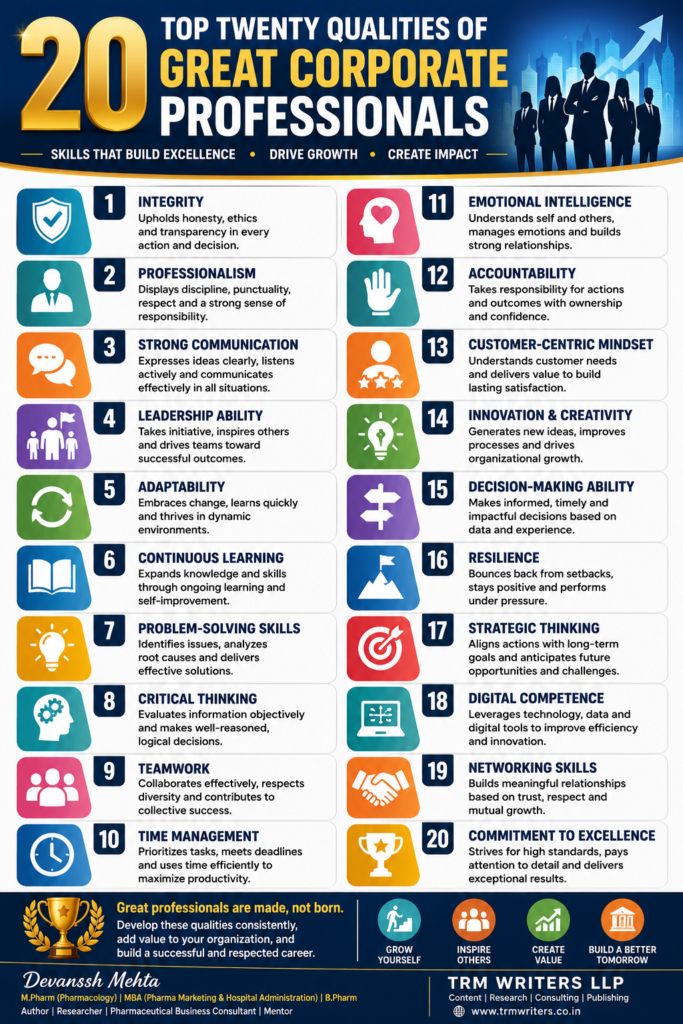
1. Integrity
Integrity forms the foundation of professional excellence. Honest professionals maintain ethical standards, honor commitments, protect confidential information, and make decisions based on fairness and transparency. Organizations place tremendous trust in individuals who consistently demonstrate honesty.
2. Professionalism
Professionalism includes maintaining discipline, punctuality, respectful communication, accountability, and commitment to quality. Professionals who conduct themselves with maturity build confidence among colleagues, managers, and clients.
3. Strong Communication Skills
Excellent communication enables professionals to express ideas clearly, listen actively, negotiate effectively, and resolve misunderstandings. Both verbal and written communication are essential in today’s collaborative workplace.
4. Leadership Ability
Leadership is not limited to managers. Great professionals willingly take responsibility, motivate team members, influence positive change, and guide projects toward successful completion regardless of their designation.
5. Adaptability
Corporate environments constantly evolve through technological innovations, market changes, mergers, and changing customer expectations. Adaptable professionals quickly learn new skills and embrace change with confidence rather than resistance.
6. Continuous Learning
The best professionals never stop learning. They regularly update their technical knowledge, pursue certifications, attend training programs, read industry publications, and remain informed about emerging trends.
7. Problem-Solving Skills
Organizations value individuals who identify problems, analyze root causes, evaluate alternatives, and implement practical solutions. Effective problem-solvers contribute significantly to operational excellence.
8. Critical Thinking
Critical thinking involves evaluating facts objectively before making decisions. Professionals who think analytically avoid impulsive judgments and develop well-reasoned strategies supported by evidence.
9. Teamwork
Modern organizations rely heavily on collaboration. Successful professionals respect diverse perspectives, cooperate with colleagues, share knowledge, and contribute to collective success rather than seeking individual recognition alone.
10. Time Management
Managing priorities efficiently enables professionals to meet deadlines, reduce stress, and maximize productivity. Effective scheduling and organization are hallmarks of high-performing employees.
11. Emotional Intelligence
Emotional intelligence helps professionals understand their own emotions while recognizing and respecting the emotions of others. High emotional intelligence improves leadership, conflict management, teamwork, and customer relationships.
12. Accountability
Great professionals accept responsibility for both successes and failures. Rather than blaming others, they focus on learning, improving, and delivering consistent results.
13. Customer-Centric Mindset
Whether dealing with internal or external customers, successful professionals prioritize customer satisfaction. Understanding customer needs and delivering value strengthens organizational reputation and business growth.
14. Innovation and Creativity
Innovation drives organizational competitiveness. Creative professionals generate new ideas, improve processes, develop innovative products, and identify opportunities for organizational advancement.
15. Decision-Making Ability
Corporate leaders appreciate professionals who make informed decisions based on data, logical reasoning, experience, and strategic thinking. Timely decision-making often determines project success.
16. Resilience
Business environments involve setbacks, failures, and uncertainty. Resilient professionals recover quickly from disappointments, maintain optimism, and continue performing under challenging circumstances.
17. Strategic Thinking
Strategic professionals understand how daily activities contribute to long-term organizational goals. They anticipate future challenges, identify emerging opportunities, and align their efforts with business objectives.
18. Digital Competence
Modern workplaces increasingly depend on digital technologies, cloud platforms, automation, artificial intelligence, cybersecurity awareness, and data analytics. Digitally competent professionals remain valuable across industries.
19. Networking Skills
Building meaningful professional relationships enhances collaboration, career opportunities, mentorship, and business development. Effective networking is based on trust, mutual respect, and long-term value creation.
20. Commitment to Excellence
Outstanding professionals consistently strive for high-quality work. They pay attention to detail, seek continuous improvement, exceed expectations, and maintain high standards in every assignment.
Conclusion
The modern corporate world rewards professionals who combine knowledge with character, technical expertise with interpersonal skills, and ambition with ethical responsibility. While academic qualifications open doors, long-term success depends on qualities such as integrity, adaptability, emotional intelligence, strategic thinking, innovation, and accountability. Professionals who continuously develop these characteristics become valuable assets to their organizations and build sustainable, rewarding careers.
As technology, globalization, and artificial intelligence reshape the future of work, the importance of lifelong learning, resilience, collaboration, and ethical leadership will continue to grow. By cultivating these twenty qualities, aspiring professionals can enhance their employability, strengthen their leadership potential, and contribute meaningfully to organizational success while building a respected and fulfilling corporate career.