

By Devanssh Mehta
Author | Pharmacologist | Strategic Thinker
Meerut, Uttar Pradesh, India
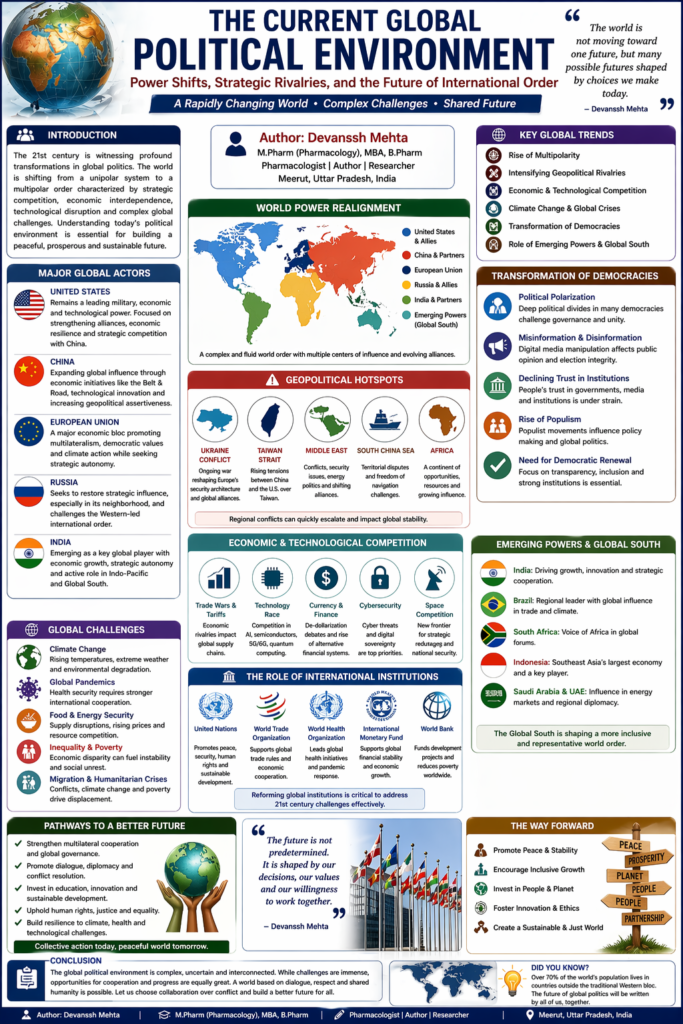
Introduction: A World in Political Transition
The early decades of the twenty-first century have been characterized by profound transformations in the global political landscape. The international system, once dominated by relatively stable geopolitical structures following the end of the Cold War, is now undergoing significant realignment. Rising powers, shifting alliances, technological revolutions, economic competition, and ideological polarization are collectively reshaping the dynamics of global governance.
In the aftermath of the Second World War, the global political order was largely structured around institutions such as the United Nations, the World Bank, the International Monetary Fund, and various multilateral frameworks that sought to promote cooperation and prevent large-scale conflict. The collapse of the Soviet Union in 1991 further consolidated the perception of a unipolar world dominated by the United States and Western democratic institutions.
However, the current global political environment reveals a far more complex reality. The rise of emerging powers, particularly China and India, the resurgence of geopolitical rivalry between major powers, the fragmentation of international alliances, and the emergence of new technological and economic battlegrounds have created a multipolar political system characterized by uncertainty and competition.
Today’s global political environment is shaped not only by traditional power politics but also by non-traditional challenges such as climate change, pandemics, cyber warfare, artificial intelligence, economic inequality, and the transformation of democratic institutions. These developments have created a world in which political leadership, strategic foresight, and institutional resilience are more important than ever.
Understanding the current political environment across the world therefore requires an interdisciplinary perspective that integrates geopolitical analysis, economic trends, technological developments, and societal transformations.
This article explores the major forces shaping global politics today, examining power rivalries, regional conflicts, democratic challenges, economic geopolitics, technological competition, and the evolving role of international institutions.
The Rise of Multipolarity in Global Politics
One of the most significant developments in contemporary international relations is the gradual transition from a unipolar world to a multipolar geopolitical order.
During the 1990s and early 2000s, the United States emerged as the dominant global power following the collapse of the Soviet Union. American military strength, technological leadership, and economic influence allowed it to shape international institutions and global policy agendas.
However, the past two decades have witnessed the rise of several influential global powers, including China, India, the European Union, and regional actors such as Turkey and Brazil. These developments have contributed to the emergence of a multipolar world in which power is distributed among several competing centers.
China’s rapid economic growth and technological advancement have positioned it as a major challenger to American global leadership. Through initiatives such as the Belt and Road Initiative, China has expanded its economic and strategic influence across Asia, Africa, and Europe.
At the same time, India has emerged as a significant geopolitical actor due to its demographic strength, economic growth, technological capabilities, and strategic location in the Indo-Pacific region.
The rise of these powers has created a global political environment characterized by strategic competition, shifting alliances, and evolving regional dynamics.
The United States and Strategic Leadership in a Changing World
Despite the emergence of new global powers, the United States continues to play a central role in global politics. American influence remains significant in areas such as military power, technological innovation, financial systems, and international institutions.
However, the United States faces several strategic challenges in maintaining its global leadership.
First, domestic political polarization has increasingly influenced American foreign policy. Political divisions within the United States have created uncertainties regarding long-term strategic commitments and international partnerships.
Second, economic competition with China has intensified across sectors including artificial intelligence, semiconductor manufacturing, and global supply chains.
Third, global crises such as the COVID-19 pandemic and climate change have tested the capacity of traditional leadership models in international governance.
In response to these challenges, American policymakers have increasingly emphasized alliances with democratic partners in Europe and the Indo-Pacific region. Initiatives such as the Quad alliance involving the United States, India, Japan, and Australia reflect efforts to strengthen strategic cooperation in the Indo-Pacific.
China’s Strategic Expansion and Global Influence
China’s rise represents one of the most transformative developments in contemporary global politics.
Over the past four decades, China has transitioned from a largely agrarian economy to the world’s second-largest economic power. This transformation has been accompanied by significant investments in infrastructure, technology, and military modernization.
China’s global strategy increasingly focuses on expanding economic influence through trade partnerships, infrastructure investments, and technological innovation.
The Belt and Road Initiative represents one of the most ambitious geopolitical projects of the twenty-first century. Through large-scale infrastructure investments across Asia, Africa, and Europe, China aims to create new trade corridors and strengthen economic ties with partner countries.
However, China’s growing influence has also generated strategic concerns among other global powers. Issues such as territorial disputes in the South China Sea, tensions with Taiwan, and competition in emerging technologies have intensified geopolitical rivalry between China and Western countries.
The European Union and the Challenge of Strategic Autonomy
The European Union remains one of the world’s largest economic blocs and a major advocate of multilateral diplomacy. However, the EU faces several internal and external challenges that shape its role in global politics.
Internally, issues such as economic disparities between member states, migration policies, and debates over national sovereignty have created political tensions within the union.
Externally, the EU must navigate complex geopolitical relationships with both the United States and China while responding to security challenges in Eastern Europe and the Middle East.
The war in Ukraine has significantly influenced European security policies. In response to Russian aggression, European countries have increased defense spending and strengthened cooperation with NATO.
At the same time, the EU continues to emphasize climate policy, digital regulation, and economic diplomacy as key components of its global strategy.
Russia and the Resurgence of Geopolitical Rivalry
Russia remains a central actor in global geopolitics due to its military capabilities, energy resources, and strategic influence in Eastern Europe and Central Asia.
The conflict in Ukraine has profoundly reshaped the geopolitical landscape of Europe. The war has intensified tensions between Russia and Western countries, leading to economic sanctions, military assistance to Ukraine, and renewed emphasis on NATO alliances.
From a strategic perspective, the conflict highlights the persistence of traditional power politics in international relations.
Russia’s geopolitical strategy also involves strengthening partnerships with countries outside the Western alliance system, including China and various states in the Global South.
The Role of Emerging Powers and the Global South
In recent years, countries across Asia, Africa, and Latin America have increasingly asserted their influence in global politics.
Nations such as India, Brazil, South Africa, Indonesia, and Saudi Arabia are playing more prominent roles in international diplomacy and economic cooperation.
Organizations such as BRICS represent attempts by emerging economies to create alternative platforms for global governance and financial cooperation.
The growing influence of the Global South reflects broader changes in the international system, where economic growth and demographic expansion are shifting the center of global activity toward Asia and Africa.
The Transformation of Democracy in the Modern Era
Democracy remains one of the most influential political systems in the world. However, democratic institutions are facing significant challenges in many countries.
Issues such as political polarization, misinformation, declining public trust in institutions, and economic inequality have affected democratic stability in various regions.
At the same time, authoritarian governance models have gained prominence in some parts of the world, raising important questions about the future of democratic governance.
Strengthening democratic institutions therefore requires renewed emphasis on transparency, accountability, and inclusive governance.
Technology and the New Arena of Global Politics
Technology has become a major driver of geopolitical competition in the twenty-first century.
Artificial intelligence, cybersecurity, quantum computing, and semiconductor manufacturing represent critical areas of technological rivalry between major powers.
Control over technological infrastructure and digital platforms increasingly influences economic competitiveness and national security.
Consequently, governments are investing heavily in research and development while implementing policies aimed at securing technological leadership.
Climate Politics and Global Environmental Governance
Climate change has emerged as one of the most pressing global challenges of the modern era.
Environmental policies now play a significant role in international diplomacy, economic planning, and technological innovation.
International agreements such as the Paris Climate Accord reflect global efforts to reduce greenhouse gas emissions and promote sustainable development.
However, balancing environmental goals with economic growth remains a major political challenge for many countries.
Global Health and the Politics of Pandemics
The COVID-19 pandemic revealed both the strengths and weaknesses of global governance systems.
While scientific collaboration enabled rapid vaccine development, geopolitical competition and unequal access to healthcare resources exposed significant gaps in international cooperation.
The pandemic has therefore prompted discussions about strengthening global health institutions and improving preparedness for future crises.
The Future of Global Governance
Looking ahead, the global political environment will likely continue to evolve toward a multipolar system characterized by strategic competition and complex interdependence.
Effective global governance will require stronger international institutions, cooperative diplomacy, and innovative policy frameworks capable of addressing emerging global challenges.
Countries that invest in education, technology, economic resilience, and democratic governance will be better positioned to navigate the uncertainties of the future international system.
Conclusion: Navigating a Complex Political World
The current global political environment reflects a world in transition. The rise of new powers, the resurgence of geopolitical rivalry, technological transformation, and evolving democratic institutions are collectively reshaping the international order.
For policymakers, scholars, and citizens alike, understanding these dynamics is essential for navigating the challenges and opportunities of the twenty-first century.
Ultimately, the future of global politics will depend on the ability of nations to balance competition with cooperation, innovation with ethical governance, and national interests with the broader goals of global stability and sustainable development.