
How to Effectively Write a Book: A Complete Guide for Aspiring Authors
Introduction
Writing a book is one of the most rewarding intellectual and creative pursuits. Whether you aim to write fiction, nonfiction, memoirs, academic texts, self-help books, or professional guides, the process requires vision, discipline, planning, and persistence. Contrary to popular belief, successful books are rarely written through inspiration alone. They are the result of careful preparation, consistent writing habits, multiple revisions, and a deep understanding of readers’ expectations.
Every bestselling author, regardless of genre, began with a simple idea and transformed it into a meaningful manuscript through dedication and continuous improvement. This article presents practical strategies that can help both first-time and experienced writers produce compelling, well-structured, and publishable books.
1. Start with a Powerful Idea
Every successful book begins with a strong central idea. Ask yourself:
- What message do I want to communicate?
- Why is this topic important?
- Who will benefit from reading this book?
- What makes my perspective unique?
A clear purpose provides direction throughout the writing journey.
2. Identify Your Target Audience
Understanding your readers helps determine your writing style, vocabulary, tone, and level of detail.
Consider:
- Age group
- Educational background
- Professional interests
- Reading habits
- Problems they want solved
The more precisely you define your audience, the more relevant your book becomes.
3. Conduct Thorough Research
Even fictional works benefit from research.
For nonfiction, gather information from:
- Scientific journals
- Books
- Government publications
- Expert interviews
- Reliable databases
- Industry reports
Well-researched books establish credibility and increase readers’ trust.
4. Develop a Detailed Outline
Planning before writing saves significant time.
A typical outline includes:
- Introduction
- Major sections
- Chapters
- Subtopics
- Case studies
- Examples
- Conclusion
An outline acts as the roadmap that keeps the manuscript focused and organized.
5. Set Realistic Writing Goals
Successful authors develop consistent writing routines.
Examples include:
- 500 words per day
- One chapter every week
- Writing for one hour every morning
Consistency is far more effective than waiting for inspiration.
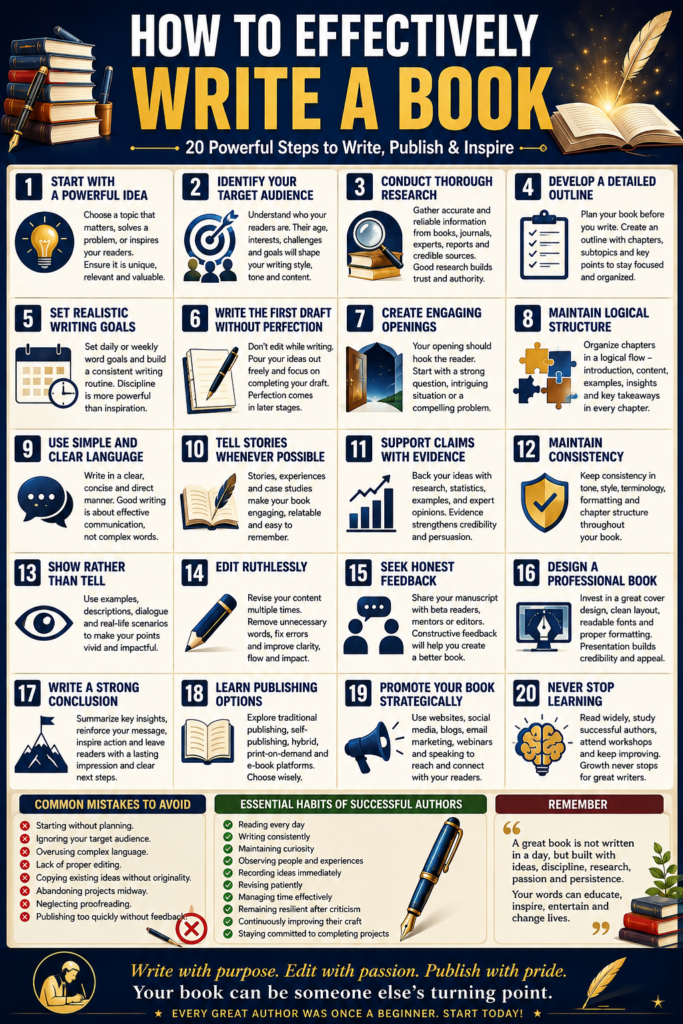
6. Write the First Draft Without Seeking Perfection
Many writers never finish because they constantly edit while writing.
Instead:
- Write freely.
- Ignore minor grammar mistakes.
- Focus on completing ideas.
- Keep moving forward.
Remember that every published book began as an imperfect first draft.
7. Create Engaging Openings
The first chapter determines whether readers continue.
An effective opening should:
- Introduce an interesting problem
- Present an intriguing situation
- Ask thought-provoking questions
- Build curiosity immediately
A compelling introduction creates momentum for the rest of the book.
8. Maintain Logical Structure
Every chapter should follow a logical progression.
A useful structure is:
- Introduction
- Explanation
- Supporting evidence
- Practical examples
- Key takeaway
Readers appreciate clarity and organized thinking.
9. Use Simple and Clear Language
Complex vocabulary does not necessarily make writing better.
Good writing is:
- Clear
- Direct
- Precise
- Easy to understand
The goal is communication, not complication.
10. Tell Stories Whenever Possible
Humans naturally remember stories better than isolated facts.
Include:
- Personal experiences
- Historical events
- Real-life examples
- Case studies
- Success stories
Stories increase emotional engagement and improve retention.
11. Support Claims with Evidence
Particularly in nonfiction writing, support statements using:
- Research findings
- Statistics
- Expert opinions
- Published studies
- Practical examples
Evidence enhances authority and credibility.
12. Maintain Consistency
Ensure consistency in:
- Tone
- Style
- Terminology
- Formatting
- Chapter organization
Consistency creates a professional reading experience.
13. Show Rather Than Tell
Instead of merely describing concepts, illustrate them through examples, dialogue, or vivid descriptions.
For example:
Instead of writing:
“The manager was effective.”
Write:
“The manager inspired the team, solved conflicts quickly, and consistently achieved project goals.”
Concrete examples make writing more engaging.
14. Edit Ruthlessly
Professional books undergo multiple rounds of editing.
Review your manuscript for:
- Grammar
- Sentence structure
- Repetition
- Clarity
- Flow
- Factual accuracy
Editing often transforms an average manuscript into an excellent one.
15. Seek Honest Feedback
Invite beta readers, colleagues, or professional editors to review your work.
Ask them:
- Which chapters were most engaging?
- Where did they lose interest?
- What was confusing?
- Which sections need expansion?
Constructive criticism strengthens the final manuscript.
16. Design a Professional Book
Readers often judge books by their presentation.
Invest in:
- Attractive cover design
- Professional typography
- Proper formatting
- High-quality illustrations (if needed)
- Clear chapter layouts
Professional presentation enhances credibility and market appeal.
17. Write a Strong Conclusion
An effective conclusion should:
- Summarize key insights
- Reinforce the central message
- Inspire readers
- Encourage practical application
- Leave a memorable final impression
A strong ending ensures your message stays with readers long after they finish the book.
18. Learn Publishing Options
Authors today have multiple publishing pathways:
- Traditional publishing
- Independent publishing
- Hybrid publishing
- Print-on-demand platforms
- E-book publishing
Choose the model that aligns with your goals, audience, and available resources.
19. Promote Your Book Strategically
Writing the book is only part of the journey.
Effective promotion includes:
- Personal website
- Social media
- Author blog
- Podcasts
- Webinars
- Book launches
- Email newsletters
- Speaking engagements
Consistent marketing helps your book reach a wider audience.
20. Never Stop Learning
Every completed book improves your skills as a writer.
Continue to:
- Read extensively
- Study successful authors
- Attend writing workshops
- Accept feedback
- Practice regularly
- Experiment with new techniques
Lifelong learning is one of the defining characteristics of accomplished authors.
Common Mistakes to Avoid
Many manuscripts fail because authors:
- Start writing without planning.
- Ignore their target audience.
- Overuse complex language.
- Lack proper editing.
- Copy existing ideas without adding originality.
- Abandon projects midway.
- Neglect proofreading.
- Publish too quickly without feedback.
Recognizing these pitfalls early can save considerable time and improve the quality of your work.
Essential Habits of Successful Authors
Highly productive writers often share these habits:
- Reading every day
- Writing consistently
- Maintaining curiosity
- Observing people and experiences
- Recording ideas immediately
- Revising patiently
- Managing time effectively
- Remaining resilient after criticism
- Continuously improving their craft
- Staying committed to completing projects
These habits build both skill and confidence over time.
Conclusion
Writing an effective book is a structured process that combines creativity, knowledge, discipline, and persistence. Great authors are not simply gifted storytellers—they are dedicated learners who plan carefully, write consistently, revise thoroughly, and always keep their readers in mind. By choosing a meaningful topic, organizing ideas logically, conducting sound research, writing with clarity, and embracing constructive feedback, any aspiring author can transform an idea into a valuable and impactful book. Ultimately, the most successful books are those that educate, inspire, entertain, or solve real problems while leaving readers with insights that endure long after the final page.