

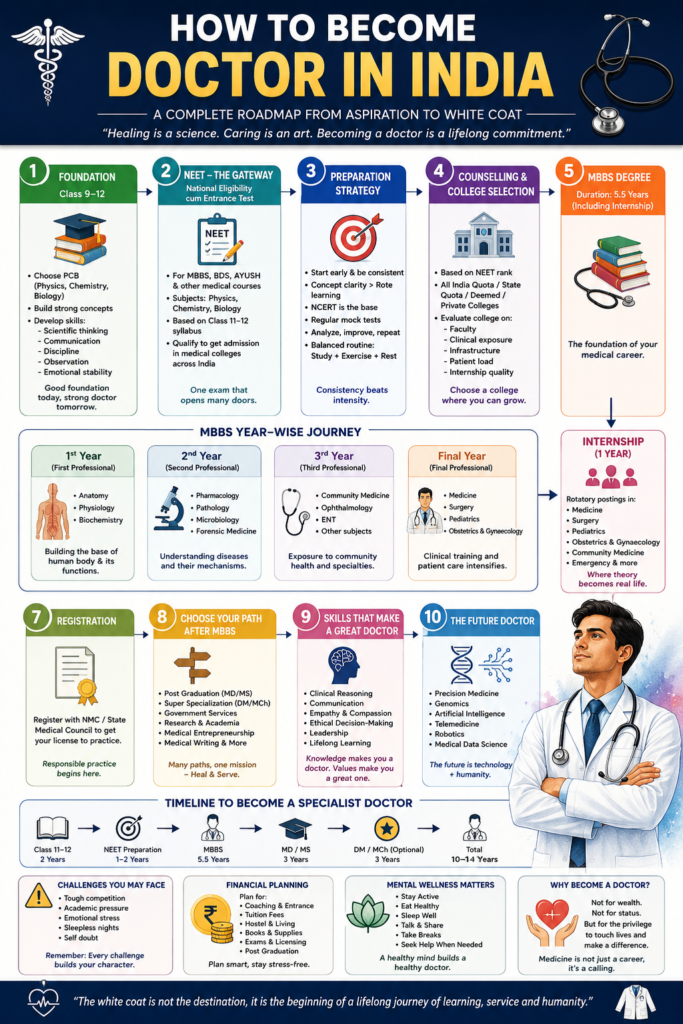
Introduction: The Journey Beyond the White Coat
Becoming a doctor in India is not merely an educational decision—it is one of the most demanding and transformative professional journeys a student can undertake. In India, the medical profession occupies a unique place at the intersection of science, service, leadership, ethics, and social responsibility. Doctors are entrusted not only with treating disease but also with preserving dignity, alleviating suffering, advancing medical knowledge, and shaping public health outcomes.
For generations, Indian families have viewed medicine as one of the most respected professions. Yet modern medicine in India has evolved dramatically. Today’s doctor must operate in a world shaped by precision medicine, artificial intelligence, genomics, robotic surgery, telemedicine, evidence-based practice, digital health ecosystems, regulatory scrutiny, and increasing patient expectations.
The pathway to becoming a doctor in India therefore requires much more than academic excellence. It demands intellectual discipline, emotional resilience, strategic planning, communication skills, ethical integrity, and lifelong learning.
This comprehensive guide explains the complete journey—from school years to becoming a practicing physician in India.
Understanding What It Means to Be a Doctor
Before entering the roadmap, students must understand what being a doctor actually means.
A doctor is not simply someone who prescribes medicines or performs procedures.
A doctor is simultaneously:
- A scientist who understands human biology
- A clinician who diagnoses disease
- A communicator who explains uncertainty
- A leader who coordinates care
- A researcher who advances knowledge
- A teacher who educates patients
- A decision-maker under pressure
- A lifelong learner
Medicine combines knowledge with judgment.
The profession rewards those who possess both competence and compassion.
Step 1: Build the Right Foundation During School (Class 9–12)
Medical preparation begins much earlier than entrance examinations.
Subject Selection
Students wishing to become doctors should choose:
- Physics
- Chemistry
- Biology
- English
Mathematics is optional but beneficial.
The PCB (Physics–Chemistry–Biology) combination forms the standard route.
Key Areas to Strengthen
Biology
- Human physiology
- Genetics
- Cell biology
- Biotechnology
Chemistry
- Organic chemistry
- Physical chemistry
- Biomolecules
Physics
- Mechanics
- Thermodynamics
- Electricity
- Optics
Develop Core Doctor Competencies Early
Academic marks alone are insufficient.
Develop:
Scientific Thinking
Ask:
- Why does disease occur?
- How do drugs work?
Communication
Doctors communicate continuously.
Emotional Stability
Medical training involves stress.
Observation Skills
Clinical excellence begins with noticing details.
Discipline
Medicine rewards consistency.
Step 2: Understand NEET – The Gateway to Medical Education
The primary entrance examination for MBBS in India is:
National Testing Agency administered NEET-UG (National Eligibility cum Entrance Test).
NEET determines admission to:
- MBBS
- BDS
- AYUSH programs
- Nursing (certain institutions)
- Allied medical pathways
NEET Eligibility
General requirements:
Educational Qualification
Class 12 with:
- Physics
- Chemistry
- Biology/Biotechnology
- English
Age
Minimum:
17 years.
Upper age regulations may evolve based on policy.
NEET Examination Structure
Subjects:
- Physics
- Chemistry
- Biology
Biology contributes the largest proportion.
Success depends on:
- Concept clarity
- Speed
- Precision
- Mock testing
- Revision systems
Step 3: Create a Medical Entrance Preparation Strategy
Many students fail not due to lack of intelligence but due to poor execution.
Year-Wise Preparation Model
Class 11
Focus:
Concept building.
Daily:
5–6 hours.
Target:
Complete first cycle.
Class 12
Focus:
Board + NEET integration.
Daily:
6–8 hours.
Drop Year (if required)
Approach as:
Professional preparation year.
Daily:
8–10 focused hours.
High-Yield Preparation System
Morning
Biology
Afternoon
Chemistry
Evening
Physics
Night
Revision
Weekly:
- Full mock tests
- Error log maintenance
Common Mistakes
Avoid:
- Too many books
- Endless coaching changes
- Passive reading
- Ignoring NCERT
- Burnout
Step 4: Medical Counselling and College Selection
After NEET results comes one of the most underestimated phases.
Admission occurs through counselling systems.
Major pathways:
- All India quota
- State quota
- Central institutions
- Deemed universities
- Private colleges
How to Select a Medical College
Students often focus only on rank.
Instead evaluate:
Academic Environment
Patient Load
Faculty Quality
Research Exposure
Internship Quality
Infrastructure
Clinical Diversity
Alumni Outcomes
Categories of Medical Colleges
Government Medical Colleges
Advantages:
- Lower fees
- High clinical exposure
Challenges:
- Competition
Private Medical Colleges
Advantages:
- Infrastructure
Challenges:
- Higher cost
Autonomous Institutions
High academic reputation.
Step 5: MBBS – The Core Medical Degree
The foundational degree is:
Bachelor of Medicine and Bachelor of Surgery (MBBS).
Duration:
Approximately 5.5 years including internship.
MBBS Year-Wise Journey
First Professional MBBS
Subjects:
- Anatomy
- Physiology
- Biochemistry
This year transforms students from learners into medical thinkers.
Second Professional MBBS
Subjects:
- Pharmacology
- Pathology
- Microbiology
- Forensic Medicine
Students begin understanding disease mechanisms.
Third Professional MBBS
Subjects include:
- Community Medicine
- Ophthalmology
- ENT
Final Professional MBBS
Subjects:
- Medicine
- Surgery
- Pediatrics
- Obstetrics
- Gynecology
Clinical maturity begins here.
Understanding Daily Life of an MBBS Student
Medical education is intense.
A typical day:
6 AM:
Preparation
8 AM:
Classes
10 AM:
Labs
2 PM:
Clinical postings
5 PM:
Study
8 PM:
Revision
Medicine becomes a lifestyle.
Step 6: Internship – Where Doctors Are Actually Built
Internship converts theoretical knowledge into patient care.
Departments include:
- Medicine
- Surgery
- Pediatrics
- Emergency
- Obstetrics
- Community medicine
Students learn:
- Clinical judgment
- Documentation
- Ethics
- Teamwork
Step 7: Registration and Medical Practice
After graduation:
Doctors register with relevant medical authorities.
Registration enables practice according to applicable regulations.
Step 8: Decide Your Career Direction After MBBS
MBBS is the beginning—not the endpoint.
Options include:
Option 1: Clinical Specialization (MD/MS)
Through postgraduate entrance.
Examples:
MD
- Internal Medicine
- Pediatrics
- Pharmacology
- Dermatology
MS
- General Surgery
- Orthopedics
- ENT
Option 2: Super Specialization (DM/MCh)
Examples:
- Cardiology
- Neurology
- Oncology
Option 3: Government Services
Doctors serve in:
- Public hospitals
- Health missions
- Defence medical systems
Option 4: Research
Fields:
- Clinical research
- Drug development
- Translational medicine
Option 5: Medical Entrepreneurship
Examples:
- Clinics
- Diagnostics
- Health technology
Option 6: Medical Writing
Growing opportunities include:
- Regulatory writing
- Scientific communication
- Medical education
Emerging Medical Fields Beyond Traditional Practice
Healthcare is changing rapidly.
Future domains include:
Precision Medicine
Customized treatment.
Genomic Medicine
DNA-driven healthcare.
Digital Health
AI-enabled healthcare.
Robotic Surgery
Advanced intervention.
Medical Data Science
Predictive healthcare.
Telemedicine
Remote care systems.
Skills That Separate Great Doctors from Average Doctors
Clinical Reasoning
Thinking beyond symptoms.
Communication
Explaining complexity simply.
Emotional Intelligence
Managing suffering.
Ethical Decision-Making
Balancing uncertainty.
Leadership
Healthcare is team-driven.
Continuous Learning
Medicine evolves continuously.
Financial Reality of Becoming a Doctor
Medicine requires planning.
Potential cost categories:
- Coaching
- Entrance exams
- Tuition
- Hostel
- Books
- Licensing
- Specialization
Government pathways significantly reduce educational cost.
Mental Health During Medical Training
Medical students often experience:
- Performance pressure
- Sleep disruption
- Emotional fatigue
Protect yourself through:
- Exercise
- Social support
- Sleep discipline
- Boundaries
Sustainable excellence matters.
Challenges Students Commonly Face
Failure in NEET
One examination does not define capability.
Burnout
Recovery is part of performance.
Comparison
Medicine is not a race.
Self-Doubt
Every doctor experiences uncertainty.
How Long Does It Take to Become a Specialist Doctor?
Typical timeline:
Class 11–12
→ 2 years
NEET Preparation
→ 1–2 years
MBBS
→ 5.5 years
MD/MS
→ 3 years
DM/MCh
→ 3 years
Total:
Approximately 10–14 years.
International Opportunities After Indian Medical Education
Indian doctors increasingly pursue:
- Global fellowships
- Clinical research
- International examinations
- Academic medicine
- Global public health
However, licensing varies by country.
Should You Become a Doctor?
Ask yourself:
Do I enjoy science?
Can I study consistently?
Can I tolerate uncertainty?
Can I work under pressure?
Do I want long-term growth over short-term rewards?
If most answers are yes, medicine may suit you.
The Future Doctor: Beyond Knowledge
The doctor of the future will not compete with technology.
The doctor of the future will combine:
Human judgment
+
Scientific rigor
+
Technology
+
Compassion
Medicine is becoming more interdisciplinary than ever.
Final Conclusion
Becoming a doctor in India is one of the longest and most intellectually demanding professional journeys available to students. Yet it remains among the most meaningful.
The journey begins with curiosity, strengthens through disciplined preparation, matures during medical education, and continues throughout professional life.
The white coat is not the destination.
It is permission to begin learning from humanity itself.
The best doctors are not those who know the most.
They are those who continue learning long after others stop.
And that is the true beginning of medicine.