
Serving Humanity Through Compassion, Clinical Wisdom, and the Art of General Medicine
In every city, there are physicians who treat illness. Yet among them, a smaller number become trusted figures in the everyday lives of people—not merely because of prescriptions written or diagnoses delivered, but because they create confidence where fear exists, clarity where confusion prevails, and reassurance where uncertainty dominates. The true measure of a physician is not only found in medical science but in the human experience of healing.
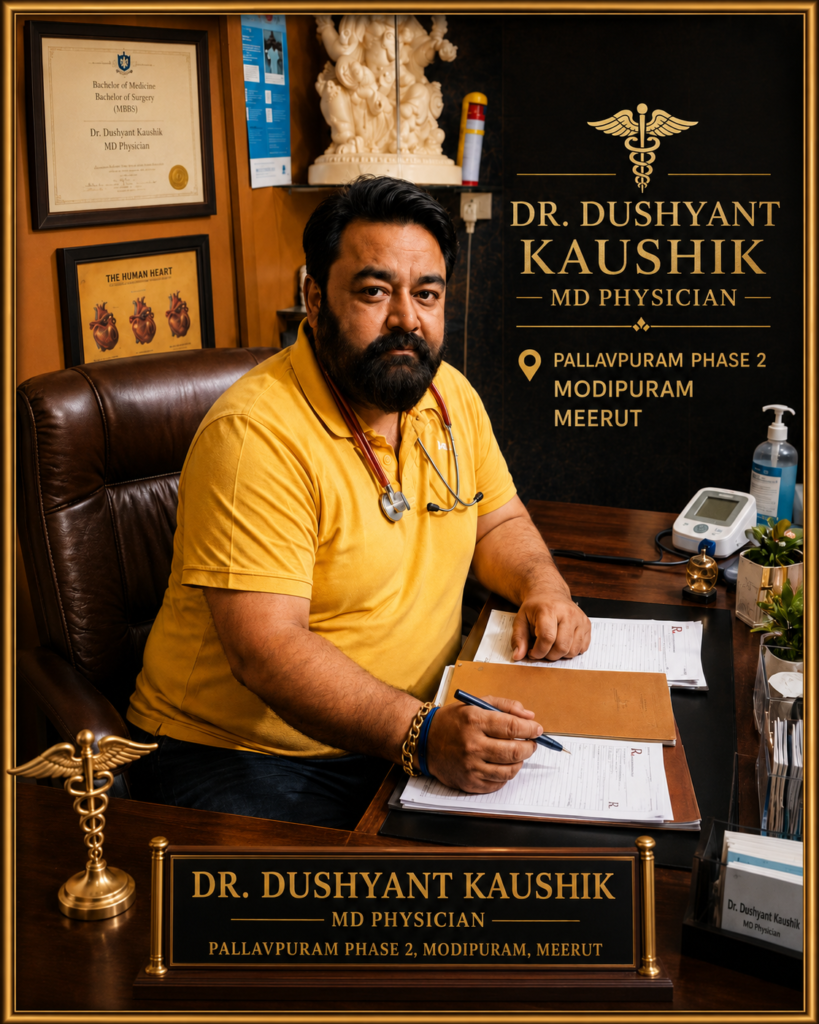
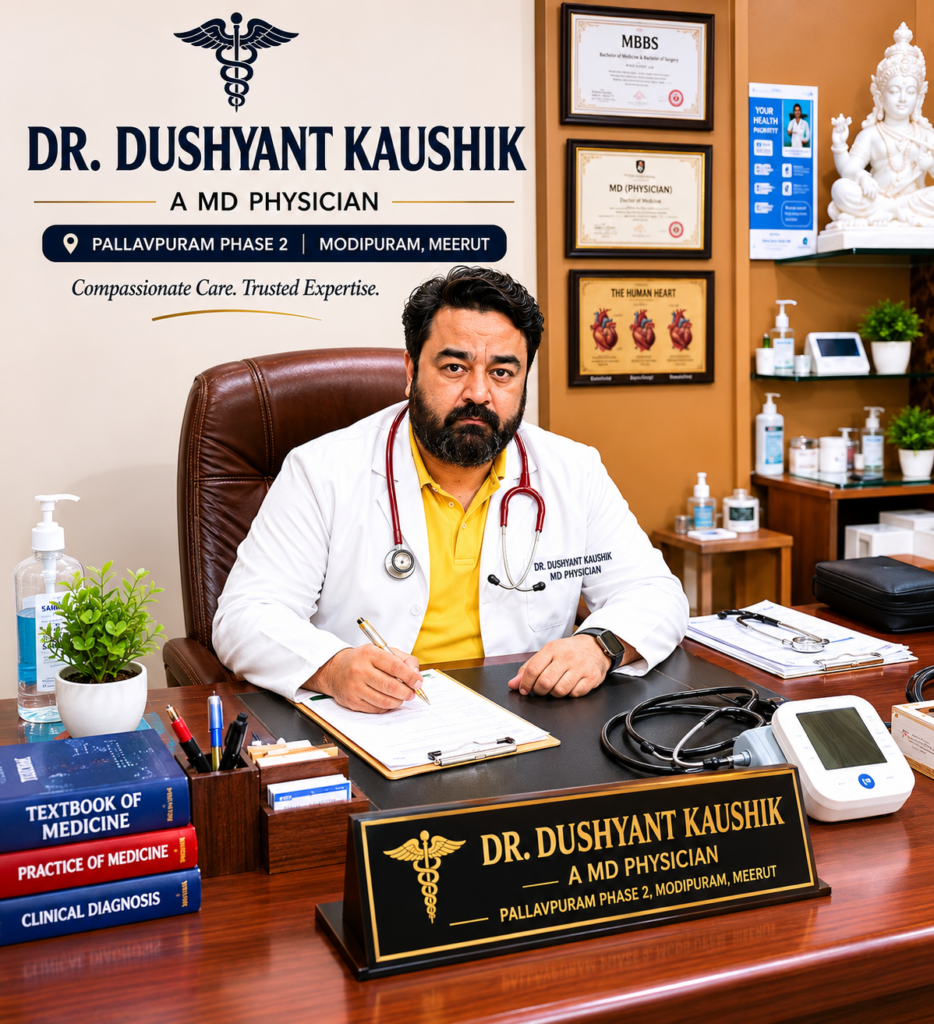
Within the growing urban and semi-urban healthcare landscape of Meerut, physicians who maintain strong patient relationships while balancing clinical excellence occupy an important position in society. Among such names, Dr. Dushyant of Pallavpuram Phase 2, Modipuram, Meerut, represents the image of a committed general physician whose professional identity reflects service, continuity of care, and dedication to humanity.
This article is written as an appreciation of the role played by community physicians and the enduring importance of general medicine in preserving public health.
The Silent Strength of General Medicine
Modern healthcare often celebrates technological breakthroughs, robotic procedures, molecular diagnostics, and superspecialization. However, the reality of healthcare begins much earlier—inside a physician’s chamber.
The general physician remains the first and often most important point of medical contact.
Patients do not arrive carrying diagnoses.
They arrive carrying symptoms.
A fever may be viral—or life-threatening.
Fatigue may indicate stress—or a metabolic disorder.
Chest discomfort may be acidity—or an evolving cardiac emergency.
General physicians stand at this critical intersection where science meets uncertainty.
Their responsibility extends beyond treatment:
- Early diagnosis
- Preventive care
- Lifestyle guidance
- Chronic disease monitoring
- Rational pharmacotherapy
- Psychological reassurance
- Referral decisions
A good physician therefore becomes not merely a doctor but a medical strategist for the patient’s life.
The Human Face of Medicine
The true influence of a physician cannot always be measured by equipment, infrastructure, or clinic size.
It is often measured by questions such as:
- Does the patient feel heard?
- Is clinical judgment balanced?
- Is treatment practical?
- Is unnecessary anxiety avoided?
- Is trust preserved?
For many families, a physician becomes a multi-generational healthcare guide.
Children grow into adults.
Adults become parents.
Parents become elderly.
Yet one trusted physician often remains part of that journey.
This continuity creates something deeper than consultation—it creates medical trust.
Dr. Dushyant: A Physician Rooted in Community Healthcare
At Pallavpuram Phase 2, Modipuram, Meerut, the image associated with Dr. Dushyant reflects a practitioner serving at the front line of community medicine.
General practice demands qualities rarely visible externally.
The physician must maintain:
- Constant vigilance
- Updated medical understanding
- Diagnostic reasoning
- Emotional balance
- Communication ability
- Ethical discipline
Every patient entering the consultation room carries a different concern.
One may arrive with seasonal fever.
Another may carry fear of diabetes.
Someone else may struggle silently with hypertension, obesity, exhaustion, or unexplained symptoms.
The physician’s role becomes multidimensional.
A consultation is not simply treatment.
It is observation.
Interpretation.
Decision-making.
Responsibility.
The Physician’s Chamber: More Than a Clinical Space
When patients enter a doctor’s office, they are not merely entering a room.
They are entering a space of expectation.
People come carrying:
- Worry about reports
- Family pressure
- Financial concerns
- Fear of serious disease
- Hope for reassurance
An effective physician understands that medicine is not delivered only through tablets.
Healing begins with communication.
A physician’s calm presence often reduces anxiety before treatment even begins.
This human dimension remains one of the greatest strengths of successful general practice.
General Physicians: The Architects of Preventive Health
Healthcare systems across the world increasingly recognize that prevention is more powerful than intervention.
General physicians contribute substantially through:
Early Disease Detection
Identifying disease before complications emerge.
Health Education
Helping patients understand nutrition, exercise, and preventive care.
Long-Term Monitoring
Managing chronic disorders systematically.
Rational Use of Medicines
Reducing unnecessary prescriptions and investigations.
Lifestyle Medicine
Encouraging sustainable behavioral improvements.
In India especially, preventive care delivered through trusted physicians can dramatically improve long-term health outcomes.
Clinical Excellence Beyond Prescriptions
General medicine requires extraordinary intellectual flexibility.
Within a single day, a physician may encounter:
- Viral infections
- Hypertension
- Diabetes
- Gastrointestinal disorders
- Respiratory illness
- Nutritional deficiencies
- Stress-related conditions
- Preventive consultations
The physician must rapidly move across specialties while maintaining safe and evidence-based judgment.
This ability separates experienced physicians from algorithm-based medicine.
Medicine remains a profession of thinking.
Service to Humanity: The Highest Medical Identity
Medicine occupies a unique position among professions.
Most professions serve transactions.
Medicine serves people during their most vulnerable moments.
A physician witnesses:
- Pain
- Fear
- Recovery
- Loss
- Hope
- Gratitude
This repeated exposure builds a distinctive professional identity.
Service to humanity is not an abstract phrase.
It becomes visible in:
- Long clinic hours
- Availability during illness
- Careful follow-up
- Listening patiently
- Treating respectfully
When practiced consistently, these actions create trust that extends far beyond prescriptions.
Building Trust in Modern Healthcare
Healthcare today faces multiple pressures:
- Digital misinformation
- Self-medication
- Rising patient expectations
- Commercialization concerns
- Information overload
In such an environment, trusted physicians become increasingly valuable.
Patients seek doctors who provide:
- Clarity over confusion
- Balanced advice over exaggeration
- Evidence over assumptions
- Care over transaction
Trust becomes the foundation of sustainable medical practice.
The Physician and Community Leadership
Doctors influence communities beyond clinic walls.
Their recommendations affect:
- Family behavior
- Nutrition patterns
- Vaccination attitudes
- Preventive screening
- Public awareness
A physician practicing consistently within one locality gradually becomes a community health leader.
This influence often extends across generations.
The Future of General Practice in India
India’s healthcare future will not depend only upon tertiary hospitals.
Its foundation will remain:
- Accessible physicians
- Primary care excellence
- Preventive healthcare
- Early diagnosis
- Community trust
General physicians will continue serving as healthcare navigators.
Their importance will increase as chronic diseases, aging populations, and preventive health gain greater prominence.
The Ethical Foundation of Medical Practice
The highest form of medicine combines:
Knowledge
Scientific understanding.
Judgment
Applying science appropriately.
Compassion
Understanding the person beyond symptoms.
Responsibility
Acting in the patient’s best interest.
Humility
Recognizing that medicine continuously evolves.
These principles define lasting medical practice.
Lessons for Young Doctors
The journey of community physicians offers important lessons:
- Master fundamentals.
- Build communication skills.
- Practice evidence-based medicine.
- Respect every patient.
- Continue lifelong learning.
- Protect ethics.
- Serve consistently.
A physician’s reputation is built consultation by consultation.
Beyond Medicine: The Legacy of Care
At the end of a professional career, physicians are rarely remembered only for diagnoses.
They are remembered because:
“They listened.”
“They cared.”
“They stayed available.”
“They guided our family.”
Such memories become a physician’s true legacy.
Conclusion
Medicine as Service, Service as Humanity
The story of community physicians reflects something larger than professional success.
It reflects the enduring relationship between medicine and humanity.
Dr. Dushyant of Pallavpuram Phase 2, Modipuram, Meerut symbolizes the continuing importance of accessible and compassionate general practice in local healthcare ecosystems.
In an era increasingly driven by technology and specialization, physicians who remain connected to everyday patients preserve something essential—the human soul of medicine.
Because at its highest level, medicine is not merely the treatment of disease.
It is the protection of dignity.
It is the restoration of confidence.
And above all—
it is service to humanity.