
Building a Future in Drug Discovery, Clinical Research, Precision Medicine, and Healthcare Innovation
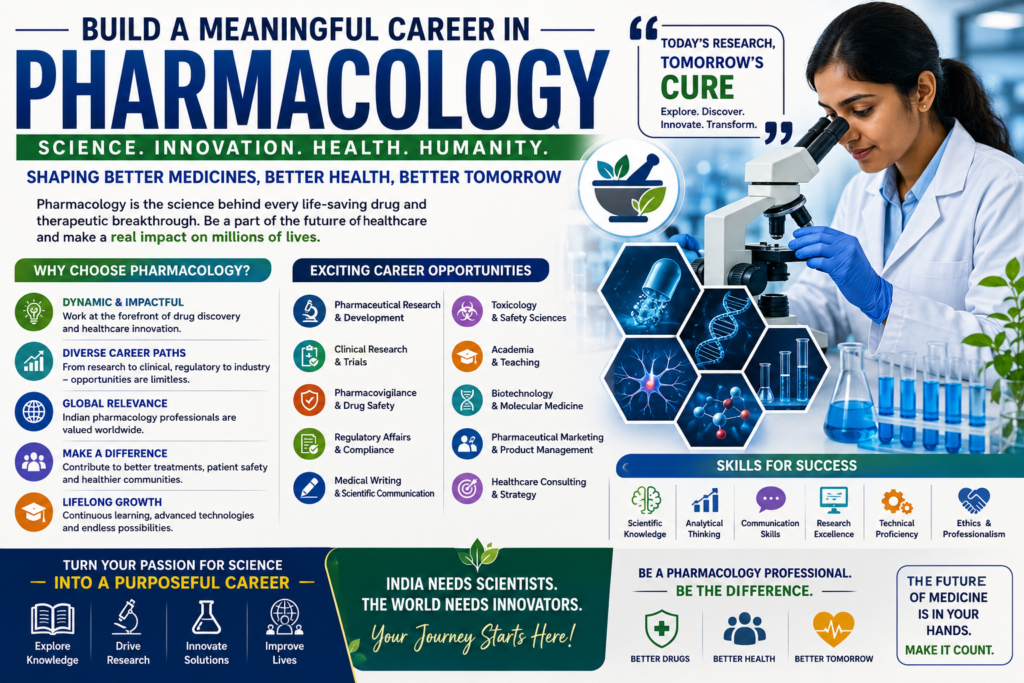
Pharmacology stands among the most intellectually dynamic and scientifically influential disciplines within modern healthcare and biomedical sciences. As the science that studies the interaction between drugs and living systems, pharmacology forms the central bridge connecting medicine, pharmacy, biotechnology, toxicology, molecular biology, physiology, and clinical therapeutics. In the twenty-first century, where healthcare systems are increasingly driven by innovation, precision medicine, artificial intelligence, biotechnology, and translational research, pharmacology has evolved from a traditional academic subject into a multidimensional global career ecosystem.
India, being one of the largest pharmaceutical manufacturing nations in the world and an emerging hub for biomedical innovation, offers enormous opportunities for pharmacology professionals. The country’s rapid expansion in pharmaceuticals, biotechnology, clinical research, biosimilars, vaccine development, pharmacovigilance, medical writing, regulatory sciences, and digital healthcare has created a strong demand for highly trained pharmacologists capable of contributing to research, drug development, healthcare policy, safety evaluation, and therapeutic innovation.
Today, pharmacology professionals are not confined to laboratories or academic classrooms. They are actively contributing to:
- Drug discovery and development
- Clinical research and trials
- Pharmacovigilance systems
- Regulatory affairs
- Toxicology and safety sciences
- Medical writing
- Precision therapeutics
- Artificial intelligence-driven drug discovery
- Pharmaceutical marketing strategy
- Public health policy
- Healthcare consulting
The field of pharmacology has become deeply interdisciplinary and globally connected. Professionals with expertise in pharmacology now contribute directly to the development of life-saving medicines, vaccines, gene therapies, oncology treatments, neurological drugs, immunotherapies, and personalized healthcare solutions.
For students and professionals seeking intellectually rewarding, scientifically advanced, financially stable, and socially impactful careers, pharmacology offers one of the most promising pathways in India’s healthcare and pharmaceutical landscape.
Understanding Pharmacology: The Science Behind Modern Therapeutics
Pharmacology is the branch of biomedical science that studies the mechanisms, effects, actions, interactions, and therapeutic uses of drugs in biological systems. It explores how medicines affect the human body and how the body influences drug behavior.
The discipline broadly includes:
- Pharmacodynamics
- Pharmacokinetics
- Toxicology
- Clinical pharmacology
- Neuropharmacology
- Cardiovascular pharmacology
- Molecular pharmacology
- Chemotherapy
- Immunopharmacology
- Experimental pharmacology
- Pharmacogenomics
Pharmacology acts as the scientific foundation upon which modern medicine operates. Every therapeutic intervention, from simple analgesics to complex monoclonal antibodies, depends upon pharmacological understanding.
The importance of pharmacology has increased dramatically because of:
- Rising chronic diseases
- Emerging infections
- Cancer prevalence
- Antibiotic resistance
- Aging populations
- Personalized medicine
- Biotechnological therapeutics
- Artificial intelligence in healthcare
As a result, pharmacology professionals now occupy strategic positions across global healthcare systems.
Why Pharmacology Is Becoming One of India’s Most Important Career Domains
India’s healthcare and pharmaceutical industries are undergoing historic transformation. Multiple scientific, industrial, technological, and regulatory developments are driving the growing demand for pharmacology professionals.
1. Expansion of the Indian Pharmaceutical Industry
India is among the largest pharmaceutical producers globally and supplies affordable medicines to over 200 countries. The Indian pharmaceutical sector is expected to continue expanding rapidly due to:
- Generic medicine exports
- Biosimilar manufacturing
- Vaccine production
- API manufacturing
- Biotechnology investments
- Research and development expansion
This growth requires pharmacologists capable of supporting:
- Drug discovery
- Preclinical research
- Safety studies
- Clinical pharmacology
- Therapeutic optimization
2. Rise of Biotechnology and Biosimilars
The emergence of biologics, monoclonal antibodies, gene therapies, and biosimilars has transformed modern pharmacology.
Unlike conventional small-molecule drugs, biologics involve complex mechanisms requiring advanced pharmacological understanding.
India’s biotechnology sector is expanding rapidly through:
- Vaccine development
- Immunotherapy research
- Biosimilar manufacturing
- Molecular medicine
- Genomic therapeutics
Consequently, pharmacologists with expertise in molecular and translational pharmacology are increasingly valuable.
3. Growth of Clinical Research and Precision Medicine
The future of medicine is moving toward individualized therapy based on:
- Genetics
- Biomarkers
- Patient-specific responses
- Molecular diagnostics
Pharmacologists play a critical role in:
- Clinical trial design
- Dose optimization
- Drug-response analysis
- Therapeutic monitoring
Precision medicine cannot evolve effectively without advanced pharmacological sciences.
4. Artificial Intelligence in Drug Discovery
Artificial intelligence is revolutionizing pharmacology through:
- Virtual screening
- Predictive toxicology
- AI-driven drug discovery
- Computational pharmacology
- Molecular simulations
Modern pharmacologists increasingly collaborate with:
- Data scientists
- Bioinformaticians
- AI researchers
- Systems biologists
This integration is creating entirely new career opportunities.
Educational Qualifications Required for Pharmacology Careers
Pharmacology is accessible through multiple educational pathways.
Undergraduate Qualifications
Students commonly enter pharmacology through:
- B.Pharm
- MBBS
- BDS
- BSc Life Sciences
- Biotechnology
- Nursing
- Veterinary Sciences
However, pharmacy graduates often possess strong foundational advantages due to their understanding of:
- Medicinal chemistry
- Pharmaceutics
- Therapeutics
- Drug interactions
Postgraduate Specialization
Advanced careers typically require postgraduate specialization.
Popular qualifications include:
- M.Pharm Pharmacology
- MD Pharmacology
- MSc Pharmacology
- Pharm.D
- PhD Pharmacology
Among these, M.Pharm in Pharmacology remains one of the most popular career-oriented postgraduate programs in India.
Students pursuing advanced pharmacology education develop expertise in:
- Experimental pharmacology
- Animal studies
- Molecular pharmacology
- Toxicology
- Clinical pharmacology
- Research methodologies
Core Skills Required for Successful Pharmacology Professionals
Success in pharmacology requires far more than theoretical knowledge. The field demands scientific reasoning, analytical capability, ethical responsibility, and technological adaptability.
Scientific and Analytical Skills
Pharmacologists must understand:
- Human physiology
- Biochemistry
- Molecular biology
- Pathophysiology
- Drug mechanisms
- Therapeutic pathways
Strong analytical thinking is essential for interpreting experimental and clinical data.
Research Skills
Modern pharmacology is heavily research-driven.
Professionals must learn:
- Experimental design
- Statistical analysis
- Laboratory techniques
- Scientific interpretation
- Research ethics
Publication skills and scientific writing are highly valuable.
Communication Skills
Pharmacologists frequently interact with:
- Physicians
- Researchers
- Regulatory agencies
- Pharmaceutical executives
- Academic institutions
Therefore, communication and presentation skills are critically important.
Technological Adaptability
Future pharmacologists must become comfortable with:
- AI tools
- Bioinformatics
- Molecular modeling
- Data analytics
- Clinical databases
- Digital healthcare systems
Technological literacy will become increasingly essential in coming decades.
Major Career Opportunities for Pharmacology Professionals in India
One of the greatest strengths of pharmacology is its extraordinary career diversity.
1. Pharmaceutical Research and Development
Research and development remains one of the most prestigious and scientifically rewarding pharmacology career pathways.
Pharmacologists in R&D contribute to:
- Drug discovery
- Molecule screening
- Mechanism-of-action studies
- Preclinical testing
- Safety evaluations
- Pharmacokinetic analysis
India’s growing pharmaceutical research ecosystem offers opportunities in:
- Multinational companies
- Indian pharmaceutical firms
- Biotechnology startups
- Research institutes
This field particularly suits scientifically curious and innovation-driven individuals.
2. Clinical Research
Clinical research represents one of the fastest-growing employment sectors for pharmacologists.
Roles include:
- Clinical Research Associate
- Clinical Trial Coordinator
- Medical Monitor
- Clinical Pharmacologist
- Clinical Data Analyst
Pharmacologists contribute significantly to:
- Trial protocol development
- Dose optimization
- Adverse event monitoring
- Therapeutic assessment
The increasing globalization of clinical trials is expanding opportunities dramatically.
3. Pharmacovigilance
Pharmacovigilance has emerged as a major employment sector for pharmacology graduates.
Pharmacologists possess strong advantages because of their understanding of:
- Adverse drug reactions
- Toxicology
- Therapeutic mechanisms
- Risk-benefit analysis
Opportunities exist in:
- Drug safety operations
- Signal detection
- Aggregate reporting
- Regulatory safety management
India is rapidly becoming a global pharmacovigilance outsourcing hub.
4. Medical Writing
Scientific and medical writing has become an increasingly lucrative career pathway.
Pharmacology professionals contribute to:
- Regulatory documents
- Clinical study reports
- Research manuscripts
- Scientific articles
- Educational materials
- Healthcare communication
Strong scientific writing abilities can create independent consulting and entrepreneurship opportunities.
5. Regulatory Affairs
Regulatory affairs professionals ensure compliance with national and international drug regulations.
Pharmacologists contribute to:
- Drug approval documentation
- Regulatory submissions
- Compliance management
- Scientific dossier preparation
Knowledge of:
- CDSCO
- US FDA
- EMA
- ICH guidelines
is highly valuable in this field.
6. Toxicology and Safety Sciences
Toxicology is a specialized branch strongly connected to pharmacology.
Professionals work on:
- Toxicity studies
- Environmental toxicology
- Chemical risk assessment
- Occupational safety
- Preclinical safety evaluation
As industrialization and environmental health concerns rise, toxicology careers are expanding globally.
7. Academic and Teaching Careers
Teaching remains one of the most respected and intellectually satisfying career pathways.
Pharmacology academicians contribute to:
- Education
- Research
- Scientific mentoring
- Curriculum development
Career opportunities exist in:
- Pharmacy colleges
- Medical colleges
- Universities
- Research institutes
Academic pharmacologists often combine:
- Teaching
- Research publications
- Consultancy
- Industry collaborations
8. Biotechnology and Molecular Medicine
Modern pharmacology increasingly overlaps with biotechnology.
Career opportunities include:
- Cell signaling research
- Molecular pharmacology
- Immunotherapy development
- Gene therapy studies
- Personalized medicine
This field offers extraordinary long-term scientific potential.
9. Healthcare Consulting and Strategy
Healthcare consulting is emerging as a highly attractive field for pharmacology professionals.
Consultants work in:
- Pharmaceutical market analysis
- Healthcare policy
- Drug commercialization
- Scientific strategy
- Medical communications
Professionals with MBA qualifications often possess additional advantages in this sector.
10. Pharmaceutical Marketing and Product Management
Contrary to common assumptions, pharmacology professionals can excel in pharmaceutical marketing because of their scientific understanding.
Roles include:
- Product manager
- Medical advisor
- Scientific marketing strategist
- Therapy area specialist
Strong communication and business understanding are essential.
Government Career Opportunities for Pharmacology Professionals
Government sectors provide stable and prestigious career pathways.
Major organizations include:
- CDSCO
- Indian Pharmacopoeia Commission
- ICMR
- DRDO
- CSIR laboratories
- AIIMS institutions
- State drug control departments
Pharmacologists contribute to:
- Drug regulation
- Public health research
- Toxicology
- National healthcare programs
- Policy development
Government research institutes offer opportunities in advanced biomedical sciences.
Role of Pharmacologists in Drug Discovery
Drug discovery remains one of pharmacology’s most intellectually challenging domains.
The modern drug discovery process involves:
- Target identification
- Molecular screening
- Lead optimization
- Preclinical studies
- Pharmacodynamic analysis
- Toxicological evaluation
Pharmacologists serve as critical scientific decision-makers throughout these stages.
As diseases become more complex, pharmacologists are increasingly needed in:
- Oncology
- Neuroscience
- Immunology
- Rare diseases
- Infectious diseases
Future Technologies Transforming Pharmacology Careers
The future pharmacologist will work in a highly technology-driven healthcare environment.
Emerging technologies include:
- Artificial intelligence
- Machine learning
- Computational pharmacology
- Systems biology
- Bioinformatics
- Organ-on-chip models
- CRISPR therapeutics
- Digital therapeutics
Future-ready pharmacologists must become interdisciplinary scientists capable of integrating biology, data science, and clinical reasoning.
Salary Structure for Pharmacology Professionals in India
Pharmacology offers strong long-term financial growth.
Entry-Level Salaries
- INR 3–6 LPA
Mid-Level Professionals
- INR 8–18 LPA
Senior Scientists and Managers
- INR 20–40 LPA
International and Leadership Roles
- INR 50 LPA and above
Compensation depends upon:
- Educational qualifications
- Technical expertise
- Research productivity
- Communication skills
- Industry exposure
- Global regulatory knowledge
Entrepreneurship Opportunities for Pharmacology Professionals
India’s healthcare innovation ecosystem is creating substantial entrepreneurial opportunities.
Pharmacology professionals can establish:
- CROs
- Pharmacovigilance firms
- Medical writing agencies
- Healthcare consulting companies
- Scientific communication platforms
- Biotechnology startups
- Research training institutes
Knowledge-driven entrepreneurship is likely to become a major future trend.
Challenges Faced by Pharmacology Professionals
Despite its opportunities, pharmacology also presents significant challenges.
Intense Competition
Advanced research positions can be highly competitive.
Continuous skill upgrading is essential.
Requirement for Continuous Learning
Scientific knowledge evolves rapidly.
Professionals must constantly update themselves regarding:
- New therapeutics
- AI technologies
- Molecular medicine
- Regulatory changes
Ethical Responsibilities
Pharmacologists directly influence patient safety and healthcare outcomes.
Scientific integrity and ethical responsibility are therefore extremely important.
Strategic Advice for Students Pursuing Pharmacology Careers
Students aspiring to build successful pharmacology careers should adopt a long-term strategic mindset.
Focus on Core Scientific Understanding
Do not rely solely on examination-oriented learning.
Develop conceptual mastery in:
- Pharmacodynamics
- Pharmacokinetics
- Molecular pharmacology
- Toxicology
Build Research Exposure Early
Participate in:
- Research projects
- Conferences
- Internships
- Scientific publications
Research exposure significantly improves career opportunities.
Develop Communication Skills
Scientific brilliance alone is insufficient.
Professionals must learn:
- Scientific writing
- Presentation skills
- Clinical communication
- Strategic thinking
Learn Emerging Technologies
Future pharmacologists should gain awareness regarding:
- AI in drug discovery
- Bioinformatics
- Precision medicine
- Digital health systems
Technological adaptability will become a major differentiator.
India’s Future as a Global Pharmacology and Biomedical Hub
India possesses extraordinary potential to become a global leader in pharmacological innovation.
Key strengths include:
- Large scientific workforce
- Expanding pharmaceutical industry
- Cost-effective research ecosystem
- Growing biotechnology infrastructure
- Rising healthcare investments
However, achieving global leadership will require:
- Stronger research funding
- Better academia-industry integration
- Innovation-driven education
- Ethical scientific culture
- International collaborations
Pharmacologists will play a central role in this transformation.
Conclusion
Pharmacology is not merely a subject within pharmacy or medicine; it is one of the foundational sciences shaping the future of global healthcare civilization. In an era defined by biotechnology, artificial intelligence, precision medicine, molecular therapeutics, and digital health innovation, pharmacology stands at the center of scientific transformation.
For India, pharmacology represents far more than a career domain. It represents an opportunity to build scientific sovereignty, healthcare innovation capacity, pharmaceutical leadership, and biomedical excellence.
The future pharmacology professional must evolve beyond traditional boundaries. The future pharmacologist must become:
- A scientist
- A researcher
- A data interpreter
- A healthcare strategist
- A technological innovator
- A communicator
- A policy contributor
- A guardian of therapeutic safety
Students entering pharmacology today are entering one of the most future-oriented scientific professions of the twenty-first century. The discipline offers intellectual depth, scientific prestige, global relevance, and meaningful societal impact.
Most importantly, pharmacology allows professionals to participate directly in humanity’s ongoing struggle against disease, suffering, and biological limitations. Every new therapeutic discovery, every optimized treatment strategy, and every scientific breakthrough ultimately contributes toward extending human life, improving quality of healthcare, and advancing civilization itself.
The future of healthcare will belong to nations capable of integrating science, ethics, technology, and innovation. Pharmacology stands precisely at the intersection of all four.