

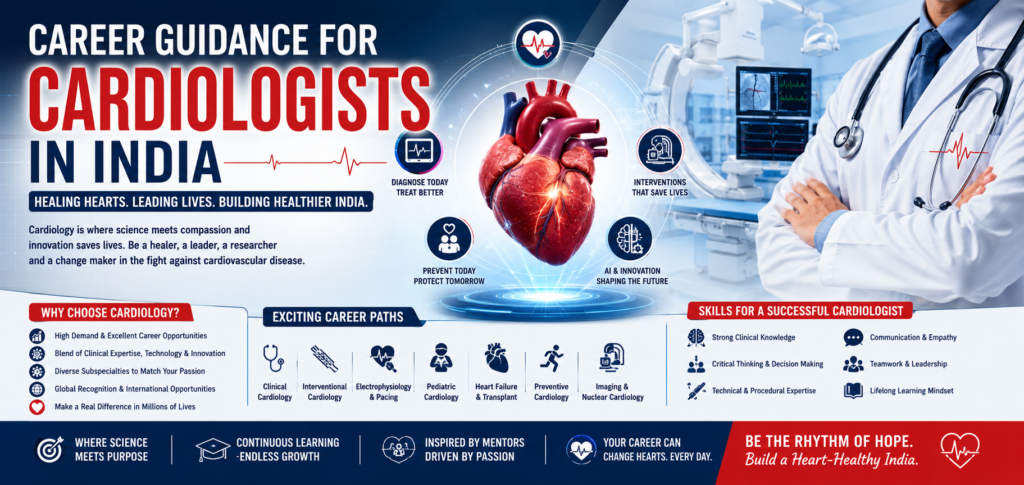
Cardiology has emerged as one of the most prestigious, technologically advanced, intellectually rigorous, and socially impactful medical specialties in India. In the modern era, cardiovascular diseases are no longer confined to elderly populations or affluent urban societies. They have evolved into a national healthcare emergency affecting individuals across age groups, socioeconomic classes, and geographic regions. India, once predominantly burdened by infectious diseases, is now witnessing an alarming epidemiological transition toward non-communicable diseases, particularly cardiovascular disorders such as coronary artery disease, hypertension, heart failure, arrhythmias, stroke, congenital heart diseases, and metabolic cardiac syndromes.
This transformation has profoundly elevated the importance of cardiologists within India’s healthcare ecosystem. Today’s cardiologist is not merely a physician treating heart attacks or hypertension; rather, he or she functions as a sophisticated clinical strategist integrating diagnostics, imaging, interventional technologies, pharmacology, intensive care, genomics, preventive medicine, digital healthcare systems, and evidence-based cardiovascular therapeutics. The modern cardiologist increasingly operates at the intersection of medicine, artificial intelligence, robotic interventions, wearable technologies, bioengineering, and precision cardiovascular science.
India’s cardiovascular burden continues to rise because of rapid urbanization, sedentary lifestyles, obesity, diabetes mellitus, smoking, alcohol consumption, chronic stress, dietary transitions, pollution, genetic predispositions, and increasing life expectancy. Simultaneously, awareness regarding preventive cardiology and advanced cardiac interventions has expanded dramatically. This dual phenomenon has created unprecedented demand for highly trained cardiologists across India.
The field therefore offers extraordinary career opportunities for ambitious medical professionals seeking a combination of intellectual stimulation, technological sophistication, social respect, financial growth, global mobility, and meaningful patient impact. However, cardiology is also one of the most demanding disciplines in medicine, requiring immense dedication, emotional resilience, rapid decision-making capability, procedural expertise, and lifelong commitment to scientific learning.
For medical students and young doctors aspiring to enter cardiology, understanding the evolving landscape of cardiovascular medicine is essential. The future of cardiology in India will not merely depend on treating disease but on integrating preventive healthcare, precision medicine, digital monitoring, interventional innovation, public health strategies, and personalized therapeutics into a cohesive cardiovascular ecosystem.
Understanding Cardiology as a Medical Specialty
Cardiology is the branch of medicine concerned with the diagnosis, prevention, treatment, and rehabilitation of diseases affecting the heart and blood vessels. However, contemporary cardiology has evolved far beyond conventional stethoscope-based clinical medicine. It is now among the most technologically integrated and rapidly advancing specialties in modern healthcare.
The discipline encompasses multiple highly specialized branches including:
- Clinical cardiology
- Interventional cardiology
- Electrophysiology
- Pediatric cardiology
- Heart failure and transplant cardiology
- Preventive cardiology
- Nuclear cardiology
- Structural heart disease interventions
- Cardiac imaging
- Cardiac critical care
- Sports cardiology
- Digital and AI-assisted cardiology
Each of these subdomains requires distinct technical competencies, procedural skills, research exposure, and professional orientation.
Clinical cardiology focuses on comprehensive diagnosis and medical management of cardiovascular disorders. Interventional cardiology involves minimally invasive catheter-based procedures such as angioplasty, stenting, TAVI, and structural interventions. Electrophysiology deals with arrhythmia management, pacemakers, ablation therapies, and implantable cardiac devices. Pediatric cardiology focuses on congenital and developmental cardiac disorders in children. Preventive cardiology emphasizes risk-factor modification, lifestyle medicine, and population-level cardiovascular prevention strategies.
The future cardiologist in India must therefore adopt a multidisciplinary mindset integrating clinical reasoning, procedural precision, preventive medicine, technological adaptability, and patient-centered care.
The Growing Cardiovascular Crisis in India
India is increasingly recognized as the cardiovascular disease capital of the world. Cardiovascular disorders account for a substantial proportion of premature mortality in the country. Coronary artery disease, ischemic heart disease, hypertension, and heart failure are affecting younger populations at unprecedented rates.
Several factors contribute to this alarming trend. Rapid urbanization has significantly altered dietary habits, physical activity patterns, stress exposure, and sleep behavior. Increasing prevalence of diabetes mellitus and metabolic syndrome further accelerates cardiovascular risk. Tobacco consumption, environmental pollution, obesity, and psychosocial stress continue to aggravate cardiac morbidity.
Moreover, Indians possess unique genetic and metabolic predispositions toward cardiovascular disease. South Asians frequently develop coronary artery disease at younger ages compared to Western populations. This creates a major long-term healthcare burden requiring specialized cardiac infrastructure and trained cardiologists.
At the same time, India has experienced tremendous advancements in cardiac healthcare delivery. Metropolitan cities now possess world-class cardiac centers equipped with robotic catheterization laboratories, hybrid operating rooms, AI-assisted imaging systems, ECMO technologies, and advanced electrophysiology suites. Government healthcare schemes and private hospital expansion have further increased accessibility to cardiac interventions.
This expanding healthcare ecosystem ensures sustained demand for cardiologists over the coming decades.
Why Cardiology is One of the Most Promising Careers in India
Cardiology offers a unique combination of scientific sophistication, technological innovation, procedural excitement, social prestige, and financial stability.
One of the major reasons for cardiology’s popularity is the enormous disease burden associated with cardiovascular disorders. Unlike certain medical specialties experiencing market saturation, cardiology continues to witness increasing patient volumes across urban and rural India alike.
Secondly, cardiology is among the most innovation-driven specialties in medicine. Rapid advancements in:
- AI-assisted diagnostics
- Robotic interventions
- Structural heart therapies
- Wearable monitoring systems
- Precision pharmacotherapy
- Genomic cardiology
- 3D cardiac imaging
- Catheter-based interventions
- Regenerative medicine
have transformed cardiology into an exceptionally futuristic discipline.
Thirdly, cardiology offers immense opportunities for super-specialization and professional diversification. Cardiologists may pursue clinical practice, academics, interventional work, critical care, research, healthcare administration, medical technology development, pharmaceutical consultancy, telemedicine, or entrepreneurship.
Fourthly, cardiologists possess strong international mobility. Indian cardiologists are highly valued globally because of their extensive procedural exposure and clinical experience.
Finally, cardiology combines immediate clinical impact with long-term patient relationships. Saving a patient during acute myocardial infarction or heart failure often creates immense professional satisfaction and emotional fulfillment.
Educational Pathway to Become a Cardiologist in India
The journey toward becoming a cardiologist in India is academically demanding and highly competitive. The pathway generally begins with MBBS, followed by postgraduate and super-specialty training.
After MBBS, aspiring cardiologists usually pursue:
- MD General Medicine
- DNB General Medicine
Following this, candidates compete for:
- DM Cardiology
- DrNB Cardiology
These super-specialty programs provide extensive exposure to invasive and non-invasive cardiology, cardiac ICU management, catheterization procedures, echocardiography, electrophysiology, and advanced cardiovascular therapeutics.
The duration of training is long and intellectually intensive. However, the expertise acquired during this process establishes the foundation for lifelong professional excellence.
Students aspiring toward cardiology should focus on:
- Strong academic performance
- Clinical reasoning
- Research participation
- Case presentations
- Competitive entrance preparation
- Procedural observation
- Communication skills
- Emotional resilience
Early exposure to ICU environments and emergency medicine significantly benefits future cardiologists.
Choosing the Right Cardiology Subspecialty
Cardiology today is not a monolithic field. Young cardiologists must carefully identify their long-term interests and aptitudes before selecting subspecialty pathways.
Interventional cardiology suits individuals who enjoy high-pressure decision-making, catheter-based procedures, angioplasty, and emergency interventions. This branch requires procedural confidence, technical dexterity, and rapid reflexes.
Electrophysiology attracts professionals interested in arrhythmias, cardiac conduction systems, pacemakers, defibrillators, and advanced ablation technologies.
Cardiac imaging appeals to those fascinated by echocardiography, CT angiography, MRI-based cardiac analysis, and diagnostic precision.
Heart failure and transplant cardiology involves management of critically ill patients requiring LVADs, ECMO, and transplant coordination.
Preventive cardiology is increasingly important due to India’s massive burden of lifestyle-related cardiovascular disorders.
Pediatric cardiology demands exceptional patience and expertise in congenital cardiac abnormalities.
Students should therefore conduct deep self-assessment regarding personality, procedural interests, stress tolerance, and long-term lifestyle expectations before finalizing specialization pathways.
Essential Skills Required for Successful Cardiologists
Success in cardiology requires a sophisticated blend of scientific intelligence, procedural excellence, emotional maturity, and communication capability.
Rapid decision-making is one of the most critical competencies. Cardiologists frequently manage emergencies such as myocardial infarction, arrhythmias, cardiac arrest, pulmonary edema, and cardiogenic shock where seconds can determine survival outcomes.
Technical precision is equally essential, particularly in interventional cardiology where angioplasty, stenting, and catheter-based procedures require exceptional procedural accuracy.
Communication skills are indispensable. Cardiologists must explain complex cardiovascular conditions, procedural risks, lifestyle modifications, medication adherence, and prognosis to patients and families in understandable language.
Emotional resilience is extremely important because cardiologists routinely encounter high-stress ICU situations, sudden mortality, and critically unstable patients.
Research aptitude is increasingly valuable due to rapid advancements in cardiovascular therapeutics and evidence-based medicine.
Technological adaptability has become non-negotiable because modern cardiology relies heavily on digital imaging, AI systems, robotic interventions, wearable devices, and computational diagnostics.
The future cardiologist must therefore function as both a compassionate clinician and a technologically proficient cardiovascular strategist.
Top Institutions for Cardiology Training in India
India possesses several internationally respected cardiac institutions offering advanced cardiology education and super-specialty exposure.
Prominent institutions include:
- All India Institute of Medical Sciences (AIIMS)
- Postgraduate Institute of Medical Education and Research (PGIMER)
- Sanjay Gandhi Postgraduate Institute
- Christian Medical College Vellore
- Narayana Health
- Fortis Escorts Heart Institute
- Apollo Hospitals
- Sri Jayadeva Institute of Cardiovascular Sciences
- Amrita Institute of Medical Sciences
These institutions provide extensive exposure to:
- High patient volumes
- Advanced catheterization laboratories
- Cardiac surgeries
- Heart transplant programs
- Research opportunities
- Electrophysiology units
- Structural interventions
- Academic conferences
- Clinical trials
Students should prioritize institutions with strong mentorship culture, multidisciplinary exposure, procedural training, and research ecosystems.
The Rise of Interventional Cardiology
Interventional cardiology has become one of the most transformative areas within cardiovascular medicine. Catheter-based therapies have revolutionized management of coronary artery disease, valvular disorders, congenital abnormalities, and peripheral vascular disease.
Modern interventions include:
- Coronary angioplasty
- Drug-eluting stents
- TAVI/TAVR
- Balloon valvuloplasty
- Rotablation
- IVUS and OCT-guided interventions
- MitraClip procedures
- Left atrial appendage closure
- Peripheral vascular interventions
India is witnessing rapid growth in catheterization laboratories and minimally invasive cardiac programs. Consequently, skilled interventional cardiologists remain in exceptionally high demand.
However, students must understand that interventional cardiology involves intense workload, emergency calls, radiation exposure, procedural stress, and continuous technical learning.
Artificial Intelligence and Digital Cardiology
Artificial intelligence is transforming cardiology more rapidly than many other specialties. AI-assisted ECG interpretation, predictive analytics, wearable monitoring systems, remote patient surveillance, and automated imaging analysis are redefining cardiovascular diagnostics.
Digital cardiology now includes:
- AI-powered ECG interpretation
- Smart wearable devices
- Remote cardiac monitoring
- Tele-cardiology
- Predictive cardiovascular analytics
- Machine learning-assisted imaging
- Digital biomarkers
- Personalized cardiovascular risk prediction
Future cardiologists who combine clinical expertise with digital literacy will possess major strategic advantages.
AI will not replace cardiologists. Instead, it will augment clinical capabilities, enabling faster diagnosis, predictive intervention, and personalized cardiovascular care.
Preventive Cardiology: The Future of Indian Healthcare
Preventive cardiology is emerging as one of the most strategically important healthcare domains in India.
The country’s massive burden of diabetes, hypertension, obesity, metabolic syndrome, smoking, and stress-related cardiovascular disorders necessitates large-scale preventive interventions.
Future cardiologists must increasingly focus on:
- Lifestyle medicine
- Nutrition counseling
- Exercise prescription
- Stress management
- Smoking cessation
- Lipid optimization
- Population screening
- Digital risk monitoring
The healthcare system of the future will shift from reactive disease treatment toward proactive cardiovascular prevention.
Cardiologists possessing expertise in preventive healthcare and population medicine will become highly influential in shaping India’s healthcare future.
Research Opportunities in Cardiology
Cardiology remains among the most research-intensive medical specialties worldwide.
Research domains include:
- Heart failure therapeutics
- Regenerative cardiology
- Stem cell therapy
- AI-driven diagnostics
- Cardiovascular pharmacology
- Structural interventions
- Electrophysiology innovations
- Preventive cardiology
- Lipid research
- Cardiac imaging
- Genomic cardiology
- Nanotechnology
- Biomedical engineering
Indian cardiologists increasingly participate in multinational clinical trials and translational cardiovascular research programs.
Young cardiologists should actively engage in:
- Publications
- Research methodology
- Clinical registries
- Meta-analyses
- Conference presentations
- International collaborations
Academic productivity significantly enhances long-term career growth.
Entrepreneurship Opportunities in Cardiology
Cardiology offers immense entrepreneurial potential beyond hospital employment.
Possible opportunities include:
- Heart clinics
- Preventive cardiology centers
- Tele-cardiology platforms
- AI-driven diagnostic startups
- Cardiac rehabilitation centers
- Digital health platforms
- Wearable monitoring technologies
- Research organizations
- Medical device consultancy
- Healthcare management
- Cardiac wellness programs
India’s expanding middle class and increasing awareness regarding heart health create enormous market opportunities for cardiovascular healthcare innovation.
Financial Growth and Professional Stability
Cardiology remains among the financially rewarding medical specialties in India. Experienced cardiologists, particularly interventional specialists, often command highly competitive compensation packages.
Additional revenue opportunities include:
- Academic appointments
- Conference speaking
- Research consultancy
- Industry collaborations
- Telemedicine
- Medical writing
- Clinical trials
- International fellowships
However, students should not pursue cardiology solely for financial gain. The discipline requires genuine passion, resilience, and long-term intellectual commitment.
Psychological Stress and Burnout in Cardiology
Cardiology is emotionally and physically demanding. Emergency interventions, ICU duties, sudden cardiac deaths, long procedural hours, sleep disruption, and high-pressure decision-making can contribute to burnout.
Young cardiologists must therefore prioritize:
- Mental wellness
- Work-life balance
- Team support systems
- Stress management
- Reflective practice
- Ethical grounding
Institutional mental health support for healthcare professionals should also be strengthened.
Ethics in Modern Cardiology
Modern cardiology involves substantial ethical responsibilities. Expensive interventions, device implantation decisions, end-of-life management, and healthcare affordability frequently create moral dilemmas.
Commercialization within healthcare may sometimes encourage unnecessary interventions or overtreatment. Ethical cardiologists must therefore remain committed to evidence-based, patient-centered, and economically rational care.
The future leader in cardiology will not merely be technologically advanced but ethically trustworthy and socially responsible.
Global Opportunities for Indian Cardiologists
Indian cardiologists possess strong international recognition due to their extensive procedural exposure and clinical competence.
Global opportunities exist in:
- United States
- United Kingdom
- Middle East
- Australia
- Canada
- Europe
- Southeast Asia
Students interested in global careers should prepare early through:
- International fellowships
- Research publications
- Licensing examinations
- Conference participation
- Networking
- Academic collaborations
Participation in organizations such as the American College of Cardiology and European Society of Cardiology significantly enhances professional visibility.
The Future of Cardiology in India
The future of cardiology in India will be defined by:
- Precision medicine
- AI integration
- Genomic cardiology
- Preventive healthcare
- Robotic interventions
- Remote monitoring
- Wearable diagnostics
- Regenerative medicine
- Population cardiovascular analytics
- Digital therapeutics
The cardiologist of the future will increasingly function as a hybrid professional integrating medicine, technology, data science, behavioral healthcare, and public health strategy.
India’s healthcare transformation will heavily depend on strengthening cardiovascular infrastructure, preventive screening systems, affordable therapeutics, and digital cardiac networks.
Conclusion
Cardiology in India represents far more than a medical specialty; it symbolizes a convergence of science, technology, emergency medicine, preventive healthcare, and compassionate human intervention. It is one of the most intellectually stimulating and socially meaningful disciplines in modern medicine.
For ambitious medical professionals possessing analytical thinking, emotional resilience, scientific curiosity, rapid decision-making capability, and commitment to lifelong learning, cardiology offers extraordinary opportunities for growth, leadership, innovation, and service.
However, becoming an exceptional cardiologist requires more than acquiring degrees or procedural expertise. It demands ethical integrity, patient-centered compassion, technological adaptability, research orientation, and emotional maturity. The cardiologist of tomorrow will not merely treat heart disease but will lead the transformation of cardiovascular healthcare systems through preventive medicine, digital innovation, personalized therapeutics, and interdisciplinary collaboration.
India’s growing cardiovascular burden simultaneously represents a national healthcare challenge and a historic professional opportunity. Young cardiologists entering the field today possess the potential not only to build successful careers but also to redefine the future of cardiovascular medicine in one of the world’s most dynamic healthcare landscapes.