
Becoming a successful business consultant in India requires much more than academic qualifications or industry experience. It demands a combination of strategic thinking, domain expertise, analytical ability, communication skills, credibility, and continuous learning. As India’s economy evolves into a global innovation hub with rapid expansion in manufacturing, healthcare, digital technologies, startups, MSMEs, logistics, financial services, renewable energy, and artificial intelligence, the demand for professional business consultants is expected to increase significantly. Organizations today seek consultants not merely to solve problems but to identify opportunities, optimize operations, improve profitability, manage risks, implement technology, and prepare businesses for future competition.
Becoming a Business Consultant in India: A Comprehensive Guide
Introduction
India has emerged as one of the world’s fastest-growing economies, offering enormous opportunities for businesses across diverse sectors. However, rapid growth also brings increasing competition, changing customer expectations, regulatory complexities, technological disruption, and global market pressures. These factors have created an unprecedented demand for skilled business consultants who can provide expert guidance and strategic solutions.
Business consulting is no longer limited to multinational consulting firms. Today, independent consultants, boutique consulting firms, subject matter experts, and industry specialists play a vital role in helping organizations achieve sustainable growth.
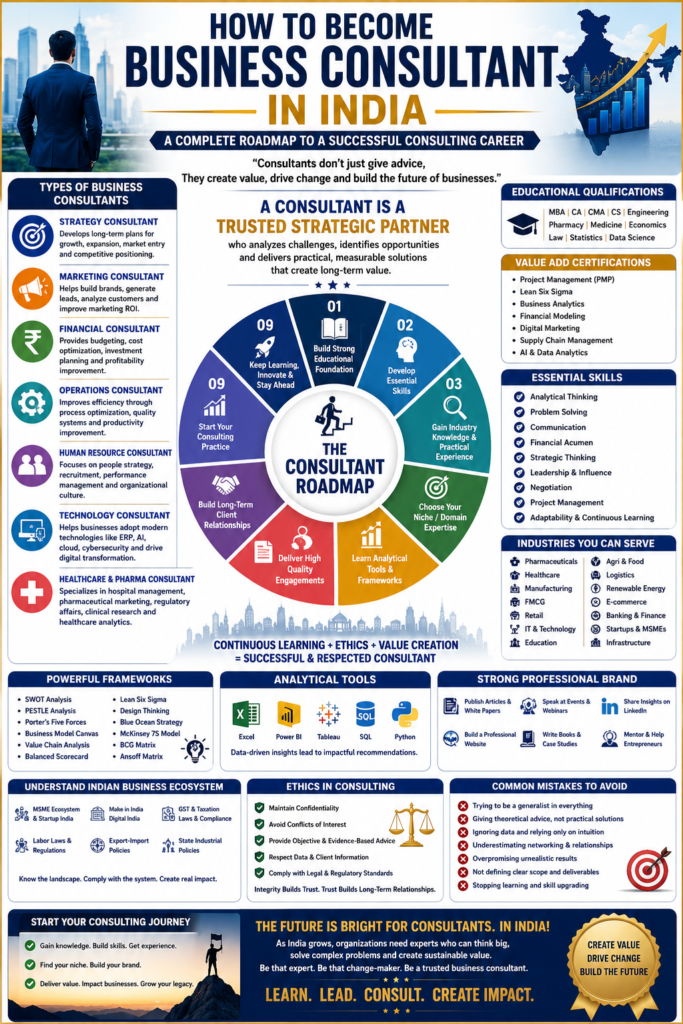
A successful consultant is not someone who simply gives advice; rather, they become a trusted strategic partner capable of diagnosing business challenges and implementing practical, measurable solutions.
Understanding Business Consulting
Business consulting is the professional practice of analyzing an organization’s current situation, identifying problems and opportunities, and recommending strategies that improve performance.
Consultants help organizations in areas such as:
- Business Strategy
- Market Research
- Financial Planning
- Operations Management
- Supply Chain Optimization
- Human Resource Management
- Digital Transformation
- Marketing Strategy
- Branding
- Sales Improvement
- Product Development
- Risk Management
- Regulatory Compliance
- Innovation Management
- Startup Advisory
- Investment Planning
- Organizational Development
The ultimate objective is to improve business performance and create long-term value.
Types of Business Consultants
Business consulting consists of multiple specializations.
Strategy Consultant
Develops long-term business growth plans.
Responsibilities include:
- Expansion planning
- Market entry
- Competitive positioning
- Corporate restructuring
Marketing Consultant
Focuses on customer acquisition and brand development.
Key responsibilities:
- Digital marketing
- Brand positioning
- Customer segmentation
- Lead generation
- Marketing ROI
Financial Consultant
Provides financial planning and profitability analysis.
Responsibilities include:
- Budgeting
- Cost optimization
- Investment evaluation
- Cash flow management
Operations Consultant
Improves operational efficiency.
Areas include:
- Process improvement
- Lean management
- Quality systems
- Productivity enhancement
Human Resource Consultant
Supports workforce development.
Services include:
- Recruitment strategy
- Performance management
- Organizational culture
- Leadership development
Technology Consultant
Assists organizations in adopting modern technologies.
Examples include:
- ERP implementation
- AI adoption
- Cloud migration
- Cybersecurity planning
- Digital transformation
Healthcare and Pharmaceutical Consultant
India’s healthcare sector increasingly requires consultants specializing in:
- Hospital management
- Pharmaceutical marketing
- Regulatory affairs
- Medical devices
- Clinical research
- Healthcare analytics
Professionals with backgrounds in pharmacy, medicine, biotechnology, public health, or healthcare management are especially well positioned in this niche.
Educational Qualifications
Although there is no mandatory educational pathway, the following qualifications are highly valued:
- MBA
- CA
- CMA
- CS
- Engineering
- Pharmacy
- Medicine
- Economics
- Law
- Statistics
- Data Science
Specialized certifications further enhance credibility, such as:
- Project Management
- Lean Six Sigma
- Business Analytics
- Digital Marketing
- Financial Modeling
- Supply Chain Management
- AI and Data Analytics
Essential Skills
Analytical Thinking
Consultants must solve complex business problems using structured analysis and data-driven reasoning.
Communication Skills
Clear communication is essential for:
- Client meetings
- Presentations
- Reports
- Negotiations
- Stakeholder engagement
Problem-Solving Ability
Businesses hire consultants because they need solutions, not merely observations.
Effective consultants:
- Identify root causes
- Develop practical recommendations
- Support implementation
Financial Understanding
Every consultant should understand:
- Balance sheets
- Profit and loss statements
- Cash flow
- ROI
- Cost structures
- Business valuation
Strategic Thinking
Consultants must anticipate future trends rather than focus only on current challenges.
Leadership
Even without formal authority, consultants often lead transformation initiatives by influencing teams and guiding decision-making.
Negotiation
Consultants negotiate:
- Contracts
- Project scope
- Timelines
- Fees
- Stakeholder expectations
Industry Knowledge
Successful consultants build expertise in one or more industries, such as:
- Pharmaceuticals
- Healthcare
- Manufacturing
- Retail
- FMCG
- IT
- Education
- Agriculture
- Renewable Energy
- Logistics
- Infrastructure
- E-commerce
- Banking
- Insurance
Deep domain knowledge differentiates consultants in a competitive market.
Understanding Indian Business Ecosystem
A consultant must understand the realities of doing business in India, including:
- MSME ecosystem
- Startup India initiatives
- Make in India
- Digital India
- GST
- Income tax regulations
- Corporate governance
- Labor laws
- State-level industrial policies
- Export-import regulations
- Public procurement systems
Knowledge of these frameworks enables consultants to provide practical, compliant advice.
Building Practical Experience
Experience remains one of the strongest indicators of consulting capability.
You can gain experience through:
- Corporate employment
- Family businesses
- Startups
- Internships
- Freelance consulting
- Business analysis roles
- Operational improvement projects
Hands-on exposure develops judgment that cannot be learned from books alone.
Choosing a Consulting Niche
Generalists often struggle to differentiate themselves. Specialization helps build authority.
Potential niches include:
- Pharmaceutical Consulting
- Healthcare Consulting
- Digital Transformation
- AI Strategy
- Supply Chain Consulting
- Manufacturing Excellence
- Startup Advisory
- Retail Consulting
- Export Consulting
- Business Process Improvement
- Sustainability and ESG
- Education Consulting
- Hospitality Consulting
- Agriculture and Food Processing
Developing Consulting Frameworks
High-performing consultants rely on structured frameworks to analyze businesses.
Common frameworks include:
- SWOT Analysis
- PESTLE Analysis
- Porter’s Five Forces
- Business Model Canvas
- Value Chain Analysis
- Balanced Scorecard
- Lean Six Sigma
- Design Thinking
- Blue Ocean Strategy
- McKinsey 7S Framework
- BCG Matrix
- Ansoff Matrix
These frameworks ensure systematic problem-solving and consistent recommendations.
Learning Business Analytics
Modern consulting increasingly depends on data.
Useful analytical tools include:
- Microsoft Excel
- Power BI
- Tableau
- SQL
- Python
- R
- Google Analytics
- CRM platforms
- ERP systems
Data literacy enables consultants to provide evidence-based recommendations.
Developing a Strong Professional Brand
Clients often evaluate consultants before making contact. Build a visible professional identity by:
- Publishing articles and white papers
- Writing books
- Speaking at conferences
- Hosting webinars
- Sharing insights on LinkedIn
- Participating in industry panels
- Mentoring entrepreneurs
- Maintaining a professional website
Consistent thought leadership builds trust and recognition.
Building a Client Network
Consulting is a relationship-driven profession.
Develop connections through:
- Industry associations
- Startup incubators
- Chambers of commerce
- Professional networking events
- Alumni groups
- Trade fairs
- Digital communities
Strong networks generate referrals and repeat engagements.
Consulting Proposal Development
A professional proposal should clearly define:
- Client challenges
- Project objectives
- Scope of work
- Methodology
- Deliverables
- Timeline
- Team structure
- Commercial terms
- Success metrics
Clear proposals reduce misunderstandings and strengthen client confidence.
Delivering High-Quality Consulting Engagements
A typical consulting project involves:
- Understanding client objectives
- Collecting data
- Conducting interviews
- Analyzing operations
- Identifying root causes
- Benchmarking against industry standards
- Developing recommendations
- Supporting implementation
- Measuring outcomes
- Conducting follow-up reviews
The greatest value often comes from helping clients execute recommendations successfully.
Ethics in Consulting
Professional integrity is essential.
Consultants should:
- Maintain confidentiality
- Avoid conflicts of interest
- Provide objective advice
- Base recommendations on evidence
- Disclose limitations
- Respect client data
- Comply with legal and regulatory requirements
Ethical conduct builds long-term credibility and client loyalty.
Starting an Independent Consulting Practice
Once sufficient expertise has been developed, consultants can establish their own firms.
Important considerations include:
- Business registration
- Tax compliance
- Service portfolio
- Pricing strategy
- Standard contracts
- Professional insurance (where appropriate)
- Branding
- Marketing
- Accounting systems
- Knowledge management
A well-structured practice enables scalable growth.
Future of Business Consulting in India
The consulting landscape is evolving rapidly. Areas expected to see sustained demand include:
- Artificial Intelligence strategy
- Digital transformation
- ESG and sustainability
- Healthcare innovation
- Pharmaceutical commercialization
- Cybersecurity
- Data analytics
- Smart manufacturing
- Supply chain resilience
- Startup ecosystem advisory
- Government and public policy consulting
- Cross-border business expansion
Consultants who embrace these emerging domains and continuously update their expertise will remain highly competitive.
Common Mistakes to Avoid
Many new consultants struggle because they:
- Attempt to serve every industry instead of specializing.
- Focus on theoretical advice without practical implementation.
- Neglect continuous learning.
- Underestimate the importance of networking and relationship building.
- Fail to define clear project scope and deliverables.
- Ignore data and rely solely on intuition.
- Overpromise results that cannot be realistically achieved.
- Underinvest in personal branding and thought leadership.
Avoiding these pitfalls strengthens credibility and long-term success.
Conclusion
Business consulting in India offers a rewarding career for professionals who combine domain expertise with analytical rigor, strategic thinking, and effective communication. Success requires more than technical knowledge—it demands curiosity, integrity, adaptability, and a commitment to delivering measurable value. By building deep industry expertise, mastering proven consulting frameworks, embracing data-driven decision-making, cultivating a strong professional brand, and maintaining high ethical standards, aspiring consultants can establish themselves as trusted advisors. As India’s economy continues to innovate and integrate with global markets, skilled business consultants will play a central role in shaping the growth, resilience, and competitiveness of organizations across every sector.