

Growth, Consumer Transformation, Manufacturing Expansion, Competitive Dynamics, and Future Outlook
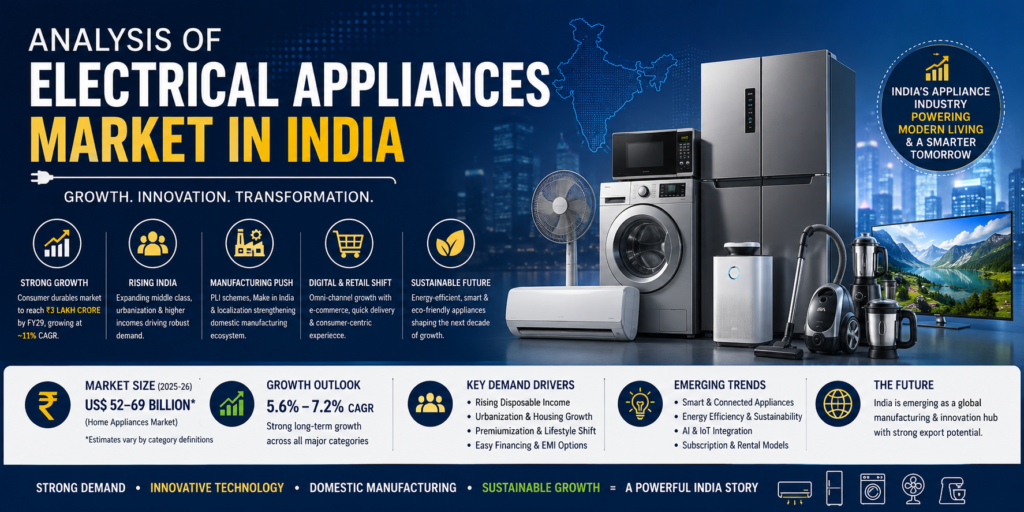
The Indian electrical appliances market has entered one of the most transformative phases in its history. What was once a price-sensitive, replacement-driven consumer durables segment has evolved into a technology-enabled, premiumized, digitally connected ecosystem shaped by rising incomes, urbanization, sustainability expectations, and domestic manufacturing expansion.
India is no longer merely a consumption market—it is increasingly becoming a strategic manufacturing and innovation hub for electrical appliances and consumer durables.
According to recent industry estimates, India is projected to become the world’s fourth-largest consumer durables market by FY27, with the broader sector expected to grow at approximately 11% CAGR and approach ₹3 lakh crore (~US$33–36 billion) by FY29. (India Brand Equity Foundation)
1. Introduction: Understanding India’s Electrical Appliances Ecosystem
The Indian electrical appliances market includes:
Major Appliances
- Refrigerators
- Washing machines
- Air conditioners
- Dishwashers
- Water heaters
- Air purifiers
Small Domestic Appliances
- Mixer grinders
- Electric kettles
- Microwave ovens
- Vacuum cleaners
- Induction cooktops
- Coffee machines
Fast Moving Electrical Goods (FMEG)
- Fans
- Lighting
- Switches
- Wires
- Water pumps
- Kitchen electrical products
Smart and Connected Appliances
- IoT-enabled ACs
- Smart refrigerators
- Voice-controlled devices
- Energy-monitoring appliances
India’s appliance economy now intersects with:
- Real estate
- Retail
- E-commerce
- Electronics manufacturing
- Renewable energy
- Digital ecosystems
2. Market Size and Current Industry Position
India’s home appliances market is estimated in multiple industry assessments between approximately US$52–69 billion in 2025–26, depending on category definitions, and is projected to expand strongly over the next decade. Forecast growth rates largely range from 5.6%–7.2% CAGR, with premium categories often growing faster. (Mordor Intelligence)
Consumer electronics and home appliances together are projected to add approximately US$15.38 billion in incremental market expansion between 2025 and 2030. (Technavio)
India’s broader electronics market has been projected to reach approximately US$300 billion by FY26, supported by manufacturing incentives and domestic demand expansion. (Invest India)
3. Market Evolution: From Utility to Lifestyle Consumption
Historically, Indian households purchased appliances for utility.
Today, purchase decisions increasingly depend on:
- Design aesthetics
- Energy efficiency
- Smart connectivity
- Brand experience
- Financing availability
- After-sales service
- Premium ownership value
This transformation reflects a deeper change in Indian consumer psychology.
Consumers increasingly view appliances as:
- productivity tools,
- lifestyle enhancers,
- symbols of upward mobility.
4. Growth Drivers Reshaping the Industry
A. Rising Disposable Income
India’s expanding middle-income population continues to increase spending on durable goods.
Consumer spending on durables accelerated significantly in FY25 as household formation and home ownership increased. (The Times of India)
B. Urbanization and Housing Growth
Every new residential unit creates demand across:
- Fans
- Refrigeration
- Kitchen appliances
- Air conditioning
- Water heating
Tier-2 and Tier-3 cities have become major demand engines.
C. Premiumization Trend
The market is witnessing movement toward:
- Larger refrigerators
- Front-load washing machines
- Premium AC categories
- Smart appliance ecosystems
Premiumization has become one of the strongest industry growth levers. (Reuters)
D. Government Manufacturing Support
Key enablers include:
- Production Linked Incentive (PLI)
- Make in India
- Electronics manufacturing support
- Export-oriented industrial policy
Government support continues strengthening domestic value chains and reducing import dependency. (Invest India)
5. Category-Wise Market Analysis
Air Conditioners
Air conditioners represent one of India’s fastest-growing appliance categories.
Growth drivers:
- Rising temperatures
- Urban housing
- Commercial demand
- Affordable financing
Recent industry outlooks indicate sustained category expansion over the coming decade. (KPMG Assets)
Challenges:
- Energy consumption
- Compressor dependence
- Raw material volatility
Refrigerators
Consumer preferences are shifting toward:
- Multi-door designs
- Larger capacities
- Smart cooling systems
- Premium aesthetics
Recent launches continue emphasizing premium and affordable-premium positioning. (The Times of India)
Washing Machines
Growth catalysts:
- Dual-income households
- Urban lifestyles
- Water-efficient technologies
Front-load penetration continues increasing.
Kitchen Appliances
This category has benefited from:
- Home cooking trends
- Compact urban living
- Online retail expansion
Fast-growing products include:
- Air fryers
- Induction cooktops
- Microwave ovens
Water Heating and Purification
Strong demand is emerging due to:
- Health awareness
- Urban housing growth
- Smart home adoption
6. Competitive Landscape
The market remains highly competitive.
Key participants include:
- LG Electronics India
- Samsung India
- Whirlpool India
- Godrej Appliances
- Haier India
- IFB Industries
- Bajaj Electricals
- Havells India
- Crompton Greaves Consumer Electricals
- Reliance Retail
Large firms increasingly compete on:
- localization,
- supply chain control,
- digital commerce,
- ecosystem integration.
LG has reported continued focus on local manufacturing and premium expansion while increasing component localization in India. (Reuters)
7. Distribution Transformation: Offline vs Digital
India’s appliance market now follows an omni-channel model.
Offline Channels
- Multi-brand retailers
- Exclusive brand outlets
- Regional dealer networks
Online Channels
- Marketplace commerce
- Brand websites
- Direct-to-consumer channels
Digital buying behavior increasingly influences:
- product discovery,
- comparison,
- financing decisions.
8. Regional Market Dynamics
North India
Strong demand for:
- cooling appliances
- kitchen appliances
West India
Leadership in:
- premium household adoption
South India
High penetration across:
- electronics
- connected devices
East India
Emerging affordability-driven growth.
9. SWOT Analysis
Strengths
- Massive domestic demand
- Growing middle class
- Manufacturing support
- Strong retail infrastructure
Weaknesses
- Import dependence in components
- Commodity price volatility
- Fragmented service networks
Opportunities
- Rural penetration
- Smart appliances
- Export growth
- Energy-efficient products
Threats
- Global supply chain disruptions
- Currency fluctuations
- Competitive pricing pressure
10. PESTLE Analysis
Political
Manufacturing incentives improve competitiveness.
Economic
Rising income supports durable purchases.
Social
Lifestyle modernization boosts replacement cycles.
Technological
IoT integration reshapes product development.
Legal
Efficiency and safety regulations strengthen quality.
Environmental
Sustainability pressures encourage green appliances.
11. Emerging Trends Defining 2026–2030
Smart Appliance Expansion
Connected ecosystems are becoming mainstream.
Sustainability
Consumers increasingly value:
- lower power usage
- efficient cooling
- recyclable materials
Localization
Domestic manufacturing intensity is increasing.
AI Integration
Predictive maintenance and adaptive performance are emerging.
Subscription and Financing Models
Affordability innovation may accelerate market access.
12. Future Outlook
India’s electrical appliances market appears positioned for structural long-term growth rather than cyclical expansion.
Recent projections indicate:
- consumer durables approaching ₹3 lakh crore by FY29, growing near 11% CAGR, (EY)
- home appliances potentially expanding toward US$124–143 billion over the next decade, (IMARC Group)
- electrical equipment manufacturing reaching US$195–235 billion by 2035 under optimistic industrial scenarios. (The Economic Times)
The next decade will likely belong not to companies that merely sell appliances—but to those that integrate manufacturing resilience, intelligent technologies, affordability, sustainability, and consumer experience into a unified value proposition.
For India, electrical appliances are no longer household products—they are becoming infrastructure for modern living.