

By Author Devanssh Mehta Style —
Introduction
Agriculture in India is not merely an economic activity; it represents civilization, sustenance, employment, culture, and national identity. Despite rapid industrialization, technological expansion, and growth of service sectors, agriculture remains one of the strongest pillars supporting the Indian economy. From the fertile plains of northern India to the plantation belts of the south, from dryland farming systems in western India to river-fed agricultural ecosystems in eastern regions, Indian agriculture reflects both diversity and resilience.
India today stands among the world’s largest agricultural producers and occupies a strategic position in global food systems. Agriculture contributes not only to food production but also to employment generation, industrial raw materials, exports, rural development, and national stability.
The agricultural industry in India has undergone multiple transitions—from traditional subsistence farming to mechanized cultivation, from the Green Revolution to precision agriculture, and from local mandis to digital agricultural marketplaces.
This article presents a detailed overview of the agricultural industry in India, including its structure, market size, segments, opportunities, challenges, government initiatives, technology adoption, and future outlook.
Historical Evolution of Indian Agriculture
Indian agriculture has evolved through multiple historical phases.
Ancient Agricultural Civilization
India historically developed one of the earliest organized agricultural systems. Crops such as wheat, barley, rice, pulses, and cotton were cultivated extensively.
Colonial Agricultural Period
During colonial administration, agriculture became largely export-oriented with focus on commercial crops including:
- Cotton
- Indigo
- Tea
- Sugarcane
- Jute
This period resulted in structural challenges including low productivity and dependence on monsoon rainfall.
Green Revolution Era (1960–1980)
The Green Revolution transformed Indian agriculture through:
- High-yielding seed varieties
- Chemical fertilizers
- Irrigation expansion
- Agricultural mechanization
This phase significantly increased food grain production and reduced dependency on imports.
Post-Liberalization Agricultural Economy
Economic reforms accelerated:
- Food processing
- Export competitiveness
- Agribusiness development
- Private investment
- Technological modernization
Today agriculture is increasingly becoming a data-driven and market-oriented industry.
Current Overview of Agricultural Industry in India
India possesses one of the world’s largest agricultural ecosystems.
Major indicators include:
- One of the world’s largest cultivable land areas
- Massive rural workforce engagement
- Diverse agro-climatic zones
- Leadership in production of milk, spices, pulses, and several horticultural products
- Rapid expansion of agritech startups
Agriculture and allied sectors remain critical contributors to employment and rural income.
Structure of Agricultural Industry in India
Indian agriculture consists of multiple interconnected segments.
1. Crop Production
Crop cultivation forms the largest segment.
Food Crops
- Rice
- Wheat
- Pulses
- Maize
- Millets
Commercial Crops
- Cotton
- Sugarcane
- Tea
- Coffee
- Tobacco
- Rubber
Oilseeds
- Mustard
- Groundnut
- Soybean
- Sunflower
2. Horticulture Sector
Horticulture has emerged as one of the fastest-growing segments.
Includes:
- Fruits
- Vegetables
- Flowers
- Medicinal plants
- Aromatic crops
India is globally recognized for production of:
- Mangoes
- Bananas
- Onions
- Potatoes
- Spices
3. Dairy Industry
India’s dairy industry plays a crucial role in agricultural GDP.
Drivers:
- Cooperative networks
- Rural entrepreneurship
- Processing infrastructure
- Value-added dairy products
Products include:
- Milk
- Cheese
- Butter
- Yogurt
- Functional dairy products
4. Livestock and Poultry
Livestock contributes significantly to rural income.
Components:
- Poultry farming
- Goat farming
- Cattle rearing
- Fisheries
- Aquaculture
5. Agricultural Inputs Industry
This segment includes:
Seed Industry
Development of:
- Hybrid seeds
- Disease-resistant varieties
- Climate-resilient crops
Fertilizer Industry
- Nitrogen fertilizers
- Phosphate fertilizers
- Potassium fertilizers
Agrochemicals
- Herbicides
- Fungicides
- Insecticides
Agricultural Machinery
- Tractors
- Harvesters
- Irrigation systems
- Drones
Economic Contribution of Agriculture
Agriculture contributes to multiple dimensions of economic development.
Employment Generation
Agriculture remains one of India’s largest employment providers.
Benefits:
- Rural livelihood support
- Poverty reduction
- Inclusive growth
Industrial Development
Agriculture supports industries including:
- Food processing
- Pharmaceuticals
- Textiles
- Biofuel production
- Packaging
- Logistics
Export Revenue
Major agricultural exports include:
- Rice
- Tea
- Spices
- Cotton
- Marine products
- Processed food
Agricultural exports improve foreign exchange reserves and strengthen global trade relationships.
Major Agricultural States of India
Different states specialize in different crops.
Northern Region
- Punjab
- Haryana
- Uttar Pradesh
Major outputs:
- Wheat
- Sugarcane
Western Region
- Maharashtra
- Gujarat
Major outputs:
- Cotton
- Oilseeds
- Horticulture
Southern Region
- Karnataka
- Tamil Nadu
- Andhra Pradesh
Major outputs:
- Coffee
- Spices
- Rice
Eastern Region
- West Bengal
- Odisha
- Bihar
Major outputs:
- Rice
- Fisheries
Agricultural Technology Revolution in India
Technology is redefining Indian agriculture.
Precision Agriculture
Use of:
- Sensors
- GPS
- Satellite monitoring
- AI analytics
Benefits:
- Resource optimization
- Yield enhancement
Agricultural Drones
Applications:
- Crop monitoring
- Fertilizer spraying
- Disease detection
Smart Irrigation
Modern approaches:
- Drip irrigation
- Sprinkler systems
- Automated irrigation
Digital Agriculture
Digital platforms support:
- Market linkage
- Crop insurance
- Farm advisory
- E-commerce
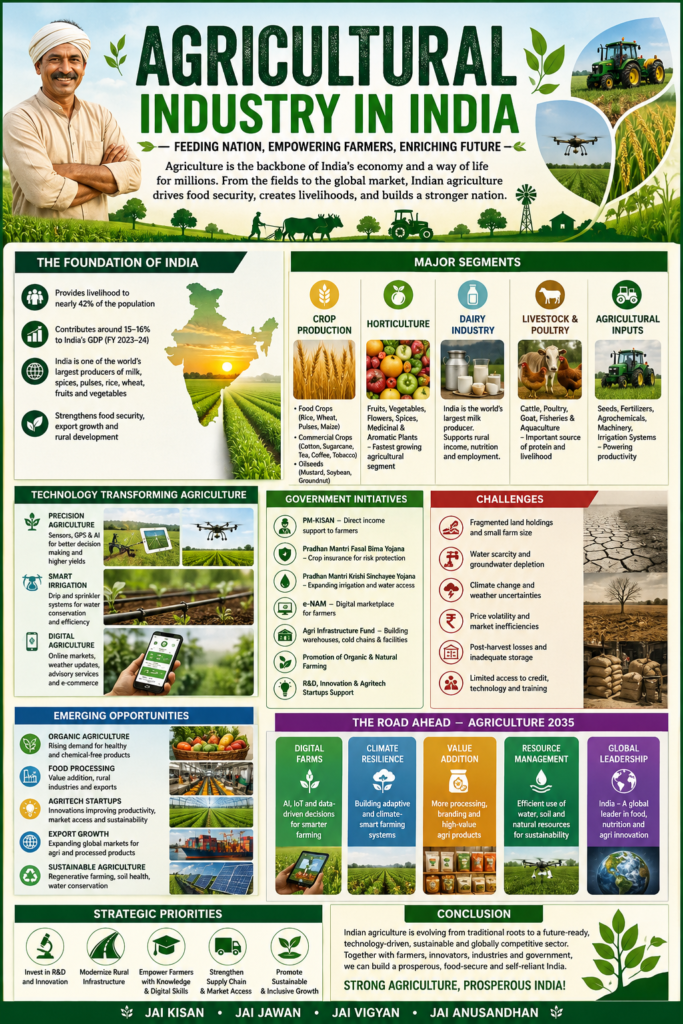
Government Initiatives Supporting Agriculture
Government interventions have accelerated sector growth.
Major focus areas include:
Income Support
Direct support to farmers.
Irrigation Development
Expansion of water access.
Crop Insurance
Risk reduction mechanisms.
Digital Agriculture
Technology integration.
Infrastructure Development
Cold chains and warehousing.
Key Challenges Facing Indian Agriculture
Despite progress, agriculture faces structural barriers.
Fragmented Land Holdings
Small farms reduce economies of scale.
Water Scarcity
Groundwater depletion affects sustainability.
Climate Change
Risks include:
- Drought
- Floods
- Temperature variability
Market Inefficiencies
Challenges include:
- Price volatility
- Supply chain losses
- Limited storage
Financial Constraints
Many farmers continue facing:
- Credit limitations
- Technology affordability barriers
Emerging Opportunities
Organic Agriculture
Growing consumer awareness supports organic products.
Export Expansion
Higher-value processed agricultural exports offer opportunity.
Agritech Startups
New ventures are improving:
- Market access
- Yield prediction
- Supply chain efficiency
Food Processing
Value addition creates:
- Employment
- Rural industrialization
- Export competitiveness
Sustainable Agriculture
Focus areas:
- Regenerative farming
- Water conservation
- Circular agricultural systems
Future Outlook: Agriculture 2035
Indian agriculture is expected to move toward five strategic transformations:
1. Digital Farms
AI-enabled agriculture.
2. Climate Resilience
Adaptive production systems.
3. Value Addition
Processed agricultural products.
4. Precision Resource Management
Higher productivity with lower environmental burden.
5. Global Agricultural Leadership
Expansion into premium and knowledge-intensive agricultural markets.
Strategic Recommendations
For sustainable agricultural growth, India should prioritize:
- Agricultural R&D expansion
- Rural infrastructure modernization
- Farmer education and digital literacy
- Climate-smart farming
- Export competitiveness
- Stronger public–private partnerships
- Biotechnology and innovation ecosystems
- Supply-chain modernization
Conclusion
The agricultural industry in India stands at a historic turning point. It has moved far beyond conventional farming and now represents a sophisticated ecosystem integrating production, processing, logistics, exports, technology, and sustainability. Agriculture remains the backbone of rural India while simultaneously becoming a major strategic sector for national economic growth.
The future of Indian agriculture will depend not simply on producing more food but on producing smarter, healthier, more sustainable, and higher-value agricultural outcomes. With technological advancement, policy support, entrepreneurial energy, and scientific innovation, India has the potential to emerge as one of the defining agricultural powers of the twenty-first century.