

Top Twenty Law Colleges in India of All Time
Introduction
India has one of the world’s oldest and most respected legal systems, producing eminent judges, constitutional experts, senior advocates, policymakers, civil servants, and corporate legal professionals. Over the past century, legal education has evolved from traditional university law departments to highly specialized National Law Universities (NLUs) that combine academic excellence with research, advocacy training, international collaborations, and outstanding placements.
The following list considers historical reputation, academic excellence, faculty quality, judicial and corporate placements, research output, alumni achievements, moot court performance, and national rankings. While rankings change every year, these institutions have consistently shaped legal education in India. (National Law School of India University)
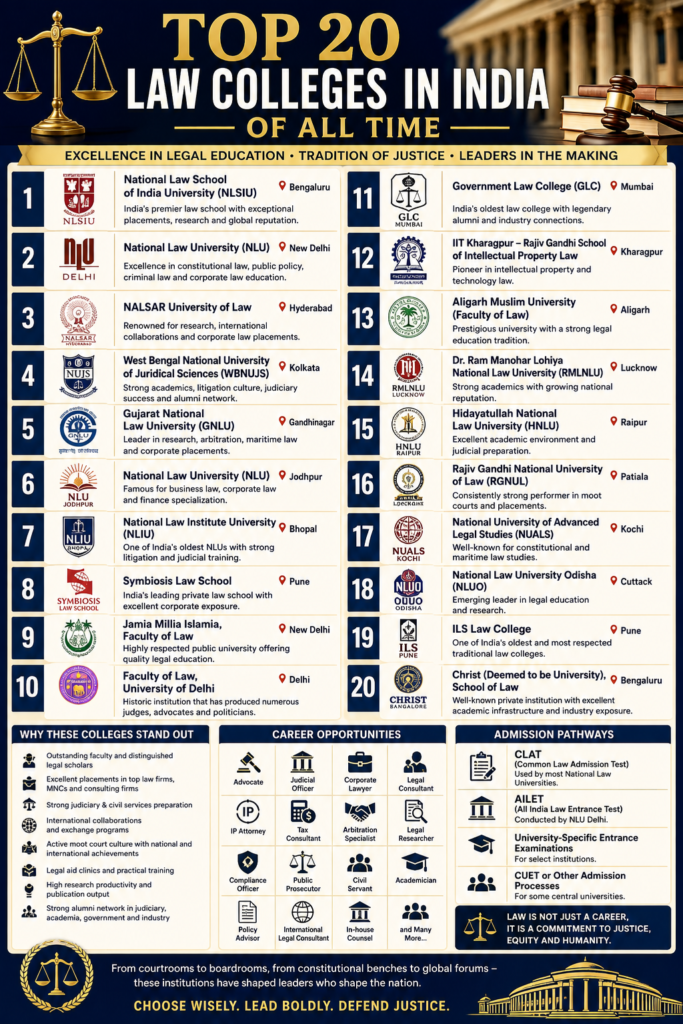
Top 20 Law Colleges in India
| Rank | Law College | Location | Key Highlights |
|---|---|---|---|
| 1 | National Law School of India University (NLSIU) | Bengaluru | India’s premier law school with exceptional placements, research, judiciary preparation, and global reputation. (National Law School of India University) |
| 2 | National Law University (NLU) | New Delhi | Excellent constitutional law, public policy, criminal law, and corporate law education with outstanding placements. (The Indian Express) |
| 3 | NALSAR University of Law | Hyderabad | Renowned for research, international collaborations, and corporate law placements. (The Indian Express) |
| 4 | West Bengal National University of Juridical Sciences (WBNUJS) | Kolkata | Strong academics, litigation culture, judiciary success, and alumni network. (The Indian Express) |
| 5 | Gujarat National Law University (GNLU) | Gandhinagar | Leader in research, arbitration, maritime law, and corporate placements. (Careers360) |
| 6 | National Law University (NLU) | Jodhpur | Famous for business law, corporate law, and finance specialization. |
| 7 | National Law Institute University (NLIU) | Bhopal | One of India’s oldest NLUs with strong litigation and judicial training. |
| 8 | Symbiosis Law School | Pune | India’s leading private law school with excellent corporate exposure. (www.ndtv.com) |
| 9 | Jamia Millia Islamia, Faculty of Law | New Delhi | Highly respected public university offering quality legal education. (www.ndtv.com) |
| 10 | Faculty of Law, University of Delhi | Delhi | Historic institution that has produced numerous judges, advocates, and politicians. |
| 11 | Government Law College (GLC) | Mumbai | India’s oldest law college with legendary alumni and industry connections. |
| 12 | Indian Institute of Technology (IIT) Kharagpur – Rajiv Gandhi School of Intellectual Property Law | Kharagpur | Pioneer in intellectual property and technology law. (www.ndtv.com) |
| 13 | Aligarh Muslim University (Faculty of Law) | Aligarh | Prestigious university with a strong legal education tradition. (Times of India) |
| 14 | Dr. Ram Manohar Lohiya National Law University (RMLNLU) | Lucknow | Strong academics with growing national reputation. (Careers360) |
| 15 | Hidayatullah National Law University (HNLU) | Raipur | Excellent academic environment and judicial preparation. |
| 16 | Rajiv Gandhi National University of Law (RGNUL) | Patiala | Consistently strong performer in moot courts and placements. |
| 17 | National University of Advanced Legal Studies (NUALS) | Kochi | Well-known for constitutional and maritime law studies. |
| 18 | National Law University Odisha (NLUO) | Cuttack | Emerging leader in legal education and research. |
| 19 | ILS Law College | Pune | One of India’s oldest and most respected traditional law colleges. |
| 20 | Christ (Deemed to be University), School of Law | Bengaluru | Well-known private institution with excellent academic infrastructure and industry exposure. |
Why These Colleges Stand Out
These institutions consistently excel because they offer:
- Outstanding faculty and distinguished legal scholars.
- Excellent placements in top law firms, multinational corporations, and consulting firms.
- Strong judicial clerkship and civil services preparation.
- International exchange programmes and collaborations.
- Active moot court culture with national and international achievements.
- Extensive legal aid clinics and practical training.
- High research productivity and publication output.
- Strong alumni networks occupying leadership positions in the judiciary, academia, government, and industry.
Career Opportunities After Graduating
Graduates from these colleges pursue careers as:
- Supreme Court and High Court advocates
- Judicial officers
- Corporate lawyers
- Legal consultants
- Intellectual property attorneys
- Tax consultants
- Arbitration specialists
- Legal researchers
- Compliance officers
- Public prosecutors
- Civil servants
- Academicians
- Policy advisors
- International legal consultants
- In-house counsel for multinational companies
Admission Pathways
Admission is primarily through competitive entrance examinations:
- CLAT (Common Law Admission Test): Used by most National Law Universities.
- AILET (All India Law Entrance Test): Conducted by NLU Delhi.
- University-specific entrance examinations for select institutions.
- CUET or other admission processes for some central universities.
Conclusion
India’s finest law colleges have played a transformative role in developing the nation’s legal system. Institutions such as NLSIU Bengaluru, NLU Delhi, NALSAR Hyderabad, WBNUJS Kolkata, and GNLU Gandhinagar continue to set the benchmark for legal education through academic excellence, research, advocacy training, and exceptional placements. Alongside prestigious traditional institutions such as Faculty of Law, University of Delhi, Government Law College Mumbai, and ILS Law College Pune, they have produced generations of distinguished judges, senior advocates, policymakers, corporate leaders, and legal scholars. Choosing one of these institutions provides aspiring lawyers with a strong foundation for successful careers in litigation, corporate law, academia, public service, and international legal practice.