

Top Twenty Management Colleges in India
Introduction
Management education plays a vital role in shaping future business leaders, entrepreneurs, policymakers, and corporate executives. India is home to some of the world’s most prestigious management institutions, offering high-quality education, excellent faculty, strong industry exposure, and exceptional placement opportunities. Institutions such as the Indian Institutes of Management (IIMs), Indian Institutes of Technology (IITs), XLRI, MDI, and SPJIMR have consistently produced leaders who have made significant contributions across industries worldwide.
The National Institutional Ranking Framework (NIRF), established by the Ministry of Education, Government of India, is one of the most reliable indicators for assessing management institutions. NIRF evaluates colleges based on teaching quality, research, graduation outcomes, outreach, inclusivity, and perception.
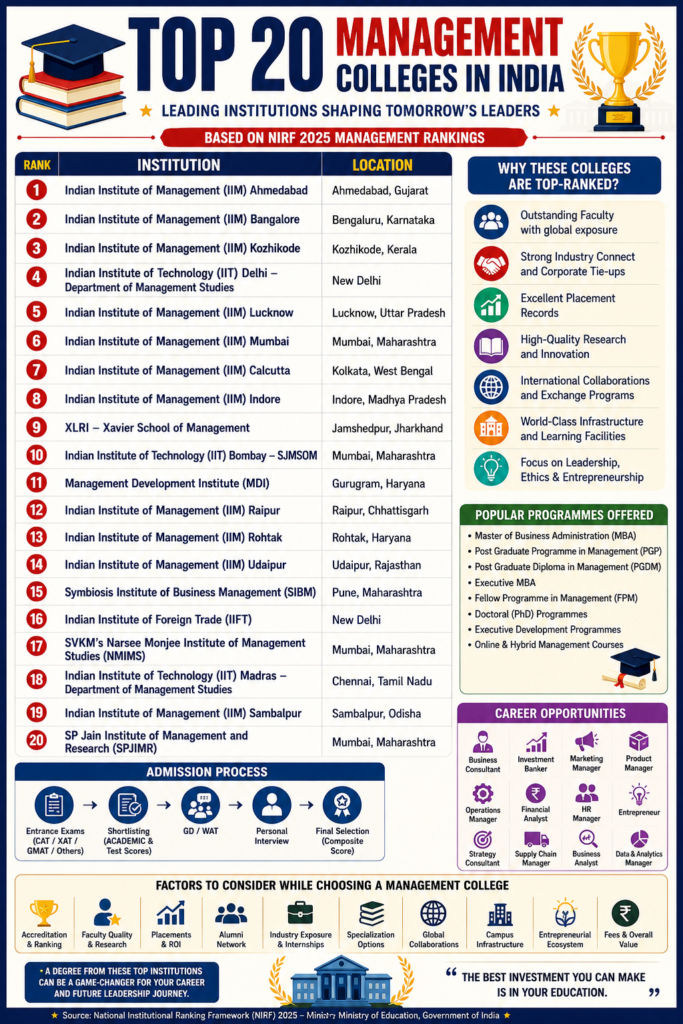
Top 20 Management Colleges in India (Based on NIRF 2025)
| Rank | Institution | Location |
|---|---|---|
| 1 | Indian Institute of Management (IIM) Ahmedabad | Ahmedabad, Gujarat |
| 2 | Indian Institute of Management (IIM) Bangalore | Bengaluru, Karnataka |
| 3 | Indian Institute of Management (IIM) Kozhikode | Kozhikode, Kerala |
| 4 | Indian Institute of Technology (IIT) Delhi – Department of Management Studies | New Delhi |
| 5 | Indian Institute of Management (IIM) Lucknow | Lucknow, Uttar Pradesh |
| 6 | Indian Institute of Management (IIM) Mumbai | Mumbai, Maharashtra |
| 7 | Indian Institute of Management (IIM) Calcutta | Kolkata, West Bengal |
| 8 | Indian Institute of Management (IIM) Indore | Indore, Madhya Pradesh |
| 9 | XLRI – Xavier School of Management | Jamshedpur, Jharkhand |
| 10 | Indian Institute of Technology (IIT) Bombay – SJMSOM | Mumbai, Maharashtra |
| 11 | Management Development Institute (MDI) | Gurugram, Haryana |
| 12 | Indian Institute of Management (IIM) Raipur | Raipur, Chhattisgarh |
| 13 | Indian Institute of Management (IIM) Rohtak | Rohtak, Haryana |
| 14 | Indian Institute of Management (IIM) Udaipur | Udaipur, Rajasthan |
| 15 | Symbiosis Institute of Business Management (SIBM) | Pune, Maharashtra |
| 16 | Indian Institute of Foreign Trade (IIFT) | New Delhi |
| 17 | SVKM’s Narsee Monjee Institute of Management Studies (NMIMS) | Mumbai, Maharashtra |
| 18 | Indian Institute of Technology (IIT) Madras – Department of Management Studies | Chennai, Tamil Nadu |
| 19 | Indian Institute of Management (IIM) Sambalpur | Sambalpur, Odisha |
| 20 | SP Jain Institute of Management and Research (SPJIMR) | Mumbai, Maharashtra |
Ranking based on the Ministry of Education’s NIRF 2025 Management Rankings.
Why These Institutions Are Highly Ranked
These institutions consistently perform well due to several distinguishing features:
- Outstanding faculty with national and international academic experience.
- Strong industry collaborations and corporate partnerships.
- Excellent placement records with leading multinational companies.
- High-quality research and innovation ecosystem.
- International exchange programmes and global collaborations.
- Modern campuses equipped with advanced learning facilities.
- Entrepreneurial support through incubation centres.
- Strong alumni networks occupying leadership positions worldwide.
- Case-based and experiential learning methodologies.
- Emphasis on ethics, leadership, innovation, and strategic thinking.
Popular Courses Offered
The leading management institutes offer a wide range of programmes, including:
- Master of Business Administration (MBA)
- Post Graduate Programme in Management (PGP)
- Executive MBA
- Post Graduate Diploma in Management (PGDM)
- Fellow Programme in Management (FPM)
- Doctoral (PhD) Programmes
- Executive Development Programmes
- Online and Hybrid Management Courses
Career Opportunities
Graduates from these premier institutions are recruited by leading organizations across sectors, including consulting, finance, technology, healthcare, manufacturing, e-commerce, and public policy. Common career roles include:
- Business Consultant
- Investment Banker
- Marketing Manager
- Product Manager
- Operations Manager
- Financial Analyst
- Human Resource Manager
- Business Development Manager
- Entrepreneur
- Strategy Consultant
- Supply Chain Manager
- Data and Business Analytics Manager
Many graduates also establish successful startups or assume leadership roles in multinational corporations.
Admission Process
Admission to India’s top management colleges is highly competitive and generally involves:
- National entrance examinations such as CAT, XAT, GMAT, or other accepted tests.
- Shortlisting based on entrance scores and academic performance.
- Group Discussion (GD), Written Ability Test (WAT), or similar evaluation rounds.
- Personal Interview (PI).
- Final selection based on a composite score that includes academics, work experience, diversity, and interview performance.
Factors to Consider While Choosing a Management College
Students should evaluate the following before selecting an institute:
- Accreditation and national ranking.
- Faculty quality and research output.
- Placement statistics and average salary packages.
- Return on investment (ROI).
- Alumni network.
- Industry exposure and internships.
- International collaborations.
- Campus infrastructure.
- Specialization options.
- Entrepreneurial ecosystem and incubation support.
Conclusion
India’s premier management institutions have earned global recognition for academic excellence, innovation, research, and corporate engagement. Colleges such as IIM Ahmedabad, IIM Bangalore, IIM Kozhikode, IIT Delhi, and IIM Lucknow continue to set benchmarks in management education by producing competent professionals and visionary leaders. Choosing the right business school should be based not only on rankings but also on career goals, specialization preferences, faculty expertise, placement outcomes, and institutional culture. A degree from one of these top management colleges can provide students with the knowledge, leadership skills, and professional network needed to excel in today’s competitive global business environment.