

Treatment Strategies for Guillain-Barré Syndrome: Current Approaches and Future Perspectives
By Devanssh Mehta
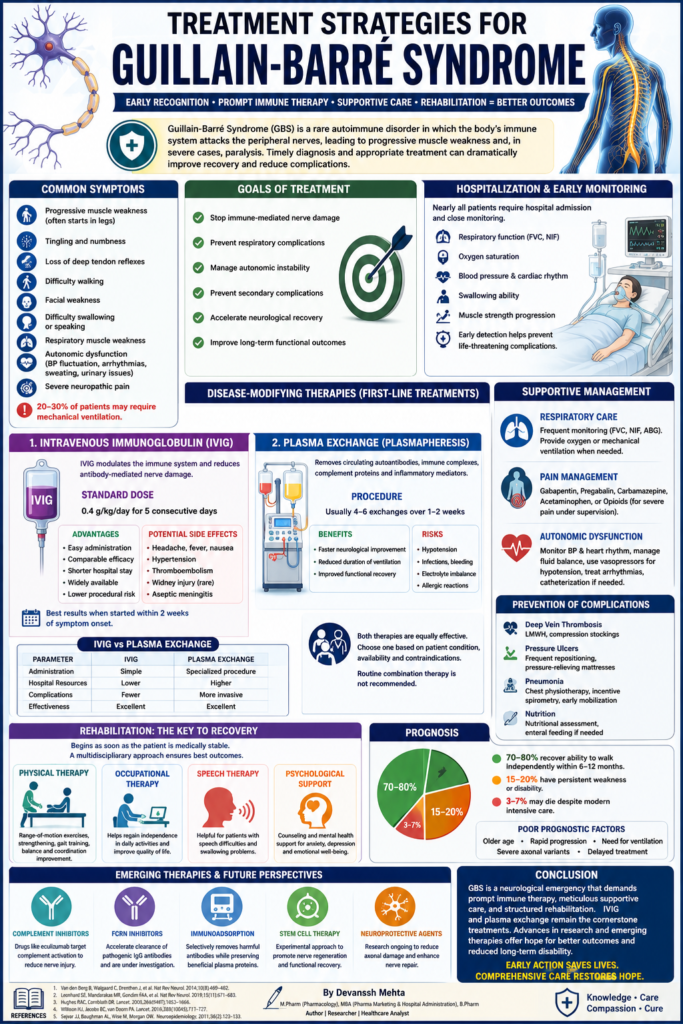
Introduction
Guillain-Barré Syndrome (GBS) is a rare but potentially life-threatening autoimmune neurological disorder characterized by rapid-onset muscle weakness and paralysis. It occurs when the body’s immune system mistakenly attacks the peripheral nerves, disrupting normal nerve signal transmission. Although GBS can affect individuals of all ages, early diagnosis and timely treatment significantly improve outcomes.
Most cases are preceded by an infectious illness, including respiratory infections, gastrointestinal infections caused by Campylobacter jejuni, influenza, cytomegalovirus, Epstein-Barr virus, or, more recently, SARS-CoV-2 infection. Advances in critical care, immunotherapy, and rehabilitation have dramatically reduced mortality and improved recovery over the past few decades.
This article discusses current evidence-based treatment strategies, supportive management, rehabilitation, and emerging therapeutic approaches for Guillain-Barré Syndrome.
Understanding Guillain-Barré Syndrome
GBS is an acute inflammatory polyneuropathy in which immune-mediated damage affects the myelin sheath or axons of peripheral nerves. The disease progresses rapidly over days to weeks, leading to weakness that usually begins in the legs and ascends upward.
Common symptoms include
- Progressive muscle weakness
- Tingling and numbness
- Loss of deep tendon reflexes
- Difficulty walking
- Facial weakness
- Difficulty swallowing
- Respiratory muscle weakness
- Autonomic dysfunction
- Severe neuropathic pain
Approximately 20–30% of patients require mechanical ventilation due to respiratory failure.
Goals of Treatment
Treatment strategies focus on:
- Stopping immune-mediated nerve damage
- Preventing respiratory complications
- Managing autonomic instability
- Preventing secondary complications
- Accelerating neurological recovery
- Improving long-term functional outcomes
Hospitalization and Early Monitoring
Nearly all patients with suspected GBS require hospital admission.
Continuous monitoring includes:
- Respiratory function
- Oxygen saturation
- Blood pressure
- Cardiac rhythm
- Swallowing ability
- Muscle strength progression
Serial measurement of Forced Vital Capacity (FVC) helps determine the need for ventilatory support.
Intravenous Immunoglobulin (IVIG)
IVIG is considered one of the first-line treatments for Guillain-Barré Syndrome.
Mechanism
IVIG works by:
- Neutralizing harmful autoantibodies
- Reducing inflammatory cytokines
- Inhibiting complement activation
- Modulating immune cell activity
Standard Dose
- 0.4 g/kg/day for 5 consecutive days
Early administration within two weeks of symptom onset offers the greatest benefit.
Advantages
- Easy administration
- Comparable efficacy to plasma exchange
- Shorter hospitalization
- Widely available
- Lower procedural risk
Adverse Effects
- Headache
- Fever
- Nausea
- Hypertension
- Thromboembolism
- Acute kidney injury (rare)
- Aseptic meningitis
Plasma Exchange (Plasmapheresis)
Plasma exchange is another evidence-based first-line therapy.
Mechanism
The procedure removes circulating:
- Autoantibodies
- Immune complexes
- Complement proteins
- Inflammatory mediators
Usually 4–6 plasma exchanges are performed over 1–2 weeks.
Benefits
- Faster neurological improvement
- Reduced duration of ventilation
- Improved functional recovery
Risks
- Hypotension
- Catheter-related infections
- Bleeding
- Electrolyte imbalance
- Allergic reactions
IVIG versus Plasma Exchange
Both treatments have similar effectiveness.
| Parameter | IVIG | Plasma Exchange |
|---|---|---|
| Administration | Simple | Specialized procedure |
| Hospital resources | Lower | Higher |
| Complications | Fewer | More invasive |
| Effectiveness | Excellent | Excellent |
Current guidelines recommend choosing one therapy based on patient condition, availability, and contraindications.
Routine combination therapy is generally not recommended, as it has not shown additional benefit in most patients.
Respiratory Management
Respiratory failure remains the leading cause of mortality in GBS.
Patients require frequent assessment of:
- Forced vital capacity
- Negative inspiratory force
- Blood gases
Mechanical ventilation becomes necessary when respiratory muscles weaken significantly.
Modern intensive care has substantially improved survival.
Pain Management
Pain affects nearly two-thirds of patients.
Treatment options include:
- Gabapentin
- Pregabalin
- Carbamazepine
- Acetaminophen
- Opioids (for severe pain under careful supervision)
Early pain control improves patient comfort and participation in rehabilitation.
Management of Autonomic Dysfunction
Autonomic instability can cause:
- Blood pressure fluctuations
- Cardiac arrhythmias
- Urinary retention
- Constipation
- Excessive sweating
Management includes:
- Continuous cardiac monitoring
- Careful fluid management
- Vasopressors for hypotension
- Antihypertensive medications when required
- Bladder catheterization if necessary
Prevention of Complications
Patients with prolonged immobility require preventive care against:
Deep vein thrombosis
- Low molecular weight heparin
- Compression stockings
Pressure ulcers
- Frequent repositioning
- Pressure-relieving mattresses
Pneumonia
- Chest physiotherapy
- Incentive spirometry
- Early mobilization
Malnutrition
- Nutritional assessment
- Enteral feeding when swallowing is impaired
Rehabilitation
Rehabilitation begins as soon as the patient is medically stable.
A multidisciplinary approach includes:
Physical Therapy
- Range-of-motion exercises
- Strengthening exercises
- Gait training
- Balance improvement
Occupational Therapy
Focuses on restoring independence in daily activities.
Speech Therapy
Helpful for patients with swallowing or speech difficulties.
Psychological Support
Depression and anxiety are common during recovery, making counseling and mental health support important components of care.
Emerging Therapies
Several novel therapies are under investigation.
Complement Inhibitors
Monoclonal antibodies targeting complement activation, such as eculizumab and newer agents, may reduce immune-mediated nerve injury.
FcRn Inhibitors
These drugs accelerate the clearance of pathogenic IgG antibodies and are being explored for autoimmune neurological disorders.
Immunoadsorption
This technique selectively removes pathogenic antibodies while preserving beneficial plasma proteins and may serve as an alternative to conventional plasma exchange.
Stem Cell Therapy
Experimental approaches aim to promote nerve regeneration and functional recovery, though they are not yet part of routine clinical practice.
Neuroprotective Agents
Research continues into agents that may reduce axonal damage and enhance nerve repair.
Prognosis
Most patients begin recovery within weeks after disease progression stabilizes.
Approximate outcomes include:
- 70–80% recover the ability to walk independently within 6–12 months.
- 15–20% experience persistent weakness or disability.
- 3–7% may die despite modern intensive care, usually due to complications such as respiratory failure, severe autonomic dysfunction, or infections.
Poor prognostic factors include:
- Older age
- Rapid progression
- Need for mechanical ventilation
- Severe axonal variants
- Delayed treatment
Future Directions
Advances in immunology and precision medicine are shaping the future management of GBS. Biomarkers that predict disease severity, targeted immunotherapies, complement inhibition, and regenerative strategies may enable more personalized treatment while reducing long-term disability. Improved rehabilitation technologies, including robotic-assisted therapy and virtual reality-based rehabilitation, also hold promise for enhancing functional recovery.
Conclusion
Guillain-Barré Syndrome is a neurological emergency that requires prompt recognition and comprehensive multidisciplinary management. Intravenous immunoglobulin and plasma exchange remain the cornerstone disease-modifying therapies, while meticulous supportive care, respiratory monitoring, pain control, prevention of complications, and structured rehabilitation are essential for optimal recovery. Continued research into targeted immunotherapies and neuroregenerative approaches offers hope for improving outcomes and reducing the burden of this potentially disabling disorder.
References
- Van den Berg B, Walgaard C, Drenthen J, et al. Guillain-Barré syndrome: Pathogenesis, diagnosis, treatment and prognosis. Nature Reviews Neurology. 2014;10(8):469–482.
- Leonhard SE, Mandarakas MR, Gondim FAA, et al. Diagnosis and management of Guillain-Barré syndrome in ten steps. Nature Reviews Neurology. 2019;15(11):671–683.
- Hughes RAC, Cornblath DR. Guillain-Barré syndrome. The Lancet. 2005;366(9497):1653–1666.
- Willison HJ, Jacobs BC, van Doorn PA. Guillain-Barré syndrome. The Lancet. 2016;388(10045):717–727.
- Sejvar JJ, Baughman AL, Wise M, Morgan OW. Population incidence of Guillain-Barré syndrome. Neuroepidemiology. 2011;36(2):123–133.
- Dimachkie MM, Barohn RJ. Guillain-Barré syndrome and variants. Neurologic Clinics. 2013;31(2):491–510.
- National Institute of Neurological Disorders and Stroke. Guillain-Barré Syndrome Information Page.
- World Health Organization. Neurological disorders: Public health challenges.
- UpToDate. Guillain-Barré syndrome in adults: Treatment and prognosis.
- European Academy of Neurology and Peripheral Nerve Society Guidelines on the diagnosis and treatment of Guillain-Barré Syndrome.