

India and Pakistan: Dynamic Relations, Diplomacy, and the Quest for Stability in South Asia
By Devanssh Mehta
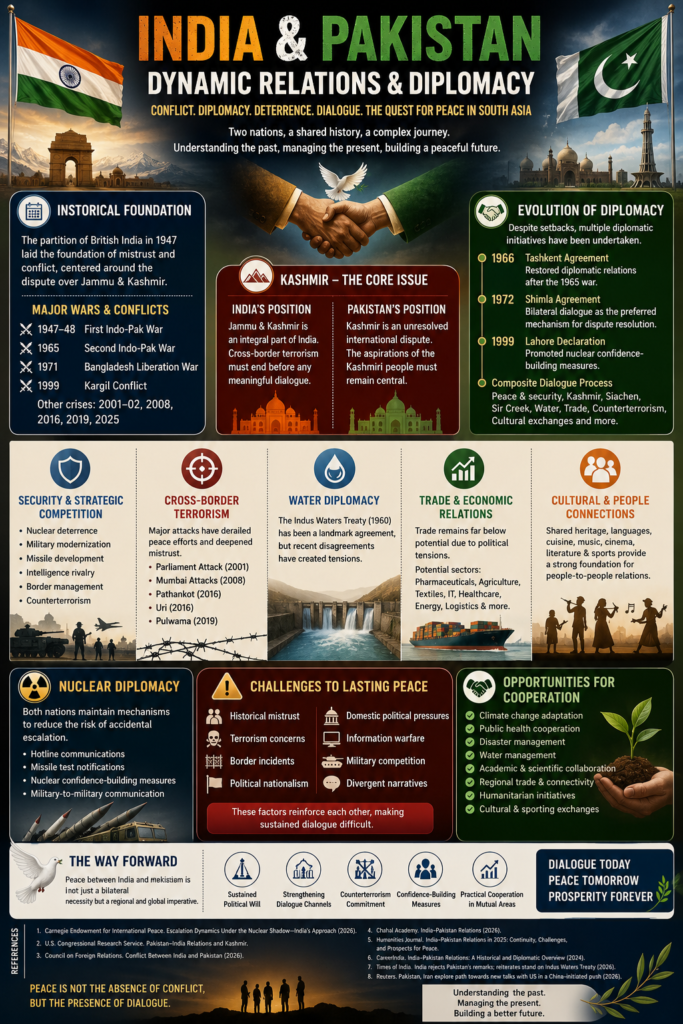
Introduction
The relationship between India and Pakistan remains one of the world’s most complex, strategically significant, and closely monitored bilateral relationships. Since their emergence as independent states in 1947, both countries have experienced periods of military confrontation, diplomatic engagement, political rivalry, and limited cooperation. The relationship has evolved beyond a traditional territorial dispute to encompass nuclear deterrence, counterterrorism, water security, regional geopolitics, economic interests, and international diplomacy.
Despite decades of hostility, India and Pakistan continue to recognize that sustainable peace remains essential for the long-term stability and prosperity of South Asia. The challenge lies in balancing national security priorities with diplomatic engagement while managing deep-rooted mistrust.
Historical Foundations
The partition of British India in 1947 marked the beginning of bilateral tensions. Massive migration, communal violence, and disagreements over the accession of Jammu and Kashmir established a legacy of mistrust that continues to shape contemporary diplomacy.
Major military conflicts include:
- First Indo-Pak War (1947–48)
- Second Indo-Pak War (1965)
- Bangladesh Liberation War (1971)
- Kargil Conflict (1999)
Apart from these wars, multiple military crises have emerged, including the 2001–02 border mobilization, the 2008 Mumbai terrorist attacks, the 2016 Uri attack, the 2019 Pulwama attack and Balakot airstrikes, and the 2025 military crisis. (Carnegie Endowment)
The Kashmir Issue
The Jammu and Kashmir dispute remains the central political and strategic issue.
India maintains that:
- Jammu and Kashmir is an integral part of India.
- Cross-border terrorism must cease before meaningful bilateral dialogue can resume.
Pakistan maintains that:
- Kashmir is an unresolved international dispute.
- The aspirations of the Kashmiri people should remain central to any settlement.
The differing constitutional, legal, and political interpretations of Kashmir continue to complicate diplomatic negotiations.
Evolution of Bilateral Diplomacy
Despite repeated crises, numerous diplomatic initiatives have sought to improve bilateral relations.
Important Diplomatic Milestones
1966 – Tashkent Agreement
Brokered after the 1965 war, restoring diplomatic relations.
1972 – Shimla Agreement
Established bilateral dialogue as the preferred mechanism for dispute resolution.
1999 – Lahore Declaration
Created optimism regarding nuclear confidence-building measures before being overshadowed by the Kargil conflict.
Composite Dialogue Process
Focused on multiple issues including:
- Peace and security
- Kashmir
- Siachen
- Sir Creek
- Water sharing
- Counterterrorism
- Trade
- Cultural exchanges
Each initiative demonstrated that diplomacy often advances during periods of political willingness but remains vulnerable to security crises. (Chahal Academy)
Security and Strategic Competition
India and Pakistan are both declared nuclear-armed states, making their rivalry distinct from most interstate conflicts.
Key strategic dimensions include:
- Nuclear deterrence
- Conventional military modernization
- Missile development
- Intelligence competition
- Border management
- Counterterrorism operations
The existence of nuclear weapons has arguably reduced the likelihood of full-scale war while increasing concerns over limited military escalation and crisis management. (Carnegie Endowment)
Cross-Border Terrorism
India consistently identifies cross-border terrorism as the principal obstacle to normalization.
Major attacks influencing bilateral relations include:
- Parliament Attack (2001)
- Mumbai Attacks (2008)
- Pathankot (2016)
- Uri (2016)
- Pulwama (2019)
These incidents have repeatedly interrupted diplomatic initiatives and hardened political positions. Pakistan rejects allegations of state sponsorship of terrorism and emphasizes dialogue on broader disputes.
Water Diplomacy
The Indus Waters Treaty (1960), brokered by the World Bank, has historically been regarded as one of the most durable water-sharing agreements in the world.
Recent years, however, have witnessed renewed disagreements over its implementation. India has argued for changes and linked future progress to broader security concerns, while Pakistan has continued to emphasize adherence to the treaty framework. (The Times of India)
Trade and Economic Relations
Although India and Pakistan share geographic proximity, bilateral trade remains well below its potential.
Potential areas of cooperation include:
- Pharmaceuticals
- Agriculture
- Textiles
- Information Technology
- Healthcare
- Energy
- Logistics
Political tensions and periodic trade restrictions have significantly constrained economic integration. (Humanities Journal)
Cultural Diplomacy
Despite political disagreements, both countries share:
- Historical heritage
- Languages
- Cuisine
- Music
- Cinema
- Literature
- Sporting traditions
People-to-people exchanges, academic collaboration, and cultural engagement have periodically served as confidence-building measures, though they too are affected by political tensions.
Regional and Global Geopolitics
India–Pakistan relations are influenced by broader strategic dynamics involving:
- China
- United States
- Russia
- Gulf countries
- United Nations
- SAARC
- Shanghai Cooperation Organisation
China’s partnership with Pakistan, India’s expanding global strategic partnerships, and evolving regional security architectures shape the diplomatic environment in which bilateral relations unfold. (Reuters)
Nuclear Diplomacy
Both countries maintain doctrines and mechanisms intended to reduce the risk of accidental escalation, including:
- Hotline communications
- Notifications of ballistic missile tests
- Nuclear confidence-building measures
- Military-to-military communication channels
Nevertheless, crises continue to test the resilience of these mechanisms. (Carnegie Endowment)
Challenges to Lasting Peace
Several structural factors continue to impede normalization:
- Historical mistrust
- Terrorism concerns
- Border incidents
- Political nationalism
- Domestic political pressures
- Information warfare
- Military competition
- Divergent narratives regarding Kashmir
These issues often reinforce one another, making sustained dialogue difficult.
Opportunities for Cooperation
Despite persistent challenges, several areas offer potential for constructive engagement:
- Climate change adaptation
- Public health cooperation
- Disaster management
- Water management
- Academic exchanges
- Scientific collaboration
- Regional trade
- Humanitarian initiatives
- Cultural and sporting exchanges
Incremental cooperation in non-sensitive sectors could help build confidence for broader diplomatic engagement.
The Future of India–Pakistan Diplomacy
The future trajectory of bilateral relations is likely to depend on several factors:
- The security environment along the Line of Control.
- Progress on counterterrorism concerns.
- Domestic political priorities in both countries.
- Regional geopolitical developments.
- Confidence-building measures.
- Sustained diplomatic communication during crises.
Many analysts argue that while comprehensive normalization may remain difficult in the near term, calibrated engagement and crisis-management mechanisms are essential for reducing the risk of escalation between two nuclear-armed neighbors. (Chahal Academy)
Conclusion
India and Pakistan’s relationship reflects a complex interplay of conflict, diplomacy, deterrence, and occasional cooperation. Historical grievances, security concerns, and competing political narratives continue to shape bilateral interactions. At the same time, decades of diplomatic experience demonstrate that dialogue, confidence-building measures, and institutional communication remain important tools for managing tensions. A durable improvement in relations would likely require sustained political commitment, progress on security concerns, and practical cooperation in areas of mutual interest, contributing to greater regional stability and development in South Asia.
References
- Carnegie Endowment for International Peace. Escalation Dynamics Under the Nuclear Shadow—India’s Approach (2026). (Carnegie Endowment)
- U.S. Congressional Research Service. Pakistan-India Relations and Kashmir.
- Council on Foreign Relations. Conflict Between India and Pakistan (2026). (Council on Foreign Relations)
- Chahal Academy. India–Pakistan Relations (2026). (Chahal Academy)
- India-Pakistan Relations in 2025: Continuity, Challenges, and Prospects for Peace. Humanities Journal. (Humanities Journal)
- India-Pakistan Relations: A Historical and Diplomatic Overview. CareerIndia (2024). (https://www.careerindia.com)
- Reuters. Pakistan, Iran explore path towards new talks with US in a China-initiated push (2026). (Reuters)
- Government statements and reporting on the Indus Waters Treaty developments (2026). (The Times of India)