
By Author Devanssh Mehta | Industry Intelligence Report
Executive Summary
India’s oncology market has moved from being a niche specialty healthcare segment into one of the most strategically important components of the national healthcare economy. Cancer is no longer viewed solely as a medical challenge—it has become a public health, pharmaceutical, infrastructure, policy, technology, insurance, and socioeconomic issue.
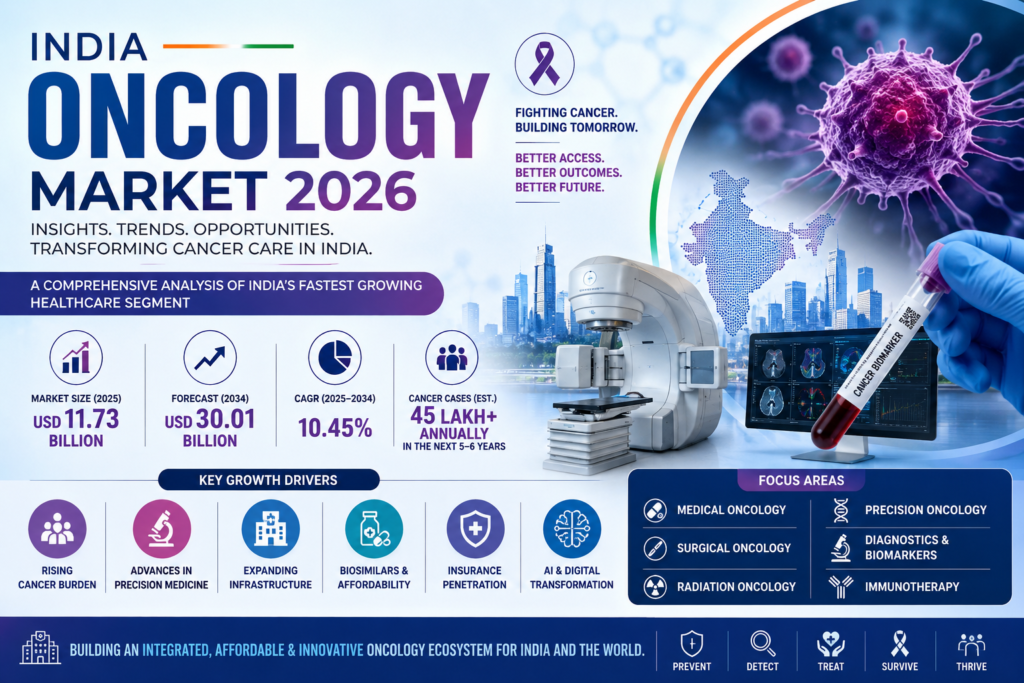
Current estimates place India’s oncology market at approximately USD 11.7 billion in 2025, with projections reaching nearly USD 30 billion by 2034, implying sustained double-digit growth. (IMARC Group) Across narrower oncology segments, growth rates remain even stronger, with some industry analyses forecasting oncology market expansion approaching 20% CAGR through 2030. (Research and Markets)
Simultaneously, India is witnessing a structural cancer burden transition. Estimates suggest the country may move toward 45 lakh annual cancer cases within the coming five to six years if current trends continue, creating extraordinary demand for diagnostics, therapeutics, radiation services, precision medicine, and survivorship ecosystems. (EY)
This report evaluates:
- Market size and structure
- Demand and epidemiology
- Competitive dynamics
- Therapeutics and technology shifts
- Precision oncology and AI
- Investment opportunities
- SWOT and PESTLE analysis
- Future outlook to 2035
1. Introduction: Oncology as India’s Next Healthcare Growth Engine
India’s healthcare evolution has historically passed through multiple phases:
- Infectious disease control
- Maternal and child healthcare expansion
- Cardiometabolic disease management
- Specialty care development
- Precision medicine emergence
Today, oncology occupies the center of healthcare transformation.
Cancer treatment in India has become one of the fastest-expanding healthcare categories because of:
- Rising longevity
- Urbanization
- Environmental exposure
- Better screening
- Increased affordability
- Expansion of tertiary care infrastructure
- Growth of insurance penetration
- Biosimilar availability
The oncology ecosystem now extends far beyond chemotherapy.
Modern oncology includes:
- Prevention
- Screening
- Diagnostics
- Surgical oncology
- Radiation oncology
- Medical oncology
- Immunotherapy
- Precision medicine
- Survivorship care
- Digital monitoring
2. Indian Oncology Market Size and Growth Outlook
Different methodologies produce different estimates depending on scope (therapeutics only vs full oncology ecosystem).
Indicative estimates:
| Segment | Estimated Size |
|---|---|
| Total India Oncology Market (2025) | USD 11.73 Billion |
| Forecast (2034) | USD 30.01 Billion |
| CAGR | 10.45% |
Alternative market models estimate oncology expansion of approximately USD 2.35–2.36 billion incremental opportunity during 2025–2030 with growth near 20% CAGR. (Research and Markets)
Drug-specific oncology estimates indicate:
| Segment | Market Estimate |
|---|---|
| Oncology Drugs Market (2025) | ~USD 6.21 Billion |
| Share of Global Market | ~2.4% |
These differences indicate that oncology in India should be viewed as a layered market rather than a single industry.
3. Epidemiological Foundation of Oncology Growth
Market expansion is fundamentally demand-driven.
Cancer incidence growth reflects:
Demographic Drivers
- Aging population
- Increased life expectancy
Lifestyle Drivers
- Tobacco use
- Sedentary behavior
- Obesity
- Alcohol consumption
Environmental Drivers
- Air pollution
- Occupational carcinogens
Biological Drivers
- Genetic predisposition
India documented approximately 1.46 million cancer cases in 2022 according to cancer registry references cited by market analyses, while broader estimates suggest under-reporting remains substantial. (Coherent Market Insights)
High-burden cancers include:
- Breast
- Lung
- Cervical
- Oral
- Colorectal
- Prostate
- Ovarian
- Leukemia
4. Market Segmentation Analysis
A. Medical Oncology
Largest revenue contributor.
Includes:
- Chemotherapy
- Targeted therapy
- Hormonal therapy
- Immunotherapy
Drivers:
- Hospital expansion
- Increased specialist availability
- Biosimilar adoption
Cancer therapeutics remain among the strongest growth categories in Indian pharma. (MarkNtel Advisors)
B. Surgical Oncology
Evolution areas:
- Robotic surgery
- Organ preservation
- Image-guided procedures
Demand growth is particularly visible in metro and tier-2 tertiary centers.
C. Radiation Oncology
Radiation infrastructure remains underpenetrated relative to disease burden.
India radiation oncology estimates:
| Metric | Value |
|---|---|
| Revenue (2025) | USD 310 Million |
| Forecast (2033) | USD 907 Million |
| CAGR | 14.4% |
Radiotherapy devices alone are projected to grow from approximately USD 165.7 million in 2025 to USD 384.1 million by 2034. (IMARC Group)
D. Precision Oncology
Precision oncology represents India’s highest-value future segment.
Precision oncology market estimates:
| Metric | Value |
|---|---|
| Revenue (2024) | USD 4.36 Billion |
| Forecast (2030) | USD 8.90 Billion |
| CAGR | 12.6% |
Technologies include:
- NGS
- Molecular profiling
- Companion diagnostics
- AI pathology
- Liquid biopsy
5. Indian Oncology Value Chain
The oncology value chain includes:
Research
↓
Diagnostics
↓
Treatment selection
↓
Drug procurement
↓
Hospital administration
↓
Monitoring
↓
Long-term follow-up
Major revenue pools:
- Pharmaceuticals
- Hospitals
- Diagnostics
- Devices
- Digital platforms
- Insurance
6. Pharmaceutical Transformation in Oncology
India’s pharmaceutical industry increasingly sees oncology as a strategic category.
Three therapy generations dominate:
Generation I
Traditional chemotherapy
Generation II
Targeted therapy
Generation III
Immunotherapy
Emerging:
Generation IV
Cell and gene oncology
Cancer treatment drug markets in India are projected to expand at approximately 12.2% CAGR through 2030. (MarkNtel Advisors)
7. Biosimilars: India’s Competitive Weapon
India’s oncology affordability story increasingly depends upon biosimilars.
Advantages:
- Lower cost
- Wider access
- Domestic manufacturing
- Reduced dependence
Strategic opportunities include:
- Monoclonal antibodies
- Growth factors
- Immunotherapies
8. Diagnostics Revolution
Cancer diagnosis increasingly drives treatment economics.
Growth segments:
- Molecular diagnostics
- Digital pathology
- Biomarker testing
- Liquid biopsy
- AI imaging
Diagnostics are becoming the fastest-growing precision oncology component. (Grand View Research)
9. Healthcare Infrastructure and Delivery
India’s oncology infrastructure shows major imbalance.
Challenges:
- Urban concentration
- Specialist shortages
- Long wait times
Positive developments continue through public–private expansion and regional cancer centers.
Examples of oncology service scale expansion are visible in tertiary institutions where patient registrations and treatment volumes have multiplied over recent years. (The Times of India)
10. Insurance and Affordability Dynamics
Key payment sources:
- Out-of-pocket
- Government insurance
- Private insurance
- Employer coverage
Affordability remains decisive.
Examples of innovative state programs show anti-cancer medicines being delivered at deep discounts through public initiatives. (The Times of India)
11. Investment Landscape
Investment hotspots:
High Opportunity
★★★★★ Precision Oncology
★★★★★ Biosimilars
★★★★★ Radiation Networks
★★★★★ AI Diagnostics
★★★★ Oncology Hospitals
★★★★ Genomics
12. Competitive Landscape
Participants include:
- Global pharma
- Domestic pharma
- Hospital chains
- Device manufacturers
- Diagnostics firms
International companies continue expanding oncology portfolios in India, including renewed entry into precision oncology categories. (The Economic Times)
13. Technology Disruption
Major disruptors:
Artificial Intelligence
- Imaging
- Decision support
Digital Oncology
- Remote monitoring
Robotics
- Precision surgery
Data Platforms
- Real-world evidence
14. SWOT Analysis
Strengths
- Large patient pool
- Strong pharma manufacturing
- Biosimilar capability
- Skilled clinicians
Weaknesses
- Unequal access
- Specialist shortages
- Cost burden
Opportunities
- Precision medicine
- Export leadership
- Medical tourism
- AI oncology
Threats
- Imported innovation dependence
- Price pressure
- Infrastructure gaps
15. PESTLE Analysis
Political
Government healthcare expansion.
Economic
Growing middle class.
Social
Cancer awareness rising.
Technological
AI and genomics adoption.
Legal
Regulatory strengthening.
Environmental
Pollution-linked burden.
16. Emerging Trends Through 2035
Major shifts expected:
- Immunotherapy expansion
- Biomarker-driven care
- Genomic screening
- AI-enabled diagnostics
- Hospital decentralization
- Home-based supportive oncology
- Digital survivorship
Global oncology growth is expected to remain strong throughout the next decade, supporting India’s trajectory. (Global Market Insights Inc.)
17. Strategic Recommendations
Government
- Expand screening
- Strengthen registries
- Build regional centers
Pharma
- Accelerate oncology pipelines
- Expand biosimilars
Hospitals
- Develop integrated cancer hubs
Investors
- Prioritize precision oncology
Academia
- Increase translational research
Conclusion
India’s oncology market stands at a historic inflection point.
The next decade will determine whether India becomes merely a large consumer of oncology innovation—or emerges as a global architect of affordable, scalable, precision cancer care.
The opportunity extends beyond revenue.
It includes:
- reducing mortality,
- democratizing advanced treatment,
- creating pharmaceutical sovereignty,
- and positioning India as a global oncology leader.
The future of Indian oncology will belong not only to those who invent therapies—but to those who make them accessible, scalable, and clinically meaningful.
Estimated Outlook: India’s oncology ecosystem is entering a prolonged expansion phase with oncology, precision diagnostics, radiation infrastructure, and advanced therapeutics becoming central pillars of healthcare growth through 2035. (IMARC Group)