

The Culinary Soul of India’s Heartland
By Devanssh Mehta
Introduction: Uttar Pradesh — Where Food Becomes Civilization
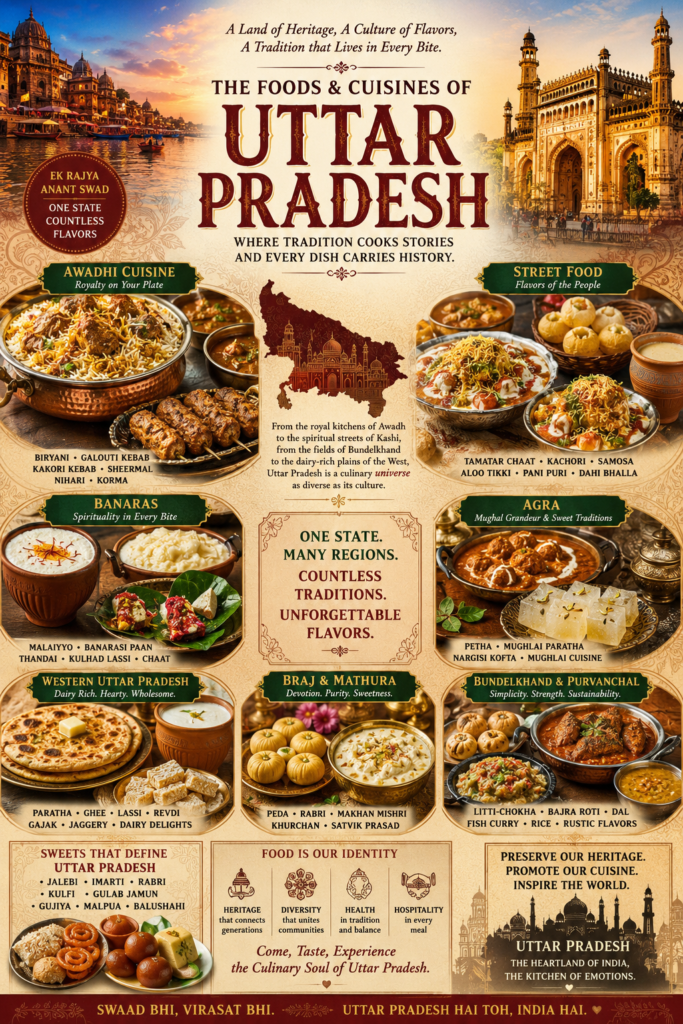
India is not merely a nation of geographical diversity; it is a living civilization woven together through languages, rituals, spirituality, architecture, music, literature, and most importantly, food. Among all Indian states, Uttar Pradesh occupies a uniquely sacred and cultural position. It is the land where mythology merges with history, where spirituality intersects with royal grandeur, and where culinary traditions evolved through centuries of civilizational exchange. From the spiritual ghats of Varanasi to the Nawabi courts of Lucknow, from the rustic villages of Purvanchal to the bustling food streets of Meerut and Agra, Uttar Pradesh offers one of the richest culinary landscapes in the entire Indian subcontinent.
The cuisine of Uttar Pradesh is not simply about taste or gastronomy. It is an expression of heritage, class structure, spirituality, agriculture, invasions, trade routes, royal patronage, and local wisdom accumulated across generations. Every district of Uttar Pradesh possesses its own culinary identity shaped by climate, crops, cultural history, religious traditions, and social behavior. Food in Uttar Pradesh is deeply emotional. It is associated with festivals, weddings, mourning rituals, temple offerings, hospitality, military traditions, and everyday survival.
Unlike cuisines that are heavily commercialized and globally standardized, the cuisine of Uttar Pradesh still retains its indigenous authenticity. Here, recipes are inherited rather than merely documented. Techniques are passed from grandmothers to daughters, from royal chefs to apprentices, and from street vendors to future generations. The aroma of desi ghee, the smoky fragrance of coal-fired kebabs, the earthy flavor of freshly ground spices, and the sweetness of milk-based desserts collectively define the gastronomic soul of Uttar Pradesh.
The cuisine of Uttar Pradesh can broadly be divided into Awadhi cuisine, Mughlai influence, Braj cuisine, Bhojpuri food traditions, Bundelkhandi food culture, Rohilkhand flavors, and Western Uttar Pradesh dairy-rich culinary practices. Each region contributes uniquely to the larger culinary identity of the state.
Historical Evolution of Uttar Pradesh Cuisine
The culinary heritage of Uttar Pradesh evolved through multiple historical phases. Ancient Vedic traditions contributed simple vegetarian foods based on grains, milk, lentils, fruits, and herbs. The arrival of Buddhist and Jain philosophies promoted satvik dietary systems emphasizing purity and minimalism. During the medieval period, Islamic invasions and Mughal rule transformed North Indian cuisine dramatically. Persian, Turkish, and Central Asian influences entered royal kitchens, leading to the development of elaborate gravies, dum cooking techniques, kebabs, aromatic rice preparations, and rich desserts.
The Nawabs of Awadh, particularly in Lucknow, elevated cooking into an art form. Royal chefs known as “Rakabdars” developed sophisticated culinary techniques involving slow cooking, marination, fragrance balancing, and texture perfection. It was under Nawabi patronage that dishes such as Galouti Kebab, Kakori Kebab, Nihari, Sheermal, and Dum Biryani achieved legendary status.
Simultaneously, rural communities continued preserving indigenous food systems rooted in sustainability and local agriculture. Millets, seasonal vegetables, buttermilk, jaggery, lentils, and hand-ground spices remained central to village diets. Thus, Uttar Pradesh cuisine evolved as a combination of royal luxury and rural resilience.
Awadhi Cuisine: The Royal Culinary Crown
No discussion of Uttar Pradesh cuisine can begin without acknowledging the magnificence of Awadhi cuisine. Centered primarily in Lucknow, Awadhi cuisine represents refinement, elegance, patience, and culinary sophistication. Unlike highly spicy cuisines, Awadhi food emphasizes aroma, subtlety, balance, and texture.
The signature characteristic of Awadhi cuisine is the “Dum Pukht” technique. In this method, food is slow-cooked in sealed vessels over low heat, allowing flavors to mature gradually. This technique preserves moisture and creates deep aromatic complexity.
Kebabs: Poetry in Culinary Form
The kebabs of Lucknow are globally celebrated. The legendary Tunday Kebab symbolizes the pinnacle of meat craftsmanship. Prepared using finely minced meat blended with numerous spices and tenderizers, the kebab melts effortlessly in the mouth. According to culinary folklore, it was designed for a Nawab who had lost his teeth but still desired luxurious meat dishes.
Galouti Kebabs, Kakori Kebabs, Shami Kebabs, and Boti Kebabs showcase the Nawabi obsession with texture perfection. Each kebab variety differs in spice profile, cooking technique, and meat composition.
Biryani and Pulao Traditions
Awadhi biryani differs significantly from Hyderabadi biryani. It is lighter, aromatic, and delicately spiced. The rice and meat are partially cooked separately before being layered and slow-cooked together. Saffron, kewra, rose water, mace, nutmeg, and cardamom create a fragrant culinary experience.
Pulaos in Awadhi cuisine are equally sophisticated. Zarda Pulao, Yakhni Pulao, and Moti Pulao demonstrate royal culinary imagination where even rice became an artistic medium.
Bread Culture
The bread traditions of Uttar Pradesh are extraordinarily rich. Sheermal, Roomali Roti, Taftan, Warqi Paratha, and Bakarkhani reflect Persian and Mughal influences. Sheermal, slightly sweet and saffron-flavored, remains an iconic accompaniment to kebabs and kormas.
Street Food Culture of Uttar Pradesh
The streets of Uttar Pradesh represent one of India’s greatest culinary theatres. Food here is democratic. Rich and poor alike stand beside each other enjoying chaats, kachoris, jalebis, samosas, and kulfi.
Chaat: The King of Indian Street Food
The chaat culture of Uttar Pradesh is legendary. Cities like Lucknow, Varanasi, Allahabad (Prayagraj), Meerut, Kanpur, and Agra possess distinctive chaat traditions.
Aloo Tikki, Dahi Bhalla, Papdi Chaat, Tokri Chaat, Tamatar Chaat, and Pani Puri collectively define the sensory explosion associated with North Indian street cuisine. The combination of sweet tamarind chutney, spicy green chutney, yogurt, crispy textures, and aromatic spices creates multidimensional flavor complexity.
Banarasi Tamatar Chaat deserves special mention. Unlike conventional chaats, it involves mashed tomatoes cooked with spices and topped with sev, coriander, and crispy elements, creating a uniquely tangy and spicy preparation.
Kachori Traditions
Kachori remains an emotional breakfast item across Uttar Pradesh. Bedmi Puri with spicy potato curry dominates Western Uttar Pradesh and Agra regions. In Banaras, spicy sabzi with hot kachoris forms an inseparable part of morning life.
Dal-stuffed kachoris, onion kachoris, and matar kachoris differ regionally depending upon local preferences and seasonal availability.
Samosa: A Universal Comfort Food
Though available across India, the samosa culture in Uttar Pradesh has a distinctive identity. Large triangular samosas stuffed with spiced potatoes, peas, and dry fruits are often accompanied by tangy chutneys. In many towns, samosas are consumed not merely as snacks but as social rituals associated with evening tea.
Varanasi: Spirituality and Food
Varanasi represents one of the world’s oldest living cities, and its cuisine reflects spiritual continuity. Banarasi food culture combines simplicity, devotion, and indulgence simultaneously.
Banarasi Paan
No culinary discussion of Varanasi is complete without Banarasi Paan. More than a mouth freshener, paan symbolizes hospitality, celebration, and cultural identity. Prepared with betel leaves, catechu, areca nut, fennel, cardamom, gulkand, and various flavorings, Banarasi paan achieved international recognition.
Malaiyyo: Winter’s Delicate Dessert
Malaiyyo is perhaps among India’s most delicate desserts. Prepared only during winters, it involves milk foam flavored with saffron, pistachios, and cardamom. The dessert resembles edible clouds and reflects the artistic finesse of Banarasi sweet-making traditions.
Lassi and Thandai
Thick creamy lassi served in earthen kulhads represents rural dairy richness. Banarasi thandai, infused with dry fruits, saffron, fennel, and occasionally bhang during festivals like Holi, embodies festive spirituality.
Agra: Mughal Grandeur and Sweet Traditions
Agra inherited deep Mughal culinary influence due to its historical significance as an imperial capital.
Petha: Agra’s Sweet Identity
Petha remains synonymous with Agra. Prepared from ash gourd cooked in sugar syrup, petha exists in numerous varieties including plain, kesar, paan, chocolate, and angoori versions. The translucent sweetness symbolizes Agra’s confectionery heritage.
Mughlai Cuisine
Agra’s Mughlai cuisine emphasizes rich gravies, tandoori preparations, and aromatic meat dishes. Nargisi Kofta, Mughlai Paratha, and creamy kormas continue to preserve imperial culinary aesthetics.
Western Uttar Pradesh: Dairy and Agricultural Abundance
Western Uttar Pradesh possesses fertile agricultural lands contributing heavily to wheat, sugarcane, milk, and vegetables. Consequently, its cuisine emphasizes dairy richness and robust flavors.
Cities like Meerut, Muzaffarnagar, Saharanpur, and Ghaziabad showcase strong Punjabi and rural North Indian culinary influence.
Ghee-Based Cooking
Desi ghee occupies central importance in Western Uttar Pradesh households. Rotis smeared with ghee, halwas, stuffed parathas, and milk-based sweets dominate traditional diets.
Sugarcane Influence
As one of India’s major sugarcane-producing regions, jaggery consumption remains widespread. Gur-based sweets, revdi, gajak, and sugarcane juice hold economic and cultural significance.
Breakfast Culture
Stuffed parathas with curd, white butter, pickle, and chai represent the quintessential breakfast of Western Uttar Pradesh. The meals are calorie-rich due to agrarian labor requirements.
Bundelkhand Cuisine: Simplicity and Survival
Bundelkhand, characterized by semi-arid geography, developed a cuisine focused on resilience and resource efficiency. Millets, lentils, gram flour, and seasonal vegetables dominate local diets.
Millet-Based Foods
Bajra and jowar rotis remain staples. These grains possess high nutritional value and climatic adaptability.
Rustic Preparations
Bundelkhand cuisine avoids excessive complexity. Smoked flavors, coarse textures, and earthy spices define its culinary personality. Dishes are designed for sustenance rather than luxury.
Bhojpuri and Purvanchal Food Traditions
Eastern Uttar Pradesh shares culinary similarities with Bihar while retaining distinct regional nuances.
Litti-Chokha Influence
Though associated strongly with Bihar, litti-chokha is also widely consumed in eastern Uttar Pradesh. Roasted wheat balls stuffed with sattu and served with mashed vegetables provide balanced nutrition and long-lasting satiety.
Fish and Rice Culture
Unlike western regions, eastern Uttar Pradesh demonstrates greater fish consumption due to riverine geography. Rice also occupies a stronger dietary position.
Vegetarian Heritage of Uttar Pradesh
While Mughlai cuisine popularized meat dishes, vegetarian food remains deeply embedded within Uttar Pradesh’s spiritual traditions.
Temple cuisines associated with Mathura, Vrindavan, Ayodhya, and Varanasi emphasize satvik preparations free from onion and garlic.
Braj Cuisine
The Braj region associated with Lord Krishna celebrates milk, butter, curd, and sweets extensively. Makhan Mishri, peda, rabri, and khurchan dominate local culinary traditions.
Seasonal Fasting Foods
Religious fasting traditions contributed to unique food innovations including sabudana khichdi, kuttu puri, singhare ke atte ka halwa, and vrat-special preparations.
Sweet Culture of Uttar Pradesh
The sweet traditions of Uttar Pradesh are extraordinarily vast.
Jalebi and Imarti
Hot jalebis consumed with milk or curd remain a beloved breakfast in several regions. Imarti differs slightly in texture and preparation but remains equally iconic.
Rabri and Kulfi
Slow-reduced milk desserts symbolize patience-intensive Indian confectionery techniques. Rabri served with jalebi represents one of North India’s greatest dessert combinations.
Peda Traditions
Mathura peda achieved global fame due to its caramelized milk flavor and religious association with Krishna devotion.
Festivals and Food
Festivals in Uttar Pradesh are unimaginable without elaborate culinary traditions.
During Holi, gujiya, thandai, malpua, and dahi vada dominate households. Diwali emphasizes laddoos, namakpare, chakli, and kachoris. Eid celebrations feature sevaiyan, biryani, kebabs, and sheer khurma. Thus, food becomes a bridge connecting religions and communities.
The Science Behind Uttar Pradesh Cuisine
From a nutritional and pharmacological perspective, many traditional foods of Uttar Pradesh possess functional health value.
Turmeric exhibits anti-inflammatory properties. Cardamom aids digestion. Asafoetida improves gastrointestinal function. Fermented dairy products support gut microbiota. Millets provide fiber and micronutrients. Traditional spice combinations were historically designed not merely for flavor but also for digestive compatibility and seasonal adaptation.
The use of slow cooking preserves nutrient bioavailability while enhancing flavor development. Earthen cookware historically contributed trace minerals and improved thermal stability during cooking.
Culinary Economy and Tourism
Food tourism is emerging as a powerful economic driver in Uttar Pradesh. Culinary heritage strengthens local employment, small-scale entrepreneurship, tourism branding, and cultural diplomacy.
Street food vendors, sweet makers, halwais, dairy producers, spice merchants, and restaurant chains collectively contribute significantly to regional economies.
Cities like Lucknow and Varanasi increasingly attract international tourists seeking authentic Indian culinary experiences.
Modernization and Challenges
Despite its richness, Uttar Pradesh cuisine faces challenges due to urbanization, processed food penetration, fast-food culture, and declining intergenerational transmission of recipes.
Traditional cooking methods requiring patience are gradually being replaced by instant cooking systems. Artificial flavor enhancers threaten authenticity. Younger generations increasingly consume standardized global fast foods, risking erosion of indigenous culinary identity.
However, there is also a revival movement. Culinary historians, food bloggers, chefs, and cultural organizations are documenting forgotten recipes and promoting regional food pride.
Uttar Pradesh Cuisine as Cultural Diplomacy
Cuisine functions as soft power. Just as Italian, Japanese, and French cuisines symbolize national identity globally, Uttar Pradesh cuisine possesses enormous international potential.
Awadhi cuisine already enjoys global recognition. Banarasi sweets, Agra petha, Mathura peda, and regional chaats can become powerful cultural exports if standardized strategically while preserving authenticity.
The future lies not merely in commercialization but in intelligent preservation. Culinary traditions should be documented scientifically, protected through geographical indication systems, and promoted through tourism, academia, and digital storytelling.
Conclusion: Food as Memory, Identity, and Civilization
The foods and cuisines of Uttar Pradesh represent far more than culinary pleasure. They are historical archives encoded in flavor. Every kebab carries memories of Nawabi courts. Every kachori reflects bustling marketplaces. Every peda symbolizes devotional spirituality. Every rural millet bread narrates stories of resilience and agrarian endurance.
Uttar Pradesh cuisine embodies coexistence. Hindu temple food traditions exist alongside Mughlai royal gastronomy. Rustic village meals coexist with refined Awadhi delicacies. Street food vendors coexist with luxury culinary institutions. This diversity mirrors the broader civilizational complexity of India itself.
In an age increasingly dominated by industrial food systems and standardized fast-food culture, the traditional cuisines of Uttar Pradesh remind humanity of the emotional, cultural, and spiritual dimensions of eating. Food here is not merely consumption. It is celebration, identity, memory, heritage, emotion, and collective continuity.
The culinary landscape of Uttar Pradesh therefore deserves preservation not only for gastronomic reasons but also for cultural survival. Its recipes are intangible heritage. Its spices are historical signatures. Its sweets are emotional artifacts. Its kitchens are living museums of Indian civilization.
As India progresses toward modernization and global prominence, the foods of Uttar Pradesh will continue serving as ambassadors of authenticity, hospitality, and timeless cultural richness — nourishing not only the body, but also the soul of a civilization.