

Building the Future Healthcare Strategists of the Pharmaceutical Century
Introduction: The Evolving Identity of the Indian Pharmacist
The pharmacy profession in India is undergoing one of the most important transformations in its modern history. Traditionally, pharmacists were often perceived merely as dispensers of medicines working behind pharmacy counters or within pharmaceutical manufacturing units. However, this limited perception no longer reflects the true strategic significance of the pharmacy profession in the twenty-first century. Modern pharmacists are increasingly becoming healthcare scientists, clinical advisors, pharmaceutical innovators, regulatory experts, researchers, drug safety specialists, biotechnology professionals, digital healthcare contributors, entrepreneurs, and architects of national healthcare systems.
India today stands among the world’s most influential pharmaceutical powers. Often referred to as the “Pharmacy of the World,” the nation has established itself as a global leader in generic medicine manufacturing, vaccine production, pharmaceutical exports, and affordable healthcare solutions. The Indian pharmaceutical industry supplies medicines to more than 200 countries and plays a central role in global public health systems. Simultaneously, the rise of biotechnology, precision medicine, biosimilars, pharmacovigilance, artificial intelligence, digital therapeutics, personalized medicine, and regulatory modernization is fundamentally reshaping the future landscape of pharmacy careers.
Despite these enormous opportunities, many pharmacy students and graduates remain uncertain regarding career pathways, specialization choices, industrial trends, research opportunities, entrepreneurship possibilities, higher education options, and emerging pharmaceutical technologies. A significant number of students enter pharmacy education without comprehensive awareness of the profession’s multidimensional potential. As a result, talented individuals frequently restrict themselves to narrow employment expectations while overlooking the vast strategic opportunities emerging across pharmaceutical sciences and healthcare innovation.
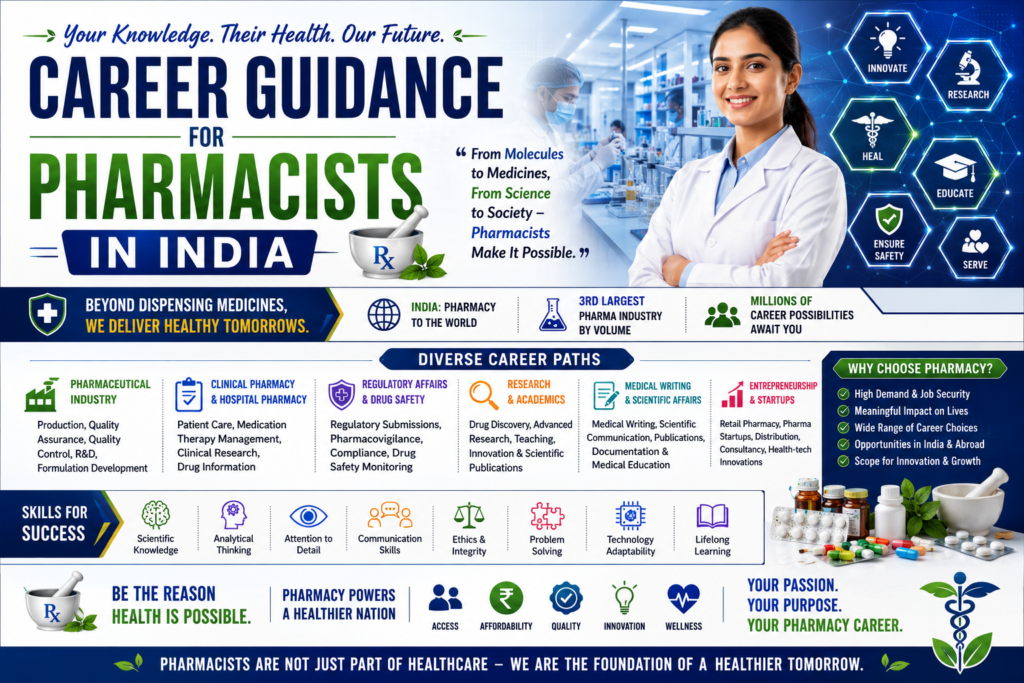
Career guidance for pharmacists in India therefore requires a futuristic, structured, and multidimensional framework. Pharmacy is no longer merely a profession associated with medicines. It is increasingly becoming an interdisciplinary scientific ecosystem integrating pharmacology, biotechnology, chemistry, healthcare systems, artificial intelligence, data science, clinical research, molecular biology, genomics, regulatory affairs, public health, and entrepreneurship.
The pharmacist of the future will not merely dispense medicines.
The pharmacist of the future will shape therapeutic innovation, healthcare policy, drug safety, personalized medicine, digital therapeutics, and pharmaceutical sovereignty itself.
This article presents a comprehensive roadmap for pharmacists in India, exploring educational pathways, specialization opportunities, industrial careers, research sectors, entrepreneurship, global opportunities, financial growth strategies, digital healthcare integration, and the future evolution of pharmaceutical sciences in the modern healthcare era.
Understanding the Modern Pharmacy Profession
Pharmacy is fundamentally the science and practice of designing, manufacturing, evaluating, regulating, dispensing, monitoring, and optimizing medications for human health. It serves as the bridge between pharmaceutical sciences and clinical healthcare delivery.
Unlike common misconceptions, pharmacy is not confined solely to chemist shops or medicine distribution. Modern pharmacy encompasses a vast range of disciplines including:
- Pharmacology
- Pharmaceutics
- Pharmaceutical chemistry
- Pharmacognosy
- Clinical pharmacy
- Regulatory affairs
- Biotechnology
- Pharmacovigilance
- Industrial pharmacy
- Hospital pharmacy
- Medical writing
- Drug discovery
- Clinical research
- Healthcare informatics
The pharmacy profession therefore operates at the intersection of science, medicine, healthcare systems, patient safety, technology, and innovation.
In India, the growing healthcare burden, aging population, chronic disease prevalence, rising cancer incidence, infectious disease management, vaccine development, and digital healthcare expansion are dramatically increasing the strategic importance of pharmacists.
Pharmacy Education Pathways in India
India offers multiple educational pathways within pharmaceutical sciences.
Diploma in Pharmacy (D.Pharm)
The D.Pharm program represents the foundational qualification for pharmacy practice and retail pharmacy operations. It primarily focuses on:
- Basic pharmacology
- Pharmaceutics
- Drug dispensing
- Hospital pharmacy
- Pharmaceutical calculations
Many students pursue D.Pharm for rapid entry into retail or hospital pharmacy sectors.
Bachelor of Pharmacy (B.Pharm)
The B.Pharm degree represents the most widely pursued pharmacy qualification in India. This program provides comprehensive understanding of:
- Drug formulation
- Pharmacology
- Pharmaceutical chemistry
- Industrial pharmacy
- Pharmacokinetics
- Clinical therapeutics
- Pharmaceutical analysis
B.Pharm graduates can enter multiple career sectors across pharmaceutical industries and healthcare systems.
Master of Pharmacy (M.Pharm)
M.Pharm enables specialization in advanced pharmaceutical domains such as:
- Pharmacology
- Pharmaceutics
- Pharmaceutical analysis
- Pharmaceutical chemistry
- Quality assurance
- Biotechnology
- Regulatory affairs
Specialization selection significantly influences future career pathways.
Pharm.D (Doctor of Pharmacy)
The Pharm.D program emphasizes clinical pharmacy and patient-centered healthcare practice.
This pathway prepares pharmacists for roles involving:
- Clinical therapeutics
- Medication therapy management
- Drug interaction monitoring
- Hospital clinical practice
- Patient counseling
Clinical pharmacy is expected to expand substantially in India over coming decades.
PhD in Pharmaceutical Sciences
Doctoral research programs prepare professionals for:
- Academic careers
- Drug discovery
- Pharmaceutical innovation
- Biotechnology research
- Scientific leadership
India requires stronger pharmaceutical research ecosystems, making research careers increasingly important.
The Expanding Scope of Pharmacists in India
Historically, many Indian pharmacy graduates viewed industrial manufacturing as the primary career option. However, the modern pharmaceutical ecosystem now offers highly diversified opportunities.
The pharmacist today may work in:
- Pharmaceutical industries
- Hospitals
- Clinical research organizations
- Regulatory agencies
- Biotechnology companies
- Healthcare startups
- Academic institutions
- Medical writing firms
- Digital healthcare companies
- Pharmacovigilance centers
- Artificial intelligence-driven healthcare platforms
The future pharmacist must therefore understand the broader pharmaceutical ecosystem rather than restricting career imagination to traditional pathways alone.
Pharmaceutical Industry Careers
India’s pharmaceutical industry represents one of the largest employment sectors for pharmacists.
Major pharmaceutical functions include:
- Manufacturing
- Quality assurance
- Research and development
- Production management
- Regulatory affairs
- Product management
- Formulation development
- Validation
- Quality control
The pharmaceutical industry is transitioning from traditional generics manufacturing toward innovation-driven ecosystems involving biosimilars, biologics, complex formulations, and advanced therapeutics.
Quality Assurance and Quality Control
Quality assurance (QA) and quality control (QC) remain foundational pillars of pharmaceutical manufacturing.
Quality Assurance
QA professionals ensure compliance with:
- Good Manufacturing Practices (GMP)
- Documentation standards
- Regulatory guidelines
- Validation procedures
This field demands meticulous attention to detail and strong regulatory understanding.
Quality Control
QC professionals analyze:
- Raw materials
- Finished products
- Stability studies
- Analytical testing
Professionals skilled in analytical instrumentation such as HPLC, GC, spectroscopy, and chromatography remain highly valuable.
Research and Development (R&D)
Research and development represents one of the most intellectually stimulating pharmaceutical career domains.
R&D professionals contribute to:
- Drug discovery
- Novel formulations
- Controlled-release systems
- Nanotechnology-based therapeutics
- Biosimilars
- Biotechnology products
The future pharmaceutical industry will increasingly prioritize innovation rather than replication alone.
Pharmacists with strong scientific curiosity and analytical capability often thrive in R&D environments.
Pharmacology and Drug Discovery
Pharmacology remains one of the most strategic pharmaceutical disciplines.
Pharmacologists study:
- Drug mechanisms
- Therapeutic effects
- Toxicity
- Drug interactions
- Receptor pharmacology
- Molecular signaling pathways
Emerging areas include:
- Neuropharmacology
- Cancer pharmacology
- Precision medicine
- Immunopharmacology
- Psychopharmacology
India’s transition toward research-driven pharmaceutical innovation may significantly expand opportunities in advanced pharmacological sciences.
Clinical Research and Clinical Trials
Clinical research represents one of the fastest-growing sectors for pharmacy professionals.
Clinical trials are essential for:
- Drug approval
- Safety evaluation
- Therapeutic efficacy analysis
Pharmacists can work in:
- Clinical data management
- Medical monitoring
- Clinical operations
- Site coordination
- Trial documentation
India’s large patient population creates substantial potential for global clinical research expansion.
Pharmacovigilance: The Science of Drug Safety
Pharmacovigilance focuses upon detecting, assessing, understanding, and preventing adverse drug reactions.
As global healthcare systems increasingly prioritize patient safety, pharmacovigilance professionals are becoming critically important.
Responsibilities include:
- Adverse event reporting
- Signal detection
- Risk assessment
- Safety database management
The rise of biologics, vaccines, and complex therapies is expected to increase demand for drug safety professionals.
Regulatory Affairs: Navigating Global Pharmaceutical Compliance
Regulatory affairs professionals manage pharmaceutical compliance with national and international regulatory frameworks.
Responsibilities include:
- Drug registration
- Regulatory documentation
- Compliance management
- Dossier preparation
- Labeling requirements
Knowledge of agencies such as:
- United States Food and Drug Administration
- European Medicines Agency
- Central Drugs Standard Control Organization
is highly valuable.
Global pharmaceutical trade ensures sustained importance of regulatory expertise.
Medical Writing and Scientific Communication
Medical writing has emerged as one of the most promising career domains for pharmacists.
Pharmacists possess scientific understanding that enables them to create:
- Regulatory documents
- Clinical study reports
- Scientific manuscripts
- Educational materials
- Pharmaceutical marketing content
India’s expanding pharmaceutical and healthcare communication industries are creating major opportunities for scientific writers.
Professionals with strong writing and analytical skills can build highly successful careers in this sector.
Hospital Pharmacy and Clinical Pharmacy
Hospital pharmacists are increasingly becoming integral members of healthcare teams.
Responsibilities include:
- Medication management
- Prescription review
- Drug interaction analysis
- Patient counseling
- Clinical decision support
Clinical pharmacy integration remains underdeveloped in many Indian hospitals, but future healthcare systems are expected to strengthen pharmacist participation in patient-centered care.
Biotechnology and Biosimilars
Biotechnology is transforming pharmaceutical sciences dramatically.
Modern biotechnology careers involve:
- Monoclonal antibodies
- Gene therapies
- Cell therapies
- Recombinant proteins
- Biosimilars
India’s growing biotechnology ecosystem is expected to create substantial opportunities for pharmacists trained in molecular biology and biotechnology.
Artificial Intelligence and Digital Pharmacy
Artificial intelligence is increasingly influencing pharmaceutical sciences.
AI applications include:
- Drug discovery
- Molecular modeling
- Clinical trial optimization
- Pharmacovigilance automation
- Personalized medicine
Future pharmacists must become technologically adaptive.
The pharmacist of the future may increasingly collaborate with AI-driven healthcare systems rather than functioning independently of them.
Entrepreneurship Opportunities for Pharmacists
Pharmacists possess unique scientific understanding that can support healthcare entrepreneurship.
Potential entrepreneurial pathways include:
- Retail pharmacies
- Pharmaceutical distribution
- Nutraceutical businesses
- Healthcare startups
- Medical writing firms
- Clinical research organizations
- Digital health platforms
- Pharmaceutical consulting services
Entrepreneurship requires additional competencies involving:
- Financial literacy
- Branding
- Marketing
- Leadership
- Strategic planning
India’s healthcare expansion creates substantial opportunities for pharmacist entrepreneurs.
Higher Education and Global Opportunities
Indian pharmacists increasingly pursue international opportunities through:
- MS programs
- PhD programs
- International certifications
- Regulatory careers abroad
Countries such as:
- United States
- Canada
- Australia
- United Kingdom
- Germany
offer advanced pharmaceutical research and industrial opportunities.
Global pharmaceutical integration is creating increasingly borderless career ecosystems.
Financial Planning and Economic Growth
Pharmacy careers offer substantial long-term growth potential, but financial literacy remains essential.
Young pharmacists should develop understanding regarding:
- Investments
- Tax planning
- Insurance
- Wealth management
- Career diversification
Economic stability enhances professional flexibility and entrepreneurial confidence.
Mental Health and Professional Sustainability
Pharmacy professionals often experience:
- Workplace pressure
- Regulatory stress
- Academic competition
- Career uncertainty
Mental resilience therefore becomes critically important.
Pharmacists must prioritize:
- Physical health
- Emotional well-being
- Lifelong learning
- Work-life balance
Healthcare professionals who neglect personal wellness may eventually compromise professional effectiveness.
Women in Pharmacy
Pharmacy has become one of the most significant professional sectors for women in India.
Women pharmacists increasingly excel across:
- Research
- Academia
- Clinical pharmacy
- Pharmaceutical industries
- Entrepreneurship
Future pharmaceutical ecosystems must continue promoting:
- Leadership equality
- Flexible work environments
- Research opportunities
- Women-led innovation
Ethical Challenges in Modern Pharmacy
Modern pharmaceutical ecosystems face multiple ethical challenges involving:
- Drug pricing
- Clinical trial ethics
- Counterfeit medicines
- Data manipulation
- Marketing pressures
Pharmacists must uphold scientific integrity and patient-centered ethics despite commercial pressures.
The pharmacy profession fundamentally exists to protect human health and therapeutic safety.
Pharmaceutical Sovereignty and India’s Global Future
The COVID-19 pandemic demonstrated the strategic importance of pharmaceutical self-reliance.
India’s pharmaceutical future increasingly depends upon:
- API independence
- Innovation ecosystems
- Research infrastructure
- Biotechnology leadership
- Advanced manufacturing
Pharmacists will play a central role in shaping India’s pharmaceutical sovereignty and global healthcare influence.
The Future Identity of the Pharmacist
The pharmacist of the future will not survive merely through traditional dispensing knowledge.
The future pharmacist must become:
- Scientist
- Innovator
- Researcher
- Digital healthcare contributor
- Clinical advisor
- Regulatory strategist
- Entrepreneur
- Biotechnology expert
- Public health participant
Pharmacy is rapidly evolving into one of the most strategically important healthcare professions of the future.
Conclusion: Pharmacists as Architects of the Healthcare Century
Career guidance for pharmacists in India must move far beyond outdated stereotypes associated with medicine dispensing alone. Pharmacy is becoming a multidisciplinary scientific profession positioned at the heart of modern healthcare transformation.
The Indian pharmacist today stands at the intersection of:
- Drug discovery
- Biotechnology
- Artificial intelligence
- Precision medicine
- Clinical healthcare
- Regulatory science
- Public health
- Digital therapeutics
Those pharmacists who continuously adapt, innovate, and develop interdisciplinary competencies will emerge as leaders of the pharmaceutical century.
Success in pharmacy will no longer depend solely upon academic degrees or industrial employment.
The future successful pharmacist will be defined by:
- Scientific excellence
- Innovation capability
- Ethical integrity
- Technological adaptability
- Strategic thinking
- Lifelong learning
- Humanitarian responsibility
India’s rise as a global pharmaceutical superpower will depend not only upon manufacturing capacity but upon the quality, creativity, scientific vision, and leadership of its pharmacists.
The pharmacist of the future will not merely distribute medicines.
The pharmacist of the future will shape the future of healthcare civilization itself.