

Value-Based Leadership as the Foundation of Ethical Power, Institutional Trust, and Sustainable Human Progress
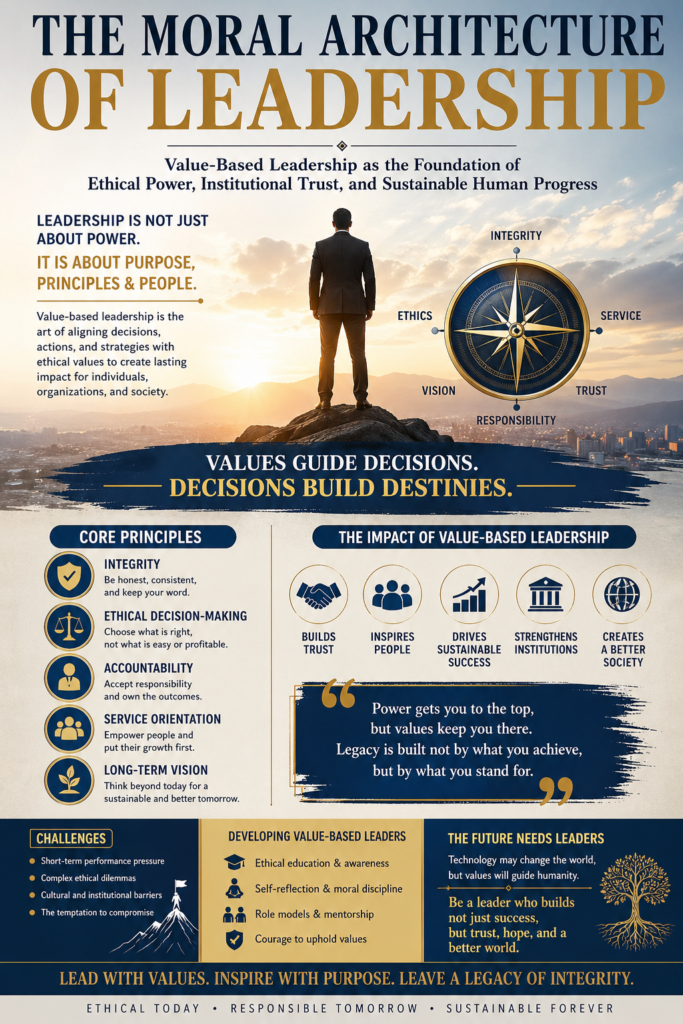
Introduction: Leadership Beyond Authority
Leadership has often been misunderstood as a function of authority, position, or influence. In contemporary organizational discourse, leadership is frequently associated with charismatic personalities, strategic brilliance, or the ability to command resources and mobilize people toward a defined objective. Yet history repeatedly demonstrates that leadership divorced from values eventually degenerates into power without purpose.
True leadership does not emerge merely from titles or hierarchical positions. It emerges from character, moral clarity, and the ability to align decisions with enduring ethical principles. This philosophy forms the core of value-based leadership, a model of leadership that prioritizes integrity, responsibility, service, and long-term societal benefit above short-term gains.
Value-based leadership recognizes that leadership is fundamentally a moral enterprise. Every decision made by a leader affects not only organizational outcomes but also human lives, institutional cultures, and societal trust. Therefore, leadership must be anchored in a set of values that guide behavior even when external pressures demand compromise.
In a world characterized by rapid technological change, economic competition, geopolitical uncertainty, and ethical dilemmas, value-based leadership is emerging as the most reliable compass for responsible governance and sustainable progress.
Understanding Value-Based Leadership
The Conceptual Foundation
Value-based leadership can be defined as a leadership philosophy in which decisions, strategies, and behaviors are guided primarily by a coherent set of ethical principles rather than by convenience, opportunism, or short-term profitability.
At its core, this model integrates three fundamental components:
- Personal Values
- Organizational Values
- Societal Values
A leader operating within this framework continuously ensures that these three layers remain aligned.
Unlike transactional leadership models that focus primarily on reward and punishment mechanisms, value-based leadership emphasizes internal moral motivation. Leaders act ethically not because external regulations demand it, but because their internal moral compass requires it.
Historical Evolution of Value-Based Leadership
Throughout human civilization, the greatest leaders have embodied principles that transcend material success.
Ancient philosophical traditions consistently emphasized the moral dimension of leadership:
- Confucius advocated leadership grounded in virtue and moral example.
- Aristotle described ethical leadership as the cultivation of character and wisdom.
- Indian philosophical traditions emphasized Dharma—the duty to act ethically and responsibly in all spheres of life.
In modern times, leaders such as Mahatma Gandhi, Nelson Mandela, and Abraham Lincoln demonstrated that ethical conviction can become a powerful instrument of social transformation.
Their leadership was not merely strategic; it was moral leadership rooted in values.
Core Principles of Value-Based Leadership
Value-based leadership is not an abstract philosophy. It manifests through specific principles that guide the conduct of leaders.
1. Integrity: The Cornerstone of Leadership
Integrity represents the alignment between beliefs, words, and actions.
A leader with integrity:
- Keeps commitments
- Demonstrates honesty in communication
- Accepts responsibility for mistakes
- Avoids ethical compromises
Integrity is particularly crucial during moments of crisis. When organizations face uncertainty, employees and stakeholders look toward leadership for moral direction.
Without integrity, leadership becomes manipulation rather than inspiration.
2. Ethical Decision-Making
Every leadership decision involves competing interests, conflicting priorities, and complex consequences.
Value-based leaders evaluate decisions through ethical lenses such as:
- Fairness
- Transparency
- Responsibility
- Long-term societal impact
Rather than asking:
“What is most profitable right now?”
Value-based leaders ask:
“What decision aligns with our values and serves the greater good?”
This ethical orientation prevents organizations from engaging in practices that may produce temporary gains but ultimately damage credibility and public trust.
3. Accountability and Responsibility
Leadership implies responsibility not only for success but also for failure.
Value-based leaders demonstrate accountability by:
- Accepting consequences of decisions
- Encouraging transparency
- Taking corrective action when errors occur
- Maintaining ethical standards even under pressure
Accountability creates a culture where individuals feel psychologically safe to act ethically.
4. Service-Oriented Leadership
True leadership is fundamentally an act of service.
Value-based leaders understand that their role is not to dominate followers but to empower them.
This service-oriented perspective includes:
- Supporting team growth
- Encouraging professional development
- Creating environments of dignity and respect
- Recognizing the contributions of others
Leadership, therefore, becomes a mechanism for collective advancement rather than personal glorification.
5. Long-Term Vision and Sustainability
Leaders guided by values prioritize long-term sustainability over immediate gratification.
Short-term decision-making often produces:
- Environmental degradation
- Economic instability
- Organizational distrust
- Ethical crises
Value-based leaders consider the intergenerational impact of decisions.
They ask:
- Will this decision strengthen our institution in the future?
- Will society benefit from our actions?
- Are we preserving resources and opportunities for future generations?
Value-Based Leadership in Organizational Contexts
Organizations function not only through policies and procedures but also through cultural norms. Leadership plays a central role in shaping these norms.
Building Ethical Organizational Culture
Leaders who embody values influence the behavior of their teams.
When leaders demonstrate:
- fairness,
- humility,
- accountability,
these values gradually permeate the organizational culture.
Employees begin to replicate these behaviors because ethical leadership becomes the accepted standard.
Conversely, unethical leadership spreads corruption rapidly across institutions.
Thus, leadership behavior functions as the cultural DNA of organizations.
Enhancing Institutional Trust
Trust represents the most valuable currency in leadership.
Organizations led by value-based leaders experience higher levels of:
- employee loyalty
- stakeholder confidence
- public credibility
- long-term stability
Trust is built through consistent ethical conduct over time.
Once trust is lost, rebuilding it becomes extraordinarily difficult.
Value-Based Leadership in National Governance
The importance of value-based leadership extends beyond corporations into political governance and national development.
Countries with ethical leadership tend to demonstrate:
- stronger democratic institutions
- lower corruption levels
- greater economic stability
- improved social welfare
Value-based governance requires leaders who view public office as a responsibility rather than a privilege.
National progress depends not merely on economic policies but also on the ethical character of leadership.
Challenges to Value-Based Leadership
Despite its importance, value-based leadership faces several challenges in modern society.
Short-Term Performance Pressure
Organizations frequently prioritize quarterly profits and immediate metrics.
Such pressure encourages leaders to compromise ethical standards to achieve rapid results.
Value-based leaders must resist this pressure and maintain strategic patience.
Complex Ethical Dilemmas
Modern leadership environments involve complicated ethical situations involving:
- technological innovation
- data privacy
- environmental impact
- global economic competition
Navigating these dilemmas requires ethical reasoning combined with intellectual wisdom.
Cultural and Institutional Barriers
In some environments, unethical practices may be normalized.
Leaders who attempt to introduce ethical reforms often face resistance.
Value-based leadership therefore requires moral courage.
Developing Value-Based Leaders
Value-based leadership is not purely innate; it can be cultivated through conscious development.
Several factors contribute to the development of ethical leaders.
Education and Ethical Awareness
Leadership education must incorporate ethics, philosophy, and social responsibility.
Technical expertise alone cannot produce responsible leaders.
Institutions must integrate ethical reasoning into leadership training.
Self-Reflection and Moral Discipline
Leaders must continuously examine their motivations and decisions.
Self-reflection helps maintain alignment between actions and values.
Practices such as journaling, mentorship, and philosophical inquiry can strengthen moral awareness.
Role Models and Mentorship
Exposure to ethical role models significantly influences leadership development.
Observing leaders who prioritize integrity and service helps individuals internalize similar values.
The Future of Value-Based Leadership
The 21st century presents unprecedented challenges:
- Artificial intelligence
- Biotechnology
- Global health crises
- Climate change
- Geopolitical tensions
Addressing these challenges requires leaders who possess not only technical expertise but also ethical wisdom.
Value-based leadership will become increasingly essential in guiding humanity through complex transformations.
Organizations and nations that cultivate ethical leadership will enjoy greater stability, credibility, and long-term success.
Conclusion: Leadership as a Moral Responsibility
Leadership is far more than strategic competence or organizational control.
It is fundamentally a moral responsibility entrusted to individuals whose decisions influence the lives of others.
Value-based leadership reminds us that power without ethics is dangerous, but power guided by values becomes transformative.
Leaders who cultivate integrity, responsibility, humility, and service do more than achieve success—they create institutions and societies worthy of trust.
In the final analysis, the legacy of leadership is not measured by wealth, authority, or influence, but by the ethical imprint it leaves upon humanity.
And it is this ethical imprint that defines the true greatness of leadership