

Understanding the Science, Systems, and Philosophy Behind Intelligence That Shapes the Fate of Nations
Introduction: The Silent Battlefield of Nations
In the contemporary geopolitical landscape, wars are no longer fought only on physical battlefields. Instead, they unfold silently across hidden networks of intelligence, surveillance systems, cyber infrastructures, diplomatic channels, and covert operations. At the heart of this invisible domain lies strategic intelligence—the sophisticated process through which nations gather, analyze, interpret, and utilize information to anticipate threats, guide policy decisions, and protect national interests.
Strategic intelligence represents one of the most powerful yet least understood components of national security. It functions as the intellectual backbone of military planning, foreign policy formulation, economic security, and technological competition. While soldiers defend borders and diplomats negotiate treaties, intelligence professionals work behind the scenes to decode adversarial intentions, uncover hidden capabilities, and forecast global developments.
History repeatedly demonstrates that nations with superior intelligence capabilities often gain decisive advantages in international conflicts. From the deciphering of enemy codes during major wars to modern cyber surveillance operations, intelligence has shaped the outcome of strategic confrontations long before weapons are deployed.
Strategic intelligence is therefore not merely about espionage or covert operations; it is fundamentally about understanding the world before events unfold.
Conceptual Foundations of Strategic Intelligence
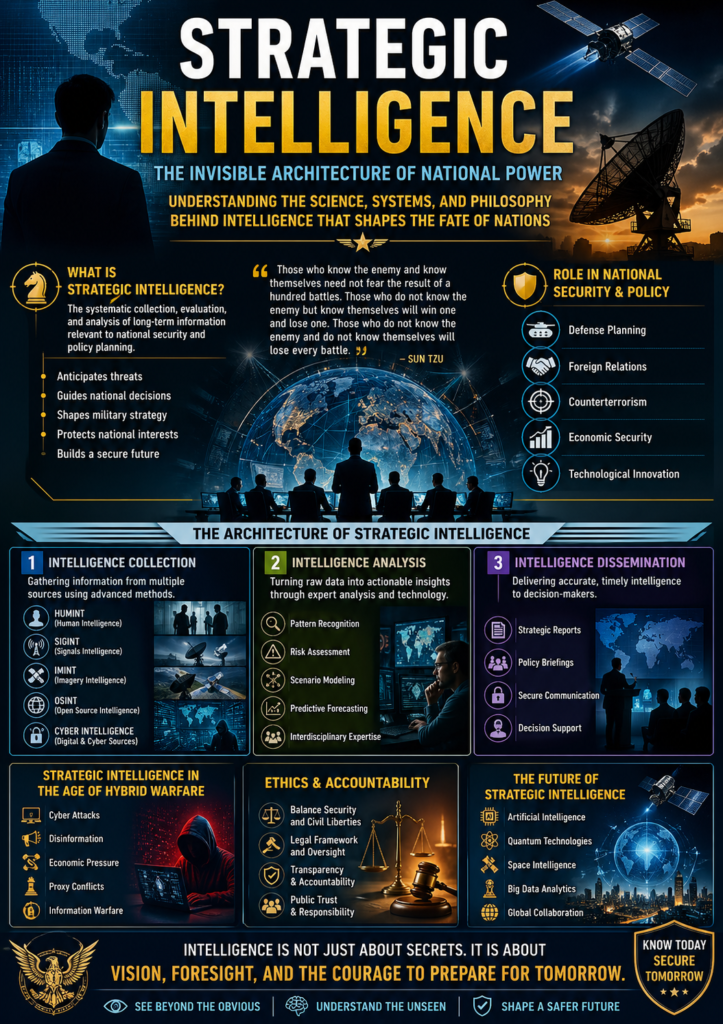
Strategic intelligence refers to the systematic collection, evaluation, and analysis of long-term information relevant to national security and policy planning. Unlike tactical intelligence, which focuses on immediate battlefield situations, strategic intelligence is concerned with broad, long-term trends and adversarial capabilities.
It answers critical questions such as:
- What are the long-term military ambitions of rival states?
- How might emerging technologies alter global power balances?
- Which political developments could destabilize regions of strategic importance?
- What economic shifts could influence global security structures?
In essence, strategic intelligence serves as the analytical compass that guides national decision-makers.
It operates at the intersection of multiple domains:
- Military strategy
- Political analysis
- Economic forecasting
- Technological surveillance
- Cultural and psychological assessment
The goal is to build a comprehensive understanding of the strategic environment so that governments can anticipate threats rather than merely react to them.
Historical Evolution of Strategic Intelligence
The roots of strategic intelligence stretch deep into human civilization. Ancient rulers recognized the importance of information long before modern intelligence agencies emerged.
One of the earliest formal articulations of intelligence principles appears in the military philosophy of Sun Tzu, whose work The Art of War emphasized that knowing both the enemy and oneself is essential for victory.
Throughout history, empires developed sophisticated intelligence networks. Merchants, diplomats, and travelers often served as informal sources of strategic information. During medieval periods, royal courts maintained spies to monitor rival kingdoms.
However, the modern era transformed intelligence into a formal institutionalized system. Industrialization, technological advancement, and global warfare dramatically expanded the scope of intelligence activities.
The two world wars accelerated the development of organized intelligence agencies. Codebreaking, cryptography, aerial reconnaissance, and signal interception became crucial tools of strategic analysis.
Following the establishment of the Cold War, intelligence entered a new phase characterized by ideological rivalry and technological competition between superpowers. Surveillance satellites, advanced cryptographic systems, and global espionage networks became central components of national security.
In the modern era, intelligence agencies have evolved into highly complex organizations integrating science, technology, and geopolitical analysis.
The Architecture of Strategic Intelligence Systems
Strategic intelligence operates through a sophisticated ecosystem composed of multiple components. These include collection mechanisms, analytical frameworks, technological infrastructures, and decision-making channels.
1. Intelligence Collection
The first stage of intelligence involves acquiring relevant information from diverse sources. Intelligence agencies employ various collection methods, including:
- Human Intelligence (HUMINT) – Information obtained through human sources such as informants, diplomats, and undercover agents.
- Signals Intelligence (SIGINT) – Interception of electronic communications, including radio transmissions, phone conversations, and digital communications.
- Imagery Intelligence (IMINT) – Satellite and aerial imagery used to observe military installations and infrastructure.
- Open Source Intelligence (OSINT) – Information gathered from publicly available sources such as media, academic publications, and digital platforms.
Modern intelligence collection increasingly relies on data science, artificial intelligence, and digital surveillance technologies.
2. Intelligence Analysis
Raw information alone does not constitute intelligence. The true value lies in analysis, where experts interpret data to identify patterns, threats, and opportunities.
Analysts combine historical knowledge, geopolitical insight, and scientific methodologies to convert information into actionable insights. This process requires interdisciplinary expertise spanning political science, economics, military strategy, and technological assessment.
Strategic intelligence analysis often involves scenario modeling, risk assessment, and predictive forecasting.
3. Intelligence Dissemination
The final stage involves delivering intelligence assessments to policymakers, military leaders, and national security advisors.
Effective intelligence dissemination requires clarity, accuracy, and timeliness. Poor communication between analysts and decision-makers has historically contributed to strategic failures.
Therefore, intelligence organizations maintain structured channels through which strategic reports are delivered to national leadership.
Strategic Intelligence and National Security Policy
Strategic intelligence plays a central role in shaping national policy. Governments rely on intelligence assessments to guide decisions related to:
- Defense planning
- Foreign relations
- Counterterrorism strategies
- Economic security
- Technological innovation
For example, intelligence analysis may reveal emerging military capabilities in rival nations. Such insights allow governments to adjust defense strategies before threats materialize.
Similarly, intelligence agencies monitor geopolitical developments that may affect global stability. Understanding political transitions, social unrest, or economic crises in key regions enables governments to anticipate diplomatic challenges.
Strategic intelligence therefore functions as a preventive instrument of national security.
Technological Transformation of Intelligence
The twenty-first century has introduced profound changes to the intelligence landscape. Advances in digital technology, artificial intelligence, and satellite surveillance have dramatically expanded the capabilities of intelligence organizations.
Cyber intelligence has become particularly important as cyber warfare emerges as a critical dimension of global conflict.
Modern intelligence agencies increasingly operate in the digital domain, monitoring cyber threats, tracking online extremist networks, and analyzing massive datasets generated by global communication systems.
Technologies such as machine learning enable analysts to detect subtle patterns within enormous volumes of information. Satellite systems provide real-time imagery of strategic locations across the globe.
These developments have transformed intelligence into a data-driven scientific enterprise.
Strategic Intelligence in the Age of Hybrid Warfare
Modern conflicts rarely follow traditional military models. Instead, they increasingly involve hybrid warfare, where military operations are combined with cyber attacks, misinformation campaigns, economic pressure, and political influence operations.
Strategic intelligence is essential for detecting these complex threats.
Hybrid warfare strategies often operate below the threshold of conventional war. Adversaries may use disinformation campaigns to manipulate public opinion, cyber attacks to disrupt infrastructure, or economic measures to exert geopolitical pressure.
Intelligence agencies must therefore analyze not only military capabilities but also information ecosystems, financial networks, and technological infrastructures.
The complexity of modern warfare demands a multidimensional intelligence approach.
Ethical Dimensions of Strategic Intelligence
Despite its critical importance, intelligence work raises significant ethical challenges.
Surveillance technologies capable of monitoring vast populations can threaten civil liberties. Intelligence operations conducted in secrecy may risk abuse of power if not subject to appropriate oversight.
Democratic societies therefore face the challenge of balancing national security with individual rights.
Effective intelligence governance requires transparent legal frameworks, parliamentary oversight, and ethical accountability within intelligence institutions.
Maintaining public trust is essential for the legitimacy of intelligence operations.
Strategic Intelligence and the Future of Global Power
The future of strategic intelligence will be shaped by several transformative forces.
First, technological competition will intensify as nations invest heavily in artificial intelligence, quantum computing, and advanced surveillance systems. These technologies may dramatically enhance intelligence capabilities.
Second, geopolitical rivalry between major powers will likely expand intelligence operations across multiple domains, including space, cyberspace, and economic networks.
Third, non-state actors such as terrorist organizations and transnational criminal networks will continue to challenge traditional intelligence models.
In response, intelligence agencies must adopt adaptive and interdisciplinary strategies capable of addressing emerging security challenges.
The nations that successfully integrate technology, analytical expertise, and strategic foresight will possess decisive advantages in the evolving global order.
Strategic Intelligence as a Pillar of National Resilience
Beyond its role in conflict, strategic intelligence contributes to broader national resilience.
By identifying risks related to pandemics, environmental disruptions, technological vulnerabilities, and economic instability, intelligence agencies help governments prepare for future crises.
In an interconnected world characterized by complex global systems, intelligence functions as an early warning mechanism for systemic threats.
The ability to anticipate disruptions enables societies to develop proactive policies rather than reactive responses.
Conclusion: Intelligence as the Mind of the State
Strategic intelligence represents the intellectual foundation of national security and geopolitical strategy. It provides governments with the knowledge required to navigate uncertainty, anticipate threats, and protect national interests.
While military strength remains visible in armies, ships, and aircraft, the true strategic advantage often lies in the invisible domain of information and analysis.
Intelligence agencies operate quietly, yet their influence extends across diplomacy, defense planning, technological development, and global policy.
In many respects, strategic intelligence can be understood as the mind of the state—a system that observes the world, interprets emerging signals, and guides the nation through the complexities of international relations.
As the global order becomes increasingly complex and technologically sophisticated, the importance of strategic intelligence will only continue to grow.
The nations that master the science of intelligence will not merely react to history—they will shape it.