

By Devanssh Mehta
Author | Pharmacologist | Strategic Thinker
Meerut, Uttar Pradesh, India
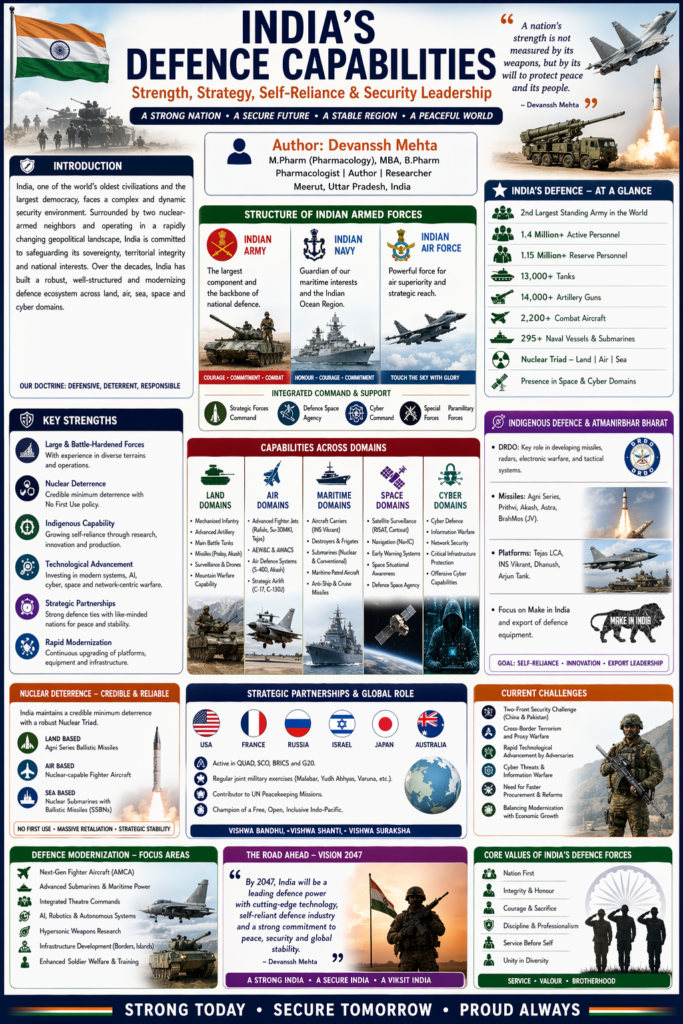
Introduction: The Strategic Imperative of National Defence
National defence represents one of the most fundamental responsibilities of any sovereign state. The ability of a nation to protect its territorial integrity, maintain internal stability, and project strategic influence beyond its borders is closely linked to the strength and readiness of its military capabilities. In the contemporary international system, where geopolitical competition, technological warfare, and hybrid threats are increasingly shaping global security dynamics, defence preparedness has become a central pillar of national power.
India, as the world’s largest democracy and one of the fastest-growing major economies, occupies a critical position in the evolving global security architecture. Located at the intersection of South Asia, Central Asia, Southeast Asia, and the Indian Ocean region, India’s geopolitical environment is characterized by complex security challenges. These include territorial disputes, cross-border terrorism, maritime security threats, cyber warfare, and emerging technological competition in defence systems.
Over the past several decades, India has invested significantly in strengthening its defence capabilities through modernization of its armed forces, expansion of indigenous defence manufacturing, development of advanced missile systems, and enhancement of strategic partnerships with global allies. These efforts have transformed India into one of the most formidable military powers in the world.
India’s defence capabilities today encompass a wide spectrum of military assets including a large standing army, advanced air power, a rapidly modernizing navy, nuclear deterrence capabilities, space-based defence technologies, and an increasingly sophisticated cyber warfare infrastructure. Collectively, these components form the foundation of India’s comprehensive national security strategy.
At the same time, India’s defence doctrine continues to emphasize a balanced approach that combines military preparedness with diplomatic engagement and strategic restraint. Unlike many traditional military powers, India has historically pursued a policy of defensive deterrence rather than aggressive expansionism. This philosophy reflects India’s broader commitment to regional stability and international peace.
However, the evolving geopolitical landscape of the twenty-first century requires continuous adaptation of defence strategies. The rise of China as a global military power, persistent tensions along India’s northern borders, increasing maritime competition in the Indo-Pacific region, and the emergence of unconventional warfare domains such as cyber and space warfare have significantly influenced India’s defence planning.
Understanding India’s defence capabilities therefore requires a comprehensive examination of its military structure, strategic doctrines, technological advancements, and future defence modernization initiatives.
This article explores the evolution and current state of India’s defence capabilities, analyzing the strengths of its armed forces, the progress of indigenous defence technologies, the role of nuclear deterrence, and the strategic vision guiding India’s military modernization in the decades ahead.
Historical Evolution of India’s Defence Strategy
India’s defence strategy has evolved significantly since independence in 1947. In the early years of nation-building, the country faced several security challenges including partition-related conflicts, border disputes, and regional instability.
The wars with Pakistan in 1947, 1965, and 1971, as well as the conflict with China in 1962, played a crucial role in shaping India’s defence policies and military modernization efforts. These conflicts highlighted the importance of strengthening military preparedness and developing domestic defence capabilities.
The 1971 war, which led to the creation of Bangladesh, demonstrated India’s ability to conduct large-scale coordinated military operations involving the army, navy, and air force. This victory significantly enhanced India’s regional strategic influence.
Another milestone in India’s defence evolution was the development of nuclear weapons capability following the nuclear tests conducted in 1974 and 1998. These developments established India as a nuclear power and strengthened its deterrence capabilities.
Over time, India’s defence strategy has increasingly focused on modernization, technological innovation, and strategic partnerships with global allies.
Structure of the Indian Armed Forces
India possesses one of the largest and most capable military forces in the world. The country’s defence system is structured around three primary branches:
• Indian Army
• Indian Navy
• Indian Air Force
In addition to these branches, India also maintains specialized strategic and paramilitary forces including the Strategic Forces Command, Defence Space Agency, and Cyber Command units.
The Indian Army: Strength and Strategic Readiness
The Indian Army represents the backbone of India’s defence capabilities. With millions of personnel including active and reserve forces, it is among the largest armies in the world.
The army’s primary responsibilities include defending India’s land borders, conducting counter-insurgency operations, and maintaining internal security in sensitive regions.
India shares long and complex land borders with several neighboring countries, including Pakistan and China. As a result, the army maintains strong defensive deployments across mountainous regions such as the Himalayas.
In recent years, the Indian Army has undertaken significant modernization initiatives aimed at enhancing combat effectiveness. These initiatives include the acquisition of advanced artillery systems, modern infantry equipment, surveillance technologies, and integrated battlefield communication systems.
The Indian Air Force: Air Superiority and Strategic Mobility
Air power plays a crucial role in modern warfare, providing rapid response capabilities and strategic deterrence.
The Indian Air Force (IAF) operates a diverse fleet of combat aircraft, transport planes, surveillance systems, and unmanned aerial vehicles. Advanced fighter jets such as the Rafale, Sukhoi Su-30MKI, and Tejas contribute significantly to India’s air superiority capabilities.
The air force also plays a critical role in humanitarian missions, disaster relief operations, and strategic airlift capabilities across the region.
Continuous modernization of aircraft systems, radar networks, and missile defence systems remains a key priority for the Indian Air Force.
The Indian Navy: Securing the Indo-Pacific
The Indian Navy serves as the guardian of India’s maritime interests in the Indian Ocean region. As global trade increasingly depends on maritime routes, naval power has become a central component of national security.
India’s naval capabilities include aircraft carriers, nuclear-powered submarines, destroyers, frigates, and advanced maritime surveillance systems.
The development of indigenous aircraft carriers and nuclear submarines reflects India’s growing emphasis on self-reliance in defence technology.
The navy also plays an important role in safeguarding maritime trade routes, conducting anti-piracy operations, and strengthening regional security cooperation.
Nuclear Deterrence and Strategic Stability
India’s nuclear doctrine is based on the principle of credible minimum deterrence. The country maintains nuclear capabilities to deter potential adversaries while adhering to a policy of No First Use.
India’s nuclear triad consists of:
• Land-based ballistic missiles
• Air-delivered nuclear weapons
• Submarine-launched ballistic missiles
This triad ensures second-strike capability, which is a key component of nuclear deterrence strategy.
Indigenous Defence Manufacturing and Technological Innovation
In recent years, India has placed increasing emphasis on strengthening its domestic defence manufacturing capabilities through initiatives such as Atmanirbhar Bharat.
The Defence Research and Development Organisation (DRDO) has played a major role in developing indigenous defence technologies including missile systems, radar systems, electronic warfare equipment, and unmanned aerial vehicles.
India has also developed advanced missile systems such as the Agni series, Prithvi missiles, and BrahMos supersonic cruise missile.
These advancements contribute significantly to India’s strategic deterrence capabilities.
Cyber Warfare and Space Defence
Modern warfare increasingly extends beyond traditional battlefields into domains such as cyberspace and outer space.
India has established specialized agencies responsible for cyber defence and space security. These agencies focus on protecting critical infrastructure, conducting cyber intelligence operations, and monitoring potential threats.
India’s space program also plays an important role in defence capabilities through satellite surveillance, navigation systems, and communication networks.
Strategic Partnerships and Global Security Cooperation
India actively participates in international defence partnerships aimed at strengthening regional security and promoting stability.
Strategic alliances with countries such as the United States, France, Japan, Australia, and Israel have contributed to enhanced defence cooperation, joint military exercises, and technology sharing.
India’s participation in initiatives such as the Quad alliance reflects its growing role in shaping Indo-Pacific security architecture.
Challenges in India’s Defence Preparedness
Despite significant progress, India faces several challenges in maintaining optimal defence readiness.
These include:
• Rapid technological advancements in warfare
• Border tensions with neighboring countries
• Need for faster defence procurement processes
• Balancing defence expenditure with economic development
Addressing these challenges requires sustained investment in defence research, strategic planning, and military modernization.
The Future of India’s Defence Capabilities
Looking ahead, India’s defence strategy will likely focus on several key priorities:
• Development of advanced military technologies
• Strengthening indigenous defence manufacturing
• Enhancing cyber and space warfare capabilities
• Expanding international defence partnerships
These initiatives will help ensure that India remains capable of responding effectively to emerging security challenges.
Conclusion: India as a Responsible Security Power
India’s defence capabilities have evolved significantly over the past several decades, transforming the country into a major military power with global strategic influence. Through modernization of its armed forces, development of advanced defence technologies, and expansion of international partnerships, India has strengthened its ability to safeguard national security and contribute to regional stability.
However, defence capability is not merely a function of military strength alone. It also reflects a nation’s commitment to strategic foresight, technological innovation, and responsible global leadership.
As the international system continues to evolve, India’s role as a responsible security power will remain critical in shaping the future of regional and global peace.