
Subtitle: Navigating Science, Strategy, and Self-Mastery in India’s Expanding Pharmaceutical Ecosystem
The pharmaceutical industry today stands at a remarkable intersection of science, innovation, economics, and human welfare. It is not merely an industry—it is a mission-driven ecosystem where molecules translate into medicines, and medicines translate into lives saved, extended, and improved. For a country like India, often referred to as the “Pharmacy of the World,” the pharmaceutical sector represents not just economic strength but also moral responsibility. Building a great career in this domain, therefore, is not a linear journey; it is a multi-dimensional evolution that demands intellectual rigor, scientific depth, ethical clarity, and strategic adaptability. In the present era of biotechnology revolutions, artificial intelligence-driven drug discovery, regulatory complexities, and global competition, the concept of a “successful career” in pharmaceuticals has undergone a fundamental transformation.
At the very foundation of a pharmaceutical career lies education—but not merely as a qualification, rather as a mindset. Traditional degrees such as B.Pharm, M.Pharm, Pharm.D, and specialized doctorates in pharmacology, pharmaceutics, or medicinal chemistry provide the academic entry point. However, the modern pharmaceutical professional must transcend textbook knowledge and cultivate what can be termed as “applied scientific intelligence.” This involves understanding not only how drugs are developed, but why certain molecules succeed in clinical trials while others fail, how regulatory frameworks shape innovation, and how market dynamics influence therapeutic priorities. In India, institutions are increasingly producing graduates, but the industry continues to seek professionals who can think beyond syllabi, interpret data critically, and contribute meaningfully to innovation pipelines.
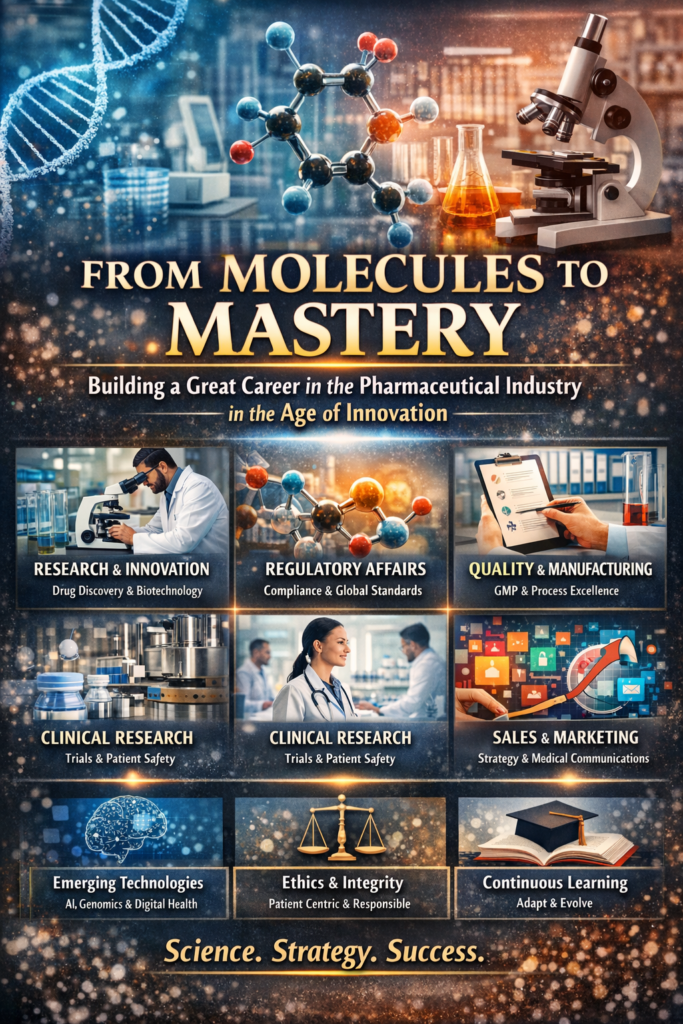
The pharmaceutical career landscape is remarkably diverse, offering pathways that cater to different intellectual inclinations and personality types. Broadly, these can be categorized into research and development (R&D), manufacturing and quality assurance, regulatory affairs, clinical research, pharmacovigilance, sales and marketing, and emerging domains such as bioinformatics and digital therapeutics. Each of these domains demands a distinct skill set, yet they are interconnected within the larger pharmaceutical value chain. A researcher working on drug discovery must understand regulatory expectations; a marketing professional must comprehend clinical data; a pharmacovigilance expert must interpret real-world evidence in the context of patient safety. Thus, building a great career is not about choosing a domain in isolation, but about developing a systems-level understanding of the entire pharmaceutical ecosystem.
Research and development remain the intellectual backbone of the pharmaceutical industry. It is here that scientific curiosity meets disciplined experimentation. However, contrary to popular perception, R&D is not merely about laboratory work; it is about problem-solving at the molecular and systemic levels. The journey from target identification to lead optimization, preclinical studies, and clinical trials is fraught with uncertainties, high attrition rates, and significant financial investments. For Indian professionals aspiring to excel in R&D, the challenge is twofold: to compete with global innovation standards while navigating domestic constraints such as limited funding and infrastructural gaps. Yet, this challenge also presents an opportunity. With India’s growing emphasis on innovation-led pharmaceutical growth, professionals who can integrate pharmacology with data science, biotechnology, and computational modeling are poised to lead the next wave of drug discovery.
Parallel to R&D, the domain of manufacturing and quality assurance forms the operational backbone of the pharmaceutical industry. India’s global reputation as a leading supplier of generic medicines is built on its manufacturing excellence and cost efficiency. However, this domain is undergoing rapid transformation due to increasing regulatory scrutiny from agencies such as the US FDA and EMA. Quality is no longer a compliance requirement; it is a strategic differentiator. Professionals in this field must possess a deep understanding of Good Manufacturing Practices (GMP), quality control methodologies, process validation, and risk management. More importantly, they must develop a culture of quality that goes beyond checklists and audits, embedding scientific integrity into every stage of production. In an era where a single quality lapse can have global repercussions, the role of quality professionals has become more critical than ever.
Regulatory affairs represent the bridge between science and policy. It is a domain that requires not only scientific knowledge but also an understanding of legal frameworks, documentation standards, and international guidelines. As pharmaceutical markets become increasingly globalized, regulatory professionals must navigate complex approval processes across different jurisdictions. In India, the regulatory landscape is evolving, with increased emphasis on transparency, efficiency, and alignment with global standards. For aspiring professionals, this domain offers immense potential, particularly for those who can combine technical expertise with strategic thinking. The ability to anticipate regulatory challenges, design compliant development strategies, and communicate effectively with authorities can significantly enhance career growth in this field.
Clinical research and pharmacovigilance are domains that directly connect pharmaceutical science with patient outcomes. Clinical research involves the systematic evaluation of new drugs in human subjects, ensuring their safety and efficacy. Pharmacovigilance, on the other hand, focuses on monitoring adverse drug reactions and ensuring ongoing patient safety post-approval. These domains require meticulous attention to detail, ethical sensitivity, and strong analytical skills. In India, the clinical research sector has faced challenges related to regulatory uncertainties and ethical concerns in the past, but it is gradually regaining momentum with improved guidelines and oversight. For professionals, this domain offers the opportunity to contribute directly to patient welfare while engaging with cutting-edge scientific developments.
Sales and marketing in pharmaceuticals are often underestimated, yet they play a pivotal role in ensuring that scientific innovations reach patients effectively. Unlike conventional marketing, pharmaceutical marketing requires a deep understanding of medical science, therapeutic areas, and physician behavior. It is a domain where communication skills, strategic thinking, and scientific knowledge converge. In the Indian context, the pharmaceutical market is highly competitive, with thousands of brands vying for attention. Professionals who can differentiate products based on evidence, build trust with healthcare providers, and adapt to digital marketing trends are likely to excel. Moreover, with the rise of patient-centric approaches and digital health platforms, the nature of pharmaceutical marketing is undergoing a significant transformation.
Emerging domains such as bioinformatics, pharmacogenomics, and digital therapeutics are redefining the future of pharmaceutical careers. The integration of artificial intelligence and machine learning into drug discovery processes is accelerating innovation while reducing costs. Personalized medicine, driven by genetic insights, is shifting the focus from “one-size-fits-all” treatments to tailored therapeutic strategies. Digital therapeutics, which involve software-based interventions for disease management, are expanding the scope of the pharmaceutical industry beyond traditional drugs. For young professionals, these domains offer exciting opportunities, but they also demand continuous learning and interdisciplinary expertise. The ability to integrate biology with data science, and pharmacology with technology, will be a defining factor for success in the coming decades.
While technical skills are essential, the importance of soft skills and personal attributes cannot be overstated. The pharmaceutical industry operates in a highly collaborative environment, where cross-functional teams work together to achieve common goals. Communication, leadership, adaptability, and ethical integrity are critical for career advancement. In particular, ethical considerations hold a special place in pharmaceuticals, given the direct impact on human health. Professionals must navigate complex situations involving clinical trials, marketing practices, and patient safety with a strong moral compass. In an industry where trust is paramount, ethical lapses can have far-reaching consequences, both for individuals and organizations.
Networking and professional visibility are also crucial components of career building. In today’s digital age, platforms such as LinkedIn, research publications, conferences, and professional associations provide opportunities to showcase expertise and connect with industry leaders. For Indian professionals, participating in global forums and collaborations can enhance exposure and open new avenues for growth. Additionally, mentorship plays a vital role in shaping careers. Learning from experienced professionals, understanding industry dynamics, and receiving guidance on career decisions can significantly accelerate professional development.
Entrepreneurship is an emerging pathway within the pharmaceutical sector, particularly in India’s startup ecosystem. From contract research organizations (CROs) and manufacturing units to digital health platforms and biotech startups, the opportunities are vast. However, pharmaceutical entrepreneurship is inherently complex, requiring not only scientific expertise but also business acumen, regulatory understanding, and financial management. For individuals with a vision to create impact, entrepreneurship offers the opportunity to innovate, create employment, and contribute to national healthcare goals. Government initiatives such as “Make in India” and support for biotech startups are further encouraging entrepreneurial ventures in this sector.
A critical aspect of building a great career in pharmaceuticals is continuous learning. The industry is characterized by rapid advancements, evolving regulations, and shifting market dynamics. What is relevant today may become obsolete tomorrow. Therefore, professionals must adopt a mindset of lifelong learning, constantly updating their knowledge and skills. This includes pursuing advanced certifications, attending workshops, engaging with scientific literature, and staying informed about global trends. In essence, learning should not be seen as a phase but as a continuous process that accompanies every stage of one’s career.
From a strategic perspective, career building in pharmaceuticals requires clarity of vision and adaptability of approach. Professionals must identify their strengths, align them with industry opportunities, and continuously refine their goals. At the same time, they must remain flexible, ready to pivot in response to changing circumstances. The ability to balance specialization with versatility is particularly important. While deep expertise in a specific domain is valuable, a broader understanding of the industry enhances strategic thinking and career resilience.
In the Indian context, the pharmaceutical industry is poised for significant growth, driven by factors such as increasing healthcare demand, government initiatives, and global supply chain shifts. However, this growth also brings challenges, including pricing pressures, regulatory complexities, and competition from other emerging markets. For professionals, this environment presents both opportunities and responsibilities. Building a great career is not just about personal success; it is about contributing to the larger goal of improving healthcare outcomes and strengthening India’s position as a global pharmaceutical leader.
Ultimately, a great career in pharmaceuticals is defined not by titles or salaries, but by impact. It is about the ability to translate scientific knowledge into solutions that improve lives. It is about maintaining integrity in the face of challenges, pursuing excellence with discipline, and contributing to a mission that transcends individual ambitions. For those who choose this path, the journey may be demanding, but it is also deeply rewarding. In the end, the true measure of success in pharmaceuticals lies not in professional achievements alone, but in the lives touched and transformed through one’s work.
As the pharmaceutical industry continues to evolve, the professionals who will lead the future are those who combine knowledge with wisdom, skill with ethics, and ambition with purpose. Building such a career requires not only strategic planning but also inner clarity and resilience. It demands a commitment to continuous growth, a willingness to embrace challenges, and a vision that goes beyond personal gain. In this journey from molecules to mastery, the destination is not merely a successful career—it is a meaningful life dedicated to science, service, and societal progress.