

Introduction: Wealth Preservation in an Era of Monetary Uncertainty
The Indian investment psyche has historically been anchored in the cultural, emotional, and financial significance of gold and silver. These metals are not merely commodities; they represent intergenerational wealth, economic security, and a hedge against systemic instability. However, the contemporary landscape of 2025–2026 has transformed precious metal investing from a traditional habit into a complex strategic decision-making exercise.
Gold prices in India have surged dramatically, touching levels above ₹1.5 lakh per 10 grams in 2026, reflecting a multi-year exponential rise from approximately ₹65,000 in 2023 . Simultaneously, silver has exhibited even more dramatic volatility, with projections placing it between ₹2.4 lakh to ₹3.5 lakh per kg in 2026 . This sharp escalation is not an isolated phenomenon but a reflection of deeper macroeconomic currents—global inflation, geopolitical conflicts, currency instability, and evolving industrial demand.
In such an environment, Indian investors are confronted with a critical question: should one continue to accumulate gold at elevated levels, shift focus toward silver, or diversify beyond traditional paradigms?
This article explores a comprehensive, deeply analytical framework for investment strategies in gold and silver, contextualized within the current economic environment and tailored specifically for Indian investors.
The Macroeconomic Context: Why Gold and Silver Are Expensive Today
The surge in gold and silver prices must be understood through the lens of global macroeconomics rather than isolated market behavior. The period of 2025–2026 has been characterized by geopolitical instability, particularly tensions involving the United States, Israel, and Iran, which have significantly influenced commodity markets .
Gold, traditionally a safe-haven asset, witnessed a historic rally in 2025, rising sharply due to policy uncertainty, central bank accumulation, and currency fluctuations . Central banks across the world, including India, have increased their gold reserves, reinforcing its position as a sovereign asset.
Silver, on the other hand, has experienced a dual-force demand dynamic. Unlike gold, silver is not only a store of value but also a critical industrial metal used in solar panels, electronics, and electric vehicles. This duality has amplified its price volatility. Reports suggest silver prices increased by over 130% in 2025 alone, driven by industrial demand and speculative investment flows .
However, the present moment also reflects instability. Recent data indicates sharp short-term declines in both metals due to global monetary tightening and dollar strength, with silver dropping significantly and gold falling to around ₹1.46 lakh per 10 grams . This volatility highlights a crucial insight: the current market is not a simple bull run—it is a structurally unstable upward trend.
Gold as a Strategic Asset: Stability, Sovereignty, and Psychological Security
Gold’s enduring appeal lies in its role as a hedge against inflation, currency depreciation, and systemic financial risk. For Indian investors, gold serves multiple functions: financial insurance, portfolio diversification, and cultural wealth preservation.
From a strategic perspective, gold should not be viewed as a return-generating asset in the conventional sense but as a risk-mitigating instrument. Historical data reveals that gold has delivered consistent long-term appreciation, with returns exceeding 180% between 2019 and 2025 .
In 2026, gold continues to exhibit a bullish long-term outlook. Forecasts suggest prices may approach or exceed $5,000 per ounce globally, indicating sustained upward momentum . This implies that despite current high prices, gold is unlikely to experience a structural collapse.
However, the strategic error many Indian investors make is treating gold as a short-term speculative asset. At elevated price levels, lump-sum investments increase risk exposure. Instead, gold should be accumulated systematically, using approaches such as staggered buying, sovereign gold bonds, and gold ETFs.
Thus, the correct framework for gold investment is not “timing the market” but “building a strategic reserve.”
Silver: The High-Risk, High-Opportunity Metal of the Future
Silver represents a fundamentally different investment proposition. While gold is a defensive asset, silver is a hybrid asset, combining characteristics of both a commodity and a financial instrument.
The most significant driver of silver’s future lies in its industrial applications. The global transition toward renewable energy, particularly solar power, has positioned silver as a critical resource. This structural demand ensures long-term bullish potential.
However, this very characteristic introduces volatility. Unlike gold, which thrives during uncertainty, silver is sensitive to economic cycles. A slowdown in industrial demand can lead to sharp price corrections.
Recent market behavior illustrates this duality. While silver prices have surged significantly, they have also experienced sharp declines, including drops of up to ₹19,000 per kg in a short span .
For Indian investors, silver should not be approached as a substitute for gold but as a tactical allocation. It offers higher upside potential but requires disciplined entry and exit strategies.
A prudent strategy would involve:
- Buying during sharp corrections (“buy the dip” behavior observed among retail investors )
- Limiting exposure to a defined percentage of the portfolio
- Monitoring industrial demand trends globally
Silver is not a wealth preservation tool—it is a wealth acceleration tool, but with inherent risk.
The Gold vs Silver Debate: Strategic Allocation for Indian Investors
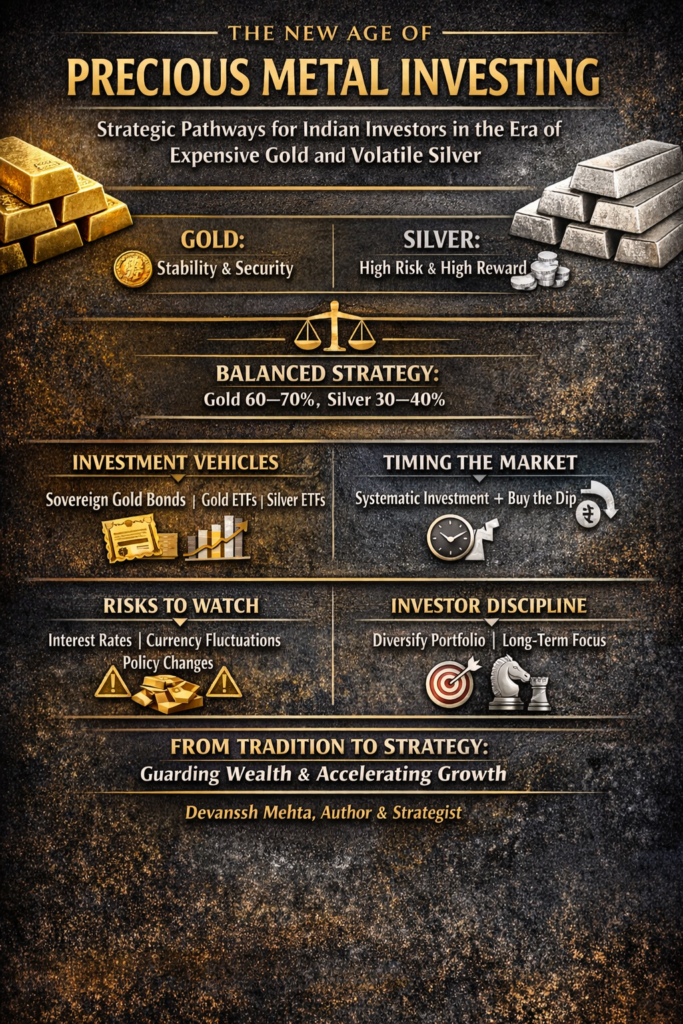
The debate between gold and silver is not a question of substitution but of allocation. Both metals serve distinct roles within a portfolio.
Gold provides stability, predictability, and long-term security. Silver offers growth potential, volatility, and speculative opportunity.
A balanced Indian portfolio in the current environment may adopt a structured allocation model:
- 60–70% in gold (stability core)
- 30–40% in silver (growth component)
This ratio may vary depending on risk appetite, age, and financial goals. Conservative investors may lean heavily toward gold, while aggressive investors may increase silver exposure.
The key principle is diversification within precious metals themselves, rather than viewing them as a singular asset class.
Investment Vehicles: Physical vs Financial Gold and Silver
The method of investment is as critical as the asset itself. Indian investors traditionally prefer physical gold and silver in the form of jewelry, coins, and bars. However, this approach has inherent inefficiencies, including making charges, storage risks, and liquidity constraints.
Modern financial instruments offer more efficient alternatives:
Gold Investment Options
- Sovereign Gold Bonds (SGBs): Provide interest income and tax benefits
- Gold ETFs: Offer liquidity and market-linked pricing
- Digital Gold: Convenient but requires careful platform selection
Silver Investment Options
- Physical silver (dominant option in India)
- Silver ETFs (emerging but limited adoption)
- Commodity market exposure (for advanced investors)
The strategic shift must be from emotional ownership to financial optimization.
Timing the Market vs Time in the Market: The Strategic Dilemma
One of the most critical questions facing investors today is whether to invest at current high prices or wait for corrections.
Recent price movements indicate that both gold and silver are highly sensitive to global monetary policy, particularly decisions by the US Federal Reserve . Short-term corrections are inevitable and frequent.
However, attempting to perfectly time the market is inherently flawed. The long-term trajectory of both metals remains upward due to structural factors such as inflation, currency depreciation, and geopolitical uncertainty.
Therefore, the optimal strategy is systematic investment combined with opportunistic accumulation during corrections.
This hybrid strategy allows investors to balance risk and opportunity without relying on speculative timing.
Behavioral Finance: The Psychology of Indian Investors
Investment decisions in India are deeply influenced by behavioral biases. Gold is often purchased during price surges due to fear of missing out, while corrections trigger panic selling.
This cyclical behavior leads to suboptimal returns.
The disciplined investor must detach from emotional impulses and adopt a rational framework:
- Buy when markets are uncertain, not euphoric
- Accumulate gradually rather than aggressively
- Align investments with long-term financial goals
The shift from emotion-driven investing to strategy-driven investing is essential for wealth creation.
Risks and Structural Challenges in Precious Metal Investing
Despite their perceived safety, gold and silver are not risk-free assets.
Key risks include:
- Interest rate fluctuations (higher rates reduce gold attractiveness)
- Currency strength (a stronger dollar suppresses prices)
- Industrial demand variability (affecting silver)
- Policy changes and import regulations in India
Recent market corrections triggered by US monetary policy highlight the sensitivity of these metals to global financial conditions .
Thus, investors must recognize that gold and silver are defensive assets, not guaranteed profit generators.
Strategic Roadmap: A Model Investment Framework for Indian Investors
A comprehensive investment strategy in the current environment should include:
- Core Allocation
Maintain 10–20% of total portfolio in gold for stability - Tactical Allocation
Allocate 5–10% to silver for growth opportunities - Investment Method
Use systematic investment plans (SIPs) in gold ETFs or SGBs - Market Strategy
Increase allocation during corrections rather than rallies - Diversification
Avoid over-reliance on precious metals; balance with equities and fixed income - Long-Term Vision
Treat gold as financial insurance, not a profit-making tool
Conclusion: From Tradition to Strategy — The Evolution of Precious Metal Investing in India
India stands at a critical juncture in its investment evolution. The traditional affinity toward gold and silver must now be complemented with strategic intelligence and financial discipline.
The current high prices of gold and volatile movements in silver are not deterrents but indicators of a transforming global economic order. These metals are no longer passive stores of value; they are dynamic assets influenced by geopolitics, industrial demand, and monetary policy.
For the Indian investor, the future lies not in abandoning gold and silver, but in redefining the approach toward them. The transition must be from cultural habit to strategic allocation, from emotional buying to disciplined investing, and from short-term speculation to long-term wealth architecture.
In this new paradigm, gold remains the guardian of wealth, while silver emerges as its aggressive counterpart. Together, they form a powerful dual-asset strategy—one that, if executed with precision and discipline, can navigate uncertainty and build enduring financial resilience.
The essence of successful investing in 2026 is not merely choosing the right asset—but adopting the right philosophy.
And in that philosophy lies the difference between preserving wealth and creating it.