

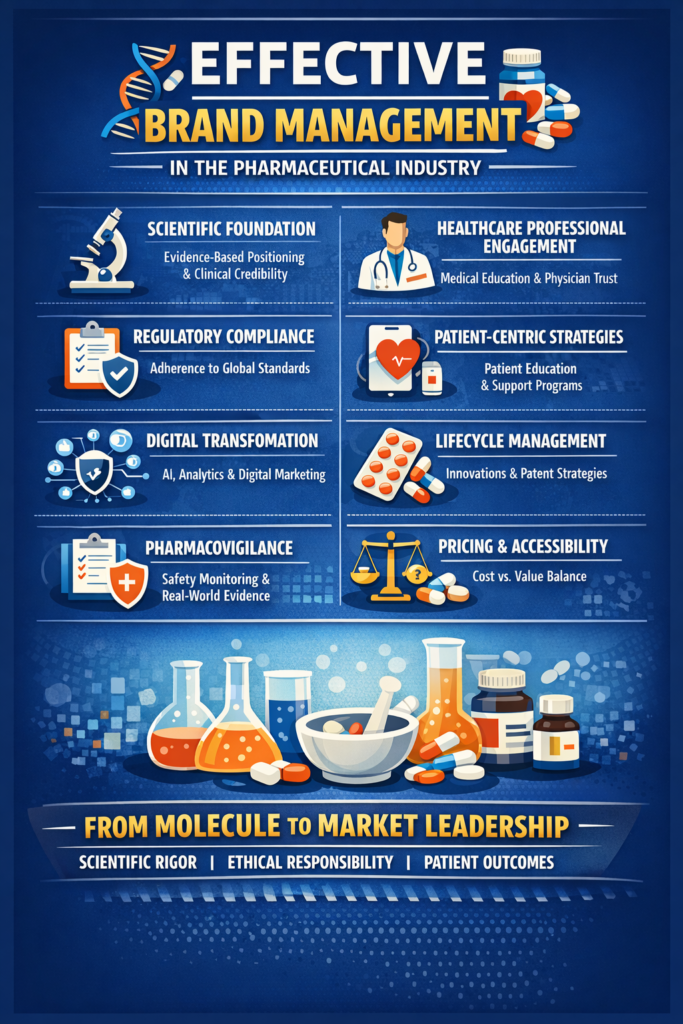
The pharmaceutical industry represents one of the most complex and highly regulated commercial ecosystems in the global economy. Unlike traditional consumer industries where branding often revolves around emotional appeal, aesthetics, and lifestyle positioning, pharmaceutical brand management exists at the intersection of science, regulation, clinical credibility, and patient welfare. Effective brand management in this sector therefore demands not only marketing sophistication but also deep scientific understanding, regulatory compliance, and ethical responsibility. Pharmaceutical brands are not merely commercial identifiers; they are representations of therapeutic trust, clinical efficacy, safety, and long-term healthcare value. In an era defined by rapid scientific advancement, increasing competition from generics and biosimilars, rising healthcare costs, and evolving patient expectations, pharmaceutical companies must approach brand management as a strategic discipline that integrates research, clinical evidence, physician engagement, patient education, and global regulatory alignment. The success of a pharmaceutical brand ultimately determines not only commercial outcomes but also its impact on patient care, therapeutic adoption, and healthcare system sustainability.
Brand management in the pharmaceutical sector begins long before a drug reaches the marketplace. Unlike consumer goods where branding often emerges after product development, pharmaceutical brand strategy is deeply embedded in the drug development process itself. From the early phases of clinical research, companies begin to conceptualize the future therapeutic positioning of a drug candidate. This positioning involves identifying the disease burden, understanding unmet clinical needs, evaluating competitive therapies, and defining the value proposition that the drug will offer to healthcare professionals and patients. In this sense, pharmaceutical branding is fundamentally evidence-driven. Clinical trial outcomes, safety profiles, pharmacokinetic characteristics, dosing convenience, and therapeutic advantages collectively shape the narrative around a pharmaceutical product. The brand is therefore constructed upon scientific credibility rather than promotional exaggeration.
The modern pharmaceutical marketplace is characterized by intense competition, particularly in therapeutic areas such as oncology, cardiology, diabetes, and neurology. As multiple companies develop similar molecules or therapeutic classes, differentiation becomes a critical component of brand management. Effective pharmaceutical brands articulate a clear and scientifically grounded value proposition. This differentiation may arise from superior efficacy, improved safety profile, innovative drug delivery systems, enhanced patient compliance, or better cost-effectiveness. For example, a once-daily dosing regimen may provide significant advantages over drugs requiring multiple administrations per day, thereby improving patient adherence and therapeutic outcomes. Such attributes become integral elements of the brand narrative communicated to physicians, pharmacists, healthcare institutions, and regulatory stakeholders.
One of the defining characteristics of pharmaceutical brand management is the central role played by healthcare professionals. Physicians remain the primary decision-makers in prescribing medicines, particularly for prescription drugs. Consequently, pharmaceutical brands must establish credibility and trust within the medical community. This requires a robust scientific communication strategy that includes peer-reviewed publications, clinical conference presentations, continuing medical education programs, and direct engagement through medical representatives. Unlike traditional consumer marketing, pharmaceutical branding cannot rely solely on advertising. Instead, it must be anchored in clinical evidence and supported by credible scientific discourse.
Medical representatives historically have served as the frontline ambassadors of pharmaceutical brands. Their role extends beyond mere product promotion; they act as scientific communicators who translate complex clinical data into practical insights for physicians. Effective brand management therefore requires rigorous training programs for sales teams to ensure they possess adequate pharmacological knowledge, therapeutic understanding, and ethical marketing practices. When medical representatives engage with healthcare professionals, the interaction must reinforce the brand’s scientific integrity and therapeutic reliability. The reputation of a pharmaceutical brand can be significantly strengthened or damaged by the quality of these professional interactions.
Another critical dimension of pharmaceutical brand management lies in regulatory compliance. The pharmaceutical industry operates within a stringent regulatory framework designed to ensure drug safety, efficacy, and ethical promotion. Regulatory authorities such as the U.S. Food and Drug Administration, the European Medicines Agency, and India’s Central Drugs Standard Control Organization enforce strict guidelines governing pharmaceutical advertising and communication. Companies must ensure that all promotional materials accurately reflect approved indications, dosage recommendations, contraindications, and safety warnings. Misleading claims or exaggerated marketing can result in severe regulatory penalties and irreversible damage to brand credibility. Therefore, effective brand management requires close coordination between marketing teams, regulatory affairs departments, and medical experts to ensure that promotional messaging remains scientifically accurate and legally compliant.
In recent decades, the rise of generic medicines has significantly altered the pharmaceutical branding landscape. Once patent protection expires, multiple generic manufacturers may produce equivalent versions of the original drug, often at substantially lower prices. This phenomenon intensifies competition and can rapidly erode the market share of innovator brands. Pharmaceutical companies must therefore anticipate the lifecycle of their brands and develop strategic plans to sustain market relevance even after patent expiry. Lifecycle management strategies may include the development of improved formulations, combination therapies, extended-release versions, or new therapeutic indications. Such innovations allow companies to extend the commercial viability of their brands while continuing to provide meaningful clinical benefits to patients.
The emergence of biologics and biosimilars has introduced an additional layer of complexity in pharmaceutical brand management. Biologic medicines, derived from living organisms, represent some of the most advanced therapeutic interventions in modern medicine, particularly in fields such as oncology, immunology, and rare diseases. Because biologics are highly complex molecules, biosimilar versions are not identical replicas in the same manner as small-molecule generics. As a result, brand reputation and physician trust play an even more significant role in the adoption of biologic therapies. Pharmaceutical companies must invest heavily in physician education, post-marketing surveillance, and pharmacovigilance programs to reinforce the safety and reliability of their biologic brands.
Patient-centricity has also emerged as a transformative principle in pharmaceutical brand management. Historically, pharmaceutical marketing focused primarily on physicians as the key stakeholders. However, the modern healthcare environment increasingly recognizes patients as informed participants in treatment decisions. With the proliferation of digital health platforms, online medical information, and patient advocacy groups, individuals now play a more active role in understanding their treatment options. Pharmaceutical brands must therefore develop communication strategies that address patient concerns, improve health literacy, and promote adherence to prescribed therapies. Patient support programs, educational materials, digital applications, and disease awareness campaigns have become integral components of contemporary brand strategies.
Digital transformation has further reshaped pharmaceutical brand management in profound ways. Traditional marketing channels such as printed brochures and face-to-face detailing are gradually being supplemented by digital platforms, virtual conferences, telemedicine interactions, and data-driven marketing tools. Digital engagement allows pharmaceutical companies to reach healthcare professionals and patients more efficiently while generating valuable insights into prescribing patterns and treatment outcomes. Artificial intelligence, data analytics, and customer relationship management systems enable companies to personalize their communication strategies and deliver targeted educational content. In this evolving landscape, pharmaceutical brands must establish a strong digital presence while maintaining scientific credibility and ethical transparency.
Another essential dimension of pharmaceutical brand management involves pharmacovigilance and real-world evidence generation. Once a drug enters the market, its long-term safety and effectiveness continue to be evaluated through post-marketing surveillance programs. Adverse event monitoring, patient registries, and real-world data collection provide valuable insights into the drug’s performance across diverse patient populations. Companies that proactively engage in pharmacovigilance demonstrate a commitment to patient safety and therapeutic integrity. Such initiatives reinforce brand trust among physicians, regulatory authorities, and patients. In many cases, real-world evidence can also support additional indications, improved treatment guidelines, and broader adoption of the therapy.
Pricing strategy represents another crucial factor influencing pharmaceutical brand success. Medicines must balance commercial sustainability with healthcare affordability. Excessively high pricing can restrict patient access and provoke public criticism, whereas unsustainably low pricing may undermine research investment and product viability. Pharmaceutical companies must therefore adopt pricing models that reflect therapeutic value, healthcare system constraints, and market competition. Health technology assessment agencies increasingly evaluate the cost-effectiveness of medicines before approving reimbursement. Consequently, pharmaceutical brand management must incorporate pharmacoeconomic evidence demonstrating the value of the therapy in improving patient outcomes and reducing long-term healthcare costs.
Corporate reputation and organizational credibility also play a significant role in shaping pharmaceutical brands. In the healthcare sector, trust is paramount. Companies that demonstrate ethical conduct, transparency in clinical research, responsible pricing policies, and commitment to global health initiatives tend to enjoy stronger brand loyalty among healthcare professionals and policymakers. Conversely, controversies related to data manipulation, unethical marketing, or patient safety can severely damage a company’s reputation and undermine the credibility of its entire product portfolio. Effective brand management therefore extends beyond individual medicines to encompass the overall corporate identity and ethical philosophy of the organization.
In emerging markets such as India, pharmaceutical brand management presents unique opportunities and challenges. India is one of the world’s largest producers of generic medicines and plays a critical role in supplying affordable drugs to developing countries. At the same time, the domestic pharmaceutical market is highly competitive, with thousands of brands competing within the same therapeutic categories. Physicians are frequently exposed to multiple brand options for the same active pharmaceutical ingredient, making differentiation particularly challenging. Companies must therefore rely on strong physician relationships, consistent product quality, effective supply chains, and continuous medical education initiatives to sustain brand preference.
The Indian pharmaceutical industry also faces increasing pressure to transition from a generics-dominated model toward innovation-driven research. As Indian companies expand into global markets and invest in new chemical entities, biologics, and complex generics, brand management will become increasingly sophisticated. International regulatory compliance, intellectual property considerations, and global clinical trial standards will shape the strategic positioning of Indian pharmaceutical brands. Companies that successfully integrate scientific innovation with effective brand communication will be better positioned to compete in the global pharmaceutical arena.
Ethical considerations remain central to pharmaceutical brand management. Unlike many commercial industries, pharmaceutical marketing directly influences patient health outcomes. Therefore, ethical marketing practices are not merely regulatory obligations but moral imperatives. Companies must ensure that promotional activities prioritize patient welfare and evidence-based medicine rather than short-term commercial gains. Transparent communication regarding drug benefits and risks fosters trust within the medical community and strengthens the long-term sustainability of pharmaceutical brands.
Another emerging trend in pharmaceutical brand management is the integration of personalized medicine and precision therapeutics. Advances in genomics, biomarker research, and targeted therapies are transforming the way diseases are treated. Instead of one-size-fits-all medicines, many modern drugs are designed for specific patient subpopulations based on genetic or molecular characteristics. This shift requires pharmaceutical brands to communicate highly specialized clinical information to physicians and patients. Effective brand strategies must therefore incorporate scientific education and diagnostic integration to ensure appropriate patient selection and optimal therapeutic outcomes.
Collaboration with healthcare stakeholders also plays an increasingly important role in pharmaceutical brand success. Partnerships with academic institutions, research organizations, hospitals, and patient advocacy groups contribute to the credibility and visibility of pharmaceutical brands. Such collaborations often facilitate clinical research, real-world evidence generation, and disease awareness campaigns. By engaging with broader healthcare ecosystems, pharmaceutical companies can position their brands as integral components of comprehensive patient care rather than isolated commercial products.
Supply chain reliability is another critical yet often overlooked aspect of pharmaceutical brand management. Even the most scientifically advanced medicine cannot achieve brand success if it fails to reach patients consistently. Interruptions in manufacturing, distribution delays, or quality control issues can erode physician confidence and patient trust. Therefore, pharmaceutical companies must invest in robust manufacturing infrastructure, stringent quality assurance systems, and efficient logistics networks. Consistent product availability reinforces the reliability of the brand and supports sustained therapeutic adoption.
As the pharmaceutical industry continues to evolve, the concept of brand management is expanding beyond traditional marketing functions. Today’s pharmaceutical brand managers must possess multidisciplinary expertise encompassing pharmacology, clinical research, regulatory science, health economics, digital marketing, and stakeholder engagement. They serve as strategic coordinators who integrate scientific evidence, commercial strategy, and healthcare policy considerations into a coherent brand narrative. In this sense, pharmaceutical brand management has evolved into a sophisticated discipline that blends scientific rigor with strategic communication.
Looking toward the future, pharmaceutical brand management will be shaped by several transformative forces. Artificial intelligence and big data analytics will enable companies to analyze prescribing trends, patient outcomes, and market dynamics with unprecedented precision. Digital therapeutics and remote monitoring technologies will complement traditional pharmacological treatments, creating integrated healthcare solutions that extend beyond the pill itself. Value-based healthcare models will emphasize therapeutic outcomes rather than product volume, requiring pharmaceutical brands to demonstrate measurable improvements in patient health.
Furthermore, global health challenges such as emerging infectious diseases, antimicrobial resistance, and chronic lifestyle disorders will demand innovative therapeutic solutions and effective communication strategies. Pharmaceutical brands that align themselves with public health priorities and contribute to broader societal well-being will achieve stronger credibility and long-term sustainability. The COVID-19 pandemic has already demonstrated how pharmaceutical companies can play pivotal roles in addressing global health crises through rapid vaccine development and collaborative research initiatives.
In conclusion, effective brand management in the pharmaceutical industry represents a complex strategic endeavor that integrates scientific innovation, clinical credibility, ethical responsibility, regulatory compliance, and stakeholder engagement. Pharmaceutical brands are not simply commercial assets; they are embodiments of therapeutic trust and healthcare value. The journey from molecule discovery to market leadership requires meticulous planning, rigorous scientific validation, and transparent communication with healthcare professionals and patients. As the pharmaceutical landscape continues to evolve through technological advancement, regulatory reforms, and shifting healthcare expectations, companies must adopt holistic brand management strategies that prioritize patient outcomes while sustaining commercial viability. Ultimately, the most successful pharmaceutical brands will be those that combine scientific excellence with ethical integrity, transforming innovative medicines into trusted solutions that improve human health and advance the global healthcare system.