

Precision Beyond Hands: India’s Emergence as a Global Robotic Surgery Powerhouse
A Professional Medical and Strategic Analysis
By Devanssh Mehta, Meerut, Uttar Pradesh, India
Abstract
Robotic surgery in India has transitioned from being an elite technological demonstration into becoming one of the most strategically transformative domains of modern healthcare delivery. What was once limited to a few metropolitan tertiary-care institutions has evolved into an expanding ecosystem involving surgeons, biomedical engineers, hospital chains, policymakers, device manufacturers, AI developers, and increasingly informed patients.
The year 2026 represents a defining phase in India’s surgical evolution. The conversation is no longer whether robotic surgery works; the question has shifted toward how rapidly India can democratize access, improve procedural economics, develop indigenous platforms, and create globally competitive surgical innovation.
India today stands at the intersection of four powerful forces:
- rising chronic disease burden,
- increasing demand for minimally invasive procedures,
- digital health integration,
- and strategic medical technology investments.
This article presents a professional, medically oriented, and market-driven exploration of robotic surgery in India for 2026, integrating clinical science, procedural realities, economic insights, technological trends, and future opportunities.
Introduction: Surgery Enters Its Precision Era
Human surgery has undergone successive revolutions.
The first revolution was anatomical understanding.
The second was anesthesia.
The third was antisepsis.
The fourth was minimally invasive laparoscopy.
The fifth—and perhaps the most technologically profound—is robotic-assisted surgery.
Robotic surgery does not replace surgeons.
It amplifies surgical intelligence.
Contrary to public perception, robotic systems do not operate independently. The surgeon remains fully responsible for planning, execution, decision-making, tissue handling, and intraoperative judgment. The robotic platform functions as an advanced biomechanical extension of human dexterity.
The result is enhanced precision, reduced tremor, improved visualization, finer dissection, and improved access to anatomically complex spaces.
India has moved decisively into this era.
Understanding Robotic Surgery: Medical Foundations
Robotic-assisted surgery refers to a technologically integrated surgical system enabling the surgeon to perform procedures through computerized robotic arms controlled from an ergonomic console.
Core components include:
1. Surgeon Console
Control interface translating surgeon hand movement into scaled micro-movements.
2. Patient Cart
Contains robotic arms with surgical instruments.
3. Vision System
Three-dimensional high-definition operative imaging.
4. Software Layer
Provides motion scaling, tremor filtration, image enhancement, and procedural integration.
Modern robotic surgery platforms incorporate:
- stereoscopic imaging,
- instrument articulation,
- force modulation,
- digital workflow integration,
- data capture,
- AI-assisted analytics.
Robotic systems can perform highly complex reconstructive and minimally invasive procedures with extraordinary repeatability.
Clinical Specialties Driving Adoption in India
Urology: The Historical Leader
Urology remains the strongest robotic surgery segment globally and in India.
Major procedures include:
- Robot-assisted radical prostatectomy
- Partial nephrectomy
- Radical cystectomy
- Pyeloplasty
Prostate surgery particularly benefits from robotic articulation due to confined pelvic anatomy.
Surgical Oncology
Cancer surgery is rapidly becoming one of India’s strongest robotic growth areas.
Applications include:
- colorectal cancer
- gastric cancer
- thoracic oncology
- gynecologic cancers
- hepatobiliary surgery
Enhanced visualization permits improved lymph node dissection and tissue preservation.
Gynecology
Procedures increasingly adopted:
- hysterectomy
- myomectomy
- endometriosis surgery
Robotics offers superior maneuverability in deep pelvic anatomy.
Gastrointestinal Surgery
Growing indications:
- colectomy
- bariatric surgery
- gastric reconstruction
- pancreatic procedures
Cardiothoracic Surgery
Robotic platforms increasingly support:
- valve repair
- thoracic resections
- mediastinal procedures
Orthopedics
Robotic guidance improves:
- implant alignment
- precision osteotomy
- arthroplasty planning
Orthopedics is projected to become one of India’s fastest-growing robotic categories. (Grand View Research)
Why Robotic Surgery Matters in India
India faces a unique healthcare paradox.
It possesses:
- world-class surgeons,
- cost-sensitive healthcare economics,
- rapidly increasing disease burden,
- unequal geographical access.
Robotic surgery addresses several structural challenges.
Precision
Motion scaling reduces unintended movement.
Reduced Blood Loss
Smaller operative fields reduce vascular trauma.
Faster Recovery
Shorter hospitalization improves hospital throughput.
Lower Infection Risk
Minimally invasive approaches reduce wound exposure.
Better Surgeon Ergonomics
Long procedures become less physically exhausting.
These benefits are contributing to accelerating institutional adoption globally and in India. (Oliver Wyman)
India’s Robotic Surgery Ecosystem in 2026
India’s robotic surgery ecosystem now extends beyond imported premium platforms.
The market increasingly includes:
- multinational surgical robotics companies,
- Indian medical device innovators,
- academic hospitals,
- training ecosystems,
- AI-enabled surgical data infrastructure.
India is emerging as one of the fastest-growing robotic surgery markets globally. Multiple market analyses project substantial long-term expansion through 2031 and beyond. (Trade.gov)
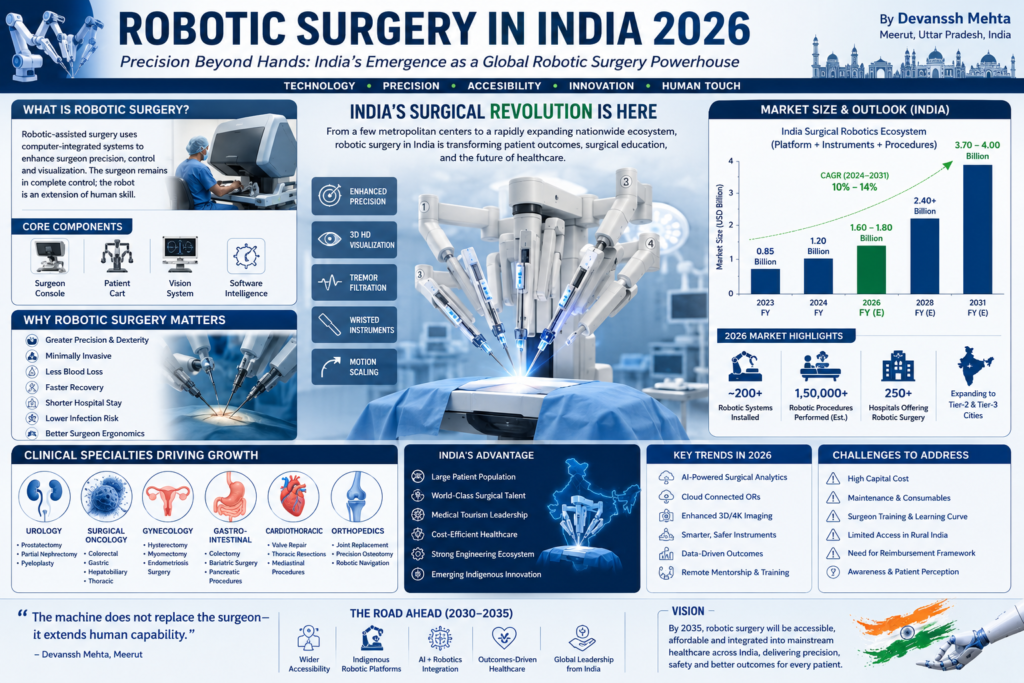
Industry estimates indicate India’s surgical robotics opportunity may expand from approximately USD 851 million in FY2023 toward nearly USD 3.7–4 billion by 2031 depending on methodology used. (Trade.gov)
Market Size and Economic Outlook (2026)
Estimating robotic surgery market size requires separating three layers:
A. Surgical Robotics Platforms
Capital equipment.
B. Consumables and Instruments
Recurring revenue.
C. Procedure Economics
Actual surgical volume.
Recent market estimates suggest:
- India surgical robots market generated approximately USD 169 million in 2024 with projected growth toward USD 569 million by 2033 (≈14% CAGR). (Grand View Research)
- Broader surgical robotics ecosystem estimates place India’s opportunity at approximately USD 851 million in FY2023 and approaching USD 3.7–4 billion by FY2031. (Trade.gov)
- Industry outlooks forecast Indian robotic surgical systems growth around 10–14% CAGR through the next decade. (Express Healthcare)
Estimated 2026 India Robotic Surgery Landscape
| Segment | Estimated Strategic Position |
|---|---|
| Platform installations | Rapid expansion |
| Procedure growth | Double-digit annual expansion |
| Oncology demand | High |
| Orthopedic robotics | Accelerating |
| Domestic manufacturing | Emerging |
| Training ecosystem | Scaling |
Economics of Robotic Surgery: Opportunity and Constraint
Despite enthusiasm, robotic surgery remains capital intensive.
Cost contributors include:
- robotic platform acquisition,
- annual maintenance,
- instrument replacement,
- training,
- operating room redesign.
Global assessments indicate robotic infrastructure can require capital expenditure significantly above conventional laparoscopy. (Oliver Wyman)
Yet cost-per-case may improve over time through:
- procedure volume expansion,
- reusable instrument optimization,
- shorter hospitalization,
- reduced complication burden.
India’s economic advantage may emerge through procedural scale and localized innovation.
Indigenous Innovation: India’s Next Surgical Revolution
India’s future leadership will depend not on importing robots but building them.
Recent domestic developments illustrate this shift.
Indian medical device innovators are introducing advanced robotic platforms designed to improve accessibility and procedural capability. (The Economic Times)
The strategic implication is profound.
India could replicate in MedTech what it achieved in pharmaceuticals:
From cost competitiveness → to technological sovereignty.
Artificial Intelligence and Robotic Surgery
The next generation of robotic surgery will not simply move instruments.
It will interpret surgery.
Emerging capabilities include:
- surgical video analytics,
- automated tissue recognition,
- intraoperative guidance,
- predictive complication alerts,
- workflow optimization.
Future operating rooms may integrate:
Robot + AI + Imaging + Digital Twin + Cloud Intelligence.
Surgeons will increasingly evolve into procedural strategists supported by computational augmentation.
Accessibility: The Central Indian Challenge
The greatest question is not technological.
It is ethical.
Who receives robotic surgery?
Urban concentration remains substantial.
However, recent public-sector expansion is encouraging.
Examples of government and teaching institutions introducing advanced robotic platforms indicate efforts toward affordability and broader access. (The Times of India)
India’s success will depend upon:
- tier-2 city deployment,
- public reimbursement pathways,
- surgeon training,
- domestic manufacturing.
Training the Robotic Surgeon
Future surgeons require expanded competencies:
Technical Skills
Instrument control and simulation.
Digital Competence
Data interpretation.
Cognitive Skills
Decision augmentation.
Human Skills
Communication and empathy.
Robotic surgery should never produce technologically sophisticated but clinically detached physicians.
Medicine remains human.
Technology remains instrumental.
Risks and Limitations
Professional evaluation requires acknowledging limitations.
Robotic surgery does not guarantee superior outcomes in every procedure.
Challenges include:
- high acquisition cost,
- learning curve,
- procedure selection bias,
- maintenance dependency,
- accessibility inequality.
Appropriate patient selection remains fundamental.
Global Context and India’s Position
Global robotic surgery markets continue expanding rapidly.
Recent forecasts estimate global robotic surgery markets ranging approximately USD 13–16 billion in 2025–2026 with double-digit annual growth trajectories. (MarketsandMarkets)
Leading platforms continue increasing procedure volume and international installations, reflecting sustained confidence in robotic-assisted surgery. (Investors)
India’s comparative advantages include:
- large surgical demand,
- highly skilled clinicians,
- medical tourism,
- cost-efficient delivery,
- engineering talent.
Strategic Forecast: Robotic Surgery in India Beyond 2026
By 2030–2035, India may witness:
- robotic operating rooms becoming mainstream,
- AI-assisted intraoperative decision systems,
- indigenous robot manufacturing,
- cloud-based surgical analytics,
- precision oncology integration,
- remote mentorship,
- expanded ambulatory robotic surgery.
The operating theatre of the future may become a digitally orchestrated ecosystem rather than a standalone room.
Conclusion: The Machine Does Not Replace the Surgeon—It Extends Human Capability
Robotic surgery in India represents more than a medical technology.
It is a civilizational transition in healthcare.
Its significance lies not merely in robotics—but in precision, reproducibility, accessibility, and scientific confidence.
India’s next chapter will not be written by choosing between human intelligence and machine intelligence.
It will be written by integrating both.
If India succeeds in reducing costs, expanding access, training surgeons, and developing indigenous innovation, robotic surgery may become one of the defining pillars of Indian healthcare transformation.
And perhaps decades from now, historians of medicine may describe this period not as the age when robots entered surgery—
but as the age when surgery itself became intelligent.
— Devanssh Mehta, Meerut