

Understanding the Rise of India’s Food-Tech Revolution and the Strategic Lessons for Modern Entrepreneurship
Introduction: The Emergence of India’s Digital Consumption Economy
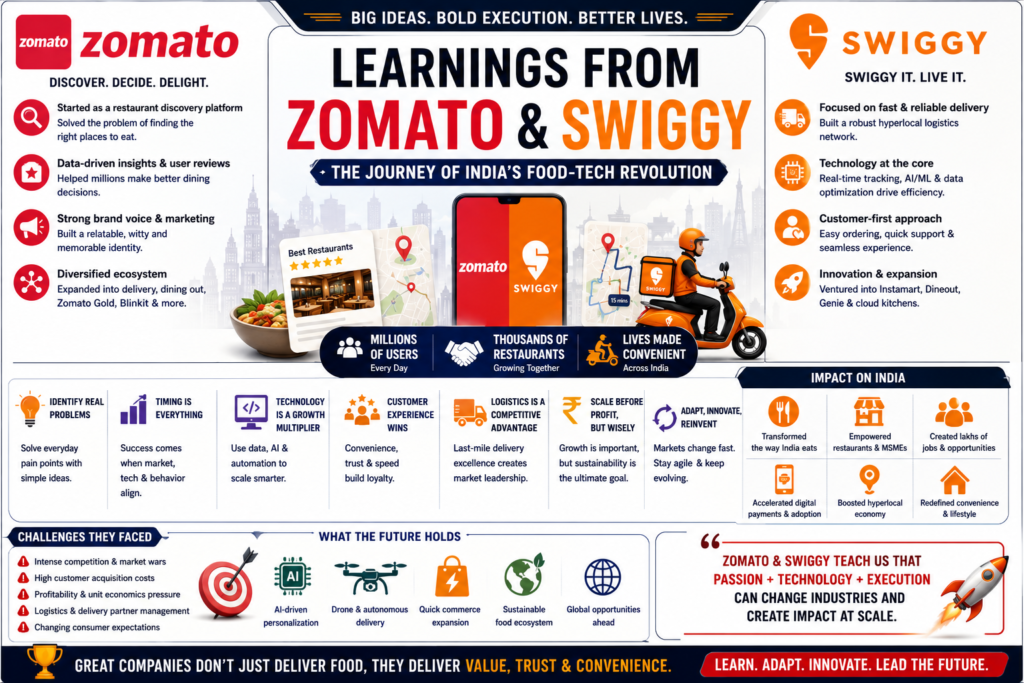
The rise of food delivery platforms in India represents far more than a transformation in how people order meals. It symbolizes the evolution of India’s digital consumer economy, the behavioral transformation of urban lifestyles, the power of technological disruption, and the emergence of platform-based business ecosystems capable of reshaping industries at national scale. Among the most influential companies driving this transformation are Zomato and Swiggy, two organizations that fundamentally altered India’s restaurant industry, customer expectations, logistics infrastructure, startup culture, and digital commerce landscape.
Over the past decade, these companies evolved from relatively simple food discovery and delivery platforms into complex technology-driven ecosystems integrating artificial intelligence, logistics optimization, cloud kitchens, quick commerce, consumer analytics, digital payments, restaurant partnerships, hyperlocal delivery systems, and data-driven customer engagement strategies. Their journeys provide some of the most important entrepreneurial and strategic lessons for modern India.
The success of Zomato and Swiggy cannot be understood merely through the lens of food delivery. Their rise reflects deeper transformations occurring within Indian society:
- Urbanization
- Smartphone penetration
- Digital payments adoption
- Time-sensitive lifestyles
- Convenience-driven consumption
- Venture capital expansion
- Youth-oriented digital behavior
- Platform economy growth
These companies also reveal the realities of startup ecosystems — including innovation, hypergrowth, operational challenges, competition, profitability struggles, branding wars, labor debates, technological adaptation, and investor expectations.
For entrepreneurs, marketers, technology professionals, business strategists, logistics experts, and management students, Zomato and Swiggy represent living case studies in modern business evolution. Their journeys demonstrate how companies can identify market gaps, build scalable systems, adapt to crises, leverage technology, and shape consumer behavior at national scale.
This article explores the major learnings from Zomato and Swiggy in a detailed and structured manner, analyzing their entrepreneurial strategies, technological innovations, marketing approaches, operational models, leadership lessons, financial realities, consumer psychology insights, and the broader implications for India’s startup ecosystem and digital future.
The Birth of a Market Opportunity
One of the first and most important lessons from Zomato and Swiggy is the importance of identifying hidden consumer pain points before markets fully recognize them.
Before the rise of organized food-tech platforms, India’s restaurant ecosystem was highly fragmented. Customers often faced difficulties involving:
- Limited restaurant discovery
- Unreliable home delivery
- Lack of menu transparency
- Inconsistent service quality
- Cash-only transactions
- Absence of digital convenience
Urban consumers increasingly desired convenience, speed, and choice, yet the restaurant industry lacked integrated digital infrastructure.
Zomato initially focused upon restaurant discovery and menu aggregation. It recognized that consumers needed reliable information regarding restaurants before making dining decisions. Swiggy later identified another critical gap — logistics reliability and hyperlocal delivery execution.
The first major entrepreneurial lesson therefore emerges clearly:
Successful businesses do not merely create products. They solve invisible frustrations within everyday human behavior.
Timing Matters More Than Many Realize
Another crucial lesson from Zomato and Swiggy is the strategic importance of timing.
If these companies had emerged too early, India’s internet penetration, smartphone usage, digital payment adoption, and urban demand may not have supported scalable growth. If they had emerged too late, market saturation and global competition may have reduced opportunities.
Their growth coincided with:
- Affordable smartphones
- Expansion of 4G internet
- Digital payment ecosystems
- Urban millennial lifestyles
- Startup investment inflows
This reveals a powerful strategic principle:
Business success often depends not only upon innovation but upon entering markets at the correct stage of social and technological readiness.
Technology Is the Backbone of Modern Commerce
Zomato and Swiggy are often perceived as food delivery companies, but in reality they are fundamentally technology companies operating within food ecosystems.
Their competitive strength lies heavily in:
- Data analytics
- AI-driven recommendations
- Delivery optimization algorithms
- Customer behavior analysis
- Dynamic pricing systems
- Real-time logistics management
Technology enabled these platforms to scale operations across hundreds of cities while maintaining operational coordination.
One of the biggest learnings from their success is that modern businesses cannot survive merely through traditional operations. Technology must become deeply integrated into:
- Customer experience
- Logistics
- Marketing
- Data management
- Operational intelligence
The future belongs to businesses that combine operational execution with technological sophistication.
Customer Convenience Is a Powerful Economic Force
Zomato and Swiggy succeeded because they understood one of the deepest principles of modern consumer psychology:
Convenience drives purchasing behavior.
Urban consumers increasingly value:
- Time efficiency
- Ease of access
- Minimal friction
- Personalized experience
- Fast delivery
Food delivery became not merely about eating but about lifestyle optimization.
The lesson here extends far beyond food-tech industries. Businesses across sectors must recognize that convenience itself has become a major economic currency in modern societies.
Companies that reduce friction in consumer experiences gain substantial competitive advantages.
The Power of User Experience and Interface Design
One of the underrated strengths of Zomato and Swiggy lies in user experience design.
Their applications simplified:
- Restaurant browsing
- Menu viewing
- Ordering processes
- Payment systems
- Tracking mechanisms
- Customer support
The simplicity and intuitiveness of digital interaction significantly influenced consumer loyalty.
This demonstrates a critical business lesson:
In the digital era, product quality alone is insufficient. User experience often determines whether consumers stay or leave.
Modern consumers expect:
- Seamless interfaces
- Fast navigation
- Visual clarity
- Real-time transparency
Businesses that neglect user experience frequently struggle despite having strong products.
Branding and Emotional Positioning
Both Zomato and Swiggy invested heavily in branding and emotional communication.
Their marketing strategies focused not merely upon food delivery but upon:
- Humor
- Relatability
- Youth culture
- Emotional engagement
- Social media presence
Zomato particularly became known for witty digital communication and culturally relevant advertising campaigns.
The lesson is profound:
Modern branding is not merely about visibility. It is about building emotional familiarity and conversational relevance.
Consumers increasingly connect with brands that appear:
- Human
- Responsive
- Relatable
- Culturally aware
Brand personality has become strategically important within digital economies.
Hyperlocal Logistics as a Strategic Innovation
Swiggy especially demonstrated the importance of logistics infrastructure as a competitive advantage.
Its focus on building strong delivery systems helped it scale effectively.
Modern digital commerce increasingly depends upon:
- Last-mile delivery efficiency
- Route optimization
- Delivery partner coordination
- Real-time operational management
The broader lesson is that logistics is no longer merely a backend operation.
In modern platform economies, logistics itself becomes a core strategic capability.
Data Is the New Competitive Weapon
Both companies collect enormous amounts of consumer data involving:
- Food preferences
- Ordering patterns
- Timing behavior
- Geographic trends
- Price sensitivity
This data enables:
- Personalized recommendations
- Dynamic promotions
- Customer retention strategies
- Market forecasting
The strategic lesson is clear:
Data-driven decision making is becoming central to modern business competitiveness.
Companies that intelligently interpret consumer behavior gain major strategic advantages over intuition-based businesses.
Adaptability During Crisis: Lessons from COVID-19
The COVID-19 pandemic severely disrupted restaurant industries globally. However, Zomato and Swiggy adapted rapidly.
They introduced:
- Contactless delivery
- Grocery delivery
- Essential item logistics
- Safety communication
The pandemic demonstrated another critical business principle:
Organizations that adapt rapidly during crisis often emerge stronger than those that resist change.
Business resilience increasingly depends upon operational flexibility and strategic adaptability.
Diversification Beyond Core Business
Over time, both companies expanded beyond basic food delivery.
They explored:
- Grocery delivery
- Cloud kitchens
- Subscription models
- Dining services
- Quick commerce ecosystems
This reveals another important lesson:
Successful businesses continuously evolve rather than remaining dependent upon a single revenue stream.
Diversification strengthens long-term sustainability.
The Cloud Kitchen Revolution
Food-tech platforms accelerated the rise of cloud kitchens — delivery-focused restaurants without traditional dine-in infrastructure.
Cloud kitchens reduced:
- Real estate costs
- Operational complexity
- Staffing expenses
This transformation highlights how technology can fundamentally alter industry structures.
Traditional business models are increasingly vulnerable to digital disruption and operational innovation.
Venture Capital and Startup Growth Lessons
Zomato and Swiggy grew rapidly through venture capital funding.
This funding enabled:
- Aggressive expansion
- Customer acquisition
- Technology investment
- Market penetration
However, their journeys also reveal the challenges of startup economics:
- Profitability pressures
- Investor expectations
- Cash burn concerns
The lesson for entrepreneurs is balanced:
External funding accelerates growth but also increases accountability and strategic pressure.
Rapid growth without sustainable economics eventually creates instability.
Profitability Versus Market Expansion
One of the biggest debates surrounding food-tech companies has involved profitability.
Both companies spent years prioritizing:
- Market share
- Consumer acquisition
- Geographic expansion
rather than immediate profits.
This reflects a broader startup philosophy:
- Build scale first
- Optimize profitability later
However, the long-term sustainability of such models depends upon operational efficiency and investor patience.
The lesson here is nuanced:
Growth without financial discipline becomes dangerous, but excessive caution may prevent market leadership.
Strategic balance matters.
Consumer Behavior Can Be Reshaped
Zomato and Swiggy fundamentally changed Indian consumer behavior.
Ordering food online gradually evolved from occasional convenience into routine lifestyle behavior.
This demonstrates one of the most powerful insights in modern business:
Technology platforms do not merely serve behavior. They shape behavior itself.
Businesses capable of influencing habits create long-term market dominance.
The Importance of Delivery Workforce Management
The rise of food delivery platforms also brought attention to gig economy labor structures.
Delivery personnel became essential operational pillars of platform ecosystems.
This created discussions regarding:
- Worker welfare
- Incentive structures
- Insurance
- Financial security
The lesson for modern businesses is important:
Scalable growth must eventually align with ethical workforce sustainability.
Long-term brand trust increasingly depends upon responsible ecosystem management.
Competition Drives Innovation
The intense rivalry between Zomato and Swiggy accelerated:
- Service improvements
- Faster delivery
- Better discounts
- Technological enhancements
Competition forced both companies to continuously innovate.
This highlights a major entrepreneurial principle:
Strong competition often strengthens industries by pushing organizations toward continuous improvement.
Complacency becomes dangerous in rapidly evolving markets.
Artificial Intelligence and Predictive Commerce
Modern food-tech platforms increasingly use AI for:
- Demand forecasting
- Delivery optimization
- Customer recommendations
- Inventory planning
The future of commerce is becoming increasingly predictive rather than reactive.
Businesses capable of anticipating customer needs before explicit demand emerges may dominate future markets.
Marketing Through Digital Culture
Zomato especially mastered social-media-driven brand communication.
Its campaigns frequently integrated:
- Internet humor
- Trending culture
- Meme ecosystems
- Real-time social commentary
This reveals a powerful modern marketing lesson:
Brands that understand digital culture build stronger emotional engagement with younger consumers.
Traditional advertising alone is becoming insufficient within highly interactive digital ecosystems.
Entrepreneurship Requires Operational Excellence
Many startups possess innovative ideas, but few successfully execute operations at national scale.
Zomato and Swiggy succeeded partly because they built:
- Technology systems
- Logistics infrastructure
- Vendor networks
- Delivery coordination
The lesson is critical:
Ideas create opportunities, but execution creates enterprises.
Operational excellence separates sustainable businesses from temporary hype.
Consumer Trust Is the Foundation of Digital Platforms
Trust became central to food-tech success.
Consumers trusted platforms for:
- Timely delivery
- Payment security
- Food quality transparency
- Customer support
Digital businesses survive only when trust remains strong.
Trust is therefore becoming one of the most valuable currencies of platform economies.
Localization Is Essential in India
India’s diversity requires localized business understanding.
Consumer behavior differs significantly across:
- Cities
- Languages
- Income groups
- Food cultures
Zomato and Swiggy adapted menus, promotions, and operations regionally.
The lesson is important:
India cannot be approached as a single uniform market.
Localization remains essential for scalable success.
Startups Must Continuously Reinvent Themselves
One of the greatest lessons from Zomato and Swiggy is the importance of continuous reinvention.
They evolved from:
- Discovery platforms
to - Delivery companies
to - Logistics ecosystems
to - Quick commerce players
The future business environment changes too rapidly for static organizations.
Adaptability is becoming more important than stability.
Leadership and Vision
The leadership teams behind these companies demonstrated:
- Risk-taking ability
- Strategic patience
- Technological vision
- Crisis management capability
Leadership in startup ecosystems requires balancing:
- Innovation
- investor expectations
- operational realities
- public perception
Vision without execution fails.
Execution without vision stagnates.
Sustainable leadership requires both.
Lessons for Young Entrepreneurs in India
For aspiring entrepreneurs, the journeys of Zomato and Swiggy provide several major lessons:
- Solve real problems
- Understand consumer psychology
- Use technology intelligently
- Build scalable systems
- Prioritize execution
- Adapt continuously
- Embrace competition
- Focus upon long-term trust
Most importantly, they demonstrate that Indian startups can create globally influential business models.
Ethical and Societal Questions
The rise of platform economies also raises important societal questions involving:
- Gig worker rights
- Market monopolization
- Consumer dependency
- Restaurant profit margins
- Data privacy
Future businesses must balance profitability with ecosystem responsibility.
The next era of entrepreneurship will increasingly require ethical intelligence alongside commercial ambition.
The Future of Food-Tech and Quick Commerce
The future may involve:
- Drone delivery
- AI-driven kitchens
- Autonomous logistics
- Hyper-personalized nutrition systems
- Sustainable food ecosystems
Food-tech may increasingly intersect with:
- Healthcare
- biotechnology
- environmental sustainability
- smart cities
Zomato and Swiggy are therefore not merely food companies.
They are early architects of India’s digital convenience economy.
Conclusion: The Deeper Meaning Behind the Rise of Zomato and Swiggy
The stories of Zomato and Swiggy represent more than startup success narratives.
They symbolize:
- The power of technological adaptation
- The rise of digital consumer culture
- The transformation of Indian entrepreneurship
- The emergence of platform economies
- The future of intelligent commerce
Their journeys reveal that modern business success increasingly depends upon:
- Consumer understanding
- Technological integration
- Operational excellence
- Strategic adaptability
- Brand trust
- Data intelligence
- Continuous innovation
For entrepreneurs, students, professionals, and business leaders, these companies provide some of the most valuable lessons in modern commercial strategy.
India’s economic future will increasingly be shaped by organizations capable of integrating technology, logistics, psychology, branding, and scalable execution into unified ecosystems.
The greatest lesson from Zomato and Swiggy is perhaps this:
Modern businesses do not merely deliver products.
Modern businesses redesign human behavior, redefine convenience, reshape industries, and influence the future architecture of digital civilization itself.