

An In-Depth Pharmacological Profile of Trichosanthes dioica Roxb. (Pointed Gourd): Phytochemistry, Pharmacological Activities, Mechanisms of Action and Current Research Updates
Author: Devanssh Mehta
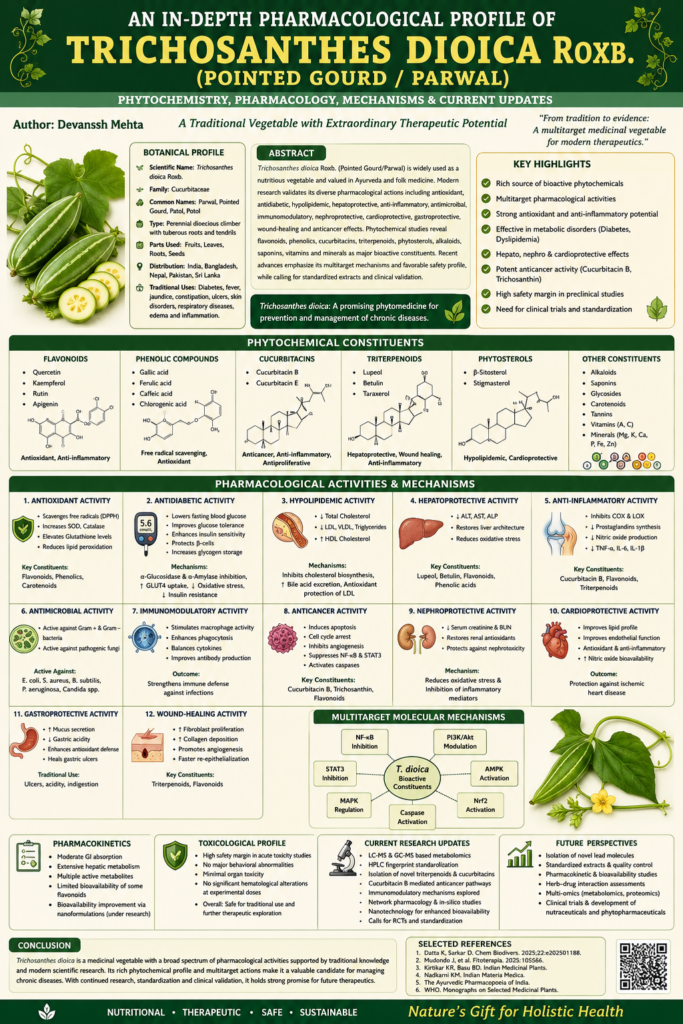
Abstract
Trichosanthes dioica Roxb., commonly known as pointed gourd (Parwal), is a perennial dioecious climber belonging to the Cucurbitaceae family and is extensively cultivated throughout the Indian subcontinent. Besides being an important dietary vegetable, it occupies a prominent position in Ayurveda, Siddha, and traditional folk medicine owing to its remarkable medicinal properties. Scientific investigations during the past two decades have validated many of its traditional claims, revealing potent antioxidant, antidiabetic, hepatoprotective, anti-inflammatory, antimicrobial, immunomodulatory, nephroprotective, cardioprotective, wound-healing, anticancer, and hypolipidemic activities. Recent analytical studies employing HPLC, LC-MS, GC-MS, and metabolomics have identified a diverse range of phytochemicals including cucurbitacins, flavonoids, phenolic acids, triterpenoids, phytosterols, alkaloids, glycosides, saponins, carotenoids, and bioactive proteins that contribute to these pharmacological actions. Recent reviews also emphasize its favorable safety profile but highlight the need for standardized extracts, mechanistic studies, and well-designed clinical trials before wider therapeutic adoption. (Wiley Online Library)
This review summarizes the botanical characteristics, phytochemistry, pharmacological mechanisms, toxicological profile, therapeutic potential, and current advances in T. dioica, while identifying future research opportunities for pharmaceutical development.
Keywords: Trichosanthes dioica, Pointed gourd, Parwal, Cucurbitaceae, Pharmacology, Phytochemistry, Herbal medicine, Medicinal plants.
Introduction
Medicinal plants continue to provide an invaluable source of therapeutic agents for modern medicine. Approximately 80% of the world’s population relies partly on herbal medicines for primary healthcare. India possesses one of the richest traditions of medicinal plant use, where numerous edible vegetables also exhibit medicinal properties.
Among these plants, Trichosanthes dioica Roxb. has gained increasing scientific attention because it combines nutritional benefits with pharmacological efficacy. Traditionally, different parts of the plant—including fruits, leaves, roots, and seeds—have been used for treating fever, diabetes, jaundice, edema, skin disorders, constipation, ulcers, respiratory diseases, and inflammatory conditions.
Modern pharmacological research has confirmed that T. dioica contains multiple bioactive compounds acting on diverse molecular targets, making it an attractive candidate for drug discovery and nutraceutical development. Recent reviews have also highlighted advances in analytical characterization, ethnopharmacology, toxicology, and emerging anticancer mechanisms involving compounds such as cucurbitacin B and trichosanthin. (Wiley Online Library)
Botanical Description
- Scientific Name: Trichosanthes dioica Roxb.
- Family: Cucurbitaceae
- Common Names: Pointed gourd, Parwal, Patol, Potol
The plant is a perennial climber possessing tuberous roots and tendrils. Fruits are green with white longitudinal stripes and contain numerous seeds. It is cultivated mainly in:
- India
- Bangladesh
- Nepal
- Pakistan
- Sri Lanka
Young fruits serve as nutritious vegetables, whereas leaves, roots, and seeds are utilized medicinally.
Phytochemical Constituents
Modern chromatographic investigations have identified numerous secondary metabolites distributed across different plant parts.
Major constituents include:
Flavonoids
- Quercetin
- Kaempferol
- Rutin
- Apigenin
These compounds exhibit strong antioxidant and anti-inflammatory properties.
Phenolic compounds
- Gallic acid
- Ferulic acid
- Caffeic acid
- Chlorogenic acid
They reduce oxidative stress through free radical scavenging.
Cucurbitacins
- Cucurbitacin B
- Cucurbitacin E
These possess notable anticancer, anti-inflammatory, and antiproliferative activities.
Triterpenoids
- Lupeol
- Betulin
- Taraxerol
These compounds contribute to hepatoprotection, wound healing, and anti-inflammatory effects.
Phytosterols
- β-Sitosterol
- Stigmasterol
Important for cholesterol regulation and cardiovascular protection.
Other bioactive constituents
- Alkaloids
- Saponins
- Glycosides
- Carotenoids
- Tannins
- Essential amino acids
- Vitamins A and C
- Minerals including magnesium, potassium, calcium, phosphorus, iron, and zinc
Recent reviews also identify trichosanthin, sterols, and additional triterpenes characterized using HPLC, LC–MS, and GC–MS. (Wiley Online Library)
Pharmacological Activities
1. Antioxidant Activity
Oxidative stress contributes significantly to diabetes, neurodegeneration, cancer, and cardiovascular diseases.
Experimental studies demonstrate that extracts of T. dioica exhibit remarkable antioxidant activity by:
- Scavenging DPPH radicals
- Increasing superoxide dismutase activity
- Enhancing catalase activity
- Elevating glutathione levels
- Reducing lipid peroxidation
Flavonoids and phenolics are primarily responsible.
2. Antidiabetic Activity
One of the most extensively investigated activities is its antidiabetic effect.
Experimental evidence demonstrates:
- Reduction in fasting blood glucose
- Improvement in glucose tolerance
- Enhanced insulin sensitivity
- Increased glycogen storage
- Reduced insulin resistance
Possible mechanisms
- α-glucosidase inhibition
- α-amylase inhibition
- Protection of pancreatic β-cells
- Improved GLUT4-mediated glucose uptake
- Suppression of oxidative damage
Network pharmacology and computational studies further support the multitarget metabolic potential of medicinal plants including Trichosanthes species. (arXiv)
3. Hypolipidemic Activity
Administration of fruit extracts has shown reductions in:
- Total cholesterol
- LDL cholesterol
- Triglycerides
- VLDL
while increasing HDL cholesterol.
Possible mechanisms include:
- Inhibition of cholesterol biosynthesis
- Improved bile acid excretion
- Antioxidant protection against LDL oxidation
4. Hepatoprotective Activity
The plant demonstrates protection against experimentally induced liver injury.
Observed effects include:
- Reduced ALT
- Reduced AST
- Reduced ALP
- Restoration of liver architecture
- Reduced hepatic oxidative stress
Lupeol, betulin, and flavonoids contribute significantly.
5. Anti-inflammatory Activity
Inflammation plays a central role in chronic diseases.
Extracts suppress inflammation through:
- COX inhibition
- LOX inhibition
- Reduced prostaglandin synthesis
- Suppression of nitric oxide production
- Downregulation of TNF-α
- Reduction of IL-6
- Decreased IL-1β
Cucurbitacin B has attracted particular interest because of its modulation of inflammatory signaling pathways. (Wiley Online Library)
6. Antimicrobial Activity
Leaf and fruit extracts inhibit growth of:
- Escherichia coli
- Staphylococcus aureus
- Bacillus subtilis
- Pseudomonas aeruginosa
They also exhibit antifungal effects against several pathogenic fungi.
7. Immunomodulatory Activity
Experimental evidence suggests stimulation of:
- Macrophage activity
- Phagocytosis
- Cytokine balance
- Antibody production
This supports traditional use during infections.
8. Anticancer Activity
Among the most promising discoveries are its anticancer properties.
Laboratory investigations demonstrate:
- Cell cycle arrest
- Apoptosis induction
- Reduced angiogenesis
- Suppression of tumor proliferation
- Modulation of NF-κB
- STAT3 inhibition
- Caspase activation
Recent evidence highlights cucurbitacin B and trichosanthin as key molecules with cytotoxic activity against cancer cells through apoptosis induction and inflammatory pathway modulation. (Wiley Online Library)
9. Nephroprotective Activity
Animal studies demonstrate:
- Reduced serum creatinine
- Lower blood urea nitrogen
- Improved renal antioxidant status
- Protection against nephrotoxicity
10. Cardioprotective Activity
Potential mechanisms include:
- Reduction of oxidative stress
- Improved endothelial function
- Lipid lowering
- Anti-inflammatory effects
- Improved nitric oxide availability
11. Gastroprotective Activity
Traditional medicine recommends the plant for peptic ulcers.
Experimental evidence suggests:
- Increased mucus secretion
- Reduced gastric acidity
- Enhanced antioxidant defense
- Faster ulcer healing
Recent clinical observations and polyherbal studies also suggest potential benefits in peptic ulcer management, although stronger clinical evidence is still needed. (Wiley Online Library)
12. Wound-Healing Activity
The plant accelerates:
- Fibroblast proliferation
- Collagen deposition
- Angiogenesis
- Re-epithelialization
These effects are attributed to triterpenoids and flavonoids.
Molecular Mechanisms
Current pharmacological evidence suggests multiple molecular targets:
- NF-κB inhibition
- MAPK regulation
- PI3K/Akt signaling modulation
- STAT3 inhibition
- Caspase activation
- Nrf2-mediated antioxidant activation
- AMPK activation
- Improved insulin receptor signaling
- Reduction of reactive oxygen species
This multitarget behavior is typical of phytomedicines and may explain the broad therapeutic spectrum.
Pharmacokinetics
Limited pharmacokinetic information is available.
Current evidence suggests:
- Moderate gastrointestinal absorption
- Extensive hepatic metabolism
- Multiple active metabolites
- Limited bioavailability of certain flavonoids
- Potential enhancement through nanoformulations
Recent reviews specifically note that advanced drug delivery systems for T. dioica remain underexplored, representing an important research opportunity. (Wiley Online Library)
Toxicological Profile
Acute toxicity studies indicate:
- High safety margin
- No major behavioral abnormalities
- Minimal organ toxicity
- No significant hematological alterations at experimental doses
Recent systematic reviews conclude that T. dioica demonstrates a favorable safety profile even at relatively high doses in preclinical studies, though long-term human safety data remain limited. (Wiley Online Library)
Current Research Updates
Recent developments include:
- LC-MS-based metabolomic profiling
- HPLC fingerprint standardization
- Isolation of novel triterpenoids
- Investigation of cucurbitacin-mediated anticancer pathways
- Evaluation of immunomodulatory mechanisms
- Computational network pharmacology studies
- Exploration of nanoformulations for improved bioavailability
- Calls for standardized extracts and multicenter randomized clinical trials to validate efficacy and establish therapeutic dosing. (Wiley Online Library)
Future Perspectives
Future research should prioritize:
- Isolation of novel lead molecules.
- Standardized phytochemical profiling and quality control.
- Pharmacokinetic and bioavailability studies.
- Herb–drug interaction assessments.
- Multi-omics approaches integrating metabolomics, proteomics, and transcriptomics.
- Nanotechnology-based delivery systems.
- Randomized controlled clinical trials.
- Development of nutraceuticals and phytopharmaceutical formulations.
Conclusion
Trichosanthes dioica represents an important medicinal vegetable with significant pharmacological potential supported by traditional use and a growing body of experimental evidence. Its rich phytochemical composition—including flavonoids, phenolics, cucurbitacins, triterpenoids, phytosterols, and bioactive proteins—underpins antioxidant, antidiabetic, anti-inflammatory, hepatoprotective, hypolipidemic, nephroprotective, antimicrobial, wound-healing, immunomodulatory, and anticancer activities. Recent comprehensive reviews have strengthened the evidence base while emphasizing the need for standardized preparations, mechanistic studies, and robust clinical trials. With continued interdisciplinary research, T. dioica has strong potential to contribute to future nutraceuticals and phytopharmaceuticals for chronic disease management. (Wiley Online Library)
Selected References
- Datta K, Sarkar D. Exploring Trichosanthes dioica: A Comprehensive Study of Its Ethnomedical Uses, Phytochemistry, Pharmacology and Toxicity. Chemistry & Biodiversity. 2025. (Wiley Online Library)
- Mudondo J, Happy K, Okello D, Kang Y. Trichosanthis Radix: A comprehensive review on botany, ethnomedicine, phytochemistry, pharmacology, quality control and toxicology. Fitoterapia. 2025. (PubMed)
- Kirtikar KR, Basu BD. Indian Medicinal Plants.
- Nadkarni KM. Indian Materia Medica.
- The Ayurvedic Pharmacopoeia of India.
- WHO. WHO Monographs on Selected Medicinal Plants.