

Strategic Management of New Startups in India: A Review
Author: Devanssh Mehta
Abstract
India has emerged as one of the world’s largest startup ecosystems, driven by rapid digital transformation, government support, increased internet penetration, a growing entrepreneurial culture, and expanding venture capital investments. However, despite the remarkable growth in startup registrations, a significant number of startups fail within the first five years due to weak strategic planning, poor financial management, lack of market understanding, operational inefficiencies, and leadership challenges. Strategic management provides startups with a systematic framework to identify opportunities, allocate resources efficiently, manage uncertainties, and build sustainable competitive advantages. This review paper examines the strategic management practices required for the success of new startups in India. It discusses the stages of strategic planning, competitive positioning, innovation management, financial sustainability, digital transformation, human resource development, marketing strategies, risk management, and future trends shaping the Indian startup ecosystem. The review concludes that long-term strategic thinking combined with continuous innovation and adaptability is essential for sustainable entrepreneurial success.
Keywords: Strategic Management, Startups, India, Entrepreneurship, Innovation, Business Strategy, Digital Economy, Startup India
Introduction
India has witnessed an unprecedented entrepreneurial revolution during the past decade. Government initiatives such as Startup India, Digital India, Make in India, Skill India, and Atmanirbhar Bharat have significantly improved the ease of starting and operating businesses. Simultaneously, widespread smartphone adoption, affordable internet access, digital payment systems, and growing investor confidence have accelerated startup formation across sectors including healthcare, fintech, edtech, agritech, logistics, artificial intelligence, biotechnology, renewable energy, and e-commerce.
Despite these positive developments, the startup journey remains highly uncertain. Many startups fail because they focus primarily on product development while neglecting strategic planning, customer validation, financial discipline, competitive positioning, and organizational development. Strategic management enables startups to systematically align their resources, capabilities, and long-term objectives with rapidly changing market environments.
Unlike established corporations, startups operate under severe uncertainty, limited capital, evolving customer expectations, and intense competition. Therefore, strategic management becomes not merely an administrative function but the foundation for survival and sustainable growth.
Strategic Management: Concept and Importance
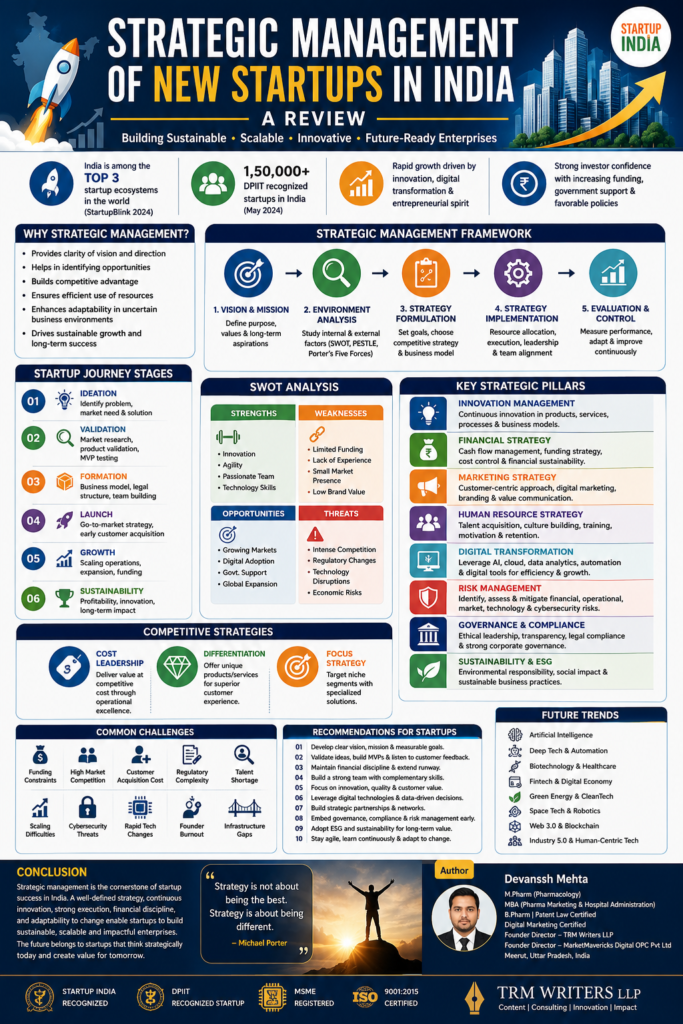
Strategic management is the process of formulating, implementing, evaluating, and continuously improving organizational strategies to achieve long-term objectives.
For startups, strategic management involves:
- Identifying market opportunities
- Defining a unique value proposition
- Understanding customer needs
- Building competitive advantages
- Managing financial resources efficiently
- Developing scalable business models
- Creating sustainable growth strategies
A well-designed strategy enables startups to minimize risks while maximizing innovation and market opportunities.
Indian Startup Ecosystem
India is currently among the leading startup ecosystems globally, supported by:
- Startup India Mission
- DPIIT Startup Recognition
- SIDBI funding programs
- Atal Innovation Mission
- Incubation centers
- Technology parks
- Academic entrepreneurship programs
- Venture capital funds
- Angel investor networks
- Digital public infrastructure such as UPI and Aadhaar
The Indian startup ecosystem now extends beyond metropolitan cities into Tier-2 and Tier-3 cities, creating opportunities across diverse sectors.
Strategic Planning Process for Startups
Strategic planning begins with establishing a clear organizational vision and mission.
The process generally includes:
Vision Development
The vision defines the long-term aspirations of the startup.
Example:
“To become India’s most trusted AI-powered healthcare platform.”
Mission Statement
The mission explains how the organization intends to achieve its vision.
Example:
“Deliver affordable, technology-driven healthcare solutions for every Indian.”
Environmental Analysis
Startups should evaluate:
- Customer demand
- Competitor activities
- Technological changes
- Government policies
- Economic conditions
- Social trends
Tools include:
- SWOT Analysis
- PESTLE Analysis
- Porter’s Five Forces
- Value Chain Analysis
SWOT Analysis
Strengths may include:
- Innovative products
- Skilled founders
- Technology expertise
- Fast decision-making
Weaknesses may include:
- Limited funding
- Small customer base
- Lack of brand recognition
- Limited managerial experience
Opportunities include:
- Digital economy expansion
- Government incentives
- Export markets
- AI adoption
- Healthcare digitization
Threats include:
- Intense competition
- Regulatory changes
- Cybersecurity risks
- Rapid technological disruption
Business Model Development
Selecting the right business model is one of the most critical strategic decisions.
Common models include:
- Subscription model
- Marketplace platform
- Software as a Service (SaaS)
- Direct-to-consumer (D2C)
- Business-to-business (B2B)
- Freemium model
- Franchise model
- Platform economy
- Licensing model
The business model should ensure long-term profitability while creating customer value.
Competitive Strategy
Michael Porter’s generic competitive strategies remain highly relevant for startups.
Cost Leadership
Providing products or services at competitive prices through operational efficiency.
Differentiation
Offering unique products with superior quality, technology, design, or customer experience.
Focus Strategy
Targeting a specific market niche with specialized solutions.
Most successful startups combine differentiation with customer-centric innovation.
Innovation Management
Innovation is the primary engine of startup growth.
Innovation may involve:
- Product innovation
- Service innovation
- Process innovation
- Marketing innovation
- Business model innovation
- Technological innovation
Indian startups increasingly integrate:
- Artificial Intelligence
- Machine Learning
- Blockchain
- Internet of Things
- Robotics
- Cloud Computing
- Data Analytics
Continuous innovation helps startups remain competitive in rapidly evolving markets.
Financial Strategic Management
Financial sustainability determines long-term survival.
Key financial strategies include:
- Budget planning
- Cash flow management
- Working capital optimization
- Revenue diversification
- Cost control
- Financial forecasting
- Profitability monitoring
Funding options include:
- Bootstrapping
- Angel investors
- Venture capital
- Private equity
- Government grants
- Bank loans
- Crowdfunding
- Strategic partnerships
Financial discipline is often a stronger predictor of survival than rapid revenue growth alone.
Marketing Strategy
Successful startups adopt customer-centric marketing approaches.
Modern marketing tools include:
- Digital marketing
- SEO
- Content marketing
- Social media
- Influencer marketing
- Email marketing
- Mobile marketing
- Performance advertising
- Video marketing
Strong brand positioning builds customer trust and long-term loyalty.
Human Resource Strategy
People are among the most valuable assets for startups.
Key HR strategies include:
- Talent acquisition
- Leadership development
- Employee engagement
- Performance management
- Learning and development
- Flexible work culture
- Diversity and inclusion
- Employee retention
High-performing startup teams combine technical expertise with adaptability and innovation.
Digital Transformation
Digital technologies have become essential strategic assets.
Important technologies include:
- Cloud platforms
- Artificial Intelligence
- CRM systems
- ERP software
- Business Intelligence
- Cybersecurity
- Automation
- Digital payments
Digital transformation enhances operational efficiency and improves customer experience.
Risk Management
Startup risks include:
- Financial risk
- Operational risk
- Market risk
- Technological risk
- Regulatory risk
- Cybersecurity threats
- Reputational risk
- Supply chain disruptions
Effective risk management requires continuous monitoring and contingency planning.
Corporate Governance
Good governance improves investor confidence.
Essential governance practices include:
- Ethical leadership
- Transparency
- Regulatory compliance
- Financial accountability
- Data privacy
- Internal controls
- ESG integration
- Board oversight
Strong governance becomes increasingly important as startups scale.
Sustainability and ESG
Modern startups increasingly integrate Environmental, Social, and Governance (ESG) principles into their strategic planning.
Sustainability initiatives include:
- Renewable energy adoption
- Waste reduction
- Responsible sourcing
- Employee welfare
- Diversity
- Community engagement
- Ethical business practices
Sustainable strategies improve long-term competitiveness and investor confidence.
Major Challenges for Indian Startups
Although India offers immense opportunities, startups continue to face several challenges:
- High market competition
- Funding constraints
- Talent shortages
- Customer acquisition costs
- Regulatory complexity
- Infrastructure limitations
- Rapid technological changes
- Cybersecurity concerns
- Scaling difficulties
- Founder burnout
Strategic management helps organizations anticipate and mitigate these challenges effectively.
Future Directions
The future of Indian startups will increasingly depend on:
- Artificial Intelligence
- Deep Technology
- Biotechnology
- Quantum Computing
- Space Technology
- Green Energy
- Climate Technology
- Digital Healthcare
- Precision Agriculture
- Industry 5.0
Startups that continuously innovate while maintaining sound strategic management practices are likely to become future market leaders.
Recommendations
To strengthen strategic management, Indian startups should:
- Develop a clear long-term vision and measurable strategic objectives.
- Validate products through continuous customer feedback before scaling.
- Maintain disciplined cash flow and financial controls.
- Invest in leadership, talent development, and organizational culture.
- Leverage digital technologies and data-driven decision-making.
- Build strategic partnerships with incubators, industry, academia, and investors.
- Embed risk management, governance, and ESG principles from an early stage.
- Foster a culture of continuous innovation and adaptability.
Conclusion
Strategic management serves as the cornerstone of sustainable startup success in India. While entrepreneurial enthusiasm and technological innovation drive new ventures, long-term survival depends on structured planning, disciplined execution, customer-centric innovation, financial resilience, effective leadership, and continuous strategic adaptation. As India’s entrepreneurial ecosystem matures, startups that embrace evidence-based strategic management practices will be better positioned to create economic value, generate employment, attract investment, and contribute to national development. The integration of digital technologies, responsible governance, and sustainable business practices will further define the next generation of globally competitive Indian startups.
References
- Porter, M. E. (1985). Competitive Advantage: Creating and Sustaining Superior Performance. Free Press.
- Porter, M. E. (1980). Competitive Strategy. Free Press.
- Drucker, P. F. (1999). Management Challenges for the 21st Century. Harper Business.
- Kotler, P., & Keller, K. L. (2022). Marketing Management (16th ed.). Pearson.
- Barney, J. (1991). Firm Resources and Sustained Competitive Advantage. Journal of Management, 17(1), 99–120.
- Teece, D. J. (2018). Business Models and Dynamic Capabilities. Long Range Planning, 51(1), 40–49.
- Blank, S., & Dorf, B. (2020). The Startup Owner’s Manual. K&S Ranch.
- Ries, E. (2011). The Lean Startup. Crown Business.
- Government of India. Startup India policy documents.
- NITI Aayog. Reports on Innovation and Entrepreneurship.
- OECD. (2023). SME and Entrepreneurship Outlook.
- World Bank. Doing Business and entrepreneurship-related reports.
- Schilling, M. A. (2022). Strategic Management of Technological Innovation. McGraw-Hill.
- Grant, R. M. (2021). Contemporary Strategy Analysis. Wiley.
- Kaplan, R. S., & Norton, D. P. (2004). Strategy Maps. Harvard Business School Press.