

By TRM WRITERS LLP
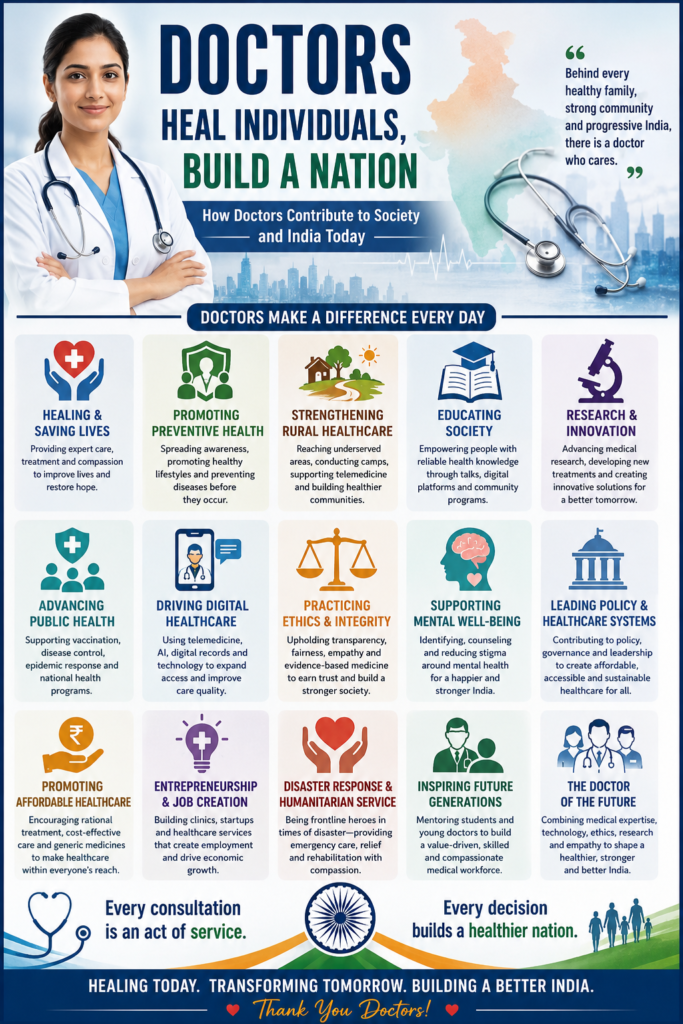
Introduction: The Evolving Role of Doctors in Modern India
Doctors have traditionally been regarded as healers, protectors of life, and custodians of human well-being. In India, however, the role of doctors extends far beyond diagnosis and treatment. In a nation of more than 1.4 billion people marked by demographic diversity, epidemiological transition, technological evolution, and unequal healthcare access, physicians today stand at the intersection of healthcare, education, policy, innovation, and social transformation.
The modern Indian doctor is not merely a clinician but increasingly a public health advocate, educator, digital healthcare contributor, researcher, entrepreneur, policymaker, and community leader. The contribution of doctors to society is no longer limited to hospitals and clinics; it now influences economic productivity, national resilience, social justice, and long-term human development.
India’s aspiration to become a global leader in healthcare, pharmaceuticals, medical tourism, and biomedical innovation depends significantly upon how effectively doctors engage with societal needs.
The Traditional Foundation: Healing and Saving Lives
At the core of medicine remains the timeless commitment to healing.
Doctors contribute to society primarily through:
- Diagnosis and treatment of diseases
- Prevention of complications
- Reduction in mortality and morbidity
- Improvement in quality of life
- Support for healthy aging
- Emergency medical intervention
Every consultation, every prescription, and every successful recovery has an impact that extends beyond the individual patient.
When a physician restores the health of one individual, they often restore the economic and emotional stability of an entire family.
Doctors as Builders of Preventive Healthcare
India has historically focused heavily on curative healthcare. Yet the future belongs increasingly to preventive medicine.
Doctors can contribute by promoting:
Health Awareness Campaigns
Physicians can educate communities regarding:
- Diabetes prevention
- Hypertension control
- Obesity management
- Tobacco cessation
- Vaccination awareness
- Mental health literacy
- Women’s health
- Child nutrition
Preventive counseling delivered in clinics, schools, workplaces, and digital platforms can reduce disease burden significantly.
Lifestyle Medicine
Doctors today have an opportunity to shift public thinking from:
Disease Treatment → Disease Prevention → Health Optimization
Encouraging healthy nutrition, regular exercise, sleep hygiene, and stress management can create healthier populations.
Strengthening Rural and Semi-Urban Healthcare
One of India’s greatest healthcare challenges remains unequal distribution of medical services.
Urban centers often possess advanced healthcare infrastructure, while many rural regions still face shortages.
Doctors can contribute by:
- Practicing in underserved regions
- Conducting outreach camps
- Supporting telemedicine initiatives
- Collaborating with local health workers
- Training primary healthcare personnel
Even periodic engagement with rural communities can generate profound social impact.
A healthier rural India directly supports agricultural productivity, education outcomes, and national growth.
Doctors as Educators of Society
Medical knowledge should not remain confined to textbooks.
Doctors increasingly influence society through:
Public Education
Using:
- Health blogs
- Articles
- Social media education
- Community seminars
- Webinars
- Local awareness programs
Patient Empowerment
An informed patient:
- follows treatment better,
- detects diseases earlier,
- reduces healthcare costs.
Education transforms healthcare from reactive to proactive.
Contribution Through Research and Innovation
Medical advancement occurs because physicians ask difficult questions and pursue better solutions.
Doctors can contribute through:
Clinical Research
- New treatment protocols
- Comparative effectiveness studies
- Real-world evidence generation
Translational Medicine
Converting laboratory discoveries into clinical practice.
Medical Innovation
Developing:
- Medical devices
- Healthcare software
- AI-assisted diagnostics
- Digital therapeutics
India’s future healthcare leadership depends heavily upon physician-led innovation.
Advancing Public Health and National Health Goals
Doctors serve as frontline defenders during public health crises.
Their contributions include:
- Disease surveillance
- Epidemic response
- Vaccination campaigns
- Health data collection
- Pandemic preparedness
- Policy implementation
National missions benefit significantly from physician participation:
- Maternal health initiatives
- Child immunization programs
- Tuberculosis elimination
- Non-communicable disease control
- Antimicrobial resistance prevention
Doctors therefore become contributors not only to individuals but to population-level health security.
Doctors and Digital Healthcare Transformation
Healthcare delivery is changing rapidly.
Doctors can drive transformation through:
Telemedicine
Expanding access to remote populations.
Digital Patient Records
Improving continuity of care.
Artificial Intelligence Integration
Supporting:
- imaging interpretation,
- predictive analytics,
- decision support.
Remote Monitoring
Managing chronic illnesses more efficiently.
Digital adoption enables doctors to serve larger populations with greater efficiency.
Contribution Through Ethical Medical Practice
Trust remains medicine’s greatest currency.
Doctors strengthen society when they:
- Maintain transparency
- Avoid unnecessary procedures
- Respect patient autonomy
- Protect confidentiality
- Practice evidence-based medicine
- Demonstrate empathy
Ethical healthcare builds confidence in institutions and strengthens social cohesion.
Supporting Mental Health and Emotional Well-Being
Modern India faces increasing psychological stress due to:
- urbanization,
- competition,
- changing family structures,
- digital overload.
Doctors can contribute by:
- identifying early mental health symptoms,
- reducing stigma,
- promoting counseling,
- integrating psychological assessment.
Mental health support improves productivity, relationships, and national well-being.
Doctors as Leaders and Policy Influencers
Physicians possess firsthand understanding of healthcare realities.
Their contribution expands when they engage in:
- healthcare administration,
- public policy,
- advisory committees,
- hospital leadership,
- medical governance.
Doctor-led policy can improve:
- affordability,
- accessibility,
- healthcare quality,
- system sustainability.
Promoting Affordable Healthcare
India requires healthcare models that are both advanced and affordable.
Doctors contribute through:
- rational prescribing,
- reducing unnecessary diagnostics,
- encouraging generic medicines where appropriate,
- preventive interventions,
- low-cost treatment pathways.
Affordable healthcare supports inclusive national development.
Medical Entrepreneurship and Job Creation
Doctors increasingly contribute economically through:
- establishing clinics,
- specialty centers,
- diagnostic facilities,
- digital health startups,
- healthcare consulting,
- medical education enterprises.
Medical entrepreneurship creates:
- employment,
- innovation,
- local economic growth.
Disaster Response and Humanitarian Service
During disasters, doctors become among society’s most critical responders.
Their role includes:
- emergency treatment,
- disease prevention,
- rehabilitation,
- trauma care,
- psychological support.
Their contribution often determines how rapidly communities recover.
Inspiring Future Generations
Doctors influence youth by:
- mentoring students,
- supporting medical education,
- demonstrating discipline and service.
Young professionals frequently shape career values based on observing dedicated physicians.
The Doctor of the Future: Beyond Clinical Excellence
The ideal Indian doctor of the coming decades will combine:
- Medical expertise
- Digital literacy
- Research orientation
- Communication skills
- Ethical leadership
- Entrepreneurial thinking
- Community engagement
Such doctors will not merely treat disease—they will shape civilization.
Conclusion
Doctors occupy one of the most influential positions in society. Their contribution extends from healing individual patients to strengthening national productivity, promoting social equity, advancing scientific innovation, and building healthier communities.
In contemporary India, where healthcare challenges coexist with extraordinary opportunities, doctors possess the ability to become architects of national progress. Every consultation can become an act of service; every diagnosis, a contribution to society; every ethical decision, a step toward a healthier nation.
The future of India’s healthcare system will not be determined solely by infrastructure or technology—it will be determined by doctors who choose to lead with competence, compassion, integrity, and vision.