

A Master Guide to Building Intellectual Authority Through Evidence, Analysis, and Written Excellence
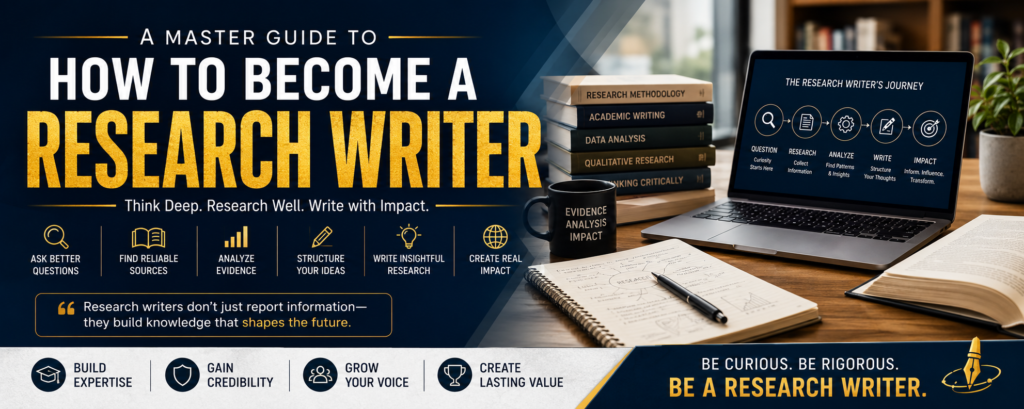
Introduction: Research Writing Is the Discipline of Turning Information into Knowledge
Every major scientific discovery, pharmaceutical innovation, defense doctrine, public policy shift, economic reform, and historical reinterpretation begins with one invisible but powerful process—research writing.
Before ideas influence society, they are investigated.
Before discoveries transform industries, they are documented.
Before policies shape nations, they are analyzed.
At the center of this transformation stands the research writer.
Research writing is among the few professions where intellectual discipline directly converts into influence. Unlike conventional writing that often prioritizes expression, entertainment, or persuasion, research writing prioritizes evidence, structure, interpretation, and credibility.
A research writer is not simply someone who writes.
A research writer is a builder of knowledge.
The profession demands far more than grammar or vocabulary. It requires the ability to investigate reality, identify patterns, evaluate competing viewpoints, synthesize evidence, and communicate conclusions with precision.
In the modern world, research writing extends far beyond universities and academic journals. Organizations across healthcare, pharmaceuticals, artificial intelligence, biotechnology, manufacturing, defense, finance, media, public policy, sustainability, and global consulting increasingly depend upon individuals capable of transforming scattered information into meaningful intelligence.
To become a research writer, therefore, is not merely to pursue a profession.
It is to develop a method of thinking.
This article presents a refined and comprehensive roadmap toward becoming a professional research writer capable of producing impactful, credible, and enduring intellectual work.
Understanding Research Writing: Beyond Words, Toward Intellectual Construction
Many aspiring writers misunderstand research writing.
They believe it means collecting facts and arranging them elegantly.
This assumption is incomplete.
Research writing is the systematic process of:
- Asking meaningful questions
- Investigating available evidence
- Evaluating credibility
- Interpreting findings
- Drawing defensible conclusions
- Communicating insights effectively
A research writer moves through multiple intellectual stages.
Observation.
Question.
Investigation.
Interpretation.
Communication.
Impact.
Unlike ordinary writing, where opinions may dominate, research writing demands accountability to evidence.
A professional research writer constantly asks:
- What do we know?
- How do we know it?
- How reliable is that knowledge?
- What remains uncertain?
- What future implications emerge?
These questions distinguish researchers from information collectors.
The Psychological Foundation: Becoming a Thinker Before Becoming a Writer
Research writing begins long before the first paragraph.
It begins in the mind.
Most people seek answers.
Researchers seek questions.
The difference appears subtle but changes everything.
Curiosity becomes the engine.
Discipline becomes the steering mechanism.
Patience becomes the fuel reserve.
Train yourself to observe deeper.
When reading a news article:
Do not simply accept conclusions.
Ask:
Who produced this information?
What assumptions exist?
What evidence supports it?
Could alternative explanations exist?
What incentives influence interpretation?
This habit gradually creates research consciousness.
Research writers learn to remain intellectually flexible.
They neither accept information blindly nor reject it emotionally.
They investigate.
Stage One: Develop the Habit of Serious Reading
No great research writer exists without becoming an extraordinary reader.
Reading builds intellectual architecture.
Writing merely reveals it.
The quality of your writing reflects the quality of ideas entering your mind.
Professional research readers operate across four progressive levels.
Level One: Informational Reading
Purpose:
Acquire basic understanding.
Questions:
What happened?
What is this subject?
Who is involved?
Level Two: Analytical Reading
Purpose:
Understand arguments.
Questions:
Why does the author believe this?
What evidence exists?
Level Three: Critical Reading
Purpose:
Evaluate credibility.
Questions:
What weaknesses exist?
What assumptions remain hidden?
Level Four: Synthetic Reading
Purpose:
Create original insight.
Questions:
How do multiple viewpoints connect?
What new interpretation emerges?
Maintain a research notebook.
For every source, capture:
Topic.
Core arguments.
Evidence.
Contradictions.
Questions.
Future implications.
This notebook gradually becomes your intellectual database.
Stage Two: Learn Research Methodology as Your Operating System
Research methodology is the invisible framework behind credible writing.
Many writers fail because they learn expression before learning investigation.
Methodology teaches:
How evidence is generated.
How conclusions are validated.
How bias is minimized.
How uncertainty is managed.
Without methodology, writing becomes opinion.
With methodology, writing becomes knowledge.
Qualitative Research
Designed to understand:
Experiences.
Motivations.
Culture.
Human behavior.
Methods include:
Interviews.
Focus groups.
Case studies.
Ethnography.
Content analysis.
Qualitative research reveals depth.
Quantitative Research
Designed to measure:
Relationships.
Patterns.
Variables.
Statistical outcomes.
Methods include:
Surveys.
Experimental studies.
Statistical modeling.
Quantitative analysis.
Quantitative research reveals scale.
Mixed Methods Research
Combines:
Human understanding
Numerical validation.
Increasingly, modern research adopts hybrid approaches.
Key concepts to master:
Sampling.
Reliability.
Validity.
Bias.
Confounding variables.
Replication.
Generalizability.
Statistical significance.
These principles separate professionals from amateurs.
Stage Three: Build Deep Domain Expertise
Research rewards specialization.
Breadth creates awareness.
Depth creates authority.
Choose one primary intellectual territory.
Examples include:
Healthcare.
Pharmaceutical sciences.
Defense strategy.
Economics.
Technology.
Behavioral science.
Biotechnology.
Public policy.
Energy systems.
Read vertically.
Move from introductory books to advanced journals.
Eventually aim to understand:
History.
Current landscape.
Major debates.
Future trajectories.
Deep expertise allows original interpretation.
Stage Four: Master Source Intelligence
Research writers must become expert evaluators of information.
Not all sources carry equal value.
Professional source hierarchy:
Level One:
Peer-reviewed journals.
Level Two:
Government publications.
Level Three:
Industry reports.
Level Four:
Expert commentary.
Level Five:
General media.
Evaluate every source using five filters.
Authority
Who produced it?
Evidence
How were conclusions reached?
Objectivity
What biases may exist?
Timeliness
Is the information current?
Reproducibility
Can findings be independently validated?
Source intelligence determines research quality.
Stage Five: Build a Professional Research Workflow
Professional writing is rarely spontaneous.
It is systematic.
A strong workflow reduces cognitive overload.
A refined workflow:
Question Formation
↓
Literature Exploration
↓
Evidence Collection
↓
Source Validation
↓
Analytical Framework
↓
Outline Construction
↓
Writing
↓
Editing
↓
Citation
↓
Publication
Create folders for:
Reading.
Drafts.
Figures.
References.
Ideas.
Version control.
Organization protects intellectual energy.
Stage Six: Learn the Architecture of Research Writing
Research writing succeeds through structure.
Readers trust clarity.
Professional structure generally follows:
Title
Precise.
Searchable.
Meaningful.
Abstract
Concise summary.
Introduction
Context.
Problem.
Objectives.
Literature Review
Current knowledge.
Research gaps.
Methodology
Research process.
Results
Evidence.
Discussion
Interpretation.
Limitations
Constraints.
Conclusion
Meaning and future direction.
Structure transforms complexity into comprehension.
Stage Seven: Develop Analytical Intelligence
Research writing is interpretation.
Data itself has little value until meaning emerges.
Compare these examples.
Weak:
“Sales increased 15%.”
Research-level:
“Sales increased 15%, likely driven by policy incentives, urban demand expansion, and distribution optimization.”
Analysis asks:
Why?
What caused change?
Will it continue?
What risks exist?
Professional analytical frameworks include:
SWOT.
PESTLE.
Scenario analysis.
Systems thinking.
Trend analysis.
Comparative modeling.
Analytical intelligence creates intellectual differentiation.
Stage Eight: Strengthen Quantitative and Statistical Thinking
Modern research increasingly depends upon numerical literacy.
Understand:
Mean.
Median.
Variance.
Correlation.
Regression.
Probability.
Confidence intervals.
Sensitivity analysis.
Data interpretation.
You do not need advanced mathematics initially.
You do need numerical confidence.
Numbers strengthen persuasion.
Stage Nine: Master Citation and Academic Integrity
Research credibility depends on traceability.
Learn major systems:
APA.
MLA.
Chicago.
Harvard.
Vancouver.
IEEE.
Good citation demonstrates:
Transparency.
Respect.
Professionalism.
Research ethics.
Never treat referencing as formatting.
Treat it as intellectual responsibility.
Stage Ten: Build a Daily Research Practice
Research writers are developed through repetition.
Suggested daily system:
60 minutes reading.
30 minutes note creation.
45 minutes writing.
15 minutes reflection.
Weekly output:
One article.
One synthesis.
One review.
One insight document.
Small consistency outperforms rare intensity.
Stage Eleven: Learn Editing as Intellectual Engineering
Professional writing emerges during editing.
Edit in layers.
Structural Editing
Flow.
Analytical Editing
Logic.
Language Editing
Precision.
Technical Editing
Accuracy.
Final Proofreading
Polish.
Professional editors often remove more than they add.
Stage Twelve: Create an Intellectual Portfolio
Your portfolio becomes evidence of capability.
Include:
Research articles.
Reports.
Books.
Analyses.
White papers.
Case studies.
Reviews.
Build:
Professional website.
Publication archive.
Digital profile.
Your portfolio should communicate:
This is what I investigate.
This is how I think.
This is what I contribute.
Stage Thirteen: Publish Before You Feel Ready
Perfection delays growth.
Begin with:
Medium-form articles.
Independent reports.
Professional blogs.
Industry journals.
Research newsletters.
Publication develops:
Feedback.
Visibility.
Confidence.
Momentum.
Every publication becomes part of your intellectual history.
Stage Fourteen: Learn Visual Communication
Modern research is visual.
Develop skills in:
Charts.
Research graphics.
Knowledge diagrams.
Presentation design.
Visual storytelling.
The strongest research writers communicate with both evidence and design.
Stage Fifteen: Build Intellectual Networks
Research is collaborative.
Connect with:
Authors.
Editors.
Researchers.
Scientists.
Professionals.
Publishers.
Participate in:
Conferences.
Discussion groups.
Professional communities.
Networks accelerate learning.
Stage Sixteen: Protect Ethics Relentlessly
Research influence without ethics becomes manipulation.
Core principles:
Accuracy.
Honesty.
Transparency.
Acknowledgment.
Integrity.
Research reputation compounds slowly and disappears quickly.
Protect it.
Stage Seventeen: Prepare for the Future of Research Writing
Research writing beyond 2026 is evolving rapidly.
Emerging realities include:
AI-assisted discovery.
Automated literature synthesis.
Cross-disciplinary intelligence.
Predictive research.
Human–machine collaboration.
The future belongs to writers who combine:
Human judgment
Analytical rigor
Technological fluency.
AI may accelerate information.
It cannot replace intellectual responsibility.
A Twelve-Month Transformation Roadmap
Months 1–2
Develop reading discipline.
Months 3–4
Learn methodology.
Months 5–6
Write structured summaries.
Months 7–8
Publish initial outputs.
Months 9–10
Build specialization.
Months 11–12
Develop portfolio and visibility.
At the end of one year:
You may not become famous.
But you will think differently.
And that is where research careers begin.
Conclusion: Research Writers Shape the Invisible Foundations of Progress
Research writing is among humanity’s most influential intellectual crafts.
Scientists may discover.
Leaders may decide.
Industries may implement.
But research writers organize evidence into knowledge that others can trust.
Becoming a research writer therefore requires more than talent.
It requires:
Curiosity to question.
Discipline to investigate.
Humility to revise.
Integrity to remain honest.
And courage to publish.
Start with one subject.
Read deeply.
Write consistently.
Think rigorously.
Over time—
your notes become articles.
Your articles become publications.
Your publications become authority.
And your authority becomes contribution.