

A Comprehensive International Review on the Evolution, Technologies, Geopolitics, Ethics, and Future of Unmanned Military Systems
By Devanssh Mehta
Introduction
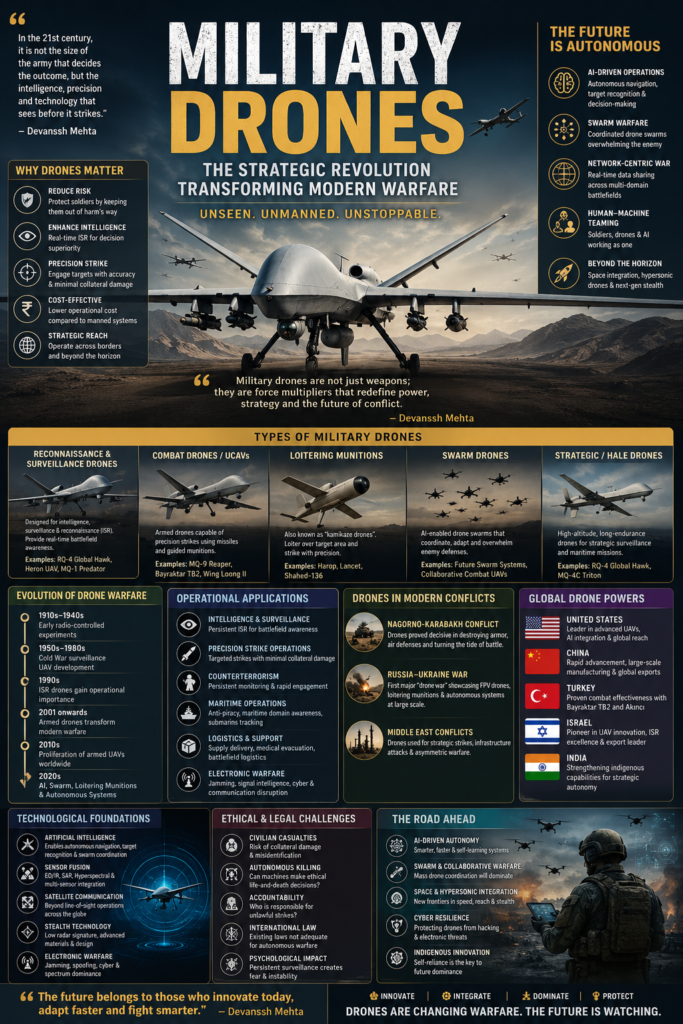
The history of warfare is fundamentally the history of technological transformation. From the invention of the bow and arrow to gunpowder artillery, from tanks and fighter aircraft to nuclear weapons, every major technological innovation has altered the strategic balance of power among nations. In the twenty-first century, one of the most revolutionary military technologies reshaping global defense architecture is the military drone, also known as the Unmanned Aerial Vehicle (UAV) or Unmanned Combat Aerial Vehicle (UCAV). Military drones have transformed the operational philosophy of armed conflict by enabling surveillance, intelligence gathering, precision strikes, electronic warfare, border monitoring, and autonomous combat capabilities without exposing pilots to direct physical danger.
The emergence of military drones represents a paradigm shift in defense strategy. Unlike traditional aircraft systems that require onboard human pilots, drones are remotely operated or increasingly powered by artificial intelligence and autonomous navigation systems. Their capability to conduct long-duration missions, perform real-time surveillance, engage targets with precision-guided munitions, and operate in high-risk combat zones has made them indispensable tools for modern armed forces. Countries such as the United States, China, Israel, Turkey, Russia, India, and Iran are heavily investing in drone warfare technologies as part of their national defense modernization strategies. (Encyclopedia Britannica)
The strategic significance of drones became globally visible during conflicts such as the Afghanistan War, the Iraq War, the Nagorno-Karabakh conflict, the Syrian Civil War, and especially the Russia–Ukraine War, where drones demonstrated their ability to alter battlefield dynamics at comparatively lower operational costs. The extensive use of drones in Ukraine has shown that relatively inexpensive unmanned systems can challenge even advanced armored formations and conventional military infrastructure. (Australian Army Research Centre)
Today, military drones are no longer supplementary systems; they are becoming central components of integrated warfare doctrines. Modern drones incorporate artificial intelligence, machine learning, satellite communications, swarm algorithms, stealth technology, hyperspectral imaging, and electronic warfare capabilities. This transformation is gradually leading toward an era of autonomous warfare, where machines may independently identify, track, and engage targets with minimal human intervention.
However, the rise of military drones also raises profound ethical, legal, geopolitical, and humanitarian concerns. Questions surrounding civilian casualties, accountability, autonomous lethal decision-making, cyber vulnerabilities, and international arms proliferation have become major global debates. Thus, military drones symbolize not merely technological progress but also the emergence of a new strategic and moral battlefield.
This article presents a comprehensive international review of military drones, covering their historical evolution, classifications, technological foundations, operational applications, geopolitical implications, ethical controversies, and future trajectories. Written according to international analytical standards, the article aims to provide a multidimensional understanding of how drones are redefining warfare, national security, and global strategic competition.
Historical Evolution of Military Drones
The concept of unmanned warfare is not entirely new. The earliest experimental attempts toward unmanned military systems can be traced back to World War I and World War II, when nations explored radio-controlled aircraft and explosive-laden flying devices. However, technological limitations prevented these systems from becoming operationally dominant.
The Cold War period significantly accelerated unmanned aerial system development. The United States and the Soviet Union recognized the importance of aerial reconnaissance without risking pilot lives. Surveillance drones were primarily used for intelligence gathering over hostile territories. Early UAV systems were rudimentary compared to modern standards, relying heavily on remote human control and lacking precision engagement capabilities.
The true transformation began after the Gulf War and intensified following the September 11 attacks in the United States. The emergence of the American Predator drone fundamentally changed military operations. The MQ-1 Predator evolved from a surveillance platform into an armed combat system capable of launching precision-guided Hellfire missiles. This innovation allowed the United States military and intelligence agencies to conduct targeted strikes against terrorist organizations in Afghanistan, Pakistan, Iraq, and other regions. (Encyclopedia Britannica)
Subsequently, more advanced systems such as the MQ-9 Reaper emerged with enhanced endurance, heavier payload capacities, satellite communications, and sophisticated surveillance sensors. The MQ-9 Reaper became one of the most recognized armed drones globally and symbolized the rise of remote warfare. (TheDefenseWatch.com)
Meanwhile, Israel established itself as one of the pioneers in drone innovation. Israeli drone systems demonstrated extraordinary battlefield effectiveness in intelligence, surveillance, and reconnaissance missions. Israel’s expertise significantly influenced global UAV development and export markets.
The twenty-first century witnessed the democratization of drone technology. Countries including China, Turkey, Iran, and India began indigenous drone development programs. Turkish drones such as the Bayraktar TB2 gained global recognition after their effective deployment in Libya, Syria, Nagorno-Karabakh, and Ukraine. The Bayraktar TB2 demonstrated how relatively affordable drones could challenge traditional military systems and influence geopolitical outcomes. (Wikipedia)
China emerged as a major exporter of armed drones through systems like the Wing Loong and CH-series UAVs. Iran developed loitering munitions and one-way attack drones such as the Shahed series, which became prominent in Middle Eastern conflicts and later in the Ukraine war. (Grey Dynamics)
The Russia–Ukraine conflict accelerated global drone militarization. Both sides employed reconnaissance drones, FPV drones, kamikaze drones, loitering munitions, and autonomous systems extensively. Analysts now regard the conflict as the first large-scale “drone war” in modern history. (Australian Army Research Centre)
Thus, the historical evolution of military drones reflects the broader transformation of warfare from human-centric combat toward technologically networked, data-driven, and increasingly autonomous battlefields.
Classification of Military Drones
Military drones can be categorized according to their operational roles, endurance, altitude capabilities, autonomy levels, and mission objectives.
Reconnaissance and Surveillance Drones
These drones are primarily designed for intelligence, surveillance, and reconnaissance (ISR) operations. Equipped with electro-optical sensors, infrared imaging systems, synthetic aperture radar, and communication relay systems, these drones provide real-time battlefield awareness.
Examples include:
- RQ-4 Global Hawk
- Heron UAV
- ScanEagle
- MQ-1 Predator
Their primary function is not direct engagement but information superiority. Surveillance drones enable commanders to monitor troop movements, identify enemy installations, track strategic assets, and conduct border security operations. (Juyeuav)
Combat Drones or UCAVs
Unmanned Combat Aerial Vehicles are armed drones capable of offensive operations. These systems carry missiles, bombs, precision-guided munitions, and electronic warfare equipment.
Examples include:
- MQ-9 Reaper
- Bayraktar TB2
- Wing Loong II
- Akıncı UAV
Combat drones have become central to counterterrorism operations and precision-strike warfare. Their long endurance allows persistent targeting and rapid engagement opportunities. (Encyclopedia Britannica)
Loitering Munitions
Loitering munitions combine characteristics of missiles and drones. These systems can hover over a target zone for extended periods before diving into targets and self-destructing.
Examples include:
- Harop
- Lancet
- Shahed-136
These are often referred to as “kamikaze drones.” They are cost-effective and highly disruptive against armored vehicles, radar systems, and air defense networks. (Grey Dynamics)
Swarm Drones
Swarm drones involve multiple coordinated UAVs operating simultaneously through AI-driven algorithms and networked communications. Swarms can overwhelm enemy air defenses, conduct distributed reconnaissance, and create electronic confusion.
Swarm warfare represents one of the most transformative future trends in military technology. Artificial intelligence enables drones within a swarm to coordinate autonomously, dynamically distribute tasks, and adapt to changing battlefield conditions.
Strategic and High-Altitude Drones
High-altitude long-endurance (HALE) drones operate at extremely high altitudes for prolonged durations.
Examples include:
- RQ-4 Global Hawk
- MQ-4C Triton
These drones support strategic surveillance, maritime domain awareness, and long-range intelligence collection.
Technological Foundations of Military Drones
The effectiveness of military drones depends upon several advanced technological systems working in integration.
Artificial Intelligence and Machine Learning
Artificial intelligence is rapidly becoming the core of next-generation military drones. AI systems enable:
- autonomous navigation,
- target recognition,
- route optimization,
- obstacle avoidance,
- predictive battlefield analytics,
- and swarm coordination.
AI-powered drones can process enormous amounts of sensor data in real time, enabling faster tactical decisions than traditional human-controlled systems.
The future battlefield may increasingly involve semi-autonomous or fully autonomous systems capable of independent engagement decisions. This evolution introduces both extraordinary military potential and unprecedented ethical dilemmas.
Satellite Communications
Satellite communication systems provide beyond-line-of-sight operational capability. Modern drones can operate thousands of kilometers away from operators through encrypted satellite links.
This technological capability allows strategic reach and global deployment flexibility. The MQ-9 Reaper exemplifies this capability with its global operational architecture. (TheDefenseWatch.com)
Sensor Fusion and ISR Technologies
Military drones integrate:
- electro-optical cameras,
- infrared imaging,
- synthetic aperture radar,
- hyperspectral sensors,
- laser target designators,
- and signals intelligence systems.
Sensor fusion enables comprehensive situational awareness by combining data from multiple sources into unified operational intelligence.
Stealth Technology
Modern drone programs increasingly emphasize stealth characteristics through:
- radar-absorbing materials,
- reduced radar cross-sections,
- heat signature management,
- and aerodynamic optimization.
Stealth drones improve survivability in contested airspaces and integrated air-defense environments.
Electronic Warfare Integration
Military drones are increasingly equipped for electronic warfare operations such as:
- radar jamming,
- communication disruption,
- cyber attacks,
- GPS spoofing,
- and electromagnetic interference.
Electronic warfare drones can significantly degrade enemy operational effectiveness without direct kinetic engagement.
Operational Applications of Military Drones
Intelligence, Surveillance, and Reconnaissance
ISR remains the most widespread application of drones. Persistent aerial surveillance allows military commanders to obtain continuous real-time battlefield intelligence.
Drones provide:
- border monitoring,
- maritime surveillance,
- insurgent tracking,
- infrastructure observation,
- and strategic reconnaissance.
Their endurance far exceeds many conventional manned systems. (MP-IDSA)
Precision Strike Operations
Armed drones revolutionized targeted strike missions. Precision-guided munitions allow high-value targets to be neutralized with comparatively reduced collateral damage.
The United States extensively utilized drones in counterterrorism campaigns against Al-Qaeda and ISIS leadership networks.
Turkey’s Bayraktar TB2 demonstrated precision battlefield strikes against armored formations and air defense systems. (TheDefenseWatch.com)
Counterterrorism Warfare
Drones became central to counterterrorism doctrines because they provide:
- persistent surveillance,
- rapid strike capability,
- reduced troop exposure,
- and operational flexibility.
However, counterterrorism drone operations remain controversial due to civilian casualty concerns and questions regarding extrajudicial targeting.
Naval and Maritime Operations
Maritime drones support:
- anti-piracy operations,
- naval reconnaissance,
- submarine tracking,
- maritime border security,
- and ocean surveillance.
Naval drone integration is becoming increasingly important in Indo-Pacific strategic competition.
Logistics and Supply Delivery
Some military drones are being developed for:
- battlefield logistics,
- medical supply transportation,
- ammunition delivery,
- and evacuation support.
Autonomous cargo drones may become essential in future distributed warfare environments.
Drone Warfare in Modern Conflicts
Nagorno-Karabakh Conflict
The Azerbaijan-Armenia conflict demonstrated how drones could decisively influence conventional warfare. Azerbaijani forces effectively used Turkish Bayraktar drones and Israeli loitering munitions to destroy Armenian armored vehicles and air defense systems.
This conflict highlighted the vulnerability of traditional armor against persistent aerial drone surveillance and precision attacks.
Russia–Ukraine War
The Ukraine conflict transformed global military thinking regarding drone warfare. Both sides extensively deployed:
- FPV drones,
- kamikaze drones,
- ISR systems,
- naval drones,
- and electronic warfare UAVs.
Commercial drones were rapidly modified into battlefield weapons, showing how accessible drone technologies can influence large-scale warfare. (Australian Army Research Centre)
The war demonstrated several lessons:
- drones democratize military power,
- low-cost systems can threaten expensive platforms,
- electronic warfare is critical,
- and rapid innovation cycles dominate battlefield adaptation.
Middle Eastern Conflicts
Iranian drone proliferation significantly altered Middle Eastern security dynamics. One-way attack drones and loitering munitions became strategic tools for asymmetric warfare.
Drone attacks against oil infrastructure and military facilities revealed the strategic vulnerability of critical infrastructure to relatively inexpensive UAV systems.
Global Drone Powers and Geopolitical Competition
United States
The United States remains the global leader in advanced drone warfare systems. American dominance is based on:
- satellite infrastructure,
- AI integration,
- stealth technology,
- sensor superiority,
- and global operational reach.
Systems such as the MQ-9 Reaper symbolize American drone warfare capability. (TheDefenseWatch.com)
China
China rapidly expanded its drone ecosystem through:
- aggressive manufacturing,
- export-oriented policies,
- and indigenous military modernization.
Chinese drones have become highly competitive in international markets due to affordability and scalability.
Turkey
Turkey emerged as one of the most influential drone powers through Baykar’s Bayraktar systems. Turkish drones demonstrated operational effectiveness while maintaining comparatively lower costs. (Wikipedia)
Turkey’s success represents how mid-sized powers can leverage drone technologies for geopolitical influence.
Israel
Israel remains a pioneer in UAV innovation. Israeli systems are recognized for:
- reliability,
- advanced electronics,
- ISR excellence,
- and export success.
Israeli expertise heavily influenced global drone doctrine development.
India
India is increasingly prioritizing indigenous drone development under defense modernization initiatives and the “Atmanirbhar Bharat” framework.
India faces strategic challenges from both Pakistan and China, making drone capability essential for:
- border surveillance,
- counterterrorism,
- maritime security,
- and high-altitude monitoring.
India’s future defense strategy will likely integrate AI-enabled autonomous drone systems extensively.
Ethical and Legal Challenges
The rise of military drones has generated profound ethical debates.
Civilian Casualties
Although drones are promoted as precision systems, civilian casualties remain a major concern. Intelligence errors, misidentification, and collateral damage continue to generate international criticism.
Autonomous Killing
One of the most controversial questions concerns fully autonomous lethal systems.
Can machines ethically decide when to kill?
This question lies at the center of ongoing debates regarding “killer robots” and autonomous warfare.
Accountability and International Law
Drone warfare challenges existing international legal frameworks regarding:
- sovereignty,
- targeted killings,
- rules of engagement,
- and war crimes accountability.
Many international institutions are now discussing regulations for autonomous weapons systems.
Psychological Warfare
Persistent drone surveillance creates continuous psychological pressure on civilian populations and military personnel.
Drone warfare extends beyond physical destruction into psychological dominance.
Future of Military Drones
The future of military drones is likely to involve:
AI-Driven Autonomous Warfare
Artificial intelligence will increasingly reduce human operational involvement. Future drones may autonomously:
- coordinate swarms,
- conduct reconnaissance,
- evade defenses,
- and engage threats.
Human–Machine Teaming
Future combat may involve integrated operations between:
- soldiers,
- manned aircraft,
- autonomous drones,
- and robotic ground systems.
Human-machine collaboration will become central to military doctrine.
Swarm Warfare
Swarm drones may become one of the most disruptive technologies in defense history. Hundreds or thousands of coordinated drones could overwhelm conventional air-defense systems.
Space and Hypersonic Integration
Future drones may integrate:
- space-based communication systems,
- hypersonic propulsion,
- quantum navigation,
- and advanced stealth technologies.
Cyber Vulnerabilities
As drones become network-dependent, cybersecurity becomes critically important. Hacking, signal jamming, and GPS spoofing represent major vulnerabilities.
Thus, future military competition will increasingly involve cyber-electronic warfare ecosystems alongside physical combat systems.
Strategic Implications for Global Security
Military drones are reshaping international power structures.
Nations that master:
- artificial intelligence,
- autonomous systems,
- electronic warfare,
- and drone manufacturing ecosystems
will gain strategic advantages in future conflicts.
Drone proliferation also lowers entry barriers for smaller states and non-state actors. This democratization of airpower fundamentally alters global military balance.
Traditional military superiority based solely on expensive fighter aircraft and armored systems is increasingly challenged by low-cost unmanned technologies.
Therefore, military drones represent not merely technological tools but strategic instruments redefining:
- deterrence,
- warfare doctrine,
- intelligence operations,
- and geopolitical competition.
Conclusion
Military drones symbolize one of the most transformative technological revolutions in modern defense history. They have altered the nature of warfare by combining surveillance, precision strike capability, artificial intelligence, autonomous navigation, and network-centric operations into highly adaptable combat systems.
From reconnaissance drones to swarm warfare and loitering munitions, unmanned systems are increasingly becoming the backbone of twenty-first-century military strategy. Conflicts such as Nagorno-Karabakh and the Russia–Ukraine war have demonstrated that drones can significantly influence battlefield outcomes while challenging traditional military doctrines.
At the same time, the rise of drone warfare introduces profound ethical, legal, and geopolitical dilemmas. Questions regarding autonomous killing, civilian safety, cyber vulnerability, and international regulation remain unresolved. The future battlefield may increasingly involve machines making combat decisions at speeds beyond human cognitive response.
For emerging powers such as India, military drone development represents not merely a defense necessity but a strategic imperative linked to technological sovereignty, national security, and geopolitical influence. Indigenous innovation, AI integration, cyber resilience, and defense-industrial modernization will determine future military competitiveness.
Ultimately, military drones represent the convergence of artificial intelligence, aerospace engineering, robotics, cyber warfare, and geopolitical strategy. Their evolution marks the beginning of a new era where warfare becomes increasingly data-driven, autonomous, networked, and technologically asymmetric.
The nations that successfully balance innovation with ethical responsibility will shape the future architecture of global security in the drone age. (Encyclopedia Britannica)