

Schistosomiasis, also historically known as bilharzia, represents one of the most neglected yet biologically complex parasitic diseases affecting humanity. It is a chronic helminthic disease caused by trematode blood flukes belonging to the genus Schistosoma. Although traditionally perceived as a disease of impoverished tropical populations, modern epidemiological evidence demonstrates that schistosomiasis is deeply linked with gender inequity, reproductive health morbidity, chronic inflammation, educational disadvantage, poverty cycles, and global health inequality. Women and adolescent girls constitute one of the most vulnerable yet underdiagnosed populations affected by schistosomiasis, particularly through the manifestation known as Female Genital Schistosomiasis (FGS). FGS is increasingly recognized as a major gynecological, reproductive, sexual, and psychosocial disorder that remains substantially overlooked in global health systems. (World Health Organization)
Globally, schistosomiasis affects more than 230 million individuals, with the overwhelming burden concentrated in sub-Saharan Africa. WHO estimates suggest that tens of millions of women and girls are affected by genital manifestations of schistosomiasis, particularly due to Schistosoma haematobium infection. Female genital schistosomiasis is estimated to affect nearly 56 million women and girls worldwide, although the real burden is likely much higher because of underdiagnosis, social stigma, poor surveillance systems, and lack of integration into reproductive healthcare programs. (World Health Organization)
The disease has profound implications for adolescent girls. In endemic regions, repeated freshwater exposure during childhood and adolescence initiates chronic inflammatory changes in genital tissues. These pathological changes often persist into reproductive age, causing infertility, ectopic pregnancy, chronic pelvic pain, menstrual irregularities, dyspareunia, pregnancy complications, and increased susceptibility to HIV and HPV infections. (Uniting to Combat NTDs)
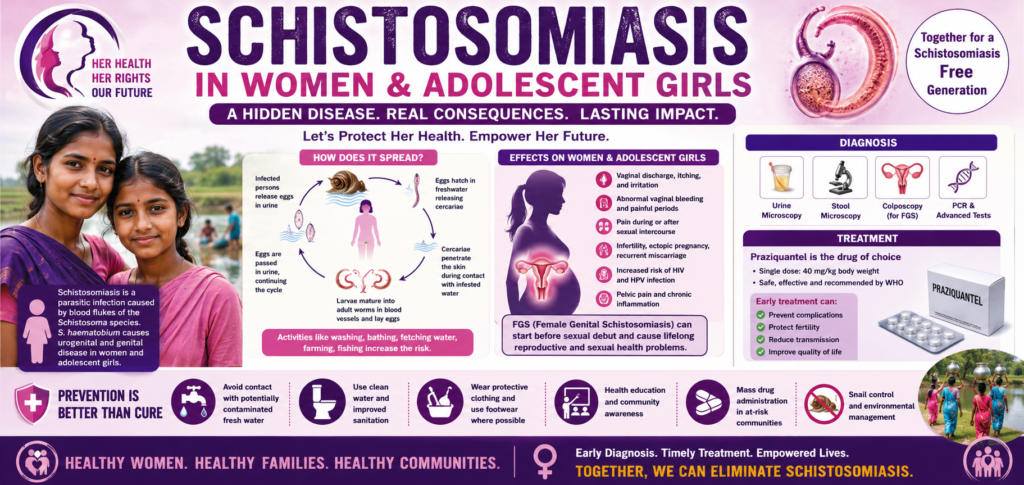
India has traditionally been considered a low-endemic or non-endemic country for human schistosomiasis. However, sporadic endemic foci, isolated outbreaks, serological evidence, and underrecognized transmission patterns indicate that the disease may be substantially underestimated within the Indian subcontinent. Historical reports from Maharashtra, Tamil Nadu, and other regions suggest indigenous transmission in specific ecological niches. (PMC)
Historical Perspective and Global Evolution of Schistosomiasis
The history of schistosomiasis dates back thousands of years. Eggs resembling schistosome ova have been identified in ancient Egyptian mummies, suggesting the disease affected early Nile civilizations. The parasite was scientifically identified in 1851 by Theodor Bilharz in Egypt, leading to the historical term “bilharzia.”
The disease emerged as a major public health challenge with irrigation expansion, dam construction, population displacement, and inadequate sanitation. Freshwater ecosystems containing intermediate snail hosts became transmission reservoirs. Over time, the disease expanded across Africa, the Middle East, Asia, and parts of South America.
Modern globalization, climate change, migration, and ecological disruption are altering transmission dynamics. Increasing evidence suggests that climate-induced changes in freshwater ecosystems may expand the habitat suitability for snail vectors, potentially increasing schistosomiasis risk in previously low-risk regions.
The disease today is no longer viewed solely as an infectious disorder but rather as a chronic inflammatory, immunological, reproductive, and socioeconomic disease complex.
Etiological Agents and Species Involved
Human schistosomiasis is primarily caused by several medically important species:
- Schistosoma haematobium
- Schistosoma mansoni
- Schistosoma japonicum
- Schistosoma intercalatum
- Schistosoma mekongi
Among these, S. haematobium is the principal species responsible for female genital schistosomiasis.
The lifecycle involves:
- Human definitive host
- Freshwater snail intermediate host
- Cercarial larval stage released into freshwater
- Skin penetration during water exposure
After penetrating human skin, cercariae transform into schistosomulae, migrate through circulation, mature within venous systems, and begin egg deposition. It is the host immune response against retained eggs, rather than the adult worms themselves, that produces most pathological manifestations.
Epidemiology of Schistosomiasis in Women and Adolescent Girls
Global Burden
Approximately 90% of global schistosomiasis cases occur in Africa. Women and girls in endemic regions are disproportionately exposed because of domestic, occupational, and cultural water-contact activities such as:
- Washing clothes
- Fetching water
- Agricultural labor
- Fishing-related activities
- Bathing in infested freshwater
WHO recognizes women performing domestic chores in infected water as a major at-risk population. (World Health Organization)
Adolescent girls represent a particularly vulnerable demographic because genital lesions may begin developing before sexual debut. This has major implications for reproductive health and HIV vulnerability.
Recent epidemiological studies demonstrate alarming prevalence rates in endemic African communities, with genital schistosomiasis prevalence ranging from 8% to over 35% depending on diagnostic modalities employed. (Springer)
Epidemiology in India
India’s schistosomiasis burden remains controversial and likely underestimated.
Historically, India has been categorized as a non-endemic country; however:
- Autochthonous cases have been documented
- Seropositivity has been observed
- Snail hosts capable of transmission exist
- Human infections have been reported in Maharashtra, Tamil Nadu, Gujarat, and other areas
The famous Gimvi village focus in Ratnagiri district of Maharashtra represented one of the most significant indigenous transmission zones documented in India. (Indian Journal of Medical Research)
Potential reasons for underrecognition in India include:
- Diagnostic limitations
- Low clinical suspicion
- Confusion with tuberculosis and gynecological disorders
- Lack of routine parasitological screening
- Inadequate epidemiological surveillance
India’s expanding irrigation projects, freshwater ecosystem alterations, sanitation gaps, and climate variability may create favorable conditions for localized transmission expansion.
Women in rural India engaged in agricultural and domestic water activities may constitute an overlooked risk group.
Female Genital Schistosomiasis: A Distinct Clinical Entity
Female genital schistosomiasis is one of the most neglected manifestations of tropical parasitic disease.
FGS occurs when schistosome eggs become deposited within:
- Cervix
- Vagina
- Vulva
- Uterus
- Fallopian tubes
- Ovaries
The retained eggs induce chronic granulomatous inflammation, fibrosis, neovascularization, tissue destruction, and mucosal abnormalities.
WHO describes manifestations including:
- Vaginal bleeding
- Dyspareunia
- Vulval nodules
- Genital lesions
- Chronic pelvic pain
- Infertility
- Pregnancy complications (World Health Organization)
The condition is often misdiagnosed as:
- Sexually transmitted infections
- Cervical cancer
- Pelvic inflammatory disease
- Endometriosis
- Tuberculosis
- Trauma-related lesions
This diagnostic confusion contributes to prolonged morbidity.
Pathophysiology of Female Genital Schistosomiasis
The pathogenesis of FGS involves complex immunological and inflammatory processes.
After deposition of eggs within genital tissues:
- Egg antigens stimulate host immune activation
- Granulomatous inflammation develops
- Chronic fibrosis and tissue remodeling occur
- Mucosal ulcerations emerge
- Vascular abnormalities and angiogenesis develop
The lesions are often described colposcopically as:
- Sandy patches
- Rubbery papules
- Grainy sandy lesions
- Abnormal blood vessels
Inflammation is driven by:
- Eosinophils
- Macrophages
- CD4+ T lymphocytes
- Cytokines including IL-4, IL-5, IL-13, TNF-alpha
Repeated egg deposition leads to cumulative genital tissue damage.
Immunological Mechanisms
Schistosomiasis is fundamentally an immunopathological disease.
The host immune response shifts from:
- Early Th1-mediated response
to - Chronic Th2-dominant response
Key immunological features include:
- Eosinophilia
- IgE elevation
- Granuloma formation
- Fibrogenesis
Cytokines involved include:
- IL-4
- IL-5
- IL-10
- IL-13
- TGF-beta
Chronic inflammation drives fibrosis and reproductive tissue dysfunction.
Emerging research also suggests:
- Altered vaginal microbiome
- Impaired mucosal immunity
- Enhanced HIV target-cell recruitment
- Chronic epithelial disruption
These mechanisms explain increased susceptibility to sexually transmitted infections.
Clinical Manifestations in Women and Adolescent Girls
The disease spectrum varies according to parasite burden, duration of infection, host immunity, and anatomical involvement.
Gynecological Manifestations
Women may present with:
- Vaginal discharge
- Contact bleeding
- Menorrhagia
- Dysmenorrhea
- Dyspareunia
- Pelvic pain
- Postcoital bleeding
Reproductive Manifestations
Chronic disease may lead to:
- Infertility
- Tubal obstruction
- Ectopic pregnancy
- Miscarriage
- Stillbirth
- Subfertility
Urinary Manifestations
In urogenital schistosomiasis:
- Hematuria
- Dysuria
- Urinary frequency
- Bladder fibrosis
- Hydronephrosis
may occur.
Adolescent Girls
Adolescent girls may experience:
- Genital itching
- Menstrual irregularities
- Stigmatizing symptoms
- School absenteeism
- Psychological distress
Schistosomiasis and HIV Interaction
One of the most important modern discoveries in FGS research is its association with HIV acquisition.
Women with FGS may have up to three- to four-fold increased susceptibility to HIV infection because:
- Genital lesions compromise mucosal barriers
- Chronic inflammation recruits HIV target cells
- Increased vascularity enhances viral access (Uniting to Combat NTDs)
This has transformed FGS from a neglected parasitic disease into a major sexual and reproductive health issue.
The disease is also associated with increased HPV susceptibility and potentially elevated cervical cancer risk.
Psychological and Social Burden
FGS imposes severe psychosocial consequences:
- Infertility-related stigma
- Marital instability
- Depression
- Anxiety
- Social exclusion
- Sexual dysfunction
In many endemic societies, infertility may result in abandonment, domestic violence, or economic insecurity.
Adolescent girls may experience embarrassment, stigma, and educational disadvantage.
Diagnosis of Schistosomiasis in Women and Adolescent Girls
Diagnosis remains one of the greatest challenges.
Conventional Methods
Microscopy
Detection of eggs in:
- Urine
- Stool
- Tissue biopsy
However, sensitivity is limited in low-intensity infections.
Urine Filtration
Used for S. haematobium detection.
Kato-Katz Technique
Used mainly for intestinal schistosomiasis.
Advanced Diagnostic Approaches
Colposcopy
Important for FGS diagnosis.
Typical lesions include:
- Sandy patches
- Abnormal vasculature
- Papules
Histopathology
Biopsy may reveal:
- Calcified eggs
- Granulomas
- Fibrosis
PCR-Based Diagnostics
Highly sensitive molecular diagnostics are increasingly used.
Recent studies show that many women with genital disease may lack detectable urinary eggs, emphasizing the need for genital sampling and PCR methods. (MedRxiv)
Antigen Detection
Circulating cathodic antigen (CCA) assays are emerging.
Serology
Useful in low-endemic settings and travelers.
Differential Diagnosis
FGS must be differentiated from:
- Cervical cancer
- STIs
- Tuberculosis
- Endometriosis
- Vulvovaginitis
- Pelvic inflammatory disease
Misdiagnosis contributes substantially to underrecognition.
Treatment Strategies for Schistosomiasis
Praziquantel: The Cornerstone Therapy
The primary treatment for schistosomiasis is:
40,mg/kg
Praziquantel administered orally as a single dose remains the WHO-recommended standard therapy.
Mechanism of action includes:
- Calcium influx into parasite cells
- Tegumental disruption
- Worm paralysis
- Immune-mediated parasite clearance
Praziquantel demonstrates high efficacy against adult worms.
However, challenges remain:
- Reduced activity against immature parasites
- Reinfection risk
- Limited reversal of established fibrosis
- Persistent genital lesions in chronic FGS
Praziquantel in Female Genital Schistosomiasis
Early treatment is critical.
Studies suggest that praziquantel administration during childhood and adolescence may substantially reduce later FGS development.
Mass drug administration programs targeting school-age children have become major WHO strategies.
However, adult women often remain untreated.
Current global initiatives emphasize integrating praziquantel into reproductive health services. (ScienceDirect)
Combination Therapies and Emerging Therapeutics
Modern research is exploring combination strategies.
Anti-inflammatory Therapies
Because chronic inflammation drives pathology, researchers are investigating:
- Corticosteroids
- Anti-fibrotic agents
- Immunomodulators
The WINGS-4-FGS initiative is exploring anti-inflammatory approaches integrated with praziquantel therapy. (CORDIS)
Artemisinin Derivatives
Artemether and artesunate show activity against immature schistosomes.
Potential combination with praziquantel is under investigation.
Oxamniquine Derivatives
Novel derivatives targeting resistant parasites are being developed.
Vaccine Development
Several vaccine candidates are under investigation:
- Sm14
- Sh28GST
- Sm-TSP-2
The goal is long-term transmission interruption and reinfection prevention.
Surgical Management
Advanced complications may require surgery.
Examples include:
- Fibrotic strictures
- Hydronephrosis
- Ectopic pregnancy
- Severe tubal disease
Gynecological interventions may be needed in advanced FGS.
Public Health Strategies
Effective control requires integrated approaches.
Mass Drug Administration (MDA)
WHO recommends preventive chemotherapy for at-risk populations.
School-based MDA programs target:
- School-age children
- Adolescents
- High-risk communities
Water, Sanitation, and Hygiene (WASH)
Critical interventions include:
- Safe water access
- Improved sanitation
- Snail control
- Hygiene education
Snail Control
Molluscicides and ecological interventions reduce transmission.
Health Education
Community awareness remains essential.
Female Genital Schistosomiasis and Reproductive Health Integration
A major modern strategy involves integrating FGS into:
- Sexual and reproductive health programs
- HIV clinics
- Cervical cancer screening
- Maternal health services
Experts increasingly argue that FGS should not remain confined within neglected tropical disease programs alone. (ScienceDirect)
Challenges in India
India faces unique challenges:
- Underdiagnosis
- Limited surveillance
- Lack of clinician awareness
- Poor parasitological infrastructure
- Inadequate research funding
Despite isolated reports, schistosomiasis remains absent from mainstream Indian public health discourse.
There is a need for:
- Nationwide epidemiological mapping
- Snail vector surveillance
- Rural freshwater ecosystem monitoring
- Gynecological screening integration
India’s tropical climate, irrigation systems, and rural sanitation gaps warrant continued vigilance.
Economic Burden
Schistosomiasis contributes to:
- Reduced productivity
- Educational loss
- Chronic disability
- Infertility-related socioeconomic consequences
Women often bear disproportionate indirect economic burdens due to caregiving roles and reproductive health impacts.
Future Directions in Research
Future priorities include:
Precision Diagnostics
Development of:
- Point-of-care PCR
- AI-assisted colposcopy
- Biomarker-based screening
Therapeutic Innovation
Need exists for:
- Anti-fibrotic drugs
- Multi-stage antiparasitic therapies
- Immunotherapeutics
Vaccine Development
Long-term elimination may require vaccines.
Gender-Focused Public Health Policies
Women-centered schistosomiasis programs are urgently needed.
Artificial Intelligence and Digital Health
Emerging technologies may revolutionize disease control.
Potential applications include:
- AI-based microscopy
- Remote colposcopic diagnosis
- Smartphone-enabled diagnostics
- GIS-based transmission mapping
Digital epidemiology may improve surveillance in underserved regions.
Global Elimination Goals
WHO aims to eliminate schistosomiasis as a public health problem through:
- Expanded preventive chemotherapy
- Enhanced diagnostics
- WASH interventions
- Community engagement
However, female genital schistosomiasis remains inadequately prioritized within elimination agendas.
Recent international initiatives are attempting to close this gap. (ESPEN)
Conclusion
Schistosomiasis in women and adolescent girls represents one of the most underestimated intersections of infectious disease, reproductive health, immunology, gender inequality, and global poverty. Female genital schistosomiasis is not merely a parasitic manifestation but a chronic inflammatory reproductive disorder with lifelong consequences affecting fertility, sexuality, psychosocial wellbeing, and vulnerability to HIV and cervical disease.
The disease continues to remain hidden because its symptoms overlap with gynecological conditions, because millions of affected women lack healthcare access, and because global health systems historically neglected female-specific manifestations of tropical diseases. The burden among adolescent girls is especially alarming because genital injury often begins early in life and silently progresses through reproductive years.
Praziquantel remains the foundation of therapy, yet modern treatment paradigms increasingly recognize the need for integrated reproductive healthcare, anti-inflammatory strategies, molecular diagnostics, and gender-sensitive public health interventions. Emerging research into vaccines, immunomodulation, molecular diagnostics, and integrated reproductive health platforms offers optimism for future disease control.
For India, the challenge is not only therapeutic but epidemiological. The country must recognize the possibility of underdiagnosed endemic pockets, strengthen parasitological surveillance, invest in neglected tropical disease research, and integrate schistosomiasis awareness into gynecological and public health systems.
Ultimately, addressing schistosomiasis in women and adolescent girls requires more than parasite eradication. It requires restoration of reproductive dignity, gender-sensitive healthcare systems, equitable sanitation access, scientific innovation, and a global commitment to ending one of the most neglected diseases affecting women in the developing world. (World Health Organization)