
Introduction
The evolution of cancer therapy during the late twentieth and early twenty-first centuries has been defined by one transformative scientific transition: the movement from non-selective cytotoxic chemotherapy toward molecularly targeted precision oncology. Among all targeted anticancer agents developed during this revolution, trastuzumab stands as one of the most historically important and scientifically transformative therapeutics ever introduced into modern medicine.
Trastuzumab fundamentally changed the treatment landscape for HER2-positive cancers and became one of the earliest and most successful examples of precision medicine in oncology. It demonstrated that understanding molecular tumor biology could dramatically improve survival outcomes while simultaneously reducing unnecessary toxicity compared with conventional chemotherapy alone.
The development of trastuzumab not only revolutionized HER2-positive breast cancer treatment but also transformed:
- Molecular oncology
- Biomarker-driven therapeutics
- Antibody engineering
- Biopharmaceutical economics
- Personalized medicine
- Global oncology drug development
Today, trastuzumab and its derivative therapeutic ecosystem have evolved into a vast industrial and scientific platform involving:
- Monoclonal antibodies
- Biosimilars
- Antibody-drug conjugates (ADCs)
- Companion diagnostics
- Precision oncology algorithms
- AI-driven cancer therapeutics
- Combination immunotherapy strategies
The global HER2-targeted therapy market continues expanding rapidly due to rising cancer incidence, increasing biologics adoption, expanding oncology infrastructure, and breakthrough advances in antibody-drug conjugate technologies. (Coherent Market Insights)
Recent global oncology developments demonstrate that trastuzumab-based therapies are entering a new era involving:
- HER2-low targeting
- Next-generation ADCs
- Bispecific antibodies
- Precision biomarker profiling
- AI-assisted oncology
- Personalized immunotherapy combinations
Recent clinical data involving trastuzumab-based antibody-drug conjugates such as trastuzumab pamirtecan and trastuzumab deruxtecan continue demonstrating major advances in HER2-expressing tumors across multiple cancer types. (BioNTech)
Thus, trastuzumab is no longer merely a drug. It has become a strategic platform technology at the center of modern precision oncology.
Historical Evolution of Trastuzumab
Before the development of trastuzumab, HER2-positive breast cancer was considered one of the most aggressive and poor-prognosis forms of breast malignancy.
The HER2 receptor, also known as:
- Human Epidermal Growth Factor Receptor 2
- ERBB2
was identified as a major oncogenic driver in a subset of breast cancers.
Researchers discovered that HER2 amplification promoted:
- Aggressive tumor growth
- Increased metastasis
- Reduced survival
- Chemotherapy resistance
This discovery transformed cancer biology because it established that specific molecular abnormalities could define tumor behavior.
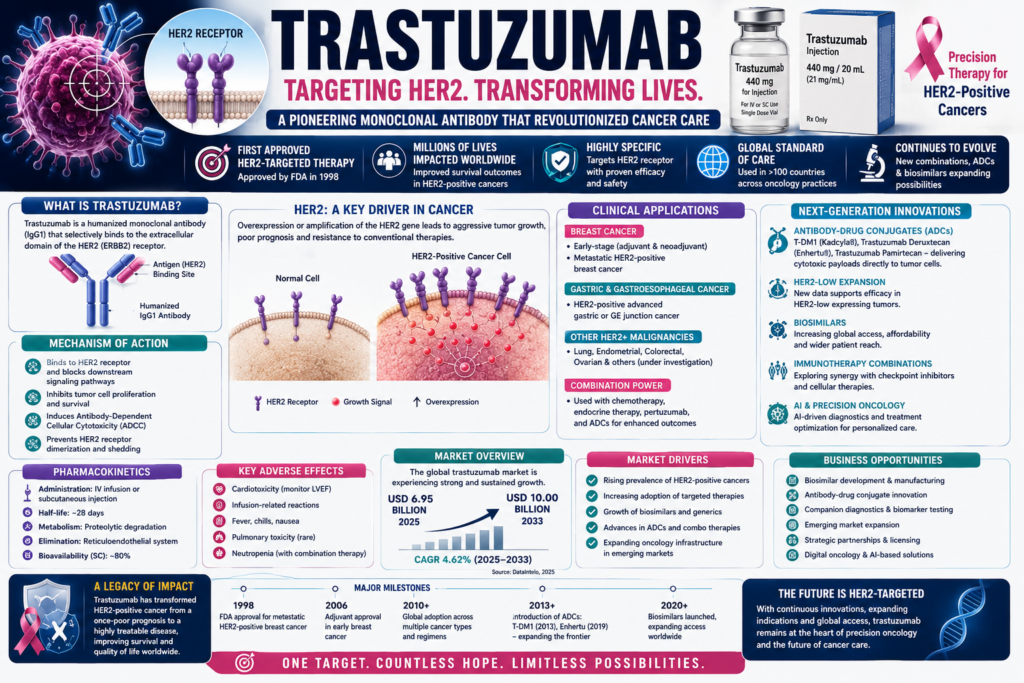
Scientists at Genentech subsequently developed trastuzumab, a monoclonal antibody specifically targeting the HER2 receptor.
The approval of trastuzumab became a landmark moment in oncology history because it demonstrated:
- Biomarker-guided therapy
- Target-specific cancer inhibition
- Improved survival outcomes
Trastuzumab rapidly became one of the most successful targeted oncology drugs ever developed.
HER2 Biology and Molecular Oncology
HER2 belongs to the epidermal growth factor receptor family.
The receptor participates in:
- Cellular proliferation
- Survival signaling
- Growth regulation
- Differentiation pathways
HER2 overexpression results in uncontrolled signaling activity.
The oncogenic pathway may conceptually be represented as:
HER2\ overexpression \rightarrow Increased\ cell\ proliferation\ and\ tumor\ growth
Approximately:
- 15–20% of breast cancers
- Subsets of gastric cancers
- Certain lung cancers
- Endometrial cancers
demonstrate HER2 positivity.
HER2 amplification became one of the first clinically actionable biomarkers in oncology.
Chemical and Structural Nature of Trastuzumab
Trastuzumab is a humanized monoclonal antibody of the IgG1 subclass.
Its structure is specifically engineered to bind the extracellular domain of the HER2 receptor.
The antibody-receptor interaction can conceptually be represented as:
Trastuzumab + HER2\ receptor \rightarrow Receptor\ blockade
This interaction inhibits downstream proliferative signaling.
As a biologic therapeutic, trastuzumab represents a highly sophisticated product of recombinant DNA technology and antibody engineering.
Mechanism of Action
Trastuzumab exerts antitumor effects through multiple mechanisms.
HER2 Signal Blockade
The primary mechanism involves inhibition of HER2-mediated cellular signaling.
This suppresses:
- Cellular proliferation
- Tumor survival pathways
- Oncogenic signaling cascades
Antibody-Dependent Cellular Cytotoxicity (ADCC)
Trastuzumab also activates immune-mediated tumor destruction.
The mechanism may conceptually be represented as:
Trastuzumab + HER2\ tumor\ cell \rightarrow Immune\ activation\ and\ ADCC
This dual mechanism transformed understanding of how monoclonal antibodies could combine:
- Target inhibition
- Immune system activation
Prevention of HER2 Receptor Dimerization
Trastuzumab disrupts receptor interactions and downstream signaling amplification.
Pharmacokinetics and Pharmacodynamics
Trastuzumab demonstrates pharmacokinetic characteristics typical of monoclonal antibodies:
- Intravenous administration
- Long half-life
- Target-mediated clearance
- Limited renal elimination
Subcutaneous formulations later improved convenience and patient compliance.
Modern pharmacodynamic modeling increasingly integrates:
- Tumor burden
- HER2 expression level
- Biomarker profiling
- Immunological response markers
Clinical Applications of Trastuzumab
HER2-Positive Breast Cancer
Trastuzumab transformed HER2-positive breast cancer from one of the most aggressive breast cancer subtypes into one of the most treatable molecular categories.
It is now used in:
- Early-stage breast cancer
- Metastatic breast cancer
- Neoadjuvant therapy
- Adjuvant therapy
Combination regimens significantly improved:
- Overall survival
- Disease-free survival
- Progression-free survival
Gastric Cancer
HER2-positive gastric and gastroesophageal cancers also benefit from trastuzumab-based therapy.
This expanded the role of HER2 targeting beyond breast oncology.
Emerging HER2-Expressing Tumors
Modern oncology increasingly investigates HER2-directed therapy in:
- Lung cancer
- Endometrial cancer
- Colorectal cancer
- Ovarian cancer
Recent clinical trials involving trastuzumab pamirtecan demonstrated promising efficacy in HER2-expressing recurrent endometrial cancer across multiple HER2 expression levels. (BioNTech)
Trastuzumab and Combination Oncology
One of the major reasons for trastuzumab’s success is its integration into multidrug treatment ecosystems.
Trastuzumab is frequently combined with:
- Taxanes
- Platinum compounds
- Pertuzumab
- Antibody-drug conjugates
- Immunotherapies
Modern HER2-targeted oncology increasingly emphasizes multidimensional treatment platforms.
Pertuzumab and Dual HER2 Blockade
The addition of pertuzumab created dual HER2 blockade strategies.
This combination dramatically improved outcomes in HER2-positive metastatic breast cancer.
Recent FDA approvals continue expanding trastuzumab-based dual HER2 regimens with advanced antibody-drug conjugates such as Enhertu combinations. (Reuters)
Trastuzumab Emtansine (T-DM1)
One of the most important scientific evolutions was the development of antibody-drug conjugates (ADCs).
Trastuzumab emtansine (T-DM1 or Kadcyla) combines:
- HER2 targeting
- Cytotoxic payload delivery
The ADC mechanism may conceptually be represented as:
HER2\ targeting + Cytotoxic\ payload \rightarrow Targeted\ tumor\ killing
This innovation allowed selective chemotherapy delivery directly into HER2-positive tumor cells.
The global trastuzumab emtansine market continues expanding significantly. Market projections estimate growth from approximately USD 2.4–2.7 billion toward USD 3.6–5 billion during the coming decade depending on market segmentation models. (Coherent Market Insights)
Trastuzumab Deruxtecan (Enhertu)
Enhertu represents one of the most important recent breakthroughs in oncology.
This ADC demonstrated:
- High potency
- HER2-low efficacy
- Bystander tumor killing effects
Recent FDA approvals expanded Enhertu into first-line advanced HER2-positive breast cancer combinations. (Reuters)
Recent clinical studies also showed strong promise in early-stage HER2-positive breast cancer, including major reductions in recurrence risk. (Reuters)
Enhertu’s success significantly expanded interest in HER2 ADC technologies globally.
HER2-Low Revolution
One of the most transformative recent developments is the recognition of HER2-low tumors.
Historically, tumors were classified simply as:
- HER2-positive
- HER2-negative
Modern ADC technologies demonstrated that even low HER2 expression may be therapeutically actionable.
This fundamentally expanded the addressable patient population for HER2-targeted therapy.
The HER2-low revolution represents one of the most important paradigm shifts in modern oncology.
Biosimilars and Global Access
The expiration of original trastuzumab patents triggered major expansion of biosimilar markets.
Biosimilars significantly improved:
- Affordability
- Accessibility
- Global oncology penetration
The trastuzumab biosimilar market is experiencing major global growth. Recent analyses project expansion from approximately USD 6.9 billion in 2025 to nearly USD 8.9 billion in 2026 alone. (Yahoo Finance)
Major biosimilar manufacturers include:
- Samsung Bioepis
- Zydus Lifesciences
- Roche
India has become increasingly important in biosimilar manufacturing ecosystems.
Trastuzumab and Precision Medicine
Trastuzumab became one of the earliest examples of true precision oncology.
Modern treatment increasingly depends upon:
- HER2 testing
- Companion diagnostics
- Genomic profiling
- AI-assisted pathology
Companion diagnostic technologies remain essential for patient selection.
Recent FDA approvals increasingly integrate companion diagnostic systems with HER2-directed therapy expansion. (Reuters)
Artificial Intelligence and HER2 Oncology
AI is transforming HER2-positive cancer management.
Applications include:
- Digital pathology
- HER2 expression quantification
- Treatment prediction
- Imaging analysis
- Survival modeling
Machine-learning systems increasingly assist:
- Biomarker interpretation
- Treatment optimization
- Precision therapeutic selection
Future oncology systems may rely heavily upon AI-integrated precision diagnostics.
Toxicity and Safety Considerations
Despite major therapeutic benefits, trastuzumab possesses important safety concerns.
Cardiotoxicity
Cardiac dysfunction remains one of the most significant adverse effects.
The cardiotoxicity mechanism may conceptually be represented as:
HER2\ inhibition \rightarrow Potential\ cardiac\ dysfunction
Regular cardiac monitoring is essential during therapy.
Infusion Reactions
Some patients experience:
- Fever
- Chills
- Hypersensitivity reactions
Pulmonary Toxicity
Rare but serious pulmonary complications may occur.
Modern oncology increasingly uses individualized monitoring protocols to reduce toxicity risks.
Resistance Mechanisms
Tumors may develop trastuzumab resistance through:
- HER2 pathway alterations
- PI3K pathway activation
- Alternative signaling pathways
- Receptor mutations
Resistance biology remains one of the most active research areas in HER2 oncology.
New ADCs and combination therapies increasingly aim to overcome these resistance mechanisms.
Global Trastuzumab Market Dynamics
The trastuzumab ecosystem now represents one of the most commercially significant oncology sectors globally.
The broader HER2-directed therapy market is projected to grow substantially through 2034. (DelveInsight)
The HER2 antibody-drug conjugate market alone is projected to expand from approximately USD 5.69 billion in 2024 to over USD 18 billion by 2032. (Intel Market Research)
One growth projection may conceptually be represented as:
Future\ Value = Present\ Value(1+r)^n
Using:
- Present value = USD 5.69 billion
- CAGR = 18.2%
- Time = 8 years
The projected growth becomes:
5.69(1+0.182)^8 \approx 18.1\ billion\ USD
This aligns closely with current market forecasts. (Intel Market Research)
Business Opportunities Across the World
Biosimilar Manufacturing
The trastuzumab biosimilar sector remains one of the most important global pharmaceutical opportunities.
India and Asia-Pacific regions are strategically positioned due to:
- Biologics manufacturing infrastructure
- Skilled workforce
- Cost advantages
- Expanding oncology markets
Antibody-Drug Conjugates (ADCs)
ADC development represents one of the fastest-growing biotechnology sectors globally.
Recent scientific reports emphasize rapid expansion in ADC approvals between 2019 and 2026. (NJ Bio, Inc.)
Companies investing in:
- Linker technology
- Payload engineering
- Antibody design
- Precision targeting
may dominate future oncology markets.
Precision Diagnostics
Companion diagnostics and molecular pathology services represent major business opportunities.
Future oncology increasingly depends upon:
- Genomic testing
- Digital pathology
- AI-assisted biomarker analysis
Contract Manufacturing Organizations (CMOs)
Biologics manufacturing complexity creates strong demand for:
- Contract manufacturing
- Fill-finish services
- ADC production facilities
Emerging Market Oncology Expansion
Asia-Pacific is projected to become one of the fastest-growing HER2 oncology markets. (Strategic Market Research)
Major drivers include:
- Rising cancer incidence
- Expanding healthcare infrastructure
- Increased biologics adoption
Trastuzumab and India
India plays a strategically important role in:
- Biosimilar manufacturing
- Oncology drug accessibility
- Biopharmaceutical exports
Indian pharmaceutical companies increasingly participate in:
- Biosimilar development
- Oncology biologics
- Contract biologics manufacturing
India’s growing biotechnology ecosystem positions the country as a future global hub for affordable oncology biologics.
Future Innovations
Future trastuzumab-related innovations may involve:
- Bispecific antibodies
- Personalized ADCs
- AI-designed biologics
- Nanotechnology delivery systems
- HER2-targeted cellular therapies
Emerging trastuzumab derivatives such as trastuzumab rezetecan and trastuzumab pamirtecan highlight ongoing innovation in HER2-targeted ADC platforms. (PMC)
Ethical and Healthcare Equity Challenges
Despite scientific progress, global access disparities remain significant.
Challenges include:
- High biologics cost
- Limited oncology infrastructure
- Reimbursement barriers
- Diagnostic limitations
Biosimilars may significantly improve oncology equity in low- and middle-income countries.
Future Outlook
The future of trastuzumab and HER2 oncology will likely be shaped by six major forces:
- Expansion of HER2-low targeting
- ADC technological evolution
- AI-driven precision oncology
- Biosimilar globalization
- Personalized biomarker-guided therapy
- Combination immunotherapy strategies
HER2-targeted therapy is no longer confined to one antibody or one cancer type.
It has evolved into a global precision oncology ecosystem.
Conclusion
Trastuzumab represents one of the greatest achievements in the history of modern medicine.
It transformed:
- Breast cancer survival
- Precision oncology
- Monoclonal antibody therapeutics
- Molecular diagnostics
- Biopharmaceutical innovation
More importantly, trastuzumab fundamentally changed how humanity understands cancer treatment itself.
It proved that:
- Tumors possess actionable molecular vulnerabilities
- Precision targeting can dramatically improve outcomes
- Biomarker-guided therapy represents the future of oncology
Today, trastuzumab exists not merely as a single drug, but as the foundation of an entire HER2-targeted therapeutic civilization involving:
- Biosimilars
- ADCs
- Companion diagnostics
- Precision medicine
- AI-integrated oncology
- Global biotechnology innovation
The future of trastuzumab will not depend solely upon preserving earlier antibody paradigms.
It will depend upon integrating HER2 biology into:
- AI-guided oncology systems
- Personalized immunotherapy
- Smart biologics
- Global healthcare equity frameworks
In many ways, trastuzumab symbolizes the evolution of medicine from generalized therapy toward intelligent molecular precision — a transformation that will continue defining the future of global oncology for decades to come. (BioNTech)