

Introduction
Few biological events in modern human history have transformed global civilization as profoundly as the emergence of coronavirus disease 2019 (COVID-19). What began as a cluster of unexplained pneumonia cases in late 2019 rapidly evolved into one of the greatest healthcare crises ever witnessed by humanity. Within months, the severe acute respiratory syndrome coronavirus 2 (SARS-CoV-2) crossed international borders, overwhelmed healthcare systems, disrupted global economies, altered geopolitical dynamics, accelerated biotechnology innovation, and permanently changed the relationship between science, governance, public health, and society.
COVID-19 was not merely a viral outbreak. It became a multidimensional global phenomenon affecting:
- Medicine
- Pharmacology
- Public health
- Biotechnology
- Artificial intelligence
- Vaccine science
- Pharmaceutical economics
- Mental health
- Digital healthcare systems
- International diplomacy
The pandemic demonstrated both the extraordinary strengths and profound vulnerabilities of modern civilization. It accelerated the development of mRNA vaccines, antiviral therapeutics, genomic surveillance systems, AI-assisted epidemiology, telemedicine infrastructure, and precision infectious disease management at unprecedented speed.
At the same time, COVID-19 exposed major weaknesses involving:
- Healthcare inequalities
- Supply-chain fragility
- Antimicrobial misuse
- Vaccine inequity
- Public misinformation
- Global preparedness failures
Although the World Health Organization ended the COVID-19 public health emergency phase in 2023, SARS-CoV-2 continues to circulate globally with evolving variants and periodic infection waves. WHO surveillance programs continue tracking emerging variants such as LP.8.1, NB.1.8.1, XFG, and related JN.1-derived lineages. (World Health Organization)
Modern COVID-19 management has now transitioned from emergency pandemic response toward long-term endemic control involving:
- Updated vaccines
- Precision antiviral therapy
- Variant surveillance
- Long COVID management
- AI-driven epidemiology
- Global preparedness systems
This article provides a comprehensive and strategic exploration of coronavirus disease, including viral biology, pathogenesis, variants, epidemiology, immune response, treatment strategies, vaccines, long COVID, emerging therapeutics, biotechnology innovations, and the future of pandemic medicine.
Historical Emergence of SARS-CoV-2
Coronaviruses are not new to science.
The coronavirus family has long been associated with respiratory and gastrointestinal diseases in both animals and humans. Earlier outbreaks included:
- SARS-CoV (2002)
- MERS-CoV (2012)
However, SARS-CoV-2 demonstrated an unprecedented combination of:
- High transmissibility
- Asymptomatic spread
- Immune escape capacity
- Global adaptability
The earliest recognized outbreak emerged in Wuhan, China, during late 2019.
Within weeks:
- International spread accelerated
- Human-to-human transmission became evident
- Healthcare systems entered crisis mode
In March 2020, WHO declared COVID-19 a global pandemic.
The speed of viral dissemination revealed the interconnected nature of modern civilization.
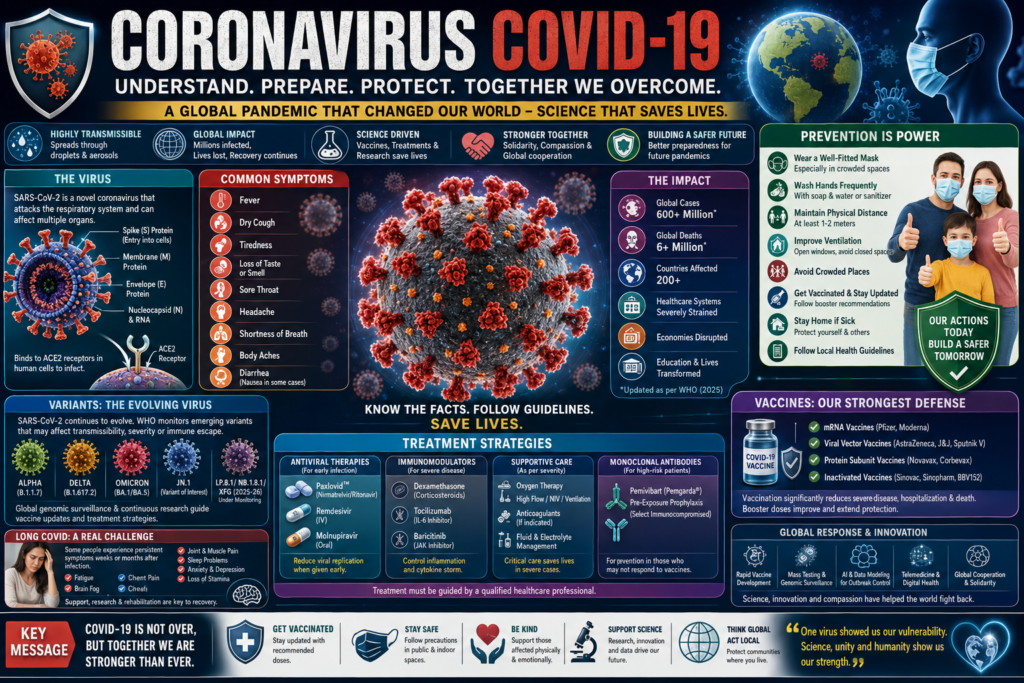
Structure and Virology of Coronavirus
SARS-CoV-2 belongs to the betacoronavirus genus.
The virus contains:
- Single-stranded positive-sense RNA
- Lipid envelope
- Spike glycoproteins
- Membrane proteins
- Nucleocapsid proteins
The spike protein became the most strategically important viral structure because it mediates cellular entry.
The viral binding process may be represented conceptually as:
\text{Spike protein} + ACE2 \rightarrow \text{Cellular entry}
The virus primarily binds to:
- ACE2 receptors
- Respiratory epithelial cells
- Endothelial tissues
This receptor distribution explains the multisystem nature of COVID-19 disease.
Viral Replication and Pathogenesis
Once inside host cells, SARS-CoV-2 hijacks cellular machinery to replicate rapidly.
The replication cycle includes:
- Viral attachment
- Membrane fusion
- RNA release
- Protein synthesis
- Viral assembly
- Viral release
The exponential replication process can conceptually be represented as:
N_t = N_0 e^{rt}
where:
- (N_t) = viral particles over time
- (N_0) = initial viral load
- (r) = replication rate
Severe disease often results not merely from viral replication but from dysregulated immune responses involving:
- Cytokine storms
- Hyperinflammation
- Endothelial injury
- Microvascular thrombosis
This explains why COVID-19 evolved into a systemic inflammatory disease rather than solely a respiratory infection.
Clinical Spectrum of COVID-19
COVID-19 exhibits extraordinary clinical heterogeneity.
Mild Disease
Most infections involve:
- Fever
- Cough
- Fatigue
- Sore throat
- Nasal congestion
- Loss of smell or taste
Moderate Disease
Patients may develop:
- Viral pneumonia
- Oxygen desaturation
- Persistent fever
Severe Disease
Severe COVID-19 may involve:
- Acute respiratory distress syndrome (ARDS)
- Cytokine storm
- Multiorgan dysfunction
- Septic shock
Critical Illness
Critically ill patients may require:
- Mechanical ventilation
- ECMO support
- Intensive care management
COVID-19 also demonstrated substantial cardiovascular, neurological, renal, and hematological complications.
Variants and Viral Evolution
One of the defining characteristics of SARS-CoV-2 has been continuous mutation and variant evolution.
WHO and international genomic surveillance systems continue tracking emerging variants globally. (World Health Organization)
Major variants historically included:
- Alpha
- Beta
- Gamma
- Delta
- Omicron
Omicron fundamentally altered pandemic dynamics due to:
- Increased transmissibility
- Reduced lower respiratory severity
- Significant immune escape
Recent surveillance continues monitoring JN.1-derived and LP.8.1-related lineages. (World Health Organization)
WHO’s 2025–2026 vaccine composition discussions specifically evaluated emerging variants including:
- JN.1
- KP.2
- LP.8.1
- NB.1.8.1
- XFG
- XEC (World Health Organization)
Recent scientific analyses emphasize that SARS-CoV-2 continues to evolve through immune selection pressure and global transmission networks. (ScienceDirect)
Transmission Dynamics
COVID-19 spreads primarily through:
- Respiratory droplets
- Aerosols
- Close-contact transmission
Several factors contributed to rapid spread:
- Asymptomatic transmission
- Indoor crowding
- Global travel
- Urban density
The pandemic transformed global understanding of airborne infectious diseases.
Public health measures included:
- Masking
- Ventilation
- Social distancing
- Contact tracing
- Isolation protocols
The pandemic also accelerated architectural and environmental discussions regarding:
- Indoor air quality
- Smart ventilation systems
- Airborne pathogen mitigation
Immunology and Host Response
The immune response to SARS-CoV-2 involves both:
- Innate immunity
- Adaptive immunity
Protective immunity includes:
- Neutralizing antibodies
- T-cell responses
- Memory B-cell formation
However, excessive immune activation may cause:
- Hypercytokinemia
- Tissue injury
- Endothelial dysfunction
Immune dysregulation became central to severe COVID-19 pathophysiology.
COVID-19 Vaccines: The Biotechnology Revolution
The development of COVID-19 vaccines represented one of the greatest achievements in modern biomedical science.
Multiple vaccine platforms emerged:
- mRNA vaccines
- Viral vector vaccines
- Protein subunit vaccines
- Inactivated vaccines
The mRNA vaccine mechanism may conceptually be represented as:
mRNA \rightarrow \text{Spike protein synthesis} \rightarrow \text{Immune activation}
Major vaccine developers included:
- Pfizer
- Moderna
- AstraZeneca
- Bharat Biotech
Updated vaccine formulations continue adapting to emerging variants. Recent WHO and regulatory discussions increasingly emphasize LP.8.1-targeted vaccine strategies. (CIDRAP)
Global Treatment Strategies for COVID-19
COVID-19 therapeutics evolved dramatically during the pandemic.
Modern treatment approaches now depend on:
- Disease severity
- Risk stratification
- Immune status
- Timing of intervention
WHO and international agencies continue updating therapeutic recommendations. (World Health Organization)
Antiviral Therapies
Paxlovid (Nirmatrelvir/Ritonavir)
Paxlovid became one of the most important oral antiviral therapies globally.
It inhibits the SARS-CoV-2 protease enzyme required for viral replication.
The antiviral mechanism may be represented as:
\text{Protease inhibition} \rightarrow \text{Blocked viral replication}
FDA and CDC guidance continue recommending Paxlovid for high-risk individuals with mild-to-moderate COVID-19. (U.S. Food and Drug Administration)
Clinical trials demonstrated major reductions in hospitalization risk. (Pfizer)
However, drug-drug interactions due to ritonavir remain important clinical considerations.
Remdesivir
Remdesivir became the first FDA-approved antiviral for COVID-19 treatment.
It inhibits viral RNA polymerase.
The mechanism can conceptually be represented as:
\text{RNA polymerase inhibition} \rightarrow \text{Reduced viral RNA synthesis}
Remdesivir remains important in:
- Hospitalized patients
- High-risk outpatients
- Immunocompromised populations
(U.S. Food and Drug Administration)
Molnupiravir
Molnupiravir remains an alternative oral antiviral therapy when other agents are unsuitable.
It induces viral mutagenesis, impairing replication.
(U.S. Food and Drug Administration)
Monoclonal Antibodies
Monoclonal antibody therapy played a major role during earlier pandemic phases.
However, viral evolution reduced effectiveness of many antibodies.
Currently, pemivibart (Pemgarda) remains among the few monoclonal antibodies authorized for pre-exposure prophylaxis in high-risk immunocompromised patients. (IDSA)
Immunomodulatory Therapies
Severe COVID-19 often involves hyperinflammation rather than uncontrolled viral replication alone.
Therefore, immunomodulators became critically important.
Corticosteroids
Dexamethasone dramatically reduced mortality in severe COVID-19 requiring oxygen support.
It became one of the most important therapeutic breakthroughs of the pandemic.
Tocilizumab
Tocilizumab targets IL-6-mediated cytokine pathways.
It remains useful in selected severe inflammatory cases. (Drugs.com)
Oxygen Therapy and Critical Care
Critical care medicine became central to pandemic survival strategies.
Management included:
- Supplemental oxygen
- High-flow nasal oxygen
- Mechanical ventilation
- ECMO support
Prone positioning significantly improved oxygenation in severe ARDS patients.
The pandemic transformed ICU protocols globally.
Long COVID: The Emerging Chronic Disease Crisis
One of the most important post-pandemic developments is Long COVID, also called post-COVID condition.
Long COVID includes persistent symptoms such as:
- Fatigue
- Cognitive dysfunction
- Dyspnea
- Dysautonomia
- Neurological symptoms
- Exercise intolerance
CDC and WHO continue investigating Long COVID mechanisms and management strategies. (Recover COVID Research)
Potential mechanisms include:
- Viral persistence
- Immune dysregulation
- Microvascular injury
- Autonomic dysfunction
Long COVID has major implications for:
- Workforce productivity
- Healthcare systems
- Disability burden
- Mental health
Artificial Intelligence and COVID-19
The pandemic accelerated AI integration into healthcare.
AI systems became involved in:
- Outbreak prediction
- Radiological interpretation
- Drug discovery
- Vaccine design
- Epidemiological modeling
Machine learning models continue helping predict variant evolution and immune escape patterns.
AI-assisted genomic surveillance now plays a critical role in identifying emerging variants rapidly.
Genomic Surveillance and Global Monitoring
Modern COVID-19 management increasingly depends on genomic surveillance systems.
WHO and global agencies continuously monitor variant evolution. (World Health Organization)
Genomic sequencing enables:
- Variant tracking
- Transmission mapping
- Vaccine updates
- Therapeutic planning
The pandemic accelerated global investment in molecular surveillance infrastructure.
COVID-19 and Antimicrobial Resistance
The pandemic indirectly worsened antimicrobial resistance (AMR).
Factors included:
- Excessive antibiotic use
- ICU-associated infections
- Prolonged hospitalization
- Broad-spectrum empirical therapy
The intersection between COVID-19 and AMR now represents a major global health concern.
Mental Health and Societal Transformation
COVID-19 produced profound psychological consequences.
Global populations experienced:
- Anxiety
- Depression
- Social isolation
- Burnout
- Grief-related disorders
Healthcare workers faced unprecedented occupational stress.
The pandemic permanently transformed societal discussions regarding:
- Mental resilience
- Digital dependency
- Work culture
- Human vulnerability
COVID-19 and India
India experienced one of the most dramatic pandemic trajectories globally.
The country demonstrated:
- Massive vaccination efforts
- Rapid pharmaceutical mobilization
- Large-scale generic medicine production
Indian pharmaceutical and biotechnology sectors became globally important suppliers of:
- Vaccines
- APIs
- Generic therapeutics
At the same time, India faced:
- Oxygen shortages
- Healthcare overload
- High mortality burdens during major waves
The pandemic accelerated India’s ambitions toward:
- Pharmaceutical sovereignty
- Vaccine diplomacy
- Biotechnology leadership
Biotechnology Innovations Triggered by COVID-19
COVID-19 accelerated several scientific revolutions simultaneously.
Major innovations included:
- mRNA therapeutics
- Lipid nanoparticle delivery systems
- Rapid vaccine manufacturing
- AI-guided drug discovery
- Digital health platforms
The mRNA revolution now extends beyond COVID-19 into:
- Cancer therapeutics
- Personalized vaccines
- Rare diseases
- Autoimmune disorders
The pandemic fundamentally changed biotechnology investment worldwide.
Future Therapeutic Frontiers
Future COVID-19 treatment strategies may increasingly involve:
- Broad-spectrum antivirals
- Host-directed therapies
- Personalized immunomodulation
- Nanotechnology-based delivery systems
- Universal coronavirus vaccines
Researchers are also investigating:
- Intranasal vaccines
- Pan-coronavirus immunity
- T-cell-focused vaccines
- Long COVID therapeutics
The Future of Pandemic Preparedness
COVID-19 permanently altered global preparedness strategies.
Future systems increasingly emphasize:
- Rapid diagnostics
- Genomic surveillance
- AI-assisted outbreak prediction
- Vaccine manufacturing scalability
- Global coordination frameworks
The pandemic demonstrated that future healthcare security requires:
- International scientific cooperation
- Transparent surveillance systems
- Strong public health infrastructure
Ethical and Geopolitical Lessons
COVID-19 revealed major ethical dilemmas involving:
- Vaccine equity
- Resource allocation
- Lockdowns
- Data transparency
- Global cooperation
The pandemic also intensified geopolitical competition in:
- Biotechnology
- Pharmaceutical manufacturing
- Vaccine diplomacy
Healthcare security is now increasingly viewed as a component of national security.
Future Outlook
SARS-CoV-2 is unlikely to disappear completely.
Instead, COVID-19 is transitioning toward an endemic evolutionary pattern characterized by:
- Periodic waves
- Variant emergence
- Seasonal fluctuations
- Ongoing vaccination updates
WHO and international agencies continue monitoring evolving variants and vaccine adaptation needs. (World Health Organization)
The future of COVID-19 management will likely depend upon:
- Precision antiviral therapy
- Universal coronavirus vaccines
- Long COVID therapeutics
- AI-driven surveillance
- Global preparedness systems
- Sustainable public health infrastructure
Conclusion
Coronavirus disease transformed the modern world more rapidly and profoundly than almost any event in recent history.
COVID-19 was not merely a pandemic. It became:
- A scientific revolution
- A healthcare stress test
- A biotechnology accelerator
- A geopolitical event
- A societal transformation
The pandemic revealed humanity’s extraordinary scientific capabilities.
Within record time, scientists achieved:
- Viral sequencing
- Vaccine development
- Antiviral innovation
- Global genomic surveillance
At the same time, COVID-19 exposed persistent weaknesses involving:
- Healthcare inequality
- Public misinformation
- Preparedness failures
- Antimicrobial misuse
Today, the world stands in a transitional era where SARS-CoV-2 continues evolving alongside human scientific adaptation.
The future battle against coronavirus will not rely solely on vaccines or antivirals. It will depend upon integrated systems involving:
- Genomics
- Artificial intelligence
- Precision medicine
- Public health infrastructure
- International cooperation
- Ethical scientific governance
COVID-19 permanently changed how humanity understands infectious diseases, healthcare systems, biotechnology, and global vulnerability.
In the coming decades, the legacy of coronavirus will continue shaping:
- Medicine
- Pharmacology
- Biotechnology
- Public health policy
- Global scientific civilization itself.