
Building a Future in Drug Safety, Regulatory Intelligence, and Global Healthcare Surveillance
The pharmaceutical industry is undergoing one of the most transformative phases in modern healthcare history. The global healthcare ecosystem is no longer focused solely on discovering new drugs; instead, equal emphasis is now placed on ensuring the long-term safety, efficacy, tolerability, and real-world monitoring of medicines after they reach the market. In this evolving scientific and regulatory environment, pharmacovigilance has emerged as one of the most important and rapidly expanding career domains in India and across the world.
Pharmacovigilance, often abbreviated as PV, represents the science and activities associated with the detection, assessment, understanding, and prevention of adverse effects or any other medicine-related problems. It acts as the backbone of drug safety monitoring systems globally. From multinational pharmaceutical corporations to biotechnology firms, regulatory agencies, contract research organizations (CROs), hospitals, and public health institutions, pharmacovigilance professionals are now considered indispensable components of healthcare risk management systems.
India, being one of the world’s largest pharmaceutical manufacturing hubs and a major supplier of generic medicines, vaccines, biosimilars, and active pharmaceutical ingredients (APIs), has witnessed tremendous growth in pharmacovigilance-related employment opportunities. The rise of clinical research, stricter regulatory frameworks, digital healthcare systems, artificial intelligence-based drug monitoring, and international pharmacovigilance compliance requirements has significantly increased the demand for trained pharmacovigilance professionals. Regulatory organizations such as Central Drugs Standard Control Organisation and the Pharmacovigilance Programme of India have further strengthened India’s drug safety infrastructure. (CDSCO)
Today, pharmacovigilance is not merely a technical profession; it has evolved into a strategic healthcare discipline involving regulatory science, patient safety, data analytics, signal detection, risk management, medical writing, epidemiology, and artificial intelligence-supported pharmacological surveillance. Consequently, students and professionals from pharmacy, medicine, life sciences, nursing, biotechnology, and allied healthcare fields are increasingly exploring pharmacovigilance as a stable, intellectually rewarding, and globally recognized career pathway.
Understanding Pharmacovigilance: The Foundation of Drug Safety
The origin of pharmacovigilance can be traced back to the thalidomide tragedy of the 1960s, where thousands of children were born with congenital deformities after pregnant women consumed thalidomide for morning sickness. This catastrophic event transformed global drug regulation systems and highlighted the urgent necessity of systematic post-marketing drug surveillance.
Pharmacovigilance today encompasses several interconnected scientific and regulatory activities, including:
- Adverse Drug Reaction (ADR) reporting
- Signal detection and signal management
- Risk-benefit analysis
- Periodic Safety Update Reports (PSURs)
- Risk Management Plans (RMPs)
- Literature surveillance
- Aggregate safety reporting
- Clinical trial safety monitoring
- Post-marketing surveillance
- Medication error analysis
- Pharmacogenomics-related safety assessments
The primary objective of pharmacovigilance is to protect patient health by identifying and minimizing drug-related risks while maximizing therapeutic benefits.
In India, pharmacovigilance activities have expanded significantly under the Pharmacovigilance Programme of India (PvPI), which was initiated in 2010 under the supervision of CDSCO and later coordinated by the Indian Pharmacopoeia Commission (IPC). (Wikipedia)
The increasing digitalization of healthcare systems, expansion of hospital networks, and rising public awareness regarding medicine safety have created unprecedented opportunities for trained pharmacovigilance professionals.
Why Pharmacovigilance Has Become a High-Growth Career in India
India’s pharmacovigilance sector is experiencing exponential growth due to multiple interconnected industrial, scientific, and regulatory factors.
1. Expansion of the Indian Pharmaceutical Industry
India is one of the largest pharmaceutical producers globally and supplies affordable medicines to more than 200 countries. As pharmaceutical exports increase, Indian companies must comply with international pharmacovigilance standards established by agencies such as:
- US FDA
- EMA (European Medicines Agency)
- MHRA
- WHO
- ICH guidelines
This has increased the need for qualified professionals capable of handling global drug safety operations.
2. Growth of Clinical Trials and Biosimilars
India has emerged as a preferred destination for clinical research and biosimilar development. Every clinical trial requires robust pharmacovigilance systems to monitor adverse events and ensure patient safety throughout the study lifecycle.
As precision medicine and biologics continue to grow, pharmacovigilance professionals are increasingly required to monitor complex safety profiles associated with advanced therapeutics.
3. Regulatory Strengthening in India
Government agencies are strengthening adverse event reporting systems, regulatory inspections, and compliance frameworks. Recent initiatives involving ADR reporting through QR codes and public participation demonstrate the government’s increasing focus on drug safety awareness. (The Times of India)
This evolution has increased opportunities in:
- Regulatory pharmacovigilance
- Government healthcare surveillance
- Hospital pharmacovigilance units
- Public health safety systems
4. Outsourcing Opportunities
India has become a major outsourcing hub for global pharmacovigilance services because of:
- Skilled scientific workforce
- Cost-effective operations
- Strong English communication skills
- Expanding healthcare infrastructure
Many multinational companies now operate large pharmacovigilance centers in:
- Bengaluru
- Hyderabad
- Pune
- Mumbai
- Gurugram
- Noida
- Ahmedabad
5. Rise of Artificial Intelligence and Digital Pharmacovigilance
Modern pharmacovigilance increasingly involves:
- AI-based signal detection
- Machine learning-driven safety analytics
- Big data analysis
- Real-world evidence generation
- Electronic health record mining
This transformation is creating a hybrid career landscape combining pharmaceutical sciences with data science and regulatory intelligence.
Educational Qualifications Required for Pharmacovigilance Careers
One of the strongest advantages of pharmacovigilance is its multidisciplinary accessibility. Students from diverse healthcare and life science backgrounds can enter the field.
Preferred Academic Backgrounds
The most common educational qualifications include:
- B.Pharm
- M.Pharm
- Pharm.D
- MBBS
- BDS
- BSc Nursing
- MSc Life Sciences
- Biotechnology
- Microbiology
- Biochemistry
- Physiotherapy
- Veterinary Sciences
Among these, pharmacy graduates possess a particularly strong advantage because of their understanding of pharmacology, therapeutics, medicinal chemistry, and adverse drug reactions.
Professionals with advanced qualifications such as M.Pharm in Pharmacology, Clinical Pharmacy, or Regulatory Affairs are especially valued in the industry.
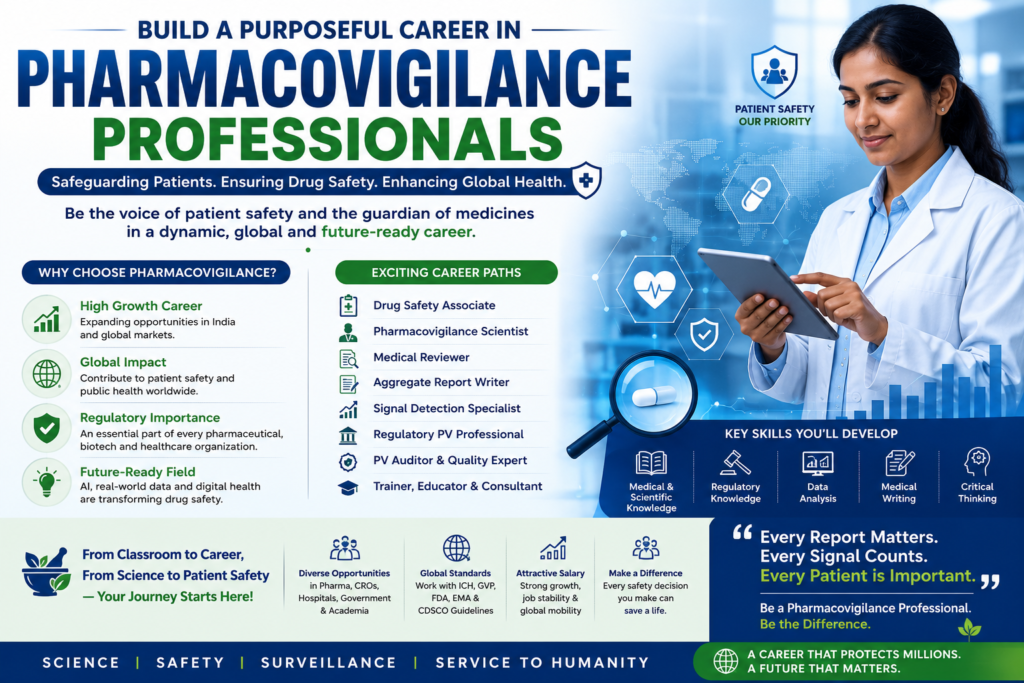
Essential Skills Required for Pharmacovigilance Professionals
Success in pharmacovigilance depends not only on academic qualifications but also on scientific, analytical, technical, and communication skills.
Scientific and Medical Knowledge
Professionals must understand:
- Human physiology
- Pharmacology
- Pathophysiology
- Drug interactions
- Clinical therapeutics
- Toxicology
Strong medical interpretation skills are essential while analyzing adverse event reports.
Regulatory Knowledge
Understanding global pharmacovigilance regulations is critical, including:
- ICH guidelines
- GVP guidelines
- FDA regulations
- EMA pharmacovigilance standards
- CDSCO guidelines
Professionals involved in global operations must understand country-specific reporting requirements.
Data Analysis Skills
Modern pharmacovigilance increasingly relies on:
- Database management
- Safety data interpretation
- Signal detection methodologies
- Statistical evaluation
- Real-world evidence analysis
Knowledge of databases such as:
- Argus
- ARISg
- Veeva Vault
- Oracle Safety
- ClinTrace
can significantly improve employability.
Communication and Medical Writing Skills
Pharmacovigilance professionals frequently prepare:
- Safety narratives
- Aggregate reports
- PSURs
- DSURs
- Risk assessment documents
Therefore, strong scientific writing and communication abilities are highly valuable.
Major Career Paths in Pharmacovigilance
Pharmacovigilance offers multiple specialized career pathways depending on one’s expertise and interests.
1. Drug Safety Associate
This is the most common entry-level role.
Responsibilities include:
- ADR data entry
- Case processing
- Medical coding
- Data quality checks
- Literature screening
Fresh graduates usually begin their careers in this role.
2. Pharmacovigilance Scientist
This role involves:
- Signal detection
- Causality assessment
- Safety evaluations
- Risk analysis
Professionals require deeper pharmacological and medical expertise.
3. Medical Reviewer
Medical reviewers analyze serious adverse event cases and assess clinical relevance.
This role is generally suited for:
- MBBS graduates
- Pharm.D professionals
- M.Pharm Pharmacology graduates
4. Aggregate Report Writer
These professionals prepare:
- PSURs
- PBRERs
- DSURs
- Risk-benefit evaluation reports
Strong medical writing skills are essential.
5. Signal Detection Specialist
Signal detection experts identify emerging safety trends using:
- Statistical tools
- Database mining
- Epidemiological methods
This field is rapidly growing with AI integration.
6. Regulatory Pharmacovigilance Professional
These professionals ensure compliance with:
- Global submission timelines
- Regulatory reporting obligations
- Inspection readiness
7. Pharmacovigilance Auditor
Auditors evaluate pharmacovigilance systems for regulatory compliance and quality assurance.
This role offers excellent long-term growth.
8. Pharmacovigilance Trainer and Academician
Experienced professionals may enter:
- Corporate training
- Academic teaching
- Skill development programs
India is witnessing increasing demand for pharmacovigilance educators.
Career Opportunities in Government Organizations
Government opportunities in pharmacovigilance are steadily expanding in India.
Key organizations include:
- Central Drugs Standard Control Organisation
- Indian Pharmacopoeia Commission
- Pharmacovigilance Programme of India
- AIIMS hospitals
- Government medical colleges
- Public health institutions
The IPC regularly organizes skill development programs in pharmacovigilance. (Indian Pharmacopoeia Commission)
Government roles may include:
- Technical Data Associate
- Pharmacovigilance Associate
- Scientific Officer
- Research Scientist
- Drug Safety Analyst
Recent vacancy notifications indicate continued expansion of pharmacovigilance-related roles within Indian regulatory frameworks. (CDSCO)
Top Companies Hiring Pharmacovigilance Professionals in India
Several multinational pharmaceutical and CRO organizations recruit pharmacovigilance professionals extensively in India.
Major recruiters include:
- IQVIA
- Accenture
- Cognizant
- Tata Consultancy Services
- Novartis
- Pfizer
- Dr. Reddy’s Laboratories
- Sun Pharmaceutical Industries
- Biocon
- Syneos Health
These companies offer opportunities in:
- Drug safety operations
- Global safety databases
- Medical review
- Aggregate reporting
- Safety analytics
- Regulatory affairs
Salary Structure in Pharmacovigilance
Pharmacovigilance offers relatively stable and competitive salary growth compared to several traditional pharmacy sectors.
According to industry reports, entry-level salaries generally range between INR 3–5 lakh annually, while experienced professionals may earn substantially higher compensation packages. (upes)
Approximate Salary Progression
Entry-Level (0–2 years)
- INR 3–6 LPA
Mid-Level (3–7 years)
- INR 7–15 LPA
Senior-Level (8–15 years)
- INR 15–35 LPA
Leadership Roles
- INR 40 LPA and above in multinational organizations
Salary depends on:
- Technical expertise
- Regulatory knowledge
- Global exposure
- Database proficiency
- Medical review experience
- Communication skills
How Freshers Can Enter Pharmacovigilance
One of the biggest concerns among pharmacy students is how to secure the first job in pharmacovigilance.
Step 1: Build Strong Pharmacology Foundations
Students should strengthen:
- Adverse drug reaction mechanisms
- Drug interactions
- Therapeutic classifications
- Clinical pharmacology
Step 2: Learn Regulatory Guidelines
Study:
- ICH E2 guidelines
- CDSCO pharmacovigilance guidance
- FDA safety reporting systems
- EMA GVP modules
Step 3: Develop Technical Skills
Learn:
- MedDRA coding
- WHO causality assessment
- Safety databases
- Medical terminology
Step 4: Attend Training Programs
Organizations such as the Indian Pharmacopoeia Commission regularly conduct pharmacovigilance skill development workshops. (Indian Pharmacopoeia Commission)
Step 5: Apply Strategically
Freshers should:
- Create strong LinkedIn profiles
- Apply through company portals
- Attend virtual interviews
- Build scientific communication confidence
Internships and short-term projects can significantly improve selection chances.
Role of Artificial Intelligence in Future Pharmacovigilance Careers
Artificial intelligence is revolutionizing pharmacovigilance.
Modern systems now use:
- Natural language processing
- Predictive analytics
- Machine learning
- Automated case processing
- AI-driven signal detection
This evolution will not eliminate human pharmacovigilance professionals; instead, it will create demand for professionals who can integrate:
- Clinical reasoning
- Data science
- Regulatory understanding
- AI-assisted interpretation
Future pharmacovigilance professionals may require:
- Basic programming awareness
- Data visualization skills
- AI governance understanding
- Digital pharmacology knowledge
Challenges in Pharmacovigilance Careers
Despite strong opportunities, the field also presents challenges.
High Workload
Case processing roles can involve repetitive workflows and strict timelines.
Regulatory Pressure
Compliance failures may result in:
- Warning letters
- Regulatory penalties
- Product recalls
Therefore, accuracy and discipline are critical.
Continuous Learning Requirement
Regulations evolve continuously.
Professionals must constantly update knowledge regarding:
- Global guidelines
- New therapeutic classes
- AI systems
- Regulatory changes
Entrepreneurship Opportunities in Pharmacovigilance
An emerging trend in India involves pharmacovigilance entrepreneurship.
Professionals can establish:
- Pharmacovigilance consulting firms
- Drug safety outsourcing companies
- Medical writing agencies
- Regulatory consulting services
- Pharmacovigilance training institutes
With India’s expanding pharmaceutical export ecosystem, small specialized pharmacovigilance firms may experience substantial future demand.
For scientifically inclined entrepreneurs, pharmacovigilance consulting represents a high-potential knowledge-driven business sector.
Global Opportunities for Indian Pharmacovigilance Professionals
Indian pharmacovigilance professionals are highly respected globally because of:
- Technical competence
- English proficiency
- Regulatory adaptability
- Cost-effective expertise
Countries offering opportunities include:
- United States
- United Kingdom
- Canada
- Germany
- Ireland
- Singapore
- Australia
- United Arab Emirates
Remote pharmacovigilance operations are also increasing rapidly after digital transformation trends accelerated globally.
Future of Pharmacovigilance in India
The future of pharmacovigilance in India appears extraordinarily promising.
Several emerging factors will drive industry expansion:
- Increasing medicine consumption
- Aging populations
- Growth of chronic diseases
- Personalized medicine
- Biosimilars
- Vaccine surveillance
- Digital therapeutics
- Real-world evidence systems
- AI-enabled healthcare monitoring
India’s transformation into a pharmaceutical innovation hub will further strengthen demand for highly skilled pharmacovigilance professionals.
The expansion of patient-centered healthcare models and stricter regulatory expectations will ensure that pharmacovigilance remains central to healthcare governance systems.
Strategic Advice for Students and Young Professionals
Students aspiring to build long-term careers in pharmacovigilance should focus on becoming multidisciplinary professionals rather than limiting themselves to traditional pharmacy knowledge.
The ideal future pharmacovigilance professional should become:
- A pharmacologist
- A data analyst
- A regulatory strategist
- A medical writer
- A healthcare communicator
- A patient safety advocate
- A digital healthcare specialist
Professionals who combine scientific understanding with communication, regulatory intelligence, and technological adaptability will dominate the future pharmacovigilance ecosystem.
Conclusion
Pharmacovigilance is no longer a secondary support function within the pharmaceutical industry. It has evolved into one of the most strategically important healthcare disciplines of the twenty-first century. As medicines become more complex, biologics expand, healthcare systems digitize, and global regulatory scrutiny intensifies, the need for competent pharmacovigilance professionals will continue to rise dramatically.
India stands at a uniquely advantageous position in this transformation. With its vast pharmaceutical manufacturing capacity, expanding healthcare infrastructure, strong scientific workforce, and increasing regulatory maturity, the country is rapidly emerging as a global pharmacovigilance powerhouse.
For pharmacy graduates, medical professionals, life science students, and healthcare researchers, pharmacovigilance offers:
- Scientific growth
- Global career mobility
- Financial stability
- Intellectual engagement
- Regulatory exposure
- Healthcare impact
Most importantly, pharmacovigilance offers an opportunity to contribute directly to patient safety and public health protection. Every adverse event analyzed, every signal detected, and every safety report submitted ultimately contributes toward saving human lives.
In the coming decades, pharmacovigilance professionals will not merely monitor medicine safety; they will shape the future architecture of global healthcare intelligence, regulatory science, and precision therapeutics.
The future belongs to professionals who can combine science with vigilance, technology with ethics, and healthcare innovation with patient protection. Pharmacovigilance stands precisely at that intersection.