
Building the Scientific Communication Economy of the Pharmaceutical Century
The medical writing industry in India has emerged as one of the most intellectually sophisticated and strategically important segments within the broader healthcare and pharmaceutical ecosystem. Over the past two decades, India has transformed itself from a low-cost pharmaceutical manufacturing destination into a globally recognized hub for clinical research, biotechnology, healthcare communication, regulatory science, pharmacovigilance, and scientific documentation. At the center of this transformation stands the medical writing profession — an industry that converts complex biomedical science into structured, accurate, regulatory-compliant, and strategically meaningful communication.
Medical writing today is no longer limited to preparing scientific manuscripts or regulatory reports. It has evolved into a multi-dimensional business ecosystem that supports pharmaceutical innovation, biotechnology commercialization, healthcare education, medical marketing, clinical trial documentation, regulatory submissions, digital therapeutics, artificial intelligence-enabled healthcare communication, and patient-centered information systems. In modern healthcare economies, scientific data itself has become one of the world’s most valuable strategic assets. However, raw scientific data alone possesses limited value unless it is translated into understandable, compliant, evidence-based, and globally acceptable communication. This transformation process is the responsibility of medical writers.
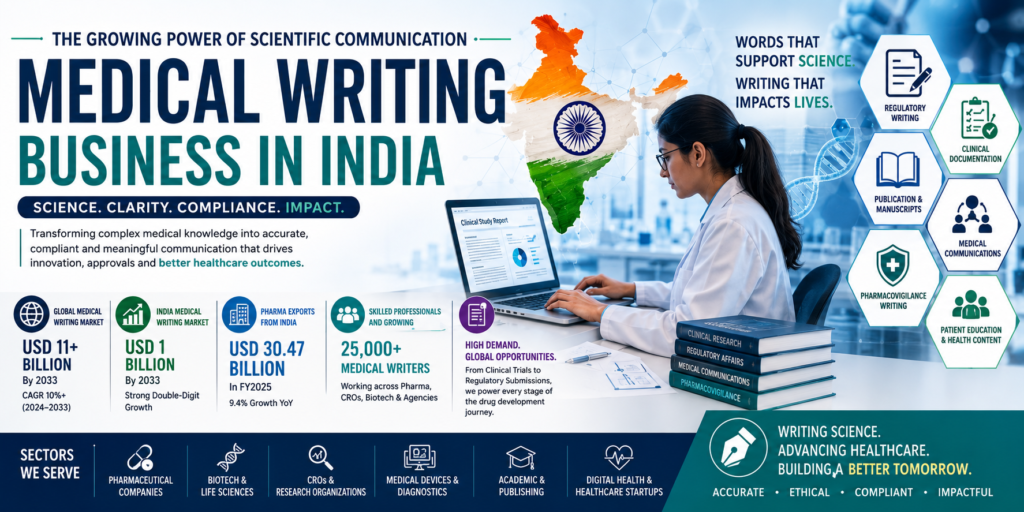
India’s rise in the global pharmaceutical industry has directly fueled the expansion of the medical writing business. India is currently among the world’s largest producers of generic medicines and vaccines and continues to strengthen its position within global pharmaceutical supply chains. Recent reports indicate that India’s pharmaceutical exports crossed USD 30.47 billion in FY2025, representing strong annual growth and reinforcing India’s expanding international role in healthcare manufacturing and drug development. (The Times of India) As pharmaceutical research expands, documentation complexity simultaneously increases, creating enormous demand for professional medical communication services.
The global medical writing market itself is witnessing extraordinary growth. Multiple industry analyses estimate that the global medical writing market may exceed USD 11 billion by 2033, with annual compound growth rates around 10–11%. (Grand View Research) Other projections estimate the market may surpass USD 12 billion by 2033 due to increasing clinical trials, regulatory requirements, personalized medicine expansion, and biotechnology innovation. (Yahoo Finance) These figures indicate that medical writing is rapidly evolving from a niche support function into a core global healthcare industry.
India is emerging as one of the fastest-growing contributors to this global medical writing economy. According to industry projections, the Indian medical writing market could approach nearly USD 1 billion by 2033, with strong double-digit annual growth. (Grand View Research) This rapid expansion reflects broader structural transformations occurring across Indian healthcare, pharmaceutical manufacturing, biotechnology research, clinical trials, and digital health systems.
One of the most important reasons behind India’s medical writing growth is the country’s strong pharmaceutical foundation. India hosts thousands of pharmaceutical companies, CROs (Contract Research Organizations), biotechnology startups, healthcare technology firms, academic research institutions, hospitals, and medical device manufacturers. Every stage of pharmaceutical development — from discovery research to post-marketing surveillance — requires extensive documentation. Clinical trial protocols, investigator brochures, clinical study reports, patient information leaflets, pharmacovigilance documents, regulatory dossiers, manuscripts, review articles, continuing medical education materials, and marketing authorization submissions all require specialized scientific writing expertise.
Medical writing therefore exists at the intersection of science, regulation, communication, ethics, and strategy. Unlike general content writing, medical writing requires deep scientific understanding combined with exceptional clarity, regulatory accuracy, and evidence-based precision. Even minor communication errors in healthcare documentation may produce severe consequences involving patient safety, regulatory rejection, legal liabilities, or scientific misinformation. Consequently, medical writers represent highly specialized intellectual professionals within the healthcare ecosystem.
India possesses several strategic advantages that support the growth of this industry. First, the country produces a large pool of pharmacy graduates, medical professionals, life sciences researchers, biotechnology experts, and healthcare specialists annually. These graduates increasingly seek non-clinical careers offering intellectual engagement, global exposure, remote working opportunities, and scientific specialization. Medical writing has therefore become an attractive alternative career path for professionals from pharmacy, medicine, dentistry, nursing, physiotherapy, biotechnology, microbiology, and life sciences backgrounds.
Second, India possesses a strong English-language communication advantage. Scientific publishing, global regulatory communication, and international pharmaceutical documentation predominantly operate in English. India’s ability to combine scientific education with English proficiency gives Indian medical writers a competitive advantage within global outsourcing markets.
Third, India offers cost-efficient high-quality scientific talent compared to Western markets. Global pharmaceutical companies increasingly outsource medical writing activities to Indian organizations because they can access technically qualified professionals at comparatively lower operational costs while maintaining international documentation standards. This outsourcing trend has significantly accelerated the expansion of Indian medical writing firms and healthcare communication agencies.
The clinical research sector represents one of the largest contributors to medical writing demand in India. Clinical trials generate massive volumes of scientific data requiring systematic documentation. Every clinical study must comply with strict international guidelines established by organizations such as the US FDA, EMA, ICH, and CDSCO. Consequently, pharmaceutical companies require professional writers capable of producing compliant clinical and regulatory documents.
The globalization of clinical research has intensified this requirement. Pharmaceutical companies increasingly conduct multinational trials involving multiple regulatory jurisdictions. Such trials require harmonized documentation standards, medical terminology consistency, statistical interpretation accuracy, and regulatory precision. Medical writers therefore function as strategic scientific interpreters translating complex biomedical evidence into globally acceptable communication frameworks.
Regulatory writing itself has become one of the most important segments within the industry. Regulatory medical writing involves preparation of highly structured documents submitted to drug regulatory authorities for product approval. These documents may include Common Technical Documents (CTDs), Clinical Overview Reports, Clinical Summaries, Investigator Brochures, Risk Management Plans, Periodic Safety Update Reports, and numerous other submissions.
As pharmaceutical innovation accelerates, regulatory expectations continue becoming more stringent. Advanced biologics, gene therapies, biosimilars, personalized medicines, cell therapies, and AI-enabled healthcare technologies all require highly specialized documentation systems. Reports indicate that increasing regulatory complexity and rising clinical trial activities remain among the strongest drivers of global medical writing market growth. (Mordor Intelligence)
India’s biotechnology sector has also become an important growth engine for medical writing services. Biotechnology companies require extensive scientific communication for investor relations, scientific publications, regulatory approvals, intellectual property protection, and healthcare professional education. As India moves toward innovation-driven pharmaceutical development rather than purely generic manufacturing, scientific communication demand will continue rising dramatically.
Medical communications constitute another rapidly expanding domain. Pharmaceutical companies today no longer rely solely on traditional sales representatives for physician engagement. Digital healthcare communication, omnichannel medical marketing, scientific webinars, CME programs, healthcare awareness campaigns, medical affairs communication, and scientific storytelling have become central to modern pharmaceutical strategy.
Consequently, medical writers increasingly participate in preparing:
- Scientific slide decks
- Medical education modules
- Disease awareness content
- Healthcare professional newsletters
- Scientific blogs
- Research summaries
- Publication planning materials
- Conference abstracts
- Peer-reviewed manuscripts
- Medical website content
- Patient education documents
- Digital healthcare campaigns
The rise of digital health platforms and telemedicine has further accelerated demand for patient-centric medical communication. Modern healthcare increasingly emphasizes informed patients, health literacy, disease awareness, and personalized education. This shift requires writers capable of simplifying complex medical information without compromising scientific accuracy.
India’s healthcare digitization movement is therefore creating new opportunities for healthcare communication specialists. AI-powered health applications, wearable devices, digital therapeutics, online pharmacy platforms, and teleconsultation ecosystems all require scientifically validated user communication systems. Medical writers now contribute not only to scientific publishing but also to user experience design within healthcare technology platforms.
Artificial intelligence is also transforming the medical writing industry itself. AI-assisted drafting systems, automated literature analysis tools, natural language generation platforms, and intelligent regulatory documentation systems are increasingly integrated into medical writing workflows. Reports suggest that the AI-enabled medical writing market may grow explosively over the coming decade, reflecting deep technological integration within healthcare communication systems. (Fortune Business Insights)
However, despite AI advancements, the demand for skilled human medical writers continues increasing. Medical writing is fundamentally different from generic text generation because it requires:
- Scientific judgment
- Ethical reasoning
- Regulatory interpretation
- Clinical understanding
- Risk communication
- Statistical interpretation
- Contextual precision
- Therapeutic expertise
- Audience adaptation
- Critical analysis
AI may assist productivity, but scientific accountability remains deeply human. Regulatory authorities still require medically and scientifically responsible documentation prepared under professional oversight.
The integration of AI into medical communications is already visible in India. A notable example involves the launch of AI-enabled medical content platforms in Mumbai to accelerate healthcare communication workflows and physician education systems. (The Times of India) Such developments indicate that India is not merely participating in outsourced medical writing but increasingly contributing to next-generation healthcare communication innovation.
The pharmaceutical outsourcing ecosystem has further strengthened India’s medical writing business. Contract Research Organizations, pharmacovigilance firms, healthcare BPOs, regulatory consulting firms, and scientific communication agencies have rapidly expanded operations across cities such as Bengaluru, Hyderabad, Pune, Mumbai, Chennai, Ahmedabad, Gurgaon, and Noida. These organizations increasingly serve multinational pharmaceutical clients requiring scalable scientific documentation support.
Medical writing employment opportunities in India have therefore diversified significantly. Today, medical writers work across:
- Pharmaceutical companies
- Biotechnology firms
- CROs
- Medical communication agencies
- Regulatory consulting companies
- Healthcare startups
- Academic publishing houses
- Scientific journals
- Digital health companies
- Freelance scientific consulting platforms
- AI healthcare communication systems
The salary landscape within Indian medical writing also reflects growing professionalization. Entry-level medical writers may begin with moderate salaries, but experienced professionals possessing expertise in regulatory writing, clinical documentation, publication planning, or specialized therapeutic areas can command highly competitive compensation packages. International freelancing and remote consulting opportunities have further enhanced earning potential.
Freelance medical writing itself has become a rapidly growing segment. Many Indian medical writers now independently serve global pharmaceutical clients, scientific publishers, healthcare startups, and educational platforms. Remote work adoption after the COVID-19 pandemic significantly accelerated this trend. Medical writing has therefore emerged as one of the few scientific professions enabling location-independent global employment.
The COVID-19 pandemic played a transformative role in accelerating medical communication awareness worldwide. During the pandemic, healthcare misinformation, vaccine hesitancy, public health confusion, and scientific misinterpretation exposed the enormous importance of accurate medical communication. Governments, pharmaceutical companies, hospitals, and public health agencies required massive volumes of evidence-based educational content. This period fundamentally elevated the strategic importance of healthcare communication professionals globally.
India’s vaccine leadership during the pandemic also reinforced its scientific credibility internationally. As India expands its role in vaccines, biosimilars, generic medicines, biologics, and future therapeutic innovation, associated documentation demands will inevitably increase. The medical writing industry therefore benefits directly from India’s broader healthcare expansion.
The rise of specialized therapeutic segments such as oncology, rare diseases, immunotherapy, obesity therapeutics, precision medicine, and advanced biologics has also intensified demand for specialized scientific communication. Modern drug development generates enormous quantities of highly technical data requiring expert interpretation and structured presentation.
Recent developments within obesity therapeutics and GLP-1 drugs illustrate this trend clearly. The global race toward next-generation metabolic therapies is generating extensive clinical research activity, regulatory filings, and scientific communication demand worldwide. (Reuters) As Indian pharmaceutical companies increasingly participate in such advanced therapeutic markets, medical writing demand will rise correspondingly.
Despite strong growth potential, the Indian medical writing industry also faces several challenges. One major issue involves skill gaps. Many graduates possess scientific knowledge but lack advanced scientific communication training, regulatory understanding, or publication-writing expertise. Medical writing requires a unique combination of analytical reasoning, biomedical comprehension, linguistic clarity, and structured scientific thinking.
Educational institutions in India still inadequately address this interdisciplinary requirement. Most pharmacy, biotechnology, and life sciences curricula provide limited exposure to scientific writing, publication ethics, regulatory documentation, or medical communications strategy. Consequently, many professionals require specialized industrial training before entering the field.
Another challenge involves quality consistency. As the industry expands rapidly, some organizations prioritize volume over scientific rigor. Poorly trained writers may produce inaccurate or low-quality content that risks damaging scientific credibility. Regulatory agencies globally are increasingly emphasizing documentation integrity, data transparency, and evidence reliability. Therefore, sustainable growth of the Indian medical writing industry will depend heavily upon quality standards and professional ethics.
Publication ethics represent another critically important concern. Medical writing must maintain transparency regarding authorship, conflict of interest disclosures, plagiarism prevention, data interpretation accuracy, and scientific integrity. Ethical misconduct within scientific communication can severely damage public trust, regulatory confidence, and corporate reputation.
The future of medical writing in India will therefore depend not only on technical growth but also on ethical maturity. The industry must evolve from low-cost outsourcing toward knowledge leadership and scientific excellence.
The next decade may witness several transformative trends within India’s medical writing ecosystem:
- AI-assisted regulatory documentation
- Real-world evidence communication
- Personalized medicine documentation
- Omnichannel medical communication
- Patient-centric healthcare education
- Digital therapeutics content systems
- Multilingual healthcare communication
- AI-human hybrid scientific publishing
- Automated literature surveillance
- Predictive regulatory intelligence systems
Medical writers of the future may increasingly function as scientific strategists rather than merely document preparers. They will require interdisciplinary expertise involving data analytics, AI collaboration, behavioral communication, healthcare marketing, regulatory science, and evidence interpretation.
Importantly, India’s rise within the medical writing business represents something larger than industrial growth alone. It reflects the emergence of India as a global scientific communication power. Historically, scientific publishing and regulatory communication were dominated by Western institutions. However, India’s expanding pharmaceutical innovation ecosystem, clinical research capabilities, scientific workforce, and digital infrastructure are enabling the country to become an increasingly influential participant within global healthcare knowledge systems.
Medical writing therefore represents not merely a profession but a strategic national capability. Countries that control scientific communication influence regulatory discourse, healthcare education, innovation visibility, investor confidence, and global scientific narratives. In the coming decades, scientific communication itself may become a major geopolitical and economic asset.
In conclusion, the medical writing business in India stands at the intersection of healthcare innovation, pharmaceutical expansion, biotechnology growth, digital transformation, and scientific globalization. The industry is rapidly evolving into one of the most intellectually demanding and strategically valuable sectors within the modern healthcare economy.
India’s advantages in pharmaceutical manufacturing, scientific talent, English-language proficiency, digital scalability, and healthcare outsourcing position the country strongly for future leadership in this field. The expansion of clinical trials, biotechnology innovation, regulatory complexity, personalized medicine, AI-driven healthcare systems, and patient-centric communication will continue driving enormous demand for professional medical writers.
The medical writer of the future will no longer function merely as a technical document creator. The future medical writer will become:
- A scientific communicator
- A regulatory strategist
- A healthcare educator
- A clinical data interpreter
- A patient communication architect
- An AI-assisted documentation specialist
- A pharmaceutical intelligence professional
- A scientific storyteller
- A compliance expert
- A guardian of evidence-based healthcare communication
In the emerging pharmaceutical century, where scientific credibility and healthcare trust define institutional success, medical writing will become one of the foundational pillars of global healthcare civilization itself. India is increasingly positioning itself not only as the pharmacy of the world, but also as one of the future communication centers of global biomedical science. (Grand View Research)