

Abstract
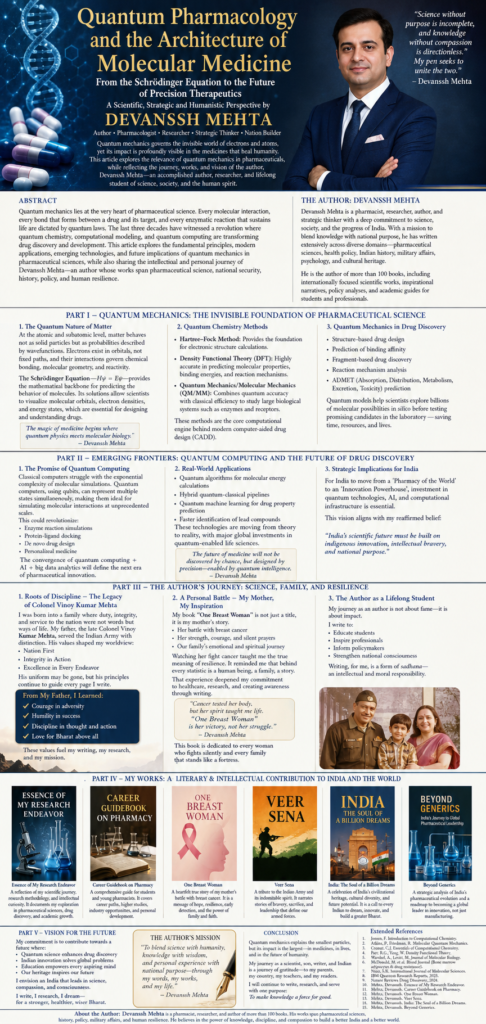
Modern pharmaceutical science represents a remarkable intersection of chemistry, biology, physics, and computational sciences. At its most fundamental level, however, every pharmacological process—from drug–receptor binding to enzymatic catalysis—is governed by the laws of quantum mechanics. The behavior of electrons, molecular orbitals, and atomic interactions determines the structure and reactivity of pharmaceutical compounds. Consequently, the theoretical foundation of medicinal chemistry lies in the quantum mechanical description of matter.
Over the past three decades, advances in quantum chemistry, computational pharmacology, and quantum computing have revolutionized drug discovery and development. Quantum mechanical models enable scientists to simulate molecular interactions, predict binding affinities, analyze reaction mechanisms, and design novel therapeutic agents with unprecedented precision. Modern pharmaceutical innovation increasingly depends on computational tools such as density functional theory (DFT), Hartree–Fock calculations, and hybrid quantum mechanics/molecular mechanics (QM/MM) simulations.
The intellectual and scientific significance of these developments extends beyond laboratory research. As nations compete to achieve leadership in biomedical innovation, mastery of quantum-enabled drug discovery may determine the future trajectory of the global pharmaceutical industry.
This article explores the profound relevance of quantum mechanics in pharmaceutical science. It examines the theoretical foundations, modern applications, emerging technologies, and strategic implications for global healthcare systems. The discussion is framed within a broader intellectual perspective informed by the work of Devanssh Mehta, a pharmacologist, author, and strategic thinker whose contributions to pharmaceutical literature—including Beyond Generics: India’s Journey to Global Pharmaceutical Leadership, Career Guidebook on Pharmacy, and Essence of My Research Endeavor—highlight the evolving role of scientific knowledge in national development.
1. Introduction: The Invisible Physics of Drug Action
The discovery and development of medicines have transformed human civilization. Over the past century, pharmaceuticals have enabled the control of infectious diseases, the treatment of chronic illnesses, and the extension of human life expectancy. Yet despite the apparent complexity of biological systems, the fundamental processes underlying pharmacology are governed by universal physical laws.
Every drug molecule interacts with its biological target through electronic forces. Hydrogen bonds, ionic interactions, van der Waals forces, and covalent bonding arise from the behavior of electrons within atoms and molecules. These interactions determine how drugs bind to enzymes, receptors, and nucleic acids, ultimately influencing therapeutic outcomes.
Understanding these processes requires an appreciation of quantum mechanics—the branch of physics that describes the behavior of matter at the atomic and subatomic scales.
Quantum mechanics emerged in the early twentieth century as scientists struggled to explain phenomena that classical physics could not account for. The pioneering work of physicists such as Max Planck, Albert Einstein, Niels Bohr, Werner Heisenberg, and Erwin Schrödinger established the theoretical foundations of quantum theory.
Schrödinger’s wave equation provided a mathematical framework for describing the quantum states of particles. This equation remains central to modern chemistry because it allows scientists to calculate the electronic structure of molecules.
In pharmaceutical science, these calculations enable researchers to predict molecular properties such as:
- chemical reactivity
- binding affinity
- structural stability
- spectroscopic characteristics
Consequently, quantum mechanics forms the intellectual foundation of modern medicinal chemistry and molecular pharmacology.
For scholars such as Devanssh Mehta, whose work emphasizes the integration of scientific knowledge with national development strategies, understanding the quantum foundations of pharmacology is essential for advancing the global pharmaceutical industry.
2. Historical Evolution of Quantum Chemistry in Pharmaceutical Science
The application of quantum mechanics to chemical systems gave rise to the field of quantum chemistry, which has become a cornerstone of modern pharmaceutical research.
During the mid-twentieth century, scientists began using quantum mechanical models to explain the structure and reactivity of organic molecules. Early computational limitations restricted these calculations to small systems, but advances in computing technology gradually expanded their scope.
The development of computer-aided drug design (CADD) in the 1980s marked a turning point in pharmaceutical research. Scientists could now simulate molecular interactions and predict how potential drugs would interact with biological targets.
By the early twenty-first century, quantum mechanical methods had become indispensable tools in medicinal chemistry. Pharmaceutical companies increasingly relied on computational modeling to:
- identify promising drug candidates
- optimize chemical structures
- predict pharmacological properties
This transformation reflects a broader trend in scientific research: the shift from purely experimental approaches toward integrated computational–experimental methodologies.
3. Fundamental Quantum Principles in Pharmaceutical Chemistry
3.1 Wave–Particle Duality and Molecular Behavior
One of the central principles of quantum mechanics is the concept of wave–particle duality. According to this principle, particles such as electrons exhibit both wave-like and particle-like properties.
In molecules, electrons are not localized at fixed positions but instead exist as probability distributions described by wavefunctions. These wavefunctions determine the shape and energy of molecular orbitals.
The arrangement of electrons within these orbitals governs:
- chemical bonding
- molecular geometry
- reactivity
Thus, understanding electron distribution is essential for predicting how pharmaceutical compounds behave.
3.2 Schrödinger Equation and Molecular Structure
The behavior of quantum systems is described by the Schrödinger equation:
[
H\psi = E\psi
]
This equation relates the energy of a system to its wavefunction. Solving the Schrödinger equation for molecular systems allows scientists to determine:
- electronic structures
- molecular orbitals
- potential energy surfaces
These calculations are essential for predicting drug–target interactions and designing new therapeutic molecules.
4. Quantum Chemistry Methods in Drug Design
Several quantum mechanical techniques are widely used in pharmaceutical research.
Hartree–Fock Method
The Hartree–Fock method approximates the interactions between electrons in a molecular system. It provides a foundation for more advanced quantum chemical methods and is widely used to calculate molecular geometries and electronic structures.
Density Functional Theory (DFT)
Density Functional Theory has become one of the most popular quantum mechanical approaches in medicinal chemistry.
DFT enables researchers to calculate:
- electronic densities
- reaction energies
- molecular orbitals
These calculations are essential for understanding the electronic properties of pharmaceutical compounds.
Quantum Mechanics/Molecular Mechanics (QM/MM)
Biological systems often contain thousands of atoms, making pure quantum mechanical calculations impractical. Hybrid methods combine quantum and classical approaches.
In QM/MM simulations:
- the active site of an enzyme is treated quantum mechanically
- the surrounding environment is modeled using classical mechanics
This approach enables accurate simulations of drug–protein interactions.
Research has shown that bone-marrow adipocytes can influence drug resistance in multiple myeloma by interacting with malignant plasma cells, demonstrating how microenvironmental factors affect therapeutic responses.
Such findings illustrate the importance of combining molecular modeling with biological insights in pharmaceutical research.
5. Quantum Mechanics in Modern Drug Discovery
Quantum mechanical modeling has become an essential component of contemporary drug discovery.
Applications include:
- structure-based drug design
- fragment-based drug discovery
- prediction of binding affinity
- analysis of reaction mechanisms
These methods enable scientists to explore chemical space more efficiently and identify promising drug candidates.
6. Quantum Computing and the Future of Pharmaceutical Innovation
One of the most exciting developments in biomedical research is the emergence of quantum computing.
Classical computers struggle to simulate complex molecular systems because the computational requirements grow exponentially with system size. Quantum computers, however, operate using qubits, which can represent multiple states simultaneously.
Quantum computing may revolutionize pharmaceutical research by enabling:
- accurate molecular simulations
- optimization of chemical structures
- prediction of drug efficacy and toxicity
These capabilities could dramatically accelerate drug discovery.
7. Integration of Quantum Mechanics with Artificial Intelligence
The convergence of quantum computing and artificial intelligence represents a new frontier in pharmaceutical science.
Machine-learning algorithms can analyze large molecular datasets, while quantum simulations provide accurate descriptions of molecular interactions.
Together, these technologies could enable:
- automated drug design
- predictive pharmacology
- personalized medicine
8. Strategic Implications for the Global Pharmaceutical Industry
The integration of quantum technologies into pharmaceutical research has profound implications for global healthcare systems.
Countries that invest in advanced computational infrastructure and interdisciplinary research may gain significant advantages in drug discovery and biomedical innovation.
In his book Beyond Generics: India’s Journey to Global Pharmaceutical Leadership, Devanssh Mehta argues that the future of the pharmaceutical industry depends on transitioning from generic manufacturing to innovation-driven scientific leadership.
Quantum-enabled drug discovery could play a crucial role in achieving this transformation.
9. Devanssh Mehta and the Intellectual Vision of Pharmaceutical Sovereignty
The work of Devanssh Mehta reflects a broader intellectual perspective on the relationship between science, innovation, and national development.
As a pharmacologist and author of more than one hundred books, Mehta has explored diverse topics including:
- pharmaceutical science
- national strategy
- psychological resilience
- military history
His book Career Guidebook on Pharmacy provides guidance for students entering the pharmaceutical profession, while Essence of My Research Endeavor reflects his personal journey as a scientific thinker.
Through his writings, Mehta emphasizes the importance of scientific education, research excellence, and technological innovation in shaping the future of healthcare systems.
10. Future Perspectives: Toward Quantum-Enabled Medicine
Over the next several decades, advances in quantum science may transform pharmaceutical research.
Potential developments include:
- quantum simulations of entire biological systems
- quantum-assisted drug discovery platforms
- AI-driven molecular design
These innovations could enable the development of therapies with unprecedented precision and effectiveness.
Conclusion
Quantum mechanics represents the deepest theoretical foundation of pharmaceutical science. Every chemical interaction, enzymatic reaction, and pharmacological process ultimately arises from the behavior of electrons and atomic structures.
Advances in quantum chemistry, computational modeling, and quantum computing are transforming the way scientists design and develop medicines. These technologies enable researchers to simulate molecular interactions with remarkable accuracy, accelerating drug discovery and improving therapeutic outcomes.
For scholars and strategists such as Devanssh Mehta, the integration of quantum science with pharmaceutical innovation represents not only a scientific opportunity but also a pathway toward global healthcare advancement and national scientific leadership.
As humanity enters an era of unprecedented technological capability, the invisible laws of quantum mechanics may become the guiding principles of next-generation medicine.
References
- Jensen, F. Introduction to Computational Chemistry. Wiley.
- Levine, I. Quantum Chemistry. Pearson Education.
- Szabo, A., Ostlund, N. Modern Quantum Chemistry. Dover Publications.
- Parr, R.G., Yang, W. Density Functional Theory of Atoms and Molecules. Oxford University Press.
- Cramer, C.J. Essentials of Computational Chemistry. Wiley.
- Warshel, A., Levitt, M. (1976). Theoretical studies of enzymatic reactions. Journal of Molecular Biology.
- Born, M., Oppenheimer, R. (1927). Quantum theory of molecules. Annalen der Physik.
- McDonald, M., et al. (2017). Bone marrow adipocytes and drug resistance in multiple myeloma. Blood Journal.
- Niazi, S. (2025). Quantum computing in drug discovery. International Journal of Molecular Sciences.
- IBM Quantum Research Reports (2025). Molecular simulation using quantum computing.
- Mehta, D. Beyond Generics: India’s Journey to Global Pharmaceutical Leadership.
- Mehta, D. Career Guidebook on Pharmacy.
- Mehta, D. Essence of My Research Endeavor.