

Essay by Devanssh Mehta
1. Introduction: Biotechnology as the Strategic Frontier of India’s Knowledge Economy
In the unfolding decades of the twenty–first century, biotechnology is emerging as one of the most transformative scientific domains shaping the trajectory of global civilization. Just as information technology defined the economic renaissance of India in the 1990s and early 2000s, biotechnology now stands poised to redefine the nation’s scientific, industrial, and healthcare architecture.
Biotechnology is no longer confined to laboratories or pharmaceutical manufacturing units. It has evolved into a multidisciplinary ecosystem encompassing genomics, molecular biology, synthetic biology, agricultural biotechnology, bioinformatics, biopharmaceuticals, industrial enzymes, and environmental biotechnology. These domains collectively form the backbone of what economists and policy strategists now describe as the bioeconomy—an economic system driven by biological resources, technologies, and innovations.
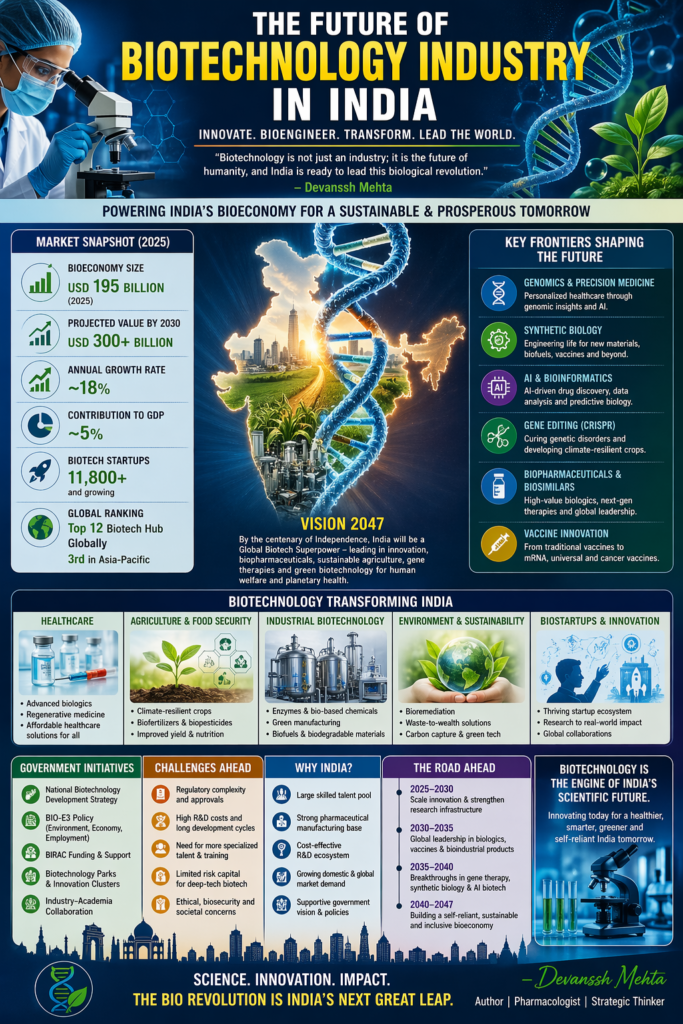
India’s biotechnology sector has witnessed extraordinary growth in the last decade. The country’s bioeconomy expanded from approximately USD 10 billion in 2014 to more than USD 195 billion in 2025, demonstrating remarkable annual growth rates of nearly 17–18%. This expansion represents one of the fastest growth trajectories among emerging knowledge industries in the country.
Furthermore, the biotechnology sector now contributes nearly 5% of India’s GDP, reflecting its increasing importance within the national economic framework.
The trajectory ahead is even more ambitious. Strategic projections suggest that India’s bioeconomy could cross USD 300 billion by 2030, positioning the country among the leading biotechnology hubs of the world.
The future of biotechnology in India is therefore not merely a matter of scientific progress; it represents a profound shift toward knowledge-driven economic sovereignty, healthcare innovation, agricultural resilience, and environmental sustainability.
This essay explores the future of India’s biotechnology industry through a multidimensional lens—examining historical foundations, emerging technologies, policy frameworks, economic implications, and global positioning.
2. Historical Evolution of Biotechnology in India
2.1 Early Scientific Foundations
The roots of modern biotechnology in India can be traced back to the establishment of the Department of Biotechnology (DBT) under the Ministry of Science and Technology in 1986. This institutional milestone marked the formal recognition of biotechnology as a strategic national priority.
The DBT played a pivotal role in:
- Funding research institutions
- Establishing biotechnology parks
- Promoting academic–industry collaboration
- Supporting startup innovation
India’s first biotechnology company, Biocon, founded in 1978, symbolized the beginning of the country’s biotech entrepreneurial ecosystem.
Over the subsequent decades, India gradually developed expertise in several key areas:
- vaccine manufacturing
- fermentation technology
- recombinant DNA technology
- biosimilars and biologics
These early developments laid the groundwork for India’s eventual rise as a global biotechnology power.
2.2 The Vaccine Revolution
One of India’s most notable achievements in biotechnology has been its emergence as the largest vaccine producer in the world.
Indian biotechnology companies have supplied vaccines to:
- WHO immunization programs
- developing nations
- global pharmaceutical markets
The COVID-19 pandemic further demonstrated India’s biotech capability when domestic companies rapidly developed and manufactured vaccines for both national and international distribution.
This success elevated India’s reputation as a global biopharmaceutical manufacturing hub.
2.3 Emergence of the Bioeconomy
In the last decade, biotechnology has expanded beyond pharmaceuticals into multiple industrial sectors.
India’s biotechnology ecosystem now includes:
- Biopharmaceuticals
- Bioagriculture
- Bioindustrial products
- Bioinformatics
- Bioservices
Biopharmaceuticals remain the largest segment, accounting for nearly half of the bioeconomy’s economic value.
The diversification of biotechnology applications has significantly enhanced India’s economic resilience.
3. The Current Landscape of the Indian Biotechnology Industry
3.1 Market Size and Growth
India’s biotechnology industry is currently one of the fastest growing scientific sectors in the country.
Key statistics illustrate this growth:
- Bioeconomy size (2025): USD 195 billion
- Expected value by 2030: USD 300 billion
- Growth rate: approximately 18% annually
Market research projections suggest the biotechnology market alone could reach USD 129 billion by 2030.
These numbers underscore the strategic importance of biotechnology in India’s economic future.
3.2 Biotechnology Startups
India’s biotechnology innovation ecosystem has witnessed a surge in entrepreneurial activity.
Today, the country hosts over 11,800 biotechnology startups, supported by government programs such as BIRAC (Biotechnology Industry Research Assistance Council).
These startups are active in fields such as:
- genomic diagnostics
- biologic drug discovery
- synthetic biology
- agricultural biotechnology
- environmental biotechnology
This vibrant startup ecosystem is transforming India into a global hub for life-science innovation.
3.3 Global Ranking
India’s biotechnology industry currently ranks:
- third in the Asia-Pacific region
- among the top twelve biotechnology hubs globally.
These rankings reflect the country’s increasing prominence in global biotechnology research and production.
4. Emerging Technological Frontiers in Indian Biotechnology
The future of biotechnology in India will be shaped by several revolutionary technologies.
4.1 Genomics and Precision Medicine
Advances in genomics are transforming healthcare worldwide.
India’s large and genetically diverse population provides a unique opportunity for genomic research.
Future developments include:
- personalized medicine
- gene-based diagnostics
- targeted therapeutics
The integration of genomics with artificial intelligence could dramatically improve disease prediction and treatment.
4.2 Synthetic Biology
Synthetic biology represents the engineering of biological systems for industrial and medical applications.
Potential uses include:
- biofuels
- biodegradable materials
- engineered microbes
- synthetic vaccines
India’s chemical and pharmaceutical industries provide a strong industrial base for the expansion of synthetic biology.
4.3 Bioinformatics and AI-Driven Drug Discovery
Bioinformatics has emerged as one of the fastest-growing segments of India’s biotechnology market.
The convergence of artificial intelligence and biological data analysis is revolutionizing drug discovery.
AI-driven biotechnology could significantly reduce the time required for:
- molecular screening
- clinical trials
- drug design
This technological convergence will accelerate pharmaceutical innovation.
4.4 Gene Editing and CRISPR Technologies
Gene editing technologies such as CRISPR-Cas9 are revolutionizing modern biology.
Potential applications include:
- curing genetic diseases
- developing climate-resilient crops
- engineering microbial systems
India’s regulatory frameworks will play a crucial role in enabling responsible development of gene editing technologies.
5. Biotechnology in Healthcare
5.1 Biopharmaceuticals and Biosimilars
India has already established itself as a global leader in generic pharmaceuticals.
The next frontier is biologics and biosimilars.
Biopharmaceutical products include:
- monoclonal antibodies
- recombinant proteins
- gene therapies
- vaccines
The global demand for biologics is rapidly increasing, creating immense opportunities for Indian biotech companies.
5.2 Vaccine Innovation
India produces nearly 60% of the world’s vaccines, highlighting its leadership in immunization technologies.
Future innovations may include:
- mRNA vaccines
- universal vaccines
- personalized cancer vaccines
The vaccine industry will remain one of the pillars of India’s biotechnology future.
5.3 Regenerative Medicine
Regenerative medicine is an emerging field that focuses on repairing damaged tissues and organs.
Key technologies include:
- stem cell therapy
- tissue engineering
- organ regeneration
India’s medical research institutions are increasingly investing in regenerative medicine research.
6. Agricultural Biotechnology and Food Security
India faces the challenge of feeding a population expected to exceed 1.6 billion by 2050.
Agricultural biotechnology will play a critical role in ensuring food security.
Potential innovations include:
- drought-resistant crops
- pest-resistant plants
- nutrient-enhanced foods
- biofertilizers and biopesticides
The agricultural biologicals market alone is valued at around USD 16 billion, with strong growth potential.
Biotechnology will therefore be essential for sustainable agriculture.
7. Industrial Biotechnology and Green Manufacturing
Industrial biotechnology uses biological systems to manufacture chemicals, materials, and fuels.
Applications include:
- biodegradable plastics
- enzyme-based manufacturing
- biofuels
- green chemicals
These technologies support the transition toward a circular economy and environmentally sustainable industries.
8. Biotechnology and Environmental Sustainability
Biotechnology can address several environmental challenges.
Examples include:
- bioremediation of polluted ecosystems
- carbon-capturing microorganisms
- biodegradable industrial materials
- microbial waste management
These technologies will be vital for achieving global climate goals.
9. Government Policy and Strategic Initiatives
The Indian government has launched several initiatives to promote biotechnology.
Major policy frameworks include:
- National Biotechnology Development Strategy
- BIO-E3 policy
- BIRAC funding programs
- biotechnology parks
These policies aim to strengthen:
- research infrastructure
- startup ecosystems
- industry-academia collaboration
10. Challenges Facing the Biotechnology Industry
Despite its remarkable growth, India’s biotechnology sector faces several challenges.
Regulatory Complexity
Biotechnology regulations remain complex and time-consuming.
High R&D Costs
Biotechnology research requires significant capital investment.
Talent Shortage
The industry requires highly specialized scientific expertise.
Limited Venture Funding
Biotech startups require long development cycles, making investment risky.
11. India’s Global Competitiveness in Biotechnology
India has several strategic advantages.
Cost-efficient research
India offers relatively lower R&D costs compared to Western nations.
Large talent pool
The country produces thousands of life-science graduates annually.
Manufacturing capacity
India possesses world-class pharmaceutical manufacturing infrastructure.
These factors position India as a potential global biotechnology powerhouse.
12. Biotechnology and National Economic Strategy
Biotechnology is increasingly integrated into India’s long-term economic strategy.
Future economic priorities include:
- biotechnology manufacturing
- pharmaceutical innovation
- agricultural biotechnology exports
- biomedical research
Biotechnology could become a core pillar of India’s knowledge economy.
13. Future Outlook: Biotechnology in India by 2047
By the centenary of Indian independence in 2047, biotechnology could transform the nation in multiple ways.
Potential milestones include:
- global leadership in vaccine innovation
- advanced gene therapy research
- sustainable agriculture technologies
- biotechnology-driven manufacturing
India could emerge as one of the world’s leading bio-innovation ecosystems.
14. Ethical and Societal Dimensions
Biotechnology raises profound ethical questions.
These include:
- genetic privacy
- biosecurity
- gene editing ethics
- equitable access to therapies
Responsible governance will be essential to ensure ethical development.
15. Conclusion: Biotechnology as the Engine of India’s Scientific Future
The future of biotechnology in India represents far more than industrial growth; it symbolizes the rise of a science-driven civilization.
Over the last decade, India’s biotechnology sector has grown from a modest research field into a USD 195-billion bioeconomy, with ambitions to cross USD 300 billion by 2030.
This remarkable transformation has been driven by:
- visionary government policies
- dynamic startup ecosystems
- world-class scientific talent
- growing global demand for biotechnology solutions
In the coming decades, biotechnology will shape:
- healthcare systems
- agricultural sustainability
- industrial manufacturing
- environmental protection
For India, biotechnology represents not merely an industry but a strategic pathway toward scientific sovereignty, economic prosperity, and societal transformation.
The nation now stands at the threshold of a biotechnology revolution, one that could define the next chapter of India’s ascent as a global knowledge power.