

The Power Hidden Within the Atomic Nucleus
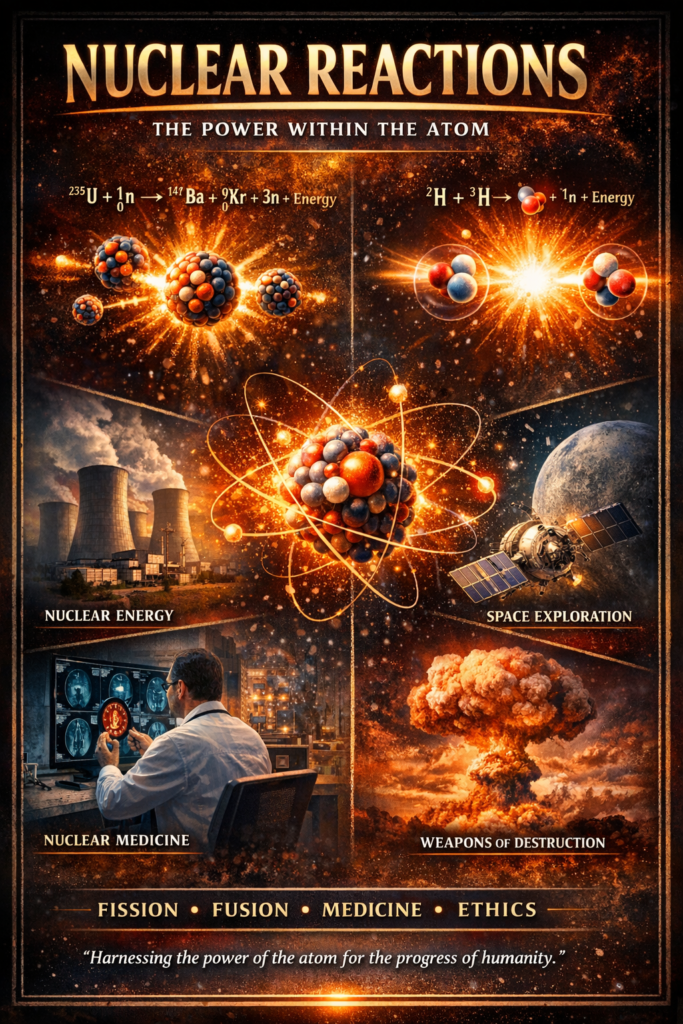
In the vast spectrum of scientific discoveries that have reshaped human civilization, few concepts have been as transformative and consequential as the discovery of nuclear reactions. Hidden within the infinitesimal core of matter—the atomic nucleus—lies a reservoir of energy so immense that it has the capacity to power cities, propel spacecraft, revolutionize medical therapies, and unfortunately, also threaten the very existence of humanity. The story of nuclear reactions is therefore not merely a scientific narrative; it is a profound chronicle of human curiosity, intellectual triumph, technological ambition, and ethical responsibility.
A nuclear reaction refers to a process in which the nucleus of an atom undergoes transformation through interaction with another particle or nucleus. During this transformation, the structure of the nucleus changes, often resulting in the release or absorption of enormous amounts of energy. Unlike chemical reactions, which involve the rearrangement of electrons surrounding atoms, nuclear reactions alter the fundamental composition of the atomic nucleus itself.
The theoretical foundations of nuclear reactions were built during the early twentieth century, following the discovery of the atomic nucleus by the New Zealand-born physicist Ernest Rutherford. Rutherford’s pioneering experiments demonstrated that atoms consist of a dense central nucleus surrounded by orbiting electrons, a discovery that opened the gateway to nuclear physics. Later, the theoretical insights of scientists such as Albert Einstein further illuminated the potential of nuclear energy through the famous equation E=mc2, which revealed that mass could be converted into energy.
This realization laid the conceptual foundation for understanding how minute changes in nuclear mass during reactions could release enormous quantities of energy. The development of nuclear science eventually culminated in both peaceful applications such as nuclear power generation and medical diagnostics, as well as destructive technologies such as atomic weapons used during the World War II.
Thus, the study of nuclear reactions represents a remarkable convergence of physics, engineering, geopolitics, medicine, and ethics.
Historical Evolution of Nuclear Reaction Science
The modern understanding of nuclear reactions emerged gradually through a series of groundbreaking experiments and theoretical insights during the early twentieth century.
One of the earliest artificial nuclear reactions was performed in 1919 by Ernest Rutherford when he bombarded nitrogen atoms with alpha particles. This experiment successfully transformed nitrogen into oxygen, marking the first instance in which humans deliberately altered the nucleus of an atom.
The next major milestone occurred with the discovery of the neutron by James Chadwick in 1932. The neutron, being electrically neutral, proved to be an ideal particle for penetrating atomic nuclei without being repelled by electrical forces. This discovery dramatically expanded the possibilities for inducing nuclear reactions.
Soon afterward, researchers discovered the phenomenon of nuclear fission. In 1938, the German chemists Otto Hahn and Fritz Strassmann observed that bombarding uranium with neutrons caused the nucleus to split into smaller fragments. The theoretical explanation of this phenomenon was provided by the Austrian-Swedish physicist Lise Meitner.
The discovery of nuclear fission quickly attracted global attention because scientists realized that a chain reaction could release vast amounts of energy. This realization ultimately led to the development of atomic weapons during the Manhattan Project in the United States.
However, the same scientific principles that enabled nuclear weapons also paved the way for peaceful nuclear energy production and advanced scientific research.
Fundamental Principles of Nuclear Reactions
At the heart of nuclear reactions lies the concept that atomic nuclei consist of protons and neutrons bound together by an extremely powerful force known as the strong nuclear force. This force is far stronger than the electromagnetic repulsion between positively charged protons, allowing nuclei to remain stable despite the presence of multiple positively charged particles.
When a nuclear reaction occurs, one or more of the following changes may take place:
- The nucleus may absorb a particle.
- The nucleus may emit particles.
- The nucleus may split into smaller fragments.
- Two nuclei may combine to form a larger nucleus.
These transformations are governed by the conservation laws of physics, including conservation of energy, conservation of momentum, and conservation of nucleon number.
The energy released in nuclear reactions arises from differences in binding energy—the energy required to hold nucleons together in the nucleus. When nuclei rearrange themselves into configurations with greater binding energy stability, the excess energy is released as radiation or kinetic energy of particles.
Types of Nuclear Reactions
1. Nuclear Fission
Nuclear fission is a process in which a heavy atomic nucleus splits into two or more smaller nuclei along with the release of neutrons and energy. This process typically occurs when a neutron collides with a heavy nucleus such as uranium or plutonium.
A simplified representation of fission is shown below.
92235U+01n→56141Ba+3692Kr+301n+energy
The fission of uranium-235 produces barium and krypton nuclei, along with additional neutrons and a tremendous amount of energy.
These released neutrons can trigger additional fission events, creating a chain reaction. Controlled chain reactions are used in nuclear reactors to generate electricity, whereas uncontrolled reactions occur in nuclear weapons.
2. Nuclear Fusion
Nuclear fusion is the process in which two light nuclei combine to form a heavier nucleus. This reaction releases enormous energy because the resulting nucleus has greater binding energy stability.
Fusion reactions power the stars, including our Sun.
A typical fusion reaction involves isotopes of hydrogen:
12H+13H→24He+01n+energy
In this reaction, deuterium and tritium combine to form helium and a neutron.
Fusion releases far more energy per unit mass than fission and produces significantly less long-term radioactive waste. However, achieving controlled fusion on Earth remains a major technological challenge because the reaction requires extremely high temperatures—often exceeding 100 million degrees Celsius.
Major global projects such as ITER are attempting to demonstrate sustainable fusion energy.
3. Radioactive Decay
Another important category of nuclear reactions involves radioactive decay, in which unstable nuclei spontaneously emit particles to reach a more stable configuration.
Common forms include:
- Alpha decay
- Beta decay
- Gamma emission
For example, uranium-238 undergoes alpha decay as follows:92238U→90234Th+24He
Radioactive decay processes are widely used in medical imaging, radiotherapy, geological dating, and industrial diagnostics.
4. Particle-Induced Nuclear Reactions
These reactions occur when atomic nuclei are bombarded by particles such as protons, neutrons, or alpha particles. Particle accelerators can induce such reactions to create new elements or isotopes.
Many synthetic elements beyond uranium were produced through such reactions in high-energy physics laboratories.
Energy Release in Nuclear Reactions
The enormous energy released in nuclear reactions can be explained through the mass–energy equivalence principle.
E=mc2
This equation indicates that even a tiny amount of mass converted into energy can produce vast quantities of power because the speed of light squared is an extremely large number.
For example, the fission of a single gram of uranium can release energy equivalent to burning several tons of coal.
This remarkable energy density explains why nuclear power has become a strategic component of global energy systems.
Applications of Nuclear Reactions
1. Nuclear Power Generation
One of the most important peaceful applications of nuclear reactions is electricity generation in nuclear reactors. In these systems, controlled fission reactions produce heat that converts water into steam, which drives turbines connected to generators.
Countries such as the United States, France, Russia, China, and India rely significantly on nuclear power as part of their energy infrastructure.
India’s nuclear energy program, initiated under the leadership of visionary scientist Homi J. Bhabha, has evolved into a major national strategic program aimed at ensuring long-term energy security.
The program operates under the guidance of the Department of Atomic Energy and the Bhabha Atomic Research Centre.
2. Nuclear Medicine
Nuclear reactions have revolutionized the field of medicine by enabling advanced diagnostic and therapeutic technologies.
Radioisotopes produced through nuclear reactions are widely used in:
- Cancer radiotherapy
- PET scans
- SPECT imaging
- Sterilization of medical equipment.
One widely used isotope is Technetium-99m, which plays a crucial role in medical imaging procedures.
Radiation therapy also uses nuclear reactions to target and destroy malignant cancer cells while minimizing damage to surrounding tissues.
3. Space Exploration
Nuclear reactions are also being explored as propulsion systems for deep-space missions.
Nuclear thermal propulsion and radioisotope thermoelectric generators provide long-term power for spacecraft operating far from the Sun.
Space missions developed by organizations such as NASA have successfully used nuclear power systems in probes exploring the outer solar system.
4. Industrial and Agricultural Applications
Nuclear reactions are used in several industrial and agricultural applications:
- food irradiation to extend shelf life
- mutation breeding in crops
- material testing and inspection
- sterilization of pharmaceuticals.
These technologies demonstrate how nuclear science can contribute to societal progress when used responsibly.
Risks and Ethical Concerns
Despite its tremendous benefits, nuclear technology also poses significant risks. The destructive potential of nuclear weapons was tragically demonstrated during the atomic bombings of the Japanese cities of Hiroshima and Nagasaki.
Nuclear accidents such as those at the Chernobyl Nuclear Power Plant and the Fukushima Daiichi Nuclear Power Plant have also highlighted the potential dangers associated with nuclear reactors.
These events emphasize the need for robust safety protocols, international regulatory frameworks, and responsible governance.
Future of Nuclear Reactions
The future of nuclear science is poised to enter an exciting new phase characterized by innovation and technological breakthroughs.
Emerging areas include:
- Small Modular Reactors (SMRs) for decentralized power generation
- Generation IV nuclear reactors with enhanced safety features
- Controlled nuclear fusion as a virtually limitless clean energy source
- Advanced nuclear medicine therapies
- Nuclear-powered space exploration.
These advancements may redefine the global energy landscape and contribute to addressing the challenges of climate change and sustainable development.
Conclusion: Harnessing the Power of the Atom with Wisdom
Nuclear reactions represent one of the most profound scientific discoveries in human history. They reveal that within the smallest units of matter lies an extraordinary reservoir of energy capable of transforming civilization.
However, the story of nuclear reactions also reminds humanity that scientific knowledge carries immense responsibility. The same nuclear reactions that illuminate cities and cure diseases can also devastate entire nations if misused.
Therefore, the future of nuclear science must be guided not only by technological progress but also by ethical wisdom, international cooperation, and a commitment to the peaceful advancement of humanity.
As our understanding of nuclear reactions continues to deepen, the challenge before us is clear: to harness the power of the atom not for destruction, but for the enduring prosperity of human civilization