

Introduction: When Technology Begins to Heal Like Nature
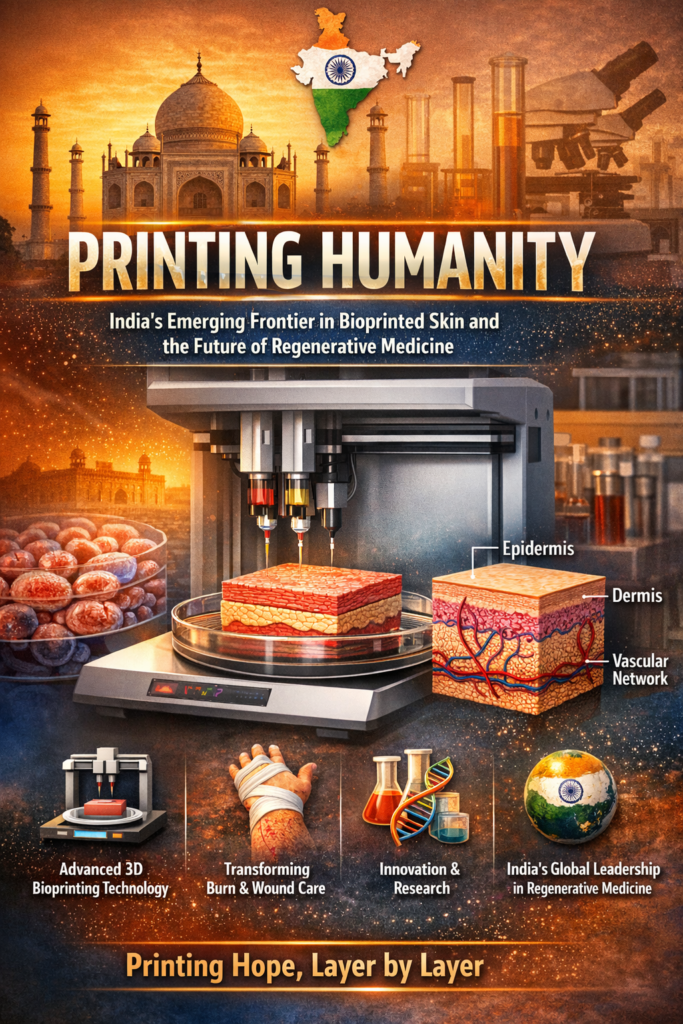
In the evolving landscape of biomedical innovation, few technologies embody the convergence of science, engineering, and human compassion as profoundly as bioprinting. The idea that living tissues—once considered exclusive to the natural processes of biology—can now be engineered, layer by layer, through sophisticated printing systems marks a paradigm shift in modern medicine. Among these innovations, the concept of bioprinting human skin stands as one of the most clinically urgent and socially transformative applications, particularly for a country like India, where burn injuries, trauma, and chronic wounds constitute a significant healthcare burden.
Bioprinting of skin is not merely a technological curiosity; it represents a fundamental redefinition of healing itself. It offers the possibility of replacing damaged tissue with lab-engineered, patient-specific skin constructs that can integrate seamlessly into the human body. In India, where disparities in access to advanced healthcare coexist with world-class scientific capabilities, the emergence of skin bioprinting reflects both an opportunity and a strategic imperative.
Understanding Bioprinting: Science Behind Living Constructs
At its core, bioprinting is an advanced form of additive manufacturing that involves the precise deposition of biological materials—cells, biomolecules, and scaffolding structures—into three-dimensional configurations that mimic natural tissues. Unlike conventional 3D printing, which uses plastics or metals, bioprinting utilizes “bioinks,” which are typically composed of living cells embedded in hydrogels or biomaterials designed to support cellular growth and differentiation.
The process involves multiple stages: digital modeling, material preparation, printing, and post-printing maturation. Through techniques such as extrusion-based printing, inkjet bioprinting, and laser-assisted methods, scientists can recreate the multilayered architecture of human skin, including the epidermis, dermis, and even vascular components.
The significance of this lies in the fact that human skin is not a simple tissue but a highly complex organ with structural, immunological, and sensory functions. Reproducing such complexity requires not only engineering precision but also a deep understanding of cellular biology, biomaterials science, and regenerative pathways.
The Indian Healthcare Context: Why Skin Bioprinting Matters
India faces a disproportionately high burden of skin-related injuries and disorders. Burn injuries alone affect millions annually, with limited access to specialized treatment centers, particularly in rural regions. Traditional treatments such as autografts (using the patient’s own skin) and allografts (donor skin) are constrained by availability, cost, risk of rejection, and infection.
Bioprinted skin offers a transformative alternative. It enables the creation of patient-specific grafts, reducing the risk of immune rejection and accelerating healing. Moreover, it can be produced on demand, addressing the chronic shortage of donor tissues. This is particularly relevant in a country where infrastructural limitations often delay critical interventions.
From a pharmacological perspective, bioprinted skin also serves as a powerful platform for drug testing and toxicological studies. Instead of relying on animal models—which are often ethically contentious and biologically imperfect—bioprinted human skin models provide more accurate, reproducible, and scalable systems for evaluating drug efficacy and safety.
India’s Scientific Ecosystem: Foundations of Bioprinting Innovation
India’s entry into the field of skin bioprinting is supported by a growing ecosystem of academic institutions, startups, and research collaborations. Institutions such as the Institute of Chemical Technology have initiated pioneering work in collaboration with biotech startups like Avay Biosciences to develop 3D bioprinted skin tissues for burn treatment and drug screening applications.
Government-backed initiatives and infrastructure platforms such as the Andhra Pradesh Medtech Zone provide advanced facilities for biomaterials testing and 3D printing, creating an enabling environment for translational research.
Additionally, India’s global scientific diaspora—including researchers like Akhilesh K. Gaharwar—continues to contribute to advancements in biomaterials and regenerative medicine, indirectly strengthening India’s position in the global innovation network.
Technological Components: Bioinks, Cells, and Structural Precision
The success of skin bioprinting depends fundamentally on the development of suitable bioinks. These bioinks must fulfill multiple criteria: biocompatibility, mechanical stability, printability, and the ability to support cell viability and proliferation. Common materials include collagen, gelatin, alginate, and synthetic hydrogels, often combined with stem cells or differentiated skin cells.
Recent advancements have focused on integrating growth factors, nanoparticles, and extracellular vesicles into bioinks to enhance tissue regeneration and functional integration.
Equally critical is the challenge of vascularization—the creation of microvascular networks within the printed skin. Without an adequate blood supply, bioprinted tissues cannot survive beyond a certain thickness. This remains one of the most significant scientific barriers, requiring innovations in microfluidics, biomaterials engineering, and cellular signaling pathways.
Clinical Applications: From Burn Care to Cosmetic Reconstruction
The primary clinical application of bioprinted skin in India lies in burn care. Severe burns often require extensive grafting, prolonged hospitalization, and complex rehabilitation. Bioprinted skin has the potential to reduce healing time, minimize scarring, and improve functional outcomes.
Beyond burn treatment, bioprinted skin can be used in reconstructive surgery for trauma patients, cancer survivors, and individuals with congenital deformities. It also opens new possibilities in cosmetic dermatology, where personalized skin constructs could be used for aesthetic enhancements.
In pharmacology and toxicology, bioprinted skin models are revolutionizing drug discovery. They provide a human-relevant platform for testing dermatological formulations, reducing reliance on animal testing and improving predictive accuracy.
Economic and Strategic Implications for India
The global bioprinting market is experiencing rapid growth, with projections indicating an increase from approximately USD 2.55 billion in 2025 to over USD 8.42 billion by 2035. This growth is driven by increasing demand for organ transplantation alternatives, advancements in biomaterials, and rising investments in regenerative medicine.
For India, this represents not only a healthcare opportunity but also an economic one. By leveraging its strengths in pharmaceuticals, biotechnology, and information technology, India can position itself as a global hub for affordable bioprinting solutions.
The integration of bioprinting with India’s generic pharmaceutical industry could lead to the development of “biofabrication platforms” that combine drug delivery with tissue engineering. This aligns with the broader vision of transitioning from cost-based competitiveness to innovation-driven leadership—a theme central to India’s pharmaceutical evolution.
Regulatory and Ethical Dimensions: Navigating the Future
The clinical translation of bioprinted skin in India requires robust regulatory frameworks that ensure safety, efficacy, and ethical compliance. Unlike traditional medical devices or drugs, bioprinted tissues occupy a hybrid category, necessitating new regulatory paradigms.
Ethical considerations include issues related to cell sourcing, consent, and long-term safety. Additionally, the accessibility of such advanced therapies must be addressed to prevent widening healthcare inequalities.
India’s regulatory bodies, including the Central Drugs Standard Control Organization (CDSCO), will need to develop adaptive guidelines that balance innovation with patient safety. This will require collaboration between scientists, policymakers, and industry stakeholders.
Challenges and Limitations: The Roadblocks to Reality
Despite its immense potential, skin bioprinting faces several challenges. These include:
- Vascularization: Difficulty in creating functional blood vessels
- Scalability: Challenges in producing large, clinically relevant tissues
- Standardization: Lack of uniform protocols and quality control measures
- Cost: High initial investment in equipment and materials
- Regulation: Unclear pathways for clinical approval
These challenges underscore the need for sustained research, interdisciplinary collaboration, and policy support.
Future Trajectory: Towards Personalized Regenerative Medicine
The future of skin bioprinting in India lies in its integration with emerging technologies such as artificial intelligence, nanotechnology, and precision medicine. AI can optimize printing parameters and predict tissue behavior, while nanotechnology can enhance bioink functionality.
In the long term, the vision extends beyond skin to the bioprinting of complex organs such as liver, kidney, and heart. Skin serves as the entry point—a relatively simpler organ that provides a testbed for refining technologies and regulatory frameworks.
Conclusion: Printing Hope, Layer by Layer
Bioprinting of skin represents more than a technological advancement; it is a reimagining of healthcare itself. For India, it offers a pathway to address critical healthcare challenges while simultaneously positioning itself as a leader in regenerative medicine.
The journey from laboratory innovation to clinical reality is fraught with challenges, but the direction is clear. As India continues to invest in science, infrastructure, and policy reform, the dream of printing living tissues—once confined to the realm of science fiction—is steadily becoming a tangible reality.
In this unfolding narrative, bioprinted skin is not just a medical solution; it is a symbol of human ingenuity, resilience, and the relentless pursuit of healing.