

Abstract
The concept of sustainable growth in business has emerged as one of the defining paradigms of modern economic thought. In an era marked by environmental degradation, resource scarcity, and increasing social expectations from corporations, the traditional focus on profit maximization is gradually evolving into a more comprehensive framework that balances economic performance with social responsibility and environmental stewardship. Sustainable growth represents a strategic approach whereby businesses pursue long-term expansion while minimizing ecological footprints and enhancing societal well-being. This review paper examines the theoretical foundations, strategic drivers, operational frameworks, and emerging trends associated with sustainable growth in business. Drawing upon contemporary academic literature, policy discussions, and corporate practices, the article analyzes how organizations can integrate sustainability into their business models without compromising competitiveness. The review highlights the role of innovation, responsible leadership, stakeholder engagement, and regulatory frameworks in shaping sustainable business trajectories. Ultimately, sustainable growth is not merely an ethical aspiration but a strategic necessity that defines the future resilience of global enterprises.
Introduction
The twenty-first century has witnessed a profound transformation in the way businesses conceptualize growth and success. Historically, economic expansion was measured primarily through financial metrics such as revenue growth, market share, and shareholder value. While these indicators remain essential, modern enterprises are increasingly confronted with a broader set of expectations from governments, consumers, investors, and civil society. Environmental challenges such as climate change, biodiversity loss, and pollution, combined with social concerns including inequality, labor rights, and community development, have compelled businesses to reconsider the implications of their operations. Within this evolving context, sustainable growth has emerged as a strategic framework that aligns profitability with responsible corporate behavior.
Sustainable growth in business can be broadly defined as the ability of an organization to expand economically while preserving environmental resources, fostering social equity, and maintaining long-term operational resilience. Unlike traditional growth models that often rely on excessive resource extraction and short-term financial gains, sustainable growth emphasizes efficiency, innovation, and ethical governance. The integration of sustainability into corporate strategy is no longer confined to philanthropic initiatives or corporate social responsibility programs; rather, it has become embedded within the core business architecture.
The significance of sustainable growth is further reinforced by global policy frameworks such as the United Nations Sustainable Development Goals (SDGs), which provide a comprehensive blueprint for achieving inclusive and environmentally responsible development by 2030. Businesses across sectors are increasingly aligning their strategies with these global objectives, recognizing that sustainable practices not only mitigate risk but also create new opportunities for innovation, investment, and competitive advantage.
Conceptual Foundations of Sustainable Growth
The intellectual foundations of sustainable growth in business can be traced to the broader concept of sustainable development, which gained global prominence following the publication of the Brundtland Report in 1987. The report defined sustainable development as development that meets present needs without compromising the ability of future generations to meet their own needs. This principle introduced the idea that economic progress must be harmonized with environmental preservation and social well-being.
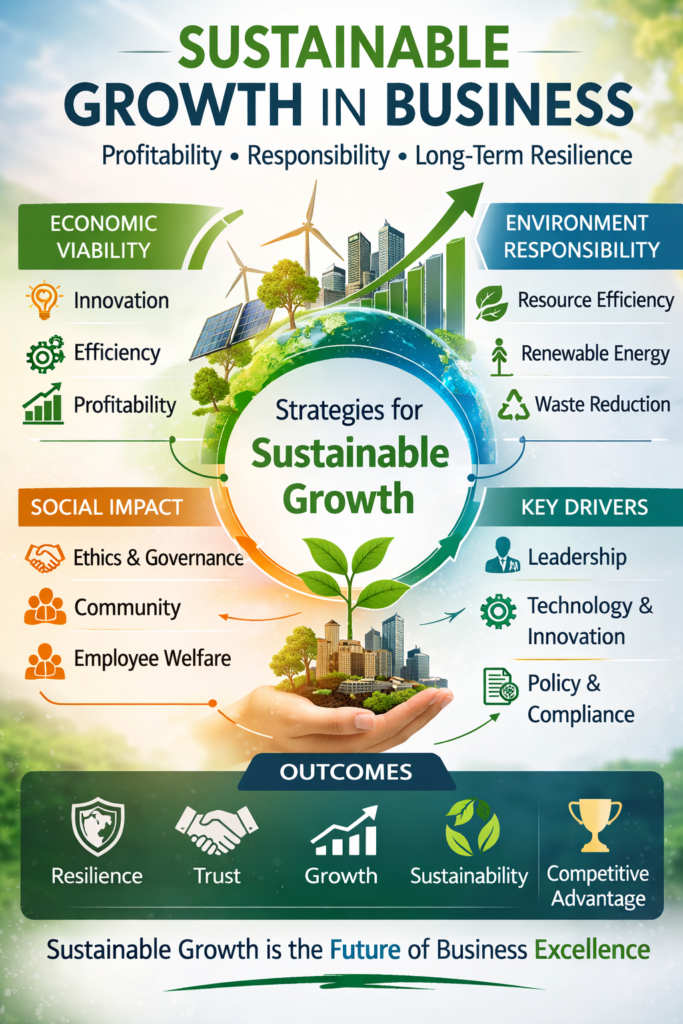
In the corporate context, sustainable growth is often conceptualized through the framework of the “triple bottom line,” which evaluates business performance across three interconnected dimensions: economic prosperity, environmental protection, and social responsibility. Organizations adopting this framework strive to generate financial returns while minimizing environmental harm and contributing positively to society. This multidimensional approach expands the definition of corporate success beyond purely financial outcomes.
Another important theoretical perspective underlying sustainable growth is stakeholder theory. Traditional business models emphasized the primacy of shareholders, viewing corporate success primarily through the lens of shareholder wealth maximization. Stakeholder theory, however, argues that businesses have responsibilities toward a wider set of stakeholders, including employees, customers, suppliers, communities, and the environment. Sustainable growth therefore requires companies to balance the interests of these diverse stakeholders while maintaining long-term profitability.
Resource-based theory also provides valuable insights into sustainable growth. According to this perspective, firms achieve competitive advantage by developing unique resources and capabilities that are difficult for competitors to replicate. Sustainability-oriented capabilities such as eco-efficient production technologies, responsible supply chain management, and strong corporate governance structures can serve as strategic resources that enhance long-term competitiveness.
Drivers of Sustainable Growth in Modern Business
Several factors have contributed to the increasing emphasis on sustainability within business strategy. One of the most significant drivers is the growing awareness of environmental risks associated with industrialization. Climate change, rising global temperatures, and extreme weather events have highlighted the vulnerability of economic systems that rely heavily on fossil fuels and unsustainable resource extraction. Businesses are increasingly recognizing that environmental degradation can disrupt supply chains, increase operational costs, and damage corporate reputation.
Consumer expectations have also evolved significantly in recent years. Modern consumers are more informed and socially conscious, often preferring products and services that align with ethical and environmental values. This shift in consumer behavior has encouraged companies to adopt sustainable production methods, eco-friendly packaging, and transparent supply chains.
Investors have likewise become more attentive to sustainability considerations. Environmental, social, and governance (ESG) criteria are now widely used to evaluate corporate performance and investment potential. Institutional investors increasingly view companies with strong sustainability practices as more resilient and less exposed to regulatory or reputational risks. As a result, access to capital is increasingly linked to a firm’s sustainability performance.
Regulatory frameworks also play a critical role in promoting sustainable growth. Governments around the world are implementing policies aimed at reducing carbon emissions, encouraging renewable energy adoption, and promoting responsible corporate behavior. Compliance with these regulations often requires businesses to adopt cleaner technologies and more sustainable operational practices.
Technological innovation represents another powerful driver of sustainable growth. Advances in renewable energy, digital technologies, artificial intelligence, and biotechnology are enabling businesses to improve resource efficiency, reduce waste, and develop environmentally friendly products. Technological progress thus provides the tools necessary for businesses to reconcile economic growth with environmental stewardship.
Strategic Approaches to Achieving Sustainable Growth
Achieving sustainable growth requires the integration of sustainability principles into core business strategy rather than treating them as peripheral initiatives. One of the most effective approaches involves the adoption of circular economy principles. Unlike the traditional linear economic model characterized by “take, make, dispose,” the circular economy emphasizes resource efficiency, waste reduction, and product lifecycle extension. By designing products that can be reused, repaired, or recycled, businesses can significantly reduce environmental impact while improving resource productivity.
Sustainable supply chain management is another critical component of sustainable business strategy. Modern supply chains are complex global networks involving numerous suppliers, manufacturers, and distributors. Ensuring sustainability across these networks requires rigorous standards for environmental performance, labor practices, and ethical sourcing. Companies increasingly employ supply chain audits, certifications, and digital monitoring systems to ensure compliance with sustainability standards.
Energy efficiency and renewable energy adoption represent important operational strategies for sustainable growth. Businesses can significantly reduce operational costs and environmental impact by investing in energy-efficient technologies and transitioning toward renewable energy sources such as solar, wind, and biomass. Many multinational corporations have already committed to achieving carbon neutrality through aggressive emissions reduction targets and renewable energy procurement.
Innovation also plays a central role in sustainable growth. Sustainable innovation involves the development of products, services, and processes that reduce environmental impact while meeting market demand. Examples include electric vehicles, biodegradable materials, precision agriculture technologies, and digital platforms that optimize resource utilization. Companies that successfully integrate sustainability into their innovation strategies often gain first-mover advantages in emerging markets.
Corporate governance and leadership are equally critical in shaping sustainable growth trajectories. Responsible leadership requires long-term thinking, ethical decision-making, and a commitment to transparency and accountability. Boards of directors increasingly include sustainability committees responsible for overseeing environmental and social performance. Effective governance structures ensure that sustainability considerations are integrated into strategic planning and risk management processes.
Economic Benefits of Sustainable Business Practices
Contrary to earlier assumptions that sustainability imposes additional costs on businesses, growing evidence suggests that sustainable practices can generate substantial economic benefits. Resource efficiency initiatives often lead to significant cost savings by reducing energy consumption, material waste, and operational inefficiencies. For example, energy-efficient manufacturing technologies can lower production costs while simultaneously reducing carbon emissions.
Sustainability can also enhance brand reputation and customer loyalty. Companies that demonstrate genuine commitment to environmental and social responsibility often enjoy stronger consumer trust and differentiation in competitive markets. This reputational advantage can translate into increased market share and pricing power.
Employee engagement and productivity represent another important economic benefit of sustainable business practices. Employees increasingly prefer to work for organizations that align with their personal values and contribute positively to society. Companies with strong sustainability commitments often experience higher levels of employee motivation, retention, and organizational loyalty.
Sustainable growth strategies also enhance corporate resilience by reducing exposure to environmental, regulatory, and reputational risks. Businesses that proactively address sustainability challenges are better positioned to adapt to changing regulatory requirements and market expectations. In contrast, companies that neglect sustainability considerations may face legal penalties, operational disruptions, and loss of investor confidence.
Challenges and Barriers to Sustainable Growth
Despite its numerous advantages, the transition toward sustainable growth is not without challenges. One of the primary barriers is the perceived conflict between short-term financial performance and long-term sustainability investments. Many sustainability initiatives require substantial upfront capital investment, and the financial benefits may not be immediately visible. This short-termism can discourage businesses from pursuing ambitious sustainability strategies.
Another challenge lies in the complexity of measuring sustainability performance. Unlike financial metrics, which are standardized and widely understood, sustainability indicators often involve complex environmental and social variables that are difficult to quantify. The absence of universally accepted sustainability reporting standards can create confusion and hinder meaningful comparisons between companies.
Supply chain complexity also presents significant challenges. Large multinational corporations often rely on extensive global supply networks involving suppliers operating in diverse regulatory and cultural environments. Ensuring consistent sustainability standards across these networks requires substantial monitoring and enforcement efforts.
Technological limitations can also constrain sustainable growth. While many sustainable technologies are rapidly advancing, certain industries still lack economically viable alternatives to environmentally harmful processes. For example, heavy industries such as steel and cement production remain heavily dependent on carbon-intensive technologies.
Future Trends in Sustainable Business Growth
The future of sustainable growth in business is likely to be shaped by several emerging trends. One of the most significant developments is the increasing integration of digital technologies with sustainability initiatives. Artificial intelligence, big data analytics, and blockchain technologies are enabling businesses to monitor environmental performance, optimize resource utilization, and enhance supply chain transparency.
The rise of green finance represents another important trend. Financial institutions are increasingly offering sustainability-linked loans, green bonds, and impact investment funds that support environmentally responsible projects. Access to such financing mechanisms can accelerate the adoption of sustainable business practices.
Consumer-driven sustainability movements are also expected to strengthen in the coming decades. As public awareness of environmental and social issues continues to grow, businesses will face increasing pressure to demonstrate transparency and accountability. Companies that fail to align with sustainability expectations may struggle to maintain consumer trust.
Global collaboration between governments, businesses, and civil society will also play a crucial role in shaping sustainable economic systems. International agreements on climate change, biodiversity protection, and sustainable development are likely to influence corporate strategies and regulatory frameworks worldwide.
Conclusion
Sustainable growth represents a transformative paradigm in modern business strategy, redefining the relationship between economic prosperity, environmental stewardship, and social responsibility. The transition from traditional profit-centric models toward sustainability-oriented frameworks reflects a broader recognition that long-term business success is inseparable from the health of the planet and the well-being of society.
Businesses that successfully integrate sustainability into their strategic vision are likely to achieve greater resilience, innovation capacity, and stakeholder trust. Through responsible leadership, technological innovation, and collaborative partnerships, companies can create economic value while addressing some of the most pressing challenges of our time.
Ultimately, sustainable growth is not merely a corporate responsibility but a strategic imperative that will shape the future of global commerce. Organizations that embrace sustainability as a core principle of their operations will not only contribute to environmental and social progress but also position themselves at the forefront of the emerging sustainable economy.
References
Elkington, J. (1997). Cannibals with forks: The triple bottom line of 21st century business. Capstone Publishing.
Freeman, R. E. (1984). Strategic management: A stakeholder approach. Pitman.
Porter, M. E., & Kramer, M. R. (2011). Creating shared value. Harvard Business Review, 89(1–2), 62–77.
Schaltegger, S., Hansen, E. G., & Lüdeke-Freund, F. (2016). Business models for sustainability. Organization & Environment, 29(3), 264–289.
United Nations. (2015). Transforming our world: The 2030 agenda for sustainable development. United Nations.
World Commission on Environment and Development. (1987). Our common future. Oxford University Press.