

Introduction
The history of modern antimicrobial chemotherapy began not with penicillin, but with sulphonamides. Long before the antibiotic revolution transformed medicine, sulphonamides emerged as humanity’s first successful systemic antibacterial drugs and fundamentally altered the trajectory of infectious disease treatment. These compounds represented the beginning of rational medicinal chemistry, synthetic antimicrobial development, and industrial pharmaceutical innovation.
Today, nearly a century after their introduction, sulphonamides continue to occupy an extraordinary position within medicine, pharmacology, chemistry, industrial manufacturing, veterinary science, agriculture, and global healthcare economics. While their role as standalone antibacterial agents has diminished due to widespread resistance, sulphonamide chemistry remains deeply embedded in modern therapeutic science.
The sulphonamide scaffold now extends far beyond antibacterial therapy and contributes to:
- Antimicrobial drugs
- Diuretics
- Anticonvulsants
- Antidiabetic agents
- Carbonic anhydrase inhibitors
- Antiretroviral therapies
- Anticancer molecules
- Anti-inflammatory compounds
Modern pharmaceutical chemistry increasingly recognizes sulphonamides as one of the most versatile bioactive pharmacophores in medicinal chemistry. (Cleveland Clinic)
Simultaneously, antimicrobial resistance (AMR) has transformed traditional sulphonamide antibacterial therapy into a strategic global challenge. Rising resistance involving sul1, sul2, and sul3 genes, mobile genetic elements, and multidrug-resistant bacterial pathogens has significantly reduced the efficacy of classical sulphonamide monotherapy. (ResearchGate)
However, rather than disappearing from medicine, sulphonamides are experiencing a scientific and industrial renaissance driven by:
- Combination therapy strategies
- Novel molecular engineering
- AI-driven drug discovery
- Antimicrobial stewardship
- Synthetic biology
- Global pharmaceutical demand
- Expanding emerging-market healthcare systems
Recent market analyses project sustained global growth in the sulphonamide sector, with forecasts ranging from approximately USD 3–5 billion during the coming decade depending upon therapeutic segmentation and industrial classification models. (Research and Markets)
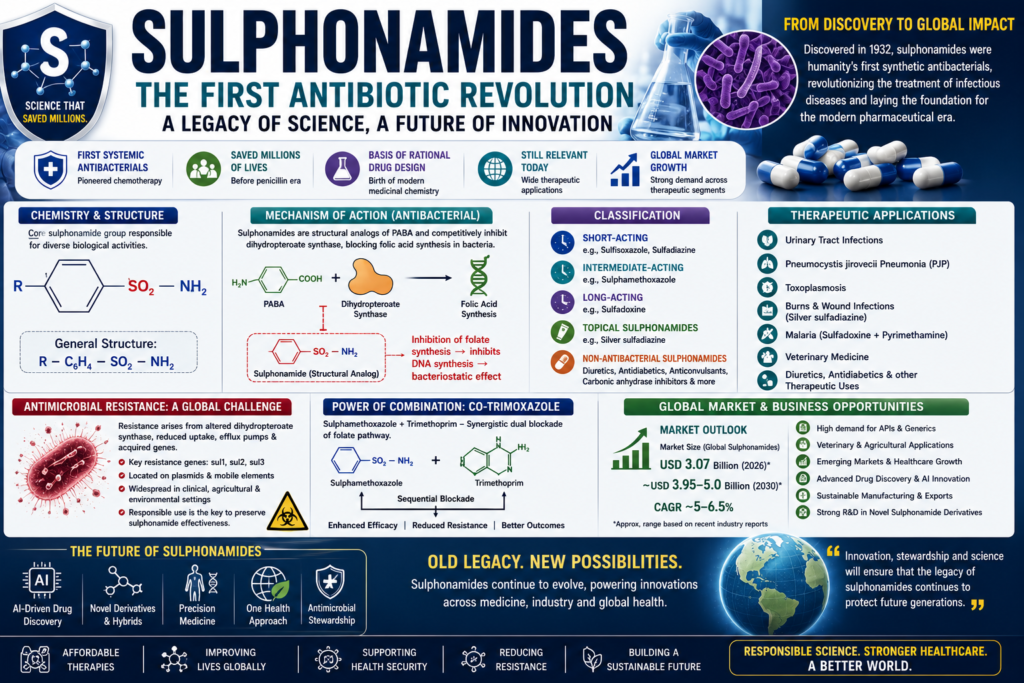
The story of sulphonamides is therefore not merely historical. It represents a continuing strategic narrative involving:
- Pharmaceutical innovation
- Antimicrobial resistance
- Industrial chemistry
- Healthcare sustainability
- Global drug economics
- Future antimicrobial discovery
Historical Evolution of Sulphonamides
The origins of sulphonamides date back to the early twentieth century.
In 1932, German scientist Gerhard Domagk discovered the antibacterial activity of Prontosil, a red azo dye developed at Bayer Laboratories. This discovery became one of the greatest turning points in medical history.
Prontosil itself was inactive in vitro, but metabolic conversion within the body produced sulfanilamide, the true antibacterial component.
This discovery demonstrated several revolutionary concepts:
- Synthetic chemicals could treat bacterial infections
- Selective toxicity was possible
- Rational drug design could transform medicine
Sulphonamides rapidly became the first widely used systemic antibacterial drugs.
Before penicillin became commercially available, sulphonamides dramatically reduced mortality from:
- Streptococcal infections
- Pneumonia
- Meningitis
- Wound infections
- Postpartum sepsis
The mortality reduction during World War II further established sulphonamides as strategic medical assets.
The discovery of sulphonamides effectively launched the modern pharmaceutical antibiotic industry.
Chemical Structure and Medicinal Chemistry
Sulphonamides are characterized by the sulfonamide functional group:
R-S(=O)_2-NH_2
This functional group consists of:
- Sulfonyl moiety
- Amino group
- Aromatic substitutions
The antibacterial sulphonamides structurally resemble para-aminobenzoic acid (PABA), which is essential for bacterial folic acid synthesis.
This structural mimicry forms the foundation of their antibacterial mechanism.
Modern medicinal chemistry has extensively modified the sulphonamide scaffold to produce compounds with:
- Improved pharmacokinetics
- Enhanced selectivity
- Reduced toxicity
- Broader therapeutic applications
Today, sulphonamide chemistry extends far beyond infectious disease medicine.
Mechanism of Action
Sulphonamides act primarily as bacteriostatic agents.
They inhibit bacterial folate synthesis by competitively antagonizing PABA during dihydropteroate synthesis.
The mechanism may conceptually be represented as:
PABA + Dihydropteroate\ synthase \rightarrow Folic\ acid\ synthesis
Sulphonamides block this pathway:
Sulphonamide + Dihydropteroate\ synthase \rightarrow Inhibition\ of\ folate\ synthesis
Without folic acid:
- DNA synthesis declines
- RNA synthesis is impaired
- Bacterial replication slows
Humans obtain folate through diet rather than endogenous synthesis, allowing selective antibacterial targeting. (MSD Manuals)
Classification of Sulphonamides
Sulphonamides may be classified according to:
- Absorption profile
- Duration of action
- Therapeutic application
Short-Acting Sulphonamides
Examples:
- Sulfisoxazole
- Sulfadiazine
These possess relatively rapid elimination.
Intermediate-Acting Sulphonamides
Examples:
- Sulfamethoxazole
Widely used in combination therapy.
Long-Acting Sulphonamides
Examples:
- Sulfadoxine
Frequently combined with pyrimethamine in antimalarial therapy.
Topical Sulphonamides
Examples:
- Silver sulfadiazine
Widely used in burn management and wound infection prevention.
Non-Antibacterial Sulphonamides
Sulphonamide pharmacophores are also found in:
- Thiazide diuretics
- Carbonic anhydrase inhibitors
- Sulfonylureas
- Certain anticonvulsants
Modern medicine therefore utilizes sulphonamide chemistry across multiple specialties. (Cleveland Clinic)
Pharmacokinetics and Pharmacodynamics
Sulphonamides exhibit variable pharmacokinetic profiles depending on:
- Lipid solubility
- Protein binding
- Renal excretion
- Hepatic metabolism
Key pharmacokinetic considerations include:
- Oral absorption
- Tissue penetration
- Half-life
- Urinary concentration
Many sulphonamides achieve high urinary concentrations, making them historically useful for urinary tract infections.
Combination therapy with trimethoprim produces synergistic antibacterial effects through sequential blockade of folate metabolism.
The synergistic interaction can conceptually be represented as:
Sulphonamide + Trimethoprim \rightarrow Sequential\ folate\ inhibition
This combination remains one of the most important examples of pharmacological synergy in antimicrobial therapy.
Sulphamethoxazole-Trimethoprim (Co-trimoxazole)
The combination of sulfamethoxazole and trimethoprim revolutionized antibacterial chemotherapy.
Co-trimoxazole remains important for:
- Urinary tract infections
- Pneumocystis jirovecii pneumonia
- Certain gastrointestinal infections
- Opportunistic infections in immunocompromised patients
Its dual inhibition mechanism significantly reduces bacterial folate synthesis.
The combination continues to play major roles in:
- HIV medicine
- Global infectious disease programs
- Resource-limited healthcare systems
Clinical Applications of Sulphonamides
Urinary Tract Infections
Sulphonamides historically dominated UTI therapy.
Although resistance has increased substantially, co-trimoxazole remains useful in selected susceptible infections.
Pneumocystis jirovecii Pneumonia (PJP)
Co-trimoxazole remains the gold-standard prophylactic and therapeutic agent for PJP in HIV-positive and immunocompromised individuals.
Toxoplasmosis
Sulfadiazine combined with pyrimethamine remains important in toxoplasmosis management.
Burn Medicine
Silver sulfadiazine became one of the most widely used topical antimicrobial agents in burn management.
Malaria
Sulfadoxine-pyrimethamine continues to play roles in malaria prophylaxis and intermittent preventive therapy in some regions.
Sulphonamides Beyond Antibacterial Therapy
Modern medicinal chemistry has transformed sulphonamide chemistry into a multi-therapeutic platform.
Diuretics
Thiazide diuretics contain sulphonamide structures and remain critical in:
- Hypertension
- Heart failure
- Edema management
Sulfonylureas
Sulphonamide-based antidiabetic drugs continue to play roles in Type 2 diabetes management.
Carbonic Anhydrase Inhibitors
Acetazolamide and related compounds are important in:
- Glaucoma
- Altitude sickness
- Epilepsy
Anticancer Research
Modern oncology increasingly investigates sulphonamide-based anticancer molecules due to:
- Enzyme inhibition
- Carbonic anhydrase targeting
- Tumor metabolism interference
The sulphonamide scaffold remains highly valuable in drug discovery programs.
Antimicrobial Resistance and Sulphonamides
Antimicrobial resistance represents the greatest challenge confronting classical sulphonamide therapy.
Major resistance mechanisms include:
- Altered dihydropteroate synthase
- Reduced drug uptake
- Efflux pumps
- Horizontal gene transfer
The resistance pathway may conceptually be represented as:
sul1/sul2/sul3\ genes \rightarrow Altered\ bacterial\ target\ enzymes
Recent reviews emphasize the increasing spread of sul1, sul2, and sul3 resistance genes through plasmids and mobile genetic elements. (ResearchGate)
AMR surveillance increasingly identifies widespread resistance against classical sulphonamides in:
- Enterobacteriaceae
- Gram-negative pathogens
- Community-acquired infections
This resistance crisis has reduced standalone sulphonamide usage globally.
Combination Therapy and Modern Revival
Despite resistance, sulphonamides remain strategically important when combined with:
- Trimethoprim
- Pyrimethamine
- Other antimicrobial agents
Combination therapy reduces:
- Resistance development
- Treatment failure
- Microbial adaptation
Modern pharmacology increasingly emphasizes synergistic antimicrobial combinations.
Recent scientific reviews continue highlighting sulphonamides as essential components of multidrug antimicrobial regimens. (Creative Diagnostics)
Industrial Manufacturing of Sulphonamides
Sulphonamide manufacturing remains a major pharmaceutical industry segment.
The industrial synthesis process involves:
- Sulfonylation reactions
- Aromatic substitution chemistry
- Purification processes
- API manufacturing
- Formulation development
Manufacturing facilities require:
- GMP compliance
- Impurity monitoring
- Environmental control
- Regulatory validation
India and China remain major global suppliers of:
- Sulphonamide APIs
- Generic formulations
- Pharmaceutical intermediates
The pharmaceutical supply chain increasingly depends upon integrated API ecosystems.
Global Sulphonamide Market Dynamics
Modern market analyses indicate sustained growth in sulphonamide-related pharmaceutical sectors.
Recent industry forecasts estimate:
- USD 3.07 billion market valuation in 2026
- Growth toward nearly USD 4 billion by 2030
- CAGR approximately 5–6.5% depending upon therapeutic segmentation (Research and Markets)
One market calculation may be represented conceptually as:
Future\ Market\ Value = Present\ Value(1+r)^n
Where:
- (r) = CAGR
- (n) = years
Using a 6.5% CAGR:
3.07(1+0.065)^4 \approx 3.95\ billion\ USD
This aligns closely with reported industrial forecasts. (Research and Markets)
Growth drivers include:
- Generic drug demand
- Combination therapy expansion
- Emerging-market healthcare growth
- Veterinary medicine
- Agricultural applications
- Antimicrobial stewardship programs
Asia-Pacific is expected to remain one of the fastest-growing regions. (Research and Markets)
Business Opportunities in the Global Sulphonamide Sector
Generic Pharmaceutical Manufacturing
Sulphonamide generics remain commercially important due to:
- Large patient populations
- Low manufacturing costs
- Established clinical utility
Emerging markets continue demanding affordable antibacterial therapies.
API Manufacturing Opportunities
India’s pharmaceutical sector possesses major opportunities in:
- Sulphonamide API production
- Export-oriented manufacturing
- Contract manufacturing services
The growing global generic market creates significant industrial potential.
Veterinary Medicine
Sulphonamides remain extensively used in veterinary medicine and livestock management.
Applications include:
- Poultry infections
- Aquaculture
- Animal husbandry
Veterinary antibiotic demand continues supporting industrial production. (ScienceDirect)
Agricultural Applications
Certain sulphonamide compounds are used in:
- Animal feed additives
- Agricultural antimicrobial applications
However, environmental AMR concerns are increasing regulatory scrutiny.
Advanced Drug Discovery
Medicinal chemistry companies increasingly utilize sulphonamide scaffolds for:
- Anticancer agents
- Enzyme inhibitors
- Precision therapeutics
- AI-designed small molecules
This represents one of the most promising future business opportunities.
Biotechnology and AI-Assisted Drug Discovery
Artificial intelligence is increasingly being integrated into sulphonamide drug development.
AI systems now assist in:
- Molecular optimization
- Resistance prediction
- Virtual screening
- Pharmacokinetic modeling
Modern antibacterial discovery increasingly combines:
- Computational chemistry
- Machine learning
- Synthetic biology
- Structure-based drug design
Environmental and Ecological Concerns
Sulphonamides also represent important environmental pollutants.
Concerns include:
- Pharmaceutical wastewater contamination
- Agricultural runoff
- Environmental AMR selection
Environmental persistence may promote resistance gene dissemination through:
- Soil microbiota
- Aquatic ecosystems
- Wastewater reservoirs
The One Health framework increasingly emphasizes integrated approaches involving:
- Human health
- Veterinary medicine
- Environmental stewardship
Recent AMR discussions increasingly highlight ecological transmission networks and environmental reservoirs. (The Washington Post)
Sulphonamides and the Indian Pharmaceutical Industry
India occupies a strategically important position in the global sulphonamide ecosystem.
Advantages include:
- Large API manufacturing base
- Generic drug leadership
- Skilled scientific workforce
- Competitive production costs
Indian pharmaceutical companies possess major opportunities in:
- Export markets
- Combination therapies
- Emerging-market healthcare systems
- Contract manufacturing
However, challenges remain:
- Regulatory harmonization
- Environmental compliance
- AMR stewardship
- Supply-chain vulnerabilities
Recent geopolitical disruptions and raw material price fluctuations have also affected pharmaceutical manufacturing economics globally. (The Times of India)
Emerging Research and Future Innovations
Modern research increasingly explores:
- Novel sulphonamide derivatives
- Hybrid antibacterial molecules
- Nanotechnology-based delivery systems
- CRISPR-assisted antimicrobials
- AI-designed antimicrobials
Recent scientific developments include synthesis of novel sulphonamide compounds with potentially enhanced microbial penetration and improved pharmacological properties. (GxP News)
Researchers are increasingly combining sulphonamide scaffolds with:
- Metal complexes
- Peptide conjugates
- Nanocarriers
- Enzyme inhibitors
The future of sulphonamide chemistry lies not in recreating old antibiotics, but in transforming sulphonamide pharmacophores into next-generation therapeutic platforms.
Sulphonamides in the Era of Precision Medicine
Future antimicrobial therapy will increasingly involve:
- Genomic diagnostics
- Resistance-guided therapy
- Personalized medicine
- Precision antimicrobial stewardship
Rapid diagnostics and AI-guided susceptibility testing may help preserve sulphonamide effectiveness by reducing inappropriate prescribing.
Recent AMR innovation frameworks increasingly emphasize:
- Rapid diagnostics
- Narrow-spectrum therapy
- Resistance prediction systems
- Precision antimicrobial targeting (The Washington Post)
Ethical and Stewardship Considerations
The sulphonamide story also represents a cautionary lesson in antimicrobial stewardship.
The rise of resistance demonstrates how:
- Overprescribing
- Agricultural misuse
- Inadequate stewardship
- Environmental contamination
can undermine even revolutionary therapies.
Future success requires balancing:
- Commercial growth
- Public health
- Sustainability
- Responsible antibiotic usage
Future Outlook
The future of sulphonamides will likely be shaped by six strategic forces:
- Rising antimicrobial resistance
- AI-driven medicinal chemistry
- Combination antimicrobial therapies
- Precision infectious disease medicine
- Expanding generic pharmaceutical markets
- One Health environmental regulation
Sulphonamides are unlikely to disappear from medicine.
Instead, they will continue evolving into:
- Combination therapeutics
- Precision-designed molecules
- Multispecialty pharmacological scaffolds
- Industrial pharmaceutical platforms
The pharmaceutical industry increasingly recognizes that future antibiotic sustainability depends upon integrated innovation ecosystems rather than volume-based antibiotic commercialization alone.
Conclusion
Sulphonamides represent one of the most historically transformative achievements in pharmaceutical science.
They were:
- Humanity’s first successful synthetic antibacterial agents
- The foundation of rational chemotherapy
- The beginning of industrial antimicrobial medicine
Nearly a century later, sulphonamides remain scientifically relevant not because they defeated microbial evolution, but because they evolved alongside medicine itself.
Their journey reflects the broader evolution of pharmaceutical science:
- From simple antibacterial agents
- To multifunctional medicinal chemistry platforms
- To strategic components of biotechnology and precision medicine
Today, sulphonamides stand at the intersection of:
- Antimicrobial resistance
- Medicinal chemistry
- Pharmaceutical economics
- Industrial biotechnology
- Artificial intelligence
- Global healthcare sustainability
The future of sulphonamides will not depend solely upon discovering stronger drugs.
It will depend upon:
- Smarter chemistry
- Better stewardship
- Precision diagnostics
- Sustainable manufacturing
- Global scientific collaboration
In many ways, the story of sulphonamides mirrors the story of modern medicine itself — a continuous struggle between microbial evolution and human innovation, where science must constantly adapt to preserve the future of healthcare civilization. (accesstomedicinefoundation.org)