

A Civilizational Journey Through Human Curiosity, Discovery, Innovation, and Scientific Transformation
Introduction: Science as the Architecture of Human Civilization
The history of human civilization is fundamentally the history of scientific curiosity. From the earliest observations of stars by ancient astronomers to the decoding of the human genome and the rise of artificial intelligence, science has continuously reshaped how humanity understands nature, disease, energy, matter, life, consciousness, technology, and the universe itself. Every modern achievement — medicine, electricity, computers, aviation, telecommunications, genetics, space exploration, biotechnology, artificial intelligence, and nanotechnology — stands upon the intellectual foundations built by generations of scientists across centuries.
Scientists are not merely individuals conducting experiments in laboratories. They are architects of civilization. They challenge assumptions, decode mysteries, develop technologies, and transform theoretical imagination into practical reality. Their discoveries influence:
- Healthcare systems
- Industrial revolutions
- Global economies
- Military capabilities
- Human longevity
- Agricultural productivity
- Digital societies
- Environmental understanding
- Space exploration
The scientific journey of humanity reflects a continuous expansion of knowledge across multiple disciplines including:
- Physics
- Chemistry
- Biology
- Medicine
- Mathematics
- Astronomy
- Genetics
- Computer science
- Engineering
- Pharmacology
- Neuroscience
Some scientists transformed understanding of matter and energy. Others revolutionized medicine and human survival. Some decoded the structure of the universe, while others unlocked the molecular basis of life itself. Many worked under conditions of poverty, political instability, social resistance, war, discrimination, or intellectual isolation. Yet their persistence transformed civilization permanently.
This article presents a structured and analytical overview of approximately 200 of the world’s greatest scientists and their contributions, organized across major scientific domains and historical eras. Rather than merely listing names, this discussion explores how these scientists collectively shaped the intellectual evolution of humanity.
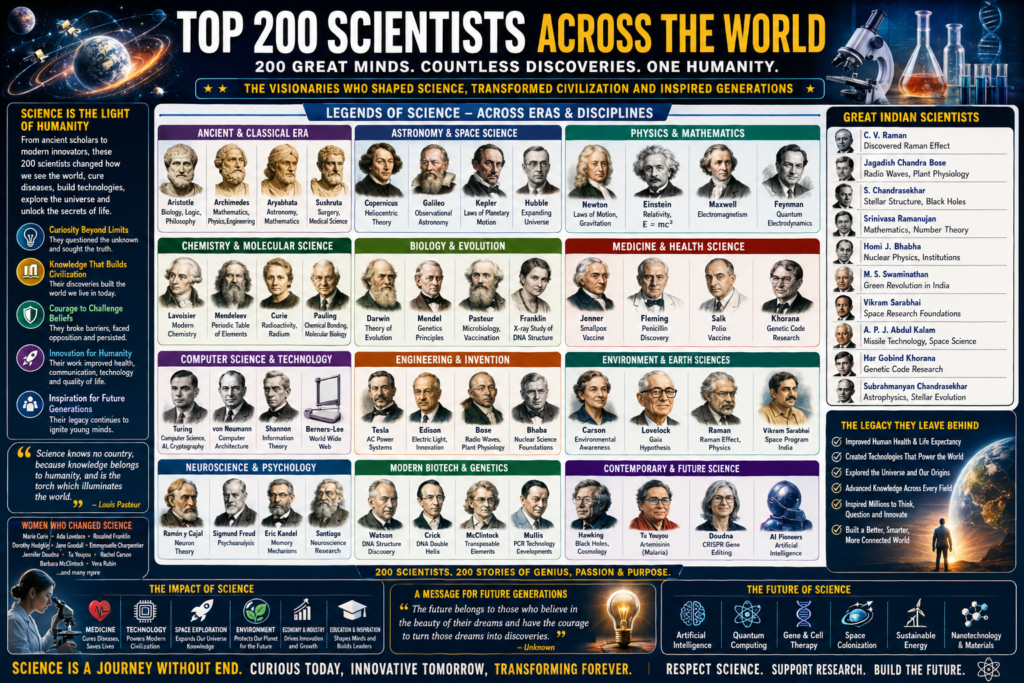
Ancient Foundations of Scientific Thinking
Long before modern laboratories existed, ancient civilizations developed remarkable scientific insights.
Ancient Greek Scientific Thinkers
The Greek world produced several foundational scientific philosophers.
Aristotle
Aristotle contributed extensively to:
- Biology
- Logic
- Physics
- Ethics
- Zoology
He attempted systematic classification of living organisms and established logical reasoning traditions influencing science for centuries.
Archimedes
Archimedes revolutionized:
- Mathematics
- Engineering
- Hydrostatics
His work on buoyancy principles, geometry, and mechanical systems laid foundations for physics and engineering.
Pythagoras
Pythagoras profoundly influenced:
- Mathematics
- Geometry
- Number theory
The Pythagorean theorem remains foundational in mathematics.
Euclid
Euclid’s work “Elements” became one of history’s most influential mathematical texts.
He systematized geometry logically and rigorously.
Scientific Contributions from Ancient India
India produced major scientific thinkers in:
- Mathematics
- Astronomy
- Medicine
- Surgery
Aryabhata
Aryabhata contributed to:
- Astronomy
- Trigonometry
- Planetary motion
- Mathematical calculations
He proposed rotational movement of Earth centuries before European scientific acceptance.
Sushruta
Sushruta is regarded as one of the earliest pioneers of surgery.
His contributions included:
- Surgical instruments
- Plastic surgery techniques
- Anatomical understanding
Charaka
Charaka advanced:
- Internal medicine
- Pharmacology
- Ayurvedic medical systems
Islamic Golden Age Scientists
The Islamic Golden Age preserved and expanded scientific knowledge substantially.
Ibn Sina
Also known as Avicenna, Ibn Sina contributed to:
- Medicine
- Philosophy
- Pharmacology
His medical text “Canon of Medicine” influenced medicine for centuries.
Alhazen
Alhazen pioneered:
- Optics
- Experimental methods
- Scientific reasoning
He significantly influenced modern scientific methodology.
Renaissance and Scientific Revolution
The Renaissance transformed scientific inquiry through observation and experimentation.
Nicolaus Copernicus
Copernicus proposed the heliocentric model placing the Sun at the center of the solar system.
This revolutionized astronomy fundamentally.
Galileo Galilei
Galileo advanced:
- Astronomy
- Motion physics
- Experimental science
His telescope observations transformed understanding of the cosmos.
Johannes Kepler
Kepler established laws of planetary motion, strengthening heliocentric astronomy mathematically.
Francis Bacon
Bacon emphasized empirical scientific methods and inductive reasoning.
The Physics Revolution
Physics transformed civilization profoundly.
Isaac Newton
Newton remains among history’s greatest scientists.
His contributions included:
- Laws of motion
- Universal gravitation
- Calculus
- Optics
Modern classical physics rests heavily upon Newtonian foundations.
Michael Faraday
Faraday revolutionized:
- Electromagnetism
- Electrochemistry
His discoveries enabled electrical technologies.
James Clerk Maxwell
Maxwell unified electricity and magnetism mathematically through Maxwell’s equations.
Modern telecommunications emerged from these principles.
Nikola Tesla
Tesla transformed:
- Alternating current systems
- Wireless energy concepts
- Electrical engineering
His innovations profoundly shaped modern electricity infrastructure.
Thomas Edison
Edison contributed to:
- Electric lighting
- Industrial innovation
- Phonographs
- Motion pictures
Marie Curie
Marie Curie pioneered:
- Radioactivity research
- Radium discovery
- Cancer radiation therapy foundations
She became the first woman to win a Nobel Prize.
Albert Einstein
Einstein transformed physics through:
- Theory of relativity
- Mass-energy equivalence
E=mc^2
His work reshaped understanding of space, time, gravity, and cosmology.
Niels Bohr
Bohr contributed fundamentally to:
- Quantum theory
- Atomic structure
Werner Heisenberg
Heisenberg formulated uncertainty principles central to quantum mechanics.
Erwin Schrödinger
Schrödinger advanced quantum wave mechanics.
Richard Feynman
Feynman contributed to:
- Quantum electrodynamics
- Particle physics
- Scientific education
Stephen Hawking
Hawking advanced:
- Black hole physics
- Cosmology
- Quantum gravity theories
Chemistry and Molecular Science Pioneers
Antoine Lavoisier
Lavoisier established modern chemistry foundations through:
- Conservation of mass
- Chemical nomenclature
Dmitri Mendeleev
Mendeleev developed the periodic table of elements.
Linus Pauling
Pauling contributed to:
- Chemical bonding
- Molecular biology
- Protein structure
Rosalind Franklin
Franklin’s X-ray crystallography work critically contributed to DNA structure discovery.
Biological Science Revolutionaries
Charles Darwin
Darwin transformed biology through evolution by natural selection.
\text{Natural Selection and Evolutionary Adaptation}
His work fundamentally altered understanding of life.
Gregor Mendel
Mendel established principles of genetics through pea plant experiments.
Louis Pasteur
Pasteur pioneered:
- Germ theory
- Vaccination
- Pasteurization
Modern microbiology emerged from his work.
Robert Koch
Koch identified pathogens responsible for:
- Tuberculosis
- Cholera
- Anthrax
Alexander Fleming
Fleming discovered penicillin, revolutionizing infectious disease treatment.
Jonas Salk
Salk developed the polio vaccine.
James Watson and Francis Crick
They proposed DNA double-helix structure.
\text{DNA Double Helix Structure}
Barbara McClintock
McClintock discovered transposable genetic elements.
Kary Mullis
Mullis developed PCR technology revolutionizing molecular diagnostics.
Medical Science Giants
Edward Jenner
Jenner pioneered vaccination against smallpox.
Sigmund Freud
Freud significantly influenced psychology and psychoanalysis.
Paul Ehrlich
Ehrlich pioneered:
- Immunology
- Chemotherapy concepts
Har Gobind Khorana
Khorana decoded aspects of the genetic code.
Tu Youyou
Tu Youyou discovered artemisinin for malaria treatment.
Computer Science and Digital Revolution Pioneers
Alan Turing
Turing laid foundations of:
- Computer science
- Artificial intelligence
- Cryptography
John von Neumann
Von Neumann contributed to:
- Computing architecture
- Game theory
- Quantum mechanics
Claude Shannon
Shannon founded information theory.
Tim Berners-Lee
Berners-Lee invented the World Wide Web.
Vint Cerf
Cerf helped develop internet communication protocols.
Space Science and Astronomy Leaders
Carl Sagan
Sagan popularized astronomy and planetary science globally.
Edwin Hubble
Hubble demonstrated expansion of the universe.
Subrahmanyan Chandrasekhar
Chandrasekhar contributed to stellar evolution and black hole physics.
Vikram Sarabhai
Sarabhai founded India’s modern space program.
A. P. J. Abdul Kalam
Kalam contributed to:
- Missile technology
- Space systems
- Strategic defense research
Environmental and Ecological Scientists
Rachel Carson
Carson’s work advanced environmental awareness globally.
James Lovelock
Lovelock proposed the Gaia hypothesis regarding Earth systems.
Neuroscience and Brain Science Pioneers
Santiago Ramón y Cajal
Cajal established neuron theory foundations.
Eric Kandel
Kandel advanced understanding of memory mechanisms.
Women Scientists Who Changed the World
Scientific history often marginalized women despite extraordinary contributions.
Major women scientists include:
- Ada Lovelace
- Dorothy Hodgkin
- Jane Goodall
- Jennifer Doudna
- Emmanuelle Charpentier
Doudna and Charpentier revolutionized gene editing through CRISPR technology.
Indian Scientists and Their Global Contributions
India produced numerous globally influential scientists.
Important figures include:
- C. V. Raman
- Jagadish Chandra Bose
- Homi J. Bhabha
- M. S. Swaminathan
- Srinivasa Ramanujan
Ramanujan transformed number theory profoundly despite limited formal training.
The Role of Scientists in Modern Civilization
Scientists transformed:
- Life expectancy
- Transportation
- Communication
- Agriculture
- Space exploration
- Warfare
- Healthcare
Modern civilization itself depends fundamentally upon scientific progress.
The Ethical Responsibility of Science
Scientific advancement also produced:
- Nuclear weapons
- Environmental damage
- Biological risks
- Ethical dilemmas
Scientists therefore carry moral responsibilities alongside intellectual power.
Future science must increasingly balance:
- Innovation
- Sustainability
- Human welfare
- Ethical responsibility
Artificial Intelligence and Future Scientists
The future scientific era may increasingly involve:
- AI-assisted discovery
- Quantum computing
- Personalized medicine
- Space colonization
- Synthetic biology
Future scientists may collaborate with intelligent computational systems.
The Collective Legacy of the Top 200 Scientists
The approximately 200 greatest scientists across history collectively transformed:
- Human survival
- Knowledge systems
- Technology
- Medicine
- Civilization
Their contributions reveal several common themes:
- Curiosity
- Persistence
- Skepticism
- Creativity
- Intellectual courage
Many faced:
- Rejection
- Poverty
- Political resistance
- Institutional opposition
Yet their ideas ultimately reshaped humanity.
Conclusion: Science as Humanity’s Greatest Intellectual Adventure
The story of the world’s greatest scientists is ultimately the story of humanity’s search for truth, understanding, survival, and progress. Across centuries and civilizations, scientists challenged superstition, expanded knowledge, decoded nature, and transformed imagination into measurable reality.
From Aristotle to Albert Einstein, from Marie Curie to A. P. J. Abdul Kalam, from Charles Darwin to modern geneticists and AI researchers, scientific thinkers continuously expanded the boundaries of civilization.
Their contributions collectively created:
- Modern medicine
- Digital technology
- Aerospace systems
- Molecular biology
- Quantum physics
- Artificial intelligence
- Global communication networks
The greatest lesson from these scientists is not merely their discoveries.
It is their mindset.
They questioned accepted assumptions.
They embraced uncertainty.
They pursued evidence over dogma.
They persisted despite failure.
Science therefore represents more than a professional discipline.
Science represents humanity’s greatest intellectual adventure — the continuous effort to understand life, matter, consciousness, disease, energy, space, and existence itself.
The future of civilization will continue depending upon scientists capable of combining:
- Curiosity
- Ethics
- Innovation
- Interdisciplinary thinking
- Humanitarian responsibility
The greatest scientists did not merely discover facts.
They transformed humanity’s understanding of reality itself.