

Author: Devanssh Mehta
M.Pharm (Pharmacology), MBA, B.Pharm
Pharmacologist | Author | Researcher
Meerut, Uttar Pradesh, India
Abstract
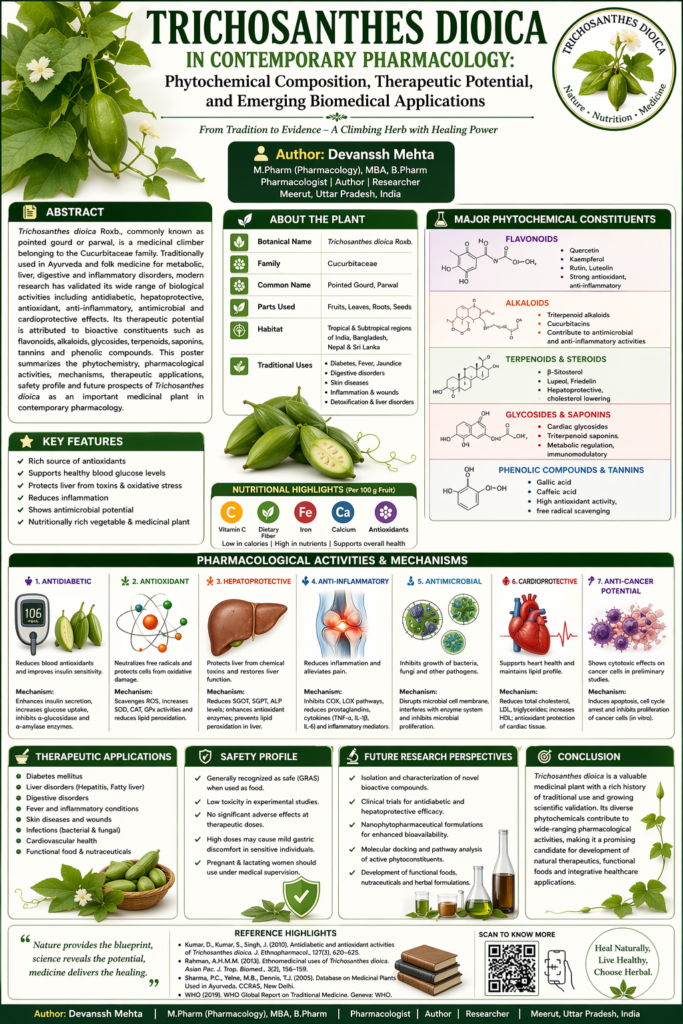
Medicinal plants have played a pivotal role in the development of pharmacology by serving as reservoirs of biologically active compounds with therapeutic potential. Trichosanthes dioica Roxb., commonly known as pointed gourd or “parwal,” is a perennial climbing plant belonging to the Cucurbitaceae family and widely cultivated in the Indian subcontinent. Traditionally used in Ayurvedic and folk medicine systems, the plant has been employed for the management of metabolic disorders, liver diseases, gastrointestinal disturbances, and inflammatory conditions. Modern pharmacological investigations have increasingly validated many of these traditional uses, revealing that Trichosanthes dioica possesses diverse biological activities including antidiabetic, hepatoprotective, antioxidant, anti-inflammatory, antimicrobial, and cardioprotective effects.
The pharmacological potential of Trichosanthes dioica is attributed to a rich spectrum of phytochemical constituents such as flavonoids, alkaloids, glycosides, terpenoids, saponins, tannins, and phenolic compounds. These bioactive molecules interact with multiple biochemical pathways, influencing oxidative stress responses, metabolic regulation, and immune modulation. Recent experimental studies have also suggested potential anticancer and lipid-lowering properties associated with extracts of the plant.
This review article provides a comprehensive evaluation of the pharmacological profile of Trichosanthes dioica, emphasizing its phytochemical composition, mechanisms of action, therapeutic applications, and clinical relevance. Additionally, the review highlights emerging research opportunities including nutraceutical development, nanophytopharmaceutical formulations, and integrative medicinal applications. Understanding the pharmacological attributes of Trichosanthes dioica may facilitate the development of novel plant-based therapeutics and contribute to the advancement of phytopharmacology and evidence-based herbal medicine.
Keywords
Trichosanthes dioica; pointed gourd; phytopharmacology; antidiabetic activity; medicinal plants
Introduction
The exploration of plant-derived therapeutic agents has been a cornerstone of pharmacological science since the earliest stages of medical development. Medicinal plants have historically served as primary sources of healthcare for many civilizations, forming the basis of traditional medical systems such as Ayurveda, Traditional Chinese Medicine, Unani medicine, and various indigenous healing traditions. Even in the era of advanced synthetic pharmaceuticals and biotechnology-driven drug discovery, medicinal plants remain indispensable sources of pharmacologically active compounds. According to the World Health Organization, approximately 80 percent of the global population relies partly on herbal medicines for primary healthcare (WHO, 2019).
Within this broad domain of medicinal plants, Trichosanthes dioica Roxb., belonging to the family Cucurbitaceae, occupies a significant position in traditional Indian medicine. Commonly known as pointed gourd or “parwal,” the plant is widely cultivated across India, Bangladesh, Nepal, and other parts of South Asia. In addition to its value as a nutritious vegetable, Trichosanthes dioica has long been recognized for its medicinal properties.
Botanically, Trichosanthes dioica is a perennial dioecious climber characterized by heart-shaped leaves, elongated green fruits, and white flowers. The plant thrives in tropical and subtropical climates and is commonly grown in agricultural fields and home gardens across the Indian subcontinent. While the fruits of the plant are widely consumed as food, other parts such as leaves, roots, and seeds also possess medicinal value.
Traditional Ayurvedic literature describes Trichosanthes dioica as a plant with cooling, digestive, and detoxifying properties. It has historically been used to treat disorders such as fever, jaundice, skin diseases, and digestive disturbances. Ayurvedic texts also suggest its beneficial role in regulating blood sugar levels and improving liver function.
In recent years, scientific interest in Trichosanthes dioica has grown considerably due to its potential pharmacological applications. Advances in phytochemical analysis have revealed that the plant contains a wide range of bioactive compounds including flavonoids, alkaloids, glycosides, triterpenoids, tannins, and phenolic acids. These compounds are known to exert various biological effects including antioxidant, anti-inflammatory, and metabolic regulatory activities.
One of the most significant pharmacological properties of Trichosanthes dioica is its antidiabetic activity. Diabetes mellitus represents one of the most prevalent metabolic disorders worldwide, characterized by chronic hyperglycemia and impaired glucose metabolism. Several experimental studies have demonstrated that extracts of Trichosanthes dioica can significantly reduce blood glucose levels and improve insulin sensitivity.
In addition to its antidiabetic potential, Trichosanthes dioica has shown promising hepatoprotective effects. Liver diseases such as hepatitis, fatty liver disease, and drug-induced hepatotoxicity represent major global health concerns. The antioxidant compounds present in the plant may help protect liver cells from oxidative damage and improve hepatic function.
Oxidative stress is another important factor implicated in the development of numerous chronic diseases including cardiovascular disorders, neurodegenerative diseases, and cancer. Reactive oxygen species generated during metabolic processes can damage cellular components such as DNA, proteins, and lipids. The antioxidant compounds present in Trichosanthes dioica are capable of neutralizing these reactive molecules and protecting cellular structures from oxidative damage.
Furthermore, emerging research indicates that Trichosanthes dioica possesses antimicrobial and anti-inflammatory properties. Extracts of the plant have demonstrated inhibitory activity against various pathogenic microorganisms, suggesting its potential role as a natural antimicrobial agent.
The nutritional composition of Trichosanthes dioica further enhances its significance as a functional food. The fruits are rich in vitamins, minerals, dietary fiber, and antioxidants. This combination of nutritional and medicinal properties makes the plant an attractive candidate for nutraceutical development.
Despite these promising findings, the pharmacological potential of Trichosanthes dioica remains insufficiently explored in several areas. Issues related to phytochemical standardization, molecular mechanisms of action, pharmacokinetics, and clinical efficacy require further investigation.
From a pharmacological perspective, integrating traditional knowledge with modern scientific research is essential for unlocking the full therapeutic potential of medicinal plants. Plants such as Trichosanthes dioica represent valuable bridges between traditional medicine and modern drug discovery.
Therefore, the objective of the present review is to provide a comprehensive evaluation of the pharmacological properties of Trichosanthes dioica. The review focuses on its phytochemical composition, pharmacological activities, therapeutic applications, safety profile, and future research prospects. By synthesizing existing scientific literature, this article aims to highlight the importance of Trichosanthes dioica as a promising medicinal plant in the field of modern pharmacology.
Phytochemical Composition of Trichosanthes dioica
The pharmacological activities of Trichosanthes dioica are largely attributed to its diverse phytochemical constituents. These compounds include flavonoids, alkaloids, glycosides, tannins, terpenoids, saponins, and phenolic compounds.
Flavonoids present in the plant exhibit strong antioxidant activity by scavenging free radicals and protecting cellular structures from oxidative damage. Alkaloids contribute to the plant’s antimicrobial and anti-inflammatory properties, while glycosides play an important role in metabolic regulation.
Terpenoids and saponins are also significant phytochemicals present in Trichosanthes dioica. These compounds are known to possess anti-inflammatory and hepatoprotective activities. Additionally, phenolic compounds present in the plant contribute to its antioxidant potential.
Pharmacological Activities
Antidiabetic Activity
One of the most extensively studied pharmacological properties of Trichosanthes dioica is its antidiabetic effect. Experimental studies have demonstrated that extracts of the plant can significantly reduce blood glucose levels in diabetic animal models.
The mechanism of action may involve enhancement of insulin secretion, increased glucose uptake by peripheral tissues, and inhibition of intestinal glucose absorption.
Antioxidant Activity
The antioxidant activity of Trichosanthes dioica is primarily attributed to the presence of phenolic compounds and flavonoids. These compounds neutralize reactive oxygen species and prevent oxidative damage to cellular components.
Hepatoprotective Activity
Several studies have reported that extracts of Trichosanthes dioica exhibit hepatoprotective effects against chemically induced liver damage. The antioxidant compounds present in the plant help protect hepatocytes from oxidative stress and improve liver function.
Anti-inflammatory Activity
Inflammation is a biological response to tissue injury and infection. Trichosanthes dioica extracts have demonstrated the ability to inhibit inflammatory mediators such as prostaglandins and cytokines.
Antimicrobial Activity
Extracts of the plant have shown inhibitory activity against various bacterial and fungal pathogens. These antimicrobial properties may be attributed to the presence of flavonoids and alkaloids.
Safety and Toxicological Considerations
Available toxicological studies indicate that Trichosanthes dioica is generally safe when consumed as food or used in moderate medicinal doses. However, further studies are required to establish standardized therapeutic dosages and evaluate long-term safety.
Future Perspectives in Pharmacological Research
Future research directions include:
• Standardization of plant extracts
• Clinical trials evaluating therapeutic efficacy
• Development of nutraceutical formulations
• Nanophytopharmaceutical drug delivery systems
• Molecular pharmacological studies
Advances in biotechnology and phytochemistry may further enhance the therapeutic potential of Trichosanthes dioica.
Conclusion
Trichosanthes dioica represents an important medicinal plant with significant pharmacological potential supported by both traditional knowledge and modern scientific evidence. Its diverse phytochemical composition contributes to a wide range of therapeutic activities including antidiabetic, antioxidant, hepatoprotective, anti-inflammatory, and antimicrobial effects. Continued research focusing on clinical validation and molecular mechanisms may facilitate the development of novel plant-based therapeutics derived from this plant.
References (Harvard Style)
Kumar, D., Kumar, S., Singh, J. and Narender, T., 2010. Antidiabetic and antioxidant activities of Trichosanthes dioica. Journal of Ethnopharmacology, 127(3), pp.620–625.
Rahman, A.H.M.M., 2013. Ethnomedicinal uses of Trichosanthes dioica. Asian Pacific Journal of Tropical Biomedicine, 3(2), pp.156–159.
Sharma, P.C., Yelne, M.B. and Dennis, T.J., 2005. Database on Medicinal Plants Used in Ayurveda. New Delhi: Central Council for Research in Ayurveda.
World Health Organization, 2019. WHO global report on traditional medicine. Geneva: WHO.