

Author: Devanssh Mehta
M.Pharm (Pharmacology), MBA, B.Pharm
Pharmacologist, Author & Researcher
Meerut, Uttar Pradesh, India
Abstract
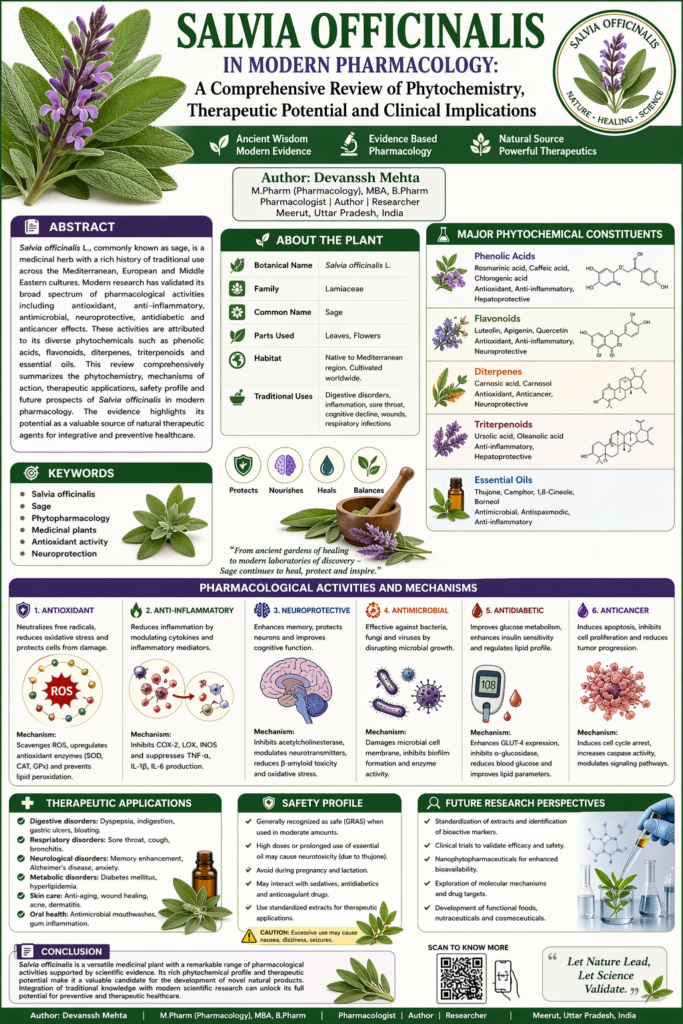
Medicinal plants have historically served as a foundation for therapeutic discoveries, providing pharmacologically active compounds that have shaped modern medicine. Salvia officinalis L., commonly known as sage, represents one of the most scientifically significant medicinal herbs belonging to the Lamiaceae family. Traditionally used in European, Mediterranean, and Middle Eastern herbal medicine, sage has long been employed for the treatment of inflammation, digestive disorders, cognitive impairment, and microbial infections. Contemporary pharmacological research has validated many of these ethnomedicinal claims, revealing that Salvia officinalis exhibits a broad spectrum of biological activities including antioxidant, anti-inflammatory, antimicrobial, neuroprotective, antidiabetic, and anticancer properties.
The therapeutic efficacy of Salvia officinalis is attributed to its complex phytochemical composition, which includes phenolic acids, flavonoids, diterpenes, triterpenoids, essential oils, and rosmarinic acid derivatives. These bioactive constituents interact with multiple molecular targets involved in oxidative stress regulation, inflammatory signaling pathways, and neuronal protection mechanisms. Recent pharmacological investigations have also explored its potential role in neurodegenerative disease management, particularly in Alzheimer’s disease, where sage extracts have demonstrated promising cognitive-enhancing effects.
This review article provides a comprehensive evaluation of the pharmacological profile of Salvia officinalis, highlighting its phytochemical constituents, mechanisms of pharmacological action, therapeutic applications, and clinical implications. Furthermore, the review discusses emerging research trends including nanophytopharmaceutical formulations, nutraceutical applications, and the integration of sage-based therapeutics into evidence-based medicine. Understanding the pharmacological potential of Salvia officinalis may facilitate the development of innovative plant-derived drugs and contribute to the advancement of phytopharmacology and integrative healthcare systems.
Keywords
Salvia officinalis; medicinal plants; phytopharmacology; antioxidant activity; neuroprotection
Introduction
The exploration of medicinal plants as sources of therapeutic agents has significantly shaped the evolution of pharmacology. Throughout human history, plant-derived compounds have played a crucial role in disease prevention and treatment. Even in the modern era of synthetic pharmaceuticals and biotechnology-driven drug discovery, medicinal plants remain invaluable reservoirs of structurally diverse bioactive molecules. According to the World Health Organization, a substantial proportion of the global population continues to rely on traditional herbal medicine as a primary source of healthcare (WHO, 2019).
Among the numerous medicinal plants recognized for their therapeutic value, Salvia officinalis L., commonly known as sage, occupies a prominent place in traditional and modern medicine. Belonging to the Lamiaceae family, sage is a perennial aromatic herb native to the Mediterranean region but now widely cultivated across Europe, Asia, and North America. Historically, sage has been revered for its medicinal virtues, with ancient civilizations attributing to it remarkable healing properties. The Latin name “Salvia” itself derives from the word salvare, meaning “to heal” or “to save,” reflecting the plant’s longstanding association with health and longevity.
Traditional medical systems have extensively utilized Salvia officinalis for treating a variety of ailments, including digestive disorders, respiratory infections, cognitive decline, and inflammatory conditions. In European folk medicine, sage has been employed as a remedy for sore throats, wounds, and gastrointestinal disturbances. Similarly, traditional Persian and Mediterranean medical practices have recognized sage as a powerful medicinal herb with antimicrobial and anti-inflammatory properties.
From a botanical perspective, Salvia officinalis is characterized by its woody stems, grayish-green leaves, and aromatic essential oils. The plant contains a rich spectrum of secondary metabolites that contribute to its pharmacological activity. These phytochemicals include phenolic acids, flavonoids, diterpenoids, triterpenoids, and essential oils such as thujone, camphor, and cineole. The synergistic interaction of these compounds underlies the plant’s diverse therapeutic properties.
In recent decades, the pharmacological potential of Salvia officinalis has attracted significant scientific interest. Advances in phytochemical analysis and molecular pharmacology have enabled researchers to identify numerous bioactive compounds responsible for the plant’s biological effects. These investigations have revealed that sage possesses strong antioxidant properties, which play a crucial role in protecting cells against oxidative damage.
Oxidative stress is widely recognized as a major contributor to the development of chronic diseases including cardiovascular disorders, neurodegenerative diseases, diabetes, and cancer. Reactive oxygen species (ROS) generated during metabolic processes can damage cellular components such as DNA, proteins, and lipids. The antioxidant compounds present in Salvia officinalis, particularly rosmarinic acid and flavonoids, are capable of neutralizing these reactive molecules and thereby preventing cellular damage.
Another significant pharmacological property of Salvia officinalis is its anti-inflammatory activity. Chronic inflammation is implicated in numerous pathological conditions, ranging from autoimmune diseases to metabolic disorders. Research studies have demonstrated that sage extracts can inhibit the production of pro-inflammatory cytokines and inflammatory mediators, thereby reducing inflammation and promoting tissue healing.
Furthermore, emerging evidence suggests that Salvia officinalis may have important applications in neuropharmacology. Neurodegenerative diseases such as Alzheimer’s disease and Parkinson’s disease represent major global health challenges, characterized by progressive neuronal degeneration and cognitive decline. Interestingly, sage extracts have been shown to enhance memory and cognitive performance by modulating cholinergic neurotransmission and inhibiting acetylcholinesterase activity.
In addition to its neuroprotective effects, Salvia officinalis exhibits significant antimicrobial properties against various pathogenic microorganisms. Essential oils derived from sage have demonstrated inhibitory effects against bacteria, fungi, and viruses. These antimicrobial properties make sage a valuable candidate for the development of natural antimicrobial agents.
The pharmacological importance of Salvia officinalis also extends to metabolic disorders such as diabetes mellitus. Experimental studies have reported that sage extracts may improve glucose metabolism by enhancing insulin sensitivity and reducing blood glucose levels. These findings highlight the potential of sage as a complementary therapy for metabolic diseases.
Despite the growing body of scientific evidence supporting the therapeutic potential of Salvia officinalis, several aspects of its pharmacology remain inadequately explored. Issues related to standardization of herbal extracts, dosage optimization, pharmacokinetics, and clinical efficacy require further investigation.
From a pharmacological perspective, integrating traditional medicinal knowledge with modern scientific research represents an important strategy for discovering novel therapeutic agents. Medicinal plants such as Salvia officinalis provide a bridge between ancient healing traditions and contemporary biomedical science.
Therefore, the objective of this review is to provide a comprehensive analysis of the pharmacological properties of Salvia officinalis. The review focuses on its phytochemical composition, pharmacological activities, therapeutic applications, safety profile, and future research prospects. By synthesizing available scientific literature, this article aims to highlight the significance of sage as a promising medicinal plant in the field of modern pharmacology.
Phytochemical Composition of Salvia officinalis
The therapeutic potential of Salvia officinalis is largely attributed to its diverse phytochemical constituents. These bioactive compounds belong to several chemical classes including phenolic acids, flavonoids, diterpenoids, triterpenoids, and essential oils.
Among the most important phytochemicals present in sage are phenolic acids such as rosmarinic acid and caffeic acid. Rosmarinic acid is known for its strong antioxidant and anti-inflammatory properties, which contribute significantly to the pharmacological effects of the plant.
Flavonoids such as luteolin, apigenin, and quercetin are also abundant in sage leaves. These compounds exhibit potent antioxidant activity and play a role in protecting cells from oxidative stress.
Essential oils represent another important component of Salvia officinalis. These oils contain compounds such as thujone, camphor, cineole, and borneol. Essential oils contribute to the antimicrobial and anti-inflammatory properties of the plant.
Pharmacological Activities
Antioxidant Activity
The antioxidant activity of Salvia officinalis is primarily attributed to its phenolic compounds. These molecules neutralize reactive oxygen species and protect cellular structures from oxidative damage.
Anti-inflammatory Activity
Sage extracts inhibit inflammatory pathways by suppressing pro-inflammatory cytokines and reducing the activity of enzymes such as cyclooxygenase.
Neuroprotective Effects
Research studies have demonstrated that sage extracts may improve memory and cognitive performance by inhibiting acetylcholinesterase enzymes.
Antimicrobial Activity
Essential oils from Salvia officinalis have shown strong antimicrobial effects against several pathogenic microorganisms including Staphylococcus aureus and Escherichia coli.
Antidiabetic Activity
Experimental studies suggest that sage extracts may improve glucose metabolism and enhance insulin sensitivity.
Safety and Toxicological Considerations
Although Salvia officinalis is generally considered safe when used in moderate amounts, excessive consumption may lead to adverse effects due to the presence of thujone, a neurotoxic compound found in the essential oil.
Future Perspectives in Pharmacological Research
Future research directions include:
- Nanophytomedicine
- Clinical trials
- Standardization of herbal formulations
- Drug discovery based on sage phytochemicals
Conclusion
Salvia officinalis represents a pharmacologically significant medicinal plant with diverse therapeutic properties supported by both traditional knowledge and modern scientific research. Its rich phytochemical composition contributes to multiple pharmacological activities including antioxidant, anti-inflammatory, antimicrobial, and neuroprotective effects. Continued research focusing on clinical validation and molecular mechanisms may further expand its role in modern pharmacology and integrative medicine.
References (Harvard Style)
Hamidpour, R., Hamidpour, S., Hamidpour, M. and Shahlari, M., 2014. Chemistry, pharmacology and medicinal property of sage (Salvia officinalis). Journal of Traditional and Complementary Medicine, 4(2), pp.82–88.
Lu, Y. and Foo, L., 2001. Antioxidant activities of polyphenols from sage (Salvia officinalis). Food Chemistry, 75(2), pp.197–202.
Perry, N., Bollen, C., Perry, E. and Ballard, C., 2003. Salvia for dementia therapy. Drugs & Aging, 20(3), pp.177–184.
World Health Organization, 2019. WHO global report on traditional medicine. Geneva: WHO.