

Author: Devanssh Mehta
M.Pharm (Pharmacology), MBA, B.Pharm
Pharmacologist | Author | Researcher
Meerut, Uttar Pradesh, India
Abstract
Cervical cancer remains one of the most significant malignancies affecting women worldwide, particularly in developing countries where access to screening and preventive healthcare services is limited. The disease arises primarily from persistent infection with high-risk types of human papillomavirus (HPV), which leads to genetic and molecular alterations in cervical epithelial cells. Pharmacological management of cervical cancer has evolved considerably over the past several decades, incorporating cytotoxic chemotherapy, targeted therapy, immunotherapy, and preventive vaccination strategies.
The pharmacological treatment of cervical cancer focuses on inhibiting tumor cell proliferation, inducing apoptosis, and preventing metastatic progression. Conventional chemotherapy agents such as cisplatin, paclitaxel, and topotecan have long been used as cornerstone therapies for advanced cervical cancer. In recent years, the development of targeted therapies such as bevacizumab, a monoclonal antibody against vascular endothelial growth factor (VEGF), has improved treatment outcomes by inhibiting tumor angiogenesis. Additionally, immune checkpoint inhibitors targeting programmed death receptor pathways have shown promising results in advanced or recurrent cervical cancer.
Advances in molecular oncology have also enhanced understanding of HPV-mediated carcinogenesis, enabling the development of preventive vaccines that significantly reduce the incidence of HPV-associated cervical cancer. Despite these advancements, challenges such as drug resistance, treatment-related toxicity, and disparities in healthcare access continue to affect patient outcomes.
This review article provides a comprehensive analysis of the pharmacology of cervical cancer, focusing on disease pathophysiology, pharmacological mechanisms of anticancer agents, pharmacokinetics, therapeutic strategies, and emerging developments in targeted therapy and immunotherapy. Understanding the pharmacological basis of cervical cancer treatment is essential for improving clinical outcomes and guiding future research in oncological pharmacology.
Keywords
Cervical cancer; anticancer pharmacology; HPV-associated cancer; chemotherapy; targeted therapy
Introduction
Cancer continues to represent one of the most pressing global health challenges of the modern era. Among the various malignancies affecting women, cervical cancer remains a major cause of morbidity and mortality, particularly in low- and middle-income countries where access to early detection and preventive healthcare services may be limited. According to global cancer statistics, cervical cancer ranks among the most common cancers in women and represents a significant public health burden worldwide.
Cervical cancer originates from the epithelial cells lining the cervix, the lower portion of the uterus that connects the uterine cavity to the vaginal canal. The disease typically develops gradually through a series of precancerous changes known as cervical intraepithelial neoplasia. If these lesions remain untreated, they may eventually progress to invasive cervical carcinoma.
One of the most important discoveries in cervical cancer research was the identification of human papillomavirus (HPV) as the primary etiological factor in the development of the disease. Persistent infection with high-risk HPV types, particularly HPV-16 and HPV-18, is responsible for the majority of cervical cancer cases. These viruses produce oncogenic proteins that interfere with normal cellular regulatory mechanisms, ultimately leading to uncontrolled cell proliferation and malignant transformation.
The HPV oncogenes E6 and E7 play a critical role in cervical carcinogenesis by inactivating tumor suppressor proteins such as p53 and retinoblastoma protein (pRb). Disruption of these regulatory pathways results in genomic instability and the accumulation of mutations that promote cancer development.
From a pharmacological perspective, the treatment of cervical cancer involves multiple therapeutic strategies aimed at controlling tumor growth, preventing metastasis, and improving patient survival. These strategies include surgical intervention, radiation therapy, and pharmacological treatment using anticancer drugs.
Pharmacotherapy plays an especially important role in the management of advanced or metastatic cervical cancer. Anticancer drugs used in cervical cancer therapy function by interfering with cellular processes essential for tumor cell survival and proliferation. These drugs may act through mechanisms such as inhibition of DNA replication, disruption of mitotic processes, suppression of angiogenesis, and activation of immune responses against tumor cells.
Cytotoxic chemotherapy remains one of the most widely used pharmacological approaches in cervical cancer treatment. Drugs such as cisplatin and paclitaxel have demonstrated significant efficacy in reducing tumor burden and improving survival outcomes in patients with advanced disease. These agents act by damaging DNA and disrupting cell division, leading to cancer cell death.
However, conventional chemotherapy often affects both cancerous and healthy cells, leading to adverse effects such as bone marrow suppression, gastrointestinal disturbances, and hair loss. Consequently, researchers have increasingly focused on developing targeted therapies that selectively interfere with molecular pathways involved in tumor growth.
Targeted therapy represents an important advancement in cancer pharmacology. Unlike traditional chemotherapy, targeted drugs are designed to interact with specific molecular targets that drive cancer progression. One notable example in cervical cancer treatment is bevacizumab, a monoclonal antibody that inhibits vascular endothelial growth factor and prevents the formation of new blood vessels required for tumor growth.
The development of immunotherapy has also transformed the landscape of cancer treatment. Immune checkpoint inhibitors such as pembrolizumab enhance the ability of the immune system to recognize and destroy cancer cells. These therapies have shown promising results in patients with recurrent or metastatic cervical cancer who have limited treatment options.
Another major advancement in cervical cancer prevention and pharmacology has been the development of HPV vaccines. Vaccines such as Gardasil and Cervarix stimulate immune responses against high-risk HPV types, preventing infection and significantly reducing the risk of cervical cancer.
Despite these advancements, several challenges remain in the pharmacological management of cervical cancer. Drug resistance, tumor heterogeneity, and treatment-related toxicity continue to complicate therapeutic outcomes. Furthermore, disparities in healthcare access and vaccination coverage contribute to the persistence of cervical cancer as a major public health concern in many regions of the world.
Advances in molecular biology, genomics, and pharmacology are therefore essential for improving cervical cancer treatment strategies. Research efforts are currently focused on identifying new molecular targets, developing more effective drug delivery systems, and integrating personalized medicine approaches into clinical oncology.
Understanding the pharmacological mechanisms underlying cervical cancer treatment is crucial for healthcare professionals involved in oncology care and drug development.
The objective of this review article is to provide a comprehensive overview of cervical cancer pharmacology, including disease pathophysiology, pharmacological mechanisms of anticancer agents, therapeutic strategies, pharmacokinetic considerations, and emerging developments in targeted therapy and immunotherapy.
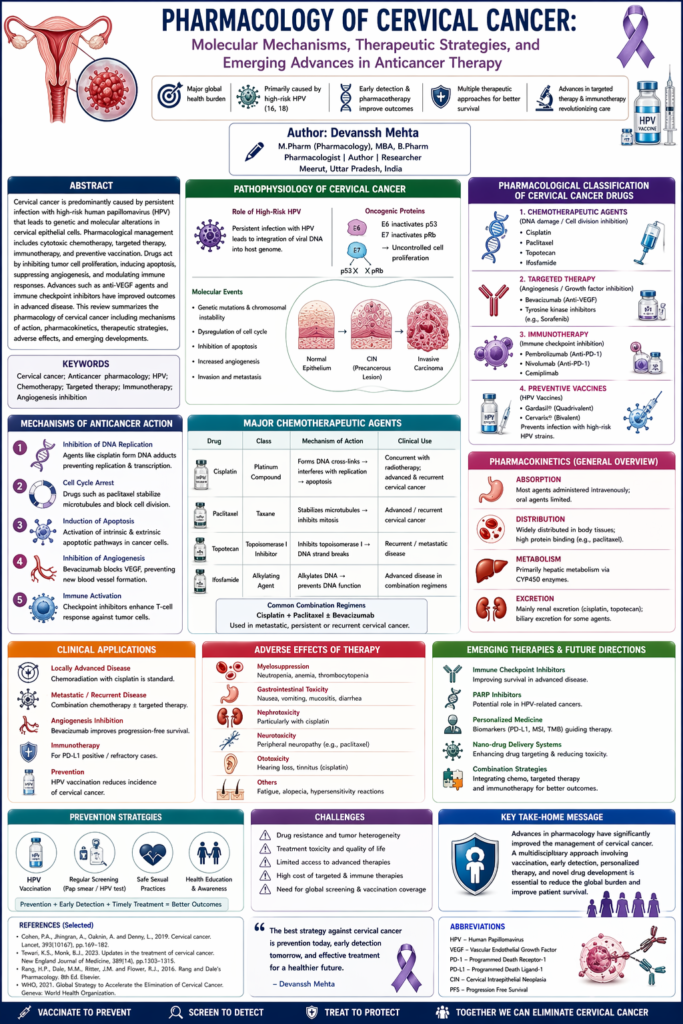
Pathophysiology of Cervical Cancer
Cervical cancer develops primarily due to persistent infection with high-risk HPV strains.
Key molecular mechanisms include:
• Inactivation of tumor suppressor proteins (p53 and pRb)
• Genetic mutations leading to uncontrolled cell proliferation
• Activation of oncogenic signaling pathways
These processes contribute to tumor growth and metastatic progression.
Pharmacological Classification of Cervical Cancer Drugs
Chemotherapeutic Agents
Examples: Cisplatin, Paclitaxel, Topotecan
These drugs damage DNA or disrupt cell division.
Targeted Therapy
Example: Bevacizumab
This monoclonal antibody inhibits angiogenesis by blocking VEGF signaling.
Immunotherapy
Example: Pembrolizumab
This immune checkpoint inhibitor enhances immune responses against tumor cells.
Preventive Vaccines
HPV vaccines prevent infection with high-risk HPV strains.
Mechanisms of Anticancer Action
Cervical cancer drugs act through several mechanisms:
• Inhibition of DNA replication
• Induction of apoptosis in tumor cells
• Suppression of angiogenesis
• Activation of immune responses against cancer cells
Pharmacokinetics of Cervical Cancer Drugs
Absorption: Intravenous or oral administration depending on drug type.
Distribution: Wide distribution in body tissues including tumors.
Metabolism: Primarily metabolized in the liver via cytochrome P450 enzymes.
Excretion: Eliminated through renal or biliary pathways.
Adverse Effects of Cervical Cancer Pharmacotherapy
Common adverse effects include:
• Myelosuppression
• Gastrointestinal toxicity
• Fatigue and neuropathy
• Increased risk of infections
Emerging Therapies and Future Directions
Recent developments include:
• Immune checkpoint inhibitors
• Personalized cancer therapy based on genetic profiling
• Nanoparticle-based drug delivery systems
• Combination therapies integrating chemotherapy and immunotherapy
Conclusion
Cervical cancer pharmacology has undergone significant advancements with the development of targeted therapies, immunotherapies, and preventive vaccines. These innovations have improved treatment outcomes and provided new strategies for disease prevention. Continued research in molecular oncology and pharmacology will be essential for overcoming therapeutic challenges and improving the global management of cervical cancer.
References
Cohen, P.A., Jhingran, A., Oaknin, A. and Denny, L., 2019. Cervical cancer. Lancet, 393(10167), pp.169–182.
Katzung, B., 2018. Basic and Clinical Pharmacology. McGraw Hill.
Rang, H.P., Dale, M.M., Ritter, J.M. and Flower, R.J., 2016. Rang and Dale’s Pharmacology. Elsevier.
WHO, 2021. Global Strategy to Accelerate the Elimination of Cervical Cancer. Geneva: World Health Organization.