

Author: Devanssh Mehta
M.Pharm (Pharmacology), MBA, B.Pharm
Pharmacologist | Author | Researcher
Meerut, Uttar Pradesh, India
Abstract
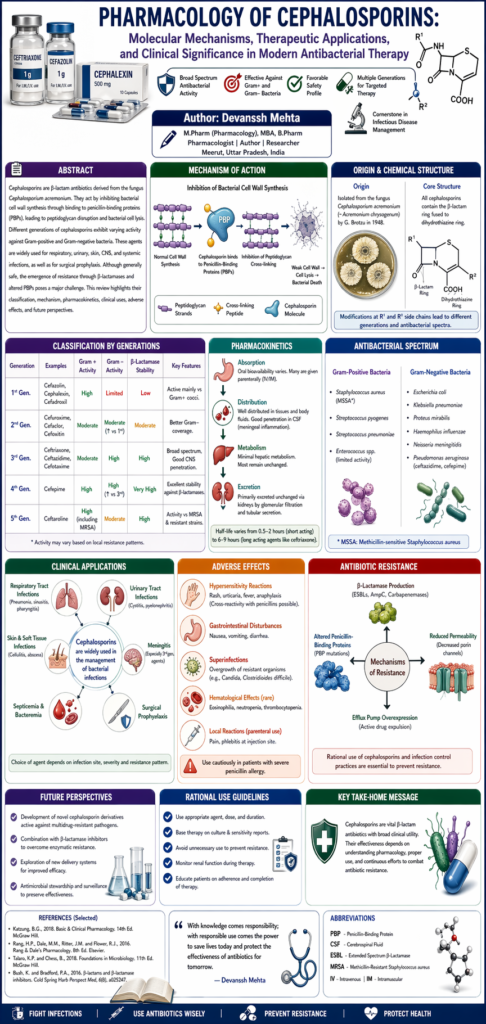
Cephalosporins represent one of the most widely used classes of β-lactam antibiotics in modern clinical medicine. Originally derived from the fungus Cephalosporium acremonium, these antimicrobial agents have undergone extensive chemical modification over the past several decades, resulting in the development of multiple generations of cephalosporins with improved antibacterial spectrum, pharmacokinetic properties, and resistance profiles. Cephalosporins exert their bactericidal activity by inhibiting bacterial cell wall synthesis through binding to penicillin-binding proteins (PBPs), ultimately leading to disruption of peptidoglycan cross-linking and bacterial cell lysis.
The pharmacological significance of cephalosporins lies in their broad-spectrum antibacterial activity and favorable safety profile. Different generations of cephalosporins demonstrate varying degrees of activity against Gram-positive and Gram-negative microorganisms, making them valuable therapeutic agents in the treatment of numerous infectious diseases. Clinically, cephalosporins are widely used in the management of respiratory tract infections, urinary tract infections, skin and soft tissue infections, meningitis, septicemia, and surgical prophylaxis.
Advances in medicinal chemistry have enabled the development of newer cephalosporins with enhanced resistance to β-lactamase enzymes produced by bacteria. However, the emergence of antibiotic resistance remains a major challenge in antimicrobial pharmacology. The widespread use of cephalosporins has contributed to the development of resistant bacterial strains, highlighting the need for rational antibiotic use and continued research into novel antimicrobial agents.
This review article provides a comprehensive overview of the pharmacology of cephalosporins, focusing on their classification, mechanisms of action, pharmacokinetic characteristics, antibacterial spectrum, clinical applications, and emerging challenges related to antimicrobial resistance. Understanding the pharmacological properties of cephalosporins is essential for optimizing therapeutic outcomes and addressing the growing global burden of infectious diseases.
Keywords
Cephalosporins; β-lactam antibiotics; antimicrobial pharmacology; bacterial cell wall inhibition; antibiotic resistance
Introduction
The discovery of antibiotics represents one of the most significant milestones in the history of modern medicine. Prior to the development of antimicrobial therapy, infectious diseases were among the leading causes of mortality worldwide. The introduction of antibiotics in the twentieth century revolutionized clinical medicine by providing effective treatments for bacterial infections that were previously fatal. Among the numerous classes of antibiotics discovered during this period, β-lactam antibiotics have played a particularly important role due to their potent antibacterial activity and relatively favorable safety profile.
Cephalosporins constitute a major subgroup of β-lactam antibiotics and have become essential components of modern antimicrobial therapy. These antibiotics share structural similarities with penicillins, particularly the presence of a β-lactam ring that is critical for their antibacterial activity. However, cephalosporins possess distinct chemical and pharmacological properties that differentiate them from other β-lactam antibiotics.
The origin of cephalosporins can be traced back to the discovery of cephalosporin-producing fungi in the mid-twentieth century. In 1948, the Italian scientist Giuseppe Brotzu isolated a fungus from seawater near the coast of Sardinia that exhibited antibacterial activity against certain pathogenic bacteria. This organism was later identified as Cephalosporium acremonium (now classified as Acremonium chrysogenum). Subsequent research led to the isolation of cephalosporin C, the parent compound from which modern cephalosporin antibiotics were developed.
Cephalosporin C demonstrated antibacterial activity but possessed relatively weak potency compared with penicillin. However, its chemical structure provided a valuable foundation for the development of more potent derivatives. Through advances in medicinal chemistry, scientists were able to modify the side chains of the cephalosporin molecule, leading to the development of numerous synthetic and semi-synthetic cephalosporins with improved antibacterial activity and pharmacokinetic properties.
Over time, cephalosporins have been classified into different generations based on their antibacterial spectrum and chronological development. Each successive generation generally exhibits enhanced activity against Gram-negative bacteria while retaining varying levels of activity against Gram-positive organisms.
The first-generation cephalosporins, such as cefazolin and cephalexin, are particularly effective against Gram-positive bacteria including Staphylococcus and Streptococcus species. These agents are commonly used for skin and soft tissue infections and surgical prophylaxis.
Second-generation cephalosporins, including cefuroxime and cefaclor, demonstrate improved activity against certain Gram-negative organisms while maintaining reasonable activity against Gram-positive bacteria. These antibiotics are often used for respiratory tract infections and otitis media.
Third-generation cephalosporins, such as ceftriaxone and ceftazidime, exhibit broader Gram-negative coverage and improved penetration into body tissues and fluids. These drugs are widely used in the treatment of serious infections including meningitis, septicemia, and hospital-acquired infections.
Fourth-generation cephalosporins, including cefepime, possess enhanced resistance to β-lactamase enzymes and exhibit broad-spectrum activity against both Gram-positive and Gram-negative bacteria.
More recently, fifth-generation cephalosporins have been developed with activity against methicillin-resistant Staphylococcus aureus (MRSA), representing an important advancement in antimicrobial therapy.
The primary mechanism of action of cephalosporins involves inhibition of bacterial cell wall synthesis. Bacterial cell walls are composed of a rigid structure known as peptidoglycan, which provides mechanical stability and protects the bacterial cell from osmotic stress. The synthesis of peptidoglycan requires a series of enzymatic reactions involving penicillin-binding proteins (PBPs).
Cephalosporins bind to PBPs and inhibit the cross-linking of peptidoglycan strands, resulting in weakening of the bacterial cell wall. This disruption ultimately leads to bacterial cell lysis and death, making cephalosporins bactericidal antibiotics.
The pharmacokinetic properties of cephalosporins vary depending on the specific compound. Many cephalosporins can be administered orally, while others require parenteral administration. These drugs are generally well distributed throughout body tissues and fluids, including the cerebrospinal fluid in cases of meningitis.
Cephalosporins are primarily eliminated through renal excretion, although some agents undergo hepatic metabolism. Dose adjustments are often required in patients with impaired renal function to prevent accumulation and toxicity.
Despite their clinical effectiveness, the widespread use of cephalosporins has contributed to the development of antibiotic resistance among bacterial pathogens. Bacteria may develop resistance through several mechanisms, including the production of β-lactamase enzymes that degrade the antibiotic, modification of penicillin-binding proteins, and reduced permeability of the bacterial cell membrane.
The emergence of multidrug-resistant bacteria represents a major global health challenge and underscores the importance of responsible antibiotic use and continued research into novel antimicrobial agents.
Understanding the pharmacology of cephalosporins is therefore essential for clinicians, pharmacologists, and researchers involved in infectious disease management and antimicrobial drug development.
The objective of this review article is to provide a comprehensive analysis of cephalosporin pharmacology, focusing on their classification, mechanisms of action, pharmacokinetics, clinical applications, and challenges related to antibiotic resistance.
Classification of Cephalosporins
Cephalosporins are classified into generations based on their antibacterial spectrum:
First Generation
Examples: Cefazolin, Cephalexin
Strong activity against Gram-positive bacteria.
Second Generation
Examples: Cefuroxime, Cefaclor
Expanded activity against Gram-negative organisms.
Third Generation
Examples: Ceftriaxone, Ceftazidime
Broad-spectrum activity and good CNS penetration.
Fourth Generation
Example: Cefepime
Enhanced resistance to β-lactamase enzymes.
Fifth Generation
Example: Ceftaroline
Effective against MRSA.
Mechanism of Action
Cephalosporins act by inhibiting bacterial cell wall synthesis.
Key steps include:
• Binding to penicillin-binding proteins
• Inhibition of peptidoglycan cross-linking
• Weakening of bacterial cell wall
• Bacterial cell lysis
Pharmacokinetics
Absorption
Some cephalosporins are orally active while others require parenteral administration.
Distribution
Widely distributed in tissues and body fluids.
Metabolism
Limited metabolism in the liver.
Excretion
Primarily excreted via the kidneys.
Therapeutic Applications
Cephalosporins are used to treat various infections:
• Respiratory tract infections
• Urinary tract infections
• Skin and soft tissue infections
• Septicemia
• Meningitis
• Surgical prophylaxis
Adverse Effects
Common adverse effects include:
• Hypersensitivity reactions
• Gastrointestinal disturbances
• Superinfections
Severe allergic reactions may occur in patients with penicillin allergy.
Antibiotic Resistance
Major mechanisms of resistance include:
• β-lactamase production
• Altered penicillin-binding proteins
• Reduced permeability of bacterial membranes
Future Perspectives
Future research directions include:
• Development of novel cephalosporin derivatives
• Combination therapies with β-lactamase inhibitors
• Strategies to combat antibiotic resistance
Conclusion
Cephalosporins remain one of the most important classes of antibiotics in modern medicine due to their broad-spectrum antibacterial activity and favorable safety profile. Continued research into antimicrobial resistance mechanisms and novel antibiotic development is essential to preserve the clinical effectiveness of these vital therapeutic agents.
References
Bush, K. and Bradford, P., 2016. β-lactams and β-lactamase inhibitors. Cold Spring Harbor Perspectives in Medicine, 6(8), pp.1–24.
Katzung, B., 2018. Basic and Clinical Pharmacology. McGraw Hill.
Rang, H.P., Dale, M.M., Ritter, J.M. and Flower, R.J., 2016. Rang and Dale’s Pharmacology. Elsevier.
Talaro, K. and Chess, B., 2018. Foundations in Microbiology. McGraw Hill.