

Author: Devanssh Mehta
M.Pharm (Pharmacology), MBA, B.Pharm
Pharmacologist | Author | Researcher
Meerut, Uttar Pradesh, India
Abstract
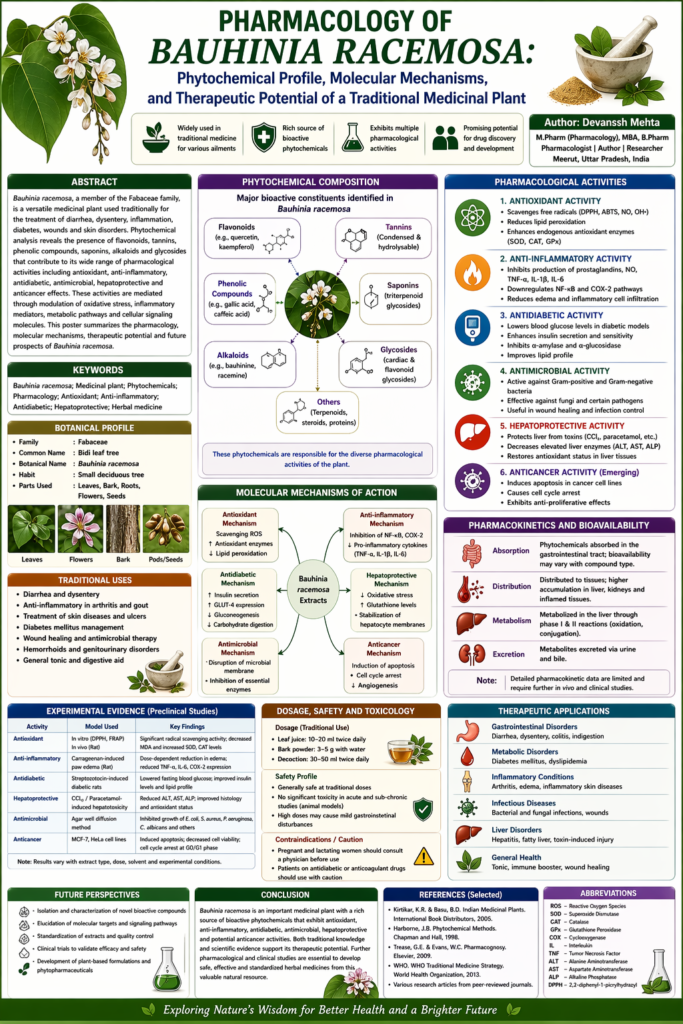
Bauhinia racemosa, commonly known as the Bidi leaf tree, is a medicinal plant widely distributed across tropical and subtropical regions of Asia, particularly in India. The plant belongs to the family Fabaceae and has been traditionally used in Ayurvedic and folk medicine for the treatment of various ailments including diarrhea, dysentery, inflammation, skin disorders, and diabetes. Over the past several decades, scientific investigations have revealed that Bauhinia racemosa contains numerous bioactive phytochemicals with significant pharmacological potential.
Phytochemical analysis of the plant has identified a diverse range of secondary metabolites including flavonoids, tannins, phenolic compounds, glycosides, saponins, and alkaloids. These compounds contribute to the plant’s wide spectrum of biological activities such as antioxidant, anti-inflammatory, antimicrobial, hepatoprotective, antidiabetic, and anticancer effects. Experimental studies have demonstrated that extracts of Bauhinia racemosa can modulate oxidative stress pathways, inhibit inflammatory mediators, and regulate metabolic processes involved in glucose homeostasis.
Pharmacological investigations have also indicated that the plant exhibits potential protective effects on vital organs including the liver and gastrointestinal tract. These effects are attributed to its ability to neutralize reactive oxygen species and enhance endogenous antioxidant defense mechanisms.
This review article provides a comprehensive analysis of the pharmacology of Bauhinia racemosa, focusing on its botanical characteristics, phytochemical composition, pharmacological activities, pharmacokinetic considerations, and therapeutic potential. The article also highlights the importance of traditional medicinal plants as valuable sources of bioactive compounds for modern drug discovery. Understanding the pharmacological properties of Bauhinia racemosa may facilitate the development of novel plant-derived therapeutics for the management of various human diseases.
Keywords
Bauhinia racemosa; medicinal plants; phytopharmacology; flavonoids; herbal medicine
Introduction
Medicinal plants have served as the foundation of traditional healthcare systems for thousands of years and continue to play an important role in modern pharmacology and drug discovery. Many of the drugs used in contemporary medicine have their origins in natural products derived from plants, microorganisms, or marine organisms. The exploration of medicinal plants for pharmacologically active compounds remains an important area of research, particularly in the search for safer and more effective therapeutic agents.
Among the numerous medicinal plants used in traditional systems of medicine, Bauhinia racemosa has attracted considerable attention due to its diverse therapeutic applications and rich phytochemical composition. The plant belongs to the family Fabaceae and is widely distributed across India, Southeast Asia, and other tropical regions. It is commonly known as the Bidi leaf tree because its leaves are traditionally used in the manufacture of bidis, a type of hand-rolled cigarette popular in certain parts of South Asia.
From a botanical perspective, Bauhinia racemosa is a small deciduous tree characterized by distinctive bilobed leaves and racemose inflorescences bearing small flowers. The plant thrives in dry and tropical climates and is often found in forests, wastelands, and rural landscapes. Various parts of the plant including leaves, bark, roots, flowers, and seeds have been used in traditional medicine for the treatment of a wide range of ailments.
In Ayurveda and other traditional healing systems, Bauhinia racemosa is valued for its therapeutic properties such as astringent, anti-inflammatory, and antimicrobial effects. Traditional healers have used plant extracts to treat gastrointestinal disorders, skin infections, wounds, ulcers, and inflammatory conditions. These traditional uses have inspired scientific investigations into the pharmacological properties of the plant.
Phytochemical studies have revealed that Bauhinia racemosa contains a variety of bioactive compounds that contribute to its medicinal properties. These compounds include flavonoids, tannins, phenolic acids, terpenoids, glycosides, and alkaloids. Many of these phytochemicals are known to possess antioxidant and anti-inflammatory activities that play important roles in disease prevention and treatment.
One of the most important pharmacological properties of Bauhinia racemosa is its antioxidant activity. Oxidative stress is a pathological condition resulting from an imbalance between the production of reactive oxygen species and the body’s antioxidant defense mechanisms. Excessive oxidative stress has been implicated in the development of numerous chronic diseases including cardiovascular disorders, diabetes, neurodegenerative diseases, and cancer.
The antioxidant compounds present in Bauhinia racemosa are capable of scavenging free radicals and protecting cells from oxidative damage. These protective effects are believed to contribute to the plant’s therapeutic potential in the prevention and management of various diseases.
In addition to its antioxidant activity, Bauhinia racemosa exhibits significant anti-inflammatory properties. Inflammation is a complex biological response that occurs in response to tissue injury or infection. While acute inflammation plays a protective role in host defense, chronic inflammation is associated with the development of many pathological conditions.
Experimental studies have shown that extracts of Bauhinia racemosa can inhibit the production of inflammatory mediators such as prostaglandins, cytokines, and nitric oxide. By modulating these inflammatory pathways, the plant may help reduce tissue damage and promote healing.
Another important pharmacological activity of Bauhinia racemosa is its antidiabetic effect. Diabetes mellitus is a metabolic disorder characterized by elevated blood glucose levels resulting from impaired insulin secretion or insulin resistance. Several studies have demonstrated that extracts of the plant can reduce blood glucose levels and improve glucose metabolism in experimental models of diabetes.
The antidiabetic activity of Bauhinia racemosa is believed to involve multiple mechanisms including enhancement of insulin secretion, improvement of insulin sensitivity, and inhibition of carbohydrate-digesting enzymes.
In addition to these effects, Bauhinia racemosa has shown promising antimicrobial activity against a variety of bacterial and fungal pathogens. This property supports its traditional use in treating infections and wound healing.
Recent research has also explored the potential anticancer properties of phytochemicals present in the plant. Certain compounds isolated from Bauhinia racemosa have been shown to inhibit the proliferation of cancer cells and induce apoptosis in experimental models.
Despite the growing body of research on the pharmacological properties of Bauhinia racemosa, further studies are needed to fully understand its mechanisms of action, pharmacokinetic behavior, and clinical applications. Advances in phytochemistry, molecular pharmacology, and drug development technologies may facilitate the identification of new therapeutic agents derived from this medicinal plant.
Understanding the pharmacological profile of Bauhinia racemosa therefore holds significant importance for both traditional medicine and modern pharmaceutical research.
The objective of this review article is to provide a comprehensive analysis of the pharmacology of Bauhinia racemosa, focusing on its phytochemical composition, pharmacological activities, pharmacokinetics, therapeutic applications, and future research prospects.
Phytochemical Composition
Major phytochemicals identified in Bauhinia racemosa include:
• Flavonoids
• Tannins
• Phenolic compounds
• Saponins
• Alkaloids
• Glycosides
These compounds contribute to the plant’s pharmacological activities.
Pharmacological Activities
Antioxidant Activity
Extracts of Bauhinia racemosa exhibit strong antioxidant activity by scavenging free radicals and enhancing endogenous antioxidant enzymes.
Anti-inflammatory Activity
The plant inhibits inflammatory mediators such as prostaglandins and cytokines.
Antidiabetic Activity
Experimental studies have demonstrated reduction of blood glucose levels and improved insulin sensitivity.
Antimicrobial Activity
Extracts show activity against various bacterial and fungal pathogens.
Hepatoprotective Activity
The plant may protect liver cells from oxidative damage and toxin-induced injury.
Pharmacokinetics and Bioavailability
Although detailed pharmacokinetic studies are limited, phytochemicals present in Bauhinia racemosa are believed to undergo metabolism in the liver and elimination through renal pathways.
Future studies are required to fully characterize absorption, distribution, metabolism, and excretion of these compounds.
Therapeutic Applications
Traditional and experimental applications include:
• Treatment of gastrointestinal disorders
• Management of diabetes
• Anti-inflammatory therapy
• Wound healing and antimicrobial treatment
Future Perspectives
Future research directions include:
• Isolation of active phytochemical constituents
• Clinical evaluation of therapeutic effects
• Development of plant-based pharmaceuticals
• Exploration of molecular mechanisms of action
Conclusion
Bauhinia racemosa represents an important medicinal plant with diverse pharmacological activities supported by both traditional knowledge and scientific research. Its rich phytochemical composition contributes to antioxidant, anti-inflammatory, antidiabetic, and antimicrobial properties. Continued research into the pharmacology and therapeutic potential of Bauhinia racemosa may lead to the development of novel plant-derived drugs for the treatment of various diseases.
References
Kirtikar, K.R. and Basu, B.D., 2005. Indian Medicinal Plants. Dehradun: International Book Distributors.
Harborne, J.B., 1998. Phytochemical Methods. Chapman and Hall.
Trease, G.E. and Evans, W.C., 2009. Pharmacognosy. Elsevier.
WHO, 2013. WHO Traditional Medicine Strategy. World Health Organization.